
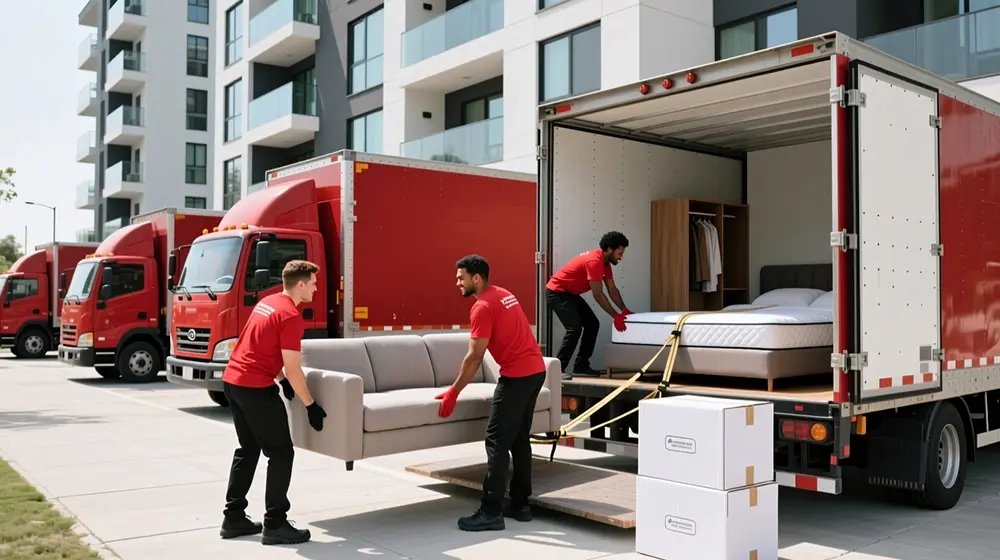
A 3-bedroom apartment move in Dubai may require one to three trucks, while a 4-bedroom move may need one to four, depending on vehicle capacity. But what happens when multiple trucks must share one service lift and a four-hour moving window? Limited loading-bay access, bulky furniture, and restricted lift timings can delay even a well-equipped moving crew.
Choosing 3 and 4 bedroom apartment movers in Dubai involves more than comparing moving prices. Truck capacity, crew size, building permits, and loading schedules all affect the relocation.
This guide covers multi-truck planning, lift sequencing, moving costs, realistic timelines, and high-value item protection. It also explains how to coordinate packing, truck arrivals, and delivery handover when moving a large family apartment in Dubai.
How many trucks and movers does a 3- or 4-bedroom apartment need?
A 3-bedroom apartment can use one 5-tonne vehicle or 2 to 3 smaller trucks. A 4-bedroom apartment may require 1 larger vehicle or 3 to 4 smaller trucks.
The required crew and vehicles depend on your household inventory, furniture dimensions, and building access.
Dubai moving packages provide different allocations for similar apartment sizes. The table compares advertised configurations rather than verified industry averages.
To request a multi-truck apartment quote, share a room-by-room inventory, furniture measurements and the access conditions at both buildings.
| Apartment size | Larger-vehicle arrangement | Smaller-truck arrangement | Published crew allocation |
| 2-bedroom apartment | One 5-tonne truck | 1 to 2 smaller trucks | 4 to 7 movers |
| 3-bedroom apartment | One 5-tonne truck | 2 to 3 smaller trucks | 5 to 9 movers |
| 4-bedroom apartment | One 5 to 10-tonne truck | 3 to 4 smaller trucks | 6 to 10 movers |
These are provider-listed configurations, not independently audited averages.
A truck’s tonne rating refers to weight capacity, not usable cargo volume. Two vehicles with similar weight ratings may offer different internal dimensions.
For example, 80 cartons measuring 60 × 40 × 40 centimeters occupy 7.68 cubic meters before loading allowances.
Add 25 cubic meters of furniture, and the estimated inventory reaches 32.68 cubic meters. This is an illustrative calculation, not an average Dubai household inventory.
Your mover must check that volume against actual vehicle dimensions and permitted payload.
1. Two-truck job
A two-truck job divides your household inventory between two vehicles operating under one coordinated loading schedule.
You may need 2 trucks when furniture and packed cartons exceed one vehicle’s usable capacity. Smaller vehicles may also suit restricted residential loading bays.
The mover determines the allocation through an inventory survey and checks the available vehicle dimensions.
A practical division separates bulky furniture from boxed household contents, although loading requirements can change this arrangement.
Ask for a truck allocation record identifying:
- Furniture and cartons assigned to truck A.
- Furniture and cartons assigned to truck B.
- Vehicle dimensions and allowable loads.
- Collection order and destination unloading sequence.
One supervisor should coordinate both vehicles. Without an agreed allocation, matching furniture components can travel separately. The receiving crew may also unload essential belongings in the wrong order.
2. Three-truck job
A 3-truck job distributes a large household inventory across 3 vehicles when capacity or access restrictions justify the additional vehicle.
A heavily furnished 4-bedroom apartment may require this arrangement, particularly when storage contents increase the shipment volume. The moving survey should identify the actual vehicle requirement before booking.
For example, three vehicles with 18 cubic meters of usable cargo space each provide 54 cubic meters in total. This calculation assumes the stated capacity is usable and each truck meets its payload limit.
The supervisor can assign vehicles by furniture category, room, or unloading priority. However, 3 trucks do not automatically shorten the move.
A single service lift still controls how quickly belongings leave the apartment. Additional vehicles require separate access periods and approved waiting locations.
Without coordinated dispatch, multiple trucks may arrive together and compete for 1 loading bay.
How do movers sequence loads when the building gives one lift window?
Movers sequence loads by assigning each truck a defined loading period within the building’s approved lift reservation.
A lift window is the period during which building management permits furniture transportation through an allocated service elevator.
For large apartment moving in Dubai, this reservation often determines the practical loading schedule.
Dubai Holding Community Management specifies permit applications at least 48 hours before moving through its Community App. Email applications require at least 72 hours.
These are requirements for the communities covered by its guidance. Your building may impose different booking conditions.
A four-hour lift reservation provides 240 minutes, but preparation and final clearance consume part of that time.
The moving supervisor must therefore schedule truck arrivals around available lift capacity.
To understand how lift slots work in a tower, confirm the approved reservation period, the number of service lifts available and the rules for moving furniture through shared areas.
1. Truck A and truck B staging
Truck A and truck B staging is the controlled arrival and loading sequence for two vehicles sharing one approved loading area.
You need this arrangement when the building allows 1 truck at a time or limits access to 1 service lift.
The supervisor first confirms the lift reservation, vehicle dimensions, parking instructions, and security requirements. Both drivers receive the approved sequence before arriving.
Truck A enters the loading bay first. Truck B waits at a lawful, prearranged location until the supervisor authorizes entry.
Consider this illustrative four-hour pickup sequence, using a hypothetical 9:00 AM to 1:00 PM booking.
2۔ One-Window Lift Sequencing Timeline
This timeline outlines how two moving trucks can share a single lift booking window through coordinated loading, scheduled truck access, and controlled lift movements. Each stage helps minimize delays and ensures the loading bay and shared areas are cleared before the access window closes.
| Time | Activity | Details |
| 09:00 AM | Window Opens | Security clearance obtained; lift and corridor protection installed; Truck A enters the loading bay. |
| 09:30 AM | Truck A Loading | Bulky furniture and assigned cartons loaded; crew controls lift movements. |
| 10:35 AM | Truck A Clears Bay | Loading checks completed; Truck B receives entry clearance. |
| 11:00 AM | Truck B Loading | Remaining furniture and cartons loaded; inventory checked against truck assignments. |
| 12:20 PM | Final Collection | Remaining approved items collected; last lift movements completed. |
| 12:45 PM | Access Handover | Corridor and lift inspected; loading bay cleared. |
| 01:00 PM | Window Closes | Scheduled moving and lift access window ends. |
The timeline represents a scheduling model, not measured loading performance. Actual timings depend on lift cycles, inventory volume, and building conditions. Its main advantage is separating vehicle arrival time from lift-use time.
For example, allocating 240 minutes across preparation, loading, vehicle exchange, and final clearance provides a visible time budget.
The supervisor can test this budget using the actual number of lift loads. Twelve lift cycles averaging 8 minutes consume 96 minutes. That calculation covers lift cycles only, excluding furniture handling and truck loading.
Skipping a timed sequence leaves no clear allowance for vehicle exchange or final inspection.
3. Waiting time at the loading bay
Loading-bay waiting time is the period between a truck’s arrival and its authorized entry for loading or unloading.
You encounter this delay when the first vehicle remains in the bay, security restricts parking, or the lift schedule changes. The second truck must not treat a residential entrance as an informal waiting area.
The Roads and Transport Authority (RTA) confirmed updated truck restrictions effective October 1, 2026. Restricted urban routes include Airport Street, Oman Street, and Damascus Street during three daily peak periods:
- 6:30 AM to 8:30 AM.
- 1:00 PM to 3:00 PM.
- 5:30 PM to 8:00 PM.
Restrictions depend on vehicle classification and route. Your transport provider must check which rules apply to the assigned truck.
The RTA also reported 1,007 parking spaces across seven expanded truck rest-stop facilities. These facilities do not replace permission to stage near your apartment building.
Agree on the second truck’s waiting location and communication method before dispatch.
If the first vehicle overruns its allocation, the supervisor can revise the sequence before the next truck approaches.
What does a 3- or 4-bedroom move cost compared with a 2-bedroom?
A 3- or 4-bedroom apartment move in Dubai generally costs more than a 2-bedroom relocation because of higher furniture volume, larger crews, and additional truck capacity. Building access, packing requirements, and lift reservations also influence the final quotation.
When comparing the cost of a 3 or 4 bedroom move, check what each published price includes before choosing a package.
2-bedroom
AED 1,200 to 2,200 is one published Dubai moving price range, with 4 movers and a 5-tonne vehicle listed in that package.
3-bedroom
Some published schedules list AED 1,800 to 3,200, reflecting greater inventory and labor requirements; actual quotations depend on access and services.
4-bedroom
The published range increases to AED 3,000 to 5,500 or more; confirm packing, additional trucks, waiting charges, and the Federal Tax Authority’s 5% VAT.
How long does a 3- or 4-bedroom move take, and when does it need a second day?
A 3-bedroom apartment move commonly receives a 6- to 10-hour service estimate. A 4-bedroom relocation generally requires a longer allocation, sometimes extending into another day.
The actual duration depends on inventory volume, furniture dismantling, truck access, and service-lift availability.
Generally, a Dubai moving schedule estimates 6 to 8 hours for 3-bedroom apartments and 8 to 10 hours for 4-bedroom properties. These are provider estimates rather than independently measured averages.
Moving duration consists of 5 operational stages:
- Packing and dismantling: Prepare furniture and secure household contents.
- Collection: Transfer items through the origin building’s lift and loading bay.
- Transportation: Move the loaded vehicles along permitted routes.
- Delivery: Unload through the destination building’s approved access route.
- Handover: Reassemble furniture, reconcile inventory, and record outstanding work.
Your moving quotation needs to distinguish these activities. A four-hour collection slot does not guarantee that packing, transportation, and destination delivery fit within the same four hours.
Second-day planning
An apartment with direct loading-bay access presents a different handling requirement from a tower with a long basement corridor.
Ask your moving surveyor to record the distance between the goods lift and the truck parking position at both addresses.
A second day becomes a practical option when the permitted access hours cannot accommodate the remaining work.
Common triggers include incomplete packing, extensive dismantling, restricted lift reservations, or incompatible moving dates.
The second day may cover destination unloading, reassembly, or the remaining inventory. The mover needs to specify this division in the quotation.
Do not assume that arranging another truck eliminates the second day. An additional vehicle increases carrying capacity. It does not extend a building’s lift reservation.
Before accepting a same-day commitment, request a written schedule identifying both access windows and the planned completion activities.
How do movers inventory and protect high-value items in a family move?
Movers protect high-value belongings by documenting each item, recording its condition, selecting suitable packing materials, and checking delivery against the inventory.
High-value household contents include artwork, antique furniture, televisions, computers, glass cabinets, and specialist equipment.
The International Organization for Standardization (ISO) publishes ISO 17451-1:2016 for coding household shipment inventories.
The standard covers item identification, condition, transport modes, and related shipment data. ISO confirmed the standard in 2022.
An inventory linked to each truck makes multi-vehicle deliveries easier to reconcile.
1. Signed inventory
A signed inventory is a documented record of household items accepted for transportation and their recorded condition.
You need this record before loading, particularly when a family move uses two or more trucks. The mover prepares the inventory during the survey and updates it as packing progresses.
Record the following information:
- Item description and quantity.
- Originating room and destination room.
- Inventory identification number.
- Existing damage or unusual condition.
- Assigned truck and delivery status.
For example, identify one dismantled king-size bed with its associated frame sections rather than recording it only as bedroom furniture.
The US Federal Motor Carrier Safety Administration (FMCSA) requires inventories for the interstate household moves it regulates. Its procedure calls for recording item condition and obtaining signatures on inventory pages.
This US regulation does not govern Dubai moves, but the documentation method provides a useful operational reference.
At delivery, reconcile each truck’s inventory separately. Record missing components before completing the handover.
Without an accurate signed inventory, identifying which vehicle carried a missing item becomes more difficult.
2. Photo record per item
An item-specific photo record captures the visible condition of valuable furniture and equipment before packing.
You need photographs for items with fragile finishes, existing damage, detachable components, or substantial replacement costs. Take photographs before the moving crew applies protective wrapping.
For a dining table, record the tabletop, corners, legs, and visible scratches. Include the inventory number in at least one image.
Use consistent file labels, such as BR1-014 for an item originating in bedroom one. The ISO household inventory framework recognizes item condition as part of structured shipment information.
A photo record provides additional visual evidence alongside that written description. Repeat photographs after unloading when damage appears or protective packaging shows signs of impact.
Skipping the initial photographs makes it harder to distinguish existing marks from damage reported after delivery.
3. Electronics and data devices
Electronics require physical protection during transport, while computers and storage devices also require data protection.
You need both precautions when relocating laptops, desktop computers, external hard drives, network equipment, and entertainment systems.
Before packing, create an independent copy of important digital files.
The US Cybersecurity and Infrastructure Security Agency (CISA) recommends the 3-2-1 backup approach:
- 3 copies of important files.
- 2 different storage media for those copies.
- 1 copy stored off-site.
Photograph cable connections before disconnecting devices. Label detachable accessories using the related inventory number.
Use original equipment packaging where available, or request suitable protective materials. Keep sensitive storage devices and essential credentials under your direct control.
At delivery, inspect casings, screens, ports, and accessories before reconnecting equipment.
Without these precautions, physical transport damage and data loss can create separate problems during handover.
Which rooms are packed first and which load last?
Pack rooms according to daily household use, then load vehicles according to furniture dimensions, weight distribution, and delivery priorities.
The packing sequence and truck loading sequence serve different purposes.
Packing early reduces the amount of work remaining near the moving date. Loading order determines how the crew handles inventory inside each vehicle.
For a furnished family apartment, use this room sequence:
- Storage rooms: Pack seasonal belongings, spare equipment, and unused household items first.
- Guest bedrooms: Clear infrequently used wardrobes, decorative items, and spare bedding.
- Living and dining rooms: Protect fragile displays and prepare furniture requiring dismantling.
- Main bedrooms: Pack non-essential clothing before dismantling beds and wardrobes.
- Kitchen and daily essentials: Pack frequently used belongings last, retaining items needed immediately after arrival.
Assign a room code to each carton. For example, BR1-015 identifies a numbered carton from bedroom one. KT-008 identifies another carton from the kitchen.
A 4-bedroom apartment benefits from separate bedroom codes because similar furniture and cartons can otherwise enter the wrong rooms.
The moving crew then organizes the vehicle loading sequence. Large furniture requires stable positioning and appropriate protection. Fragile items need separation from heavy objects that might shift during transport.
Items requiring early unloading also affect their position inside the vehicle. A wardrobe delivered before its bedroom components may obstruct reassembly. The supervisor can prevent this by linking furniture components to their inventory records.
The final handover should reconcile the signed inventory with delivered items, identify unresolved damage, and record any outstanding work.
This process gives you a specific completion record rather than relying on a general confirmation that the trucks are empty.
What happens if the new building has a smaller lift or a later slot?
A smaller destination lift requires revised furniture measurements, dismantling plans, and unloading sequences. A later reservation requires adjusted truck arrivals or agreed storage arrangements.
Confirm both restrictions before collection. Emaar Community Management confirms that approved access is essential in its managed communities. Without compatible access, delivery may require another booking or a second moving day.
Plan Your Large Apartment Move Around Access, Not Just Truck Count
A successful 3- or 4-bedroom apartment move in Dubai starts with an accurate inventory and a realistic loading schedule. Booking more trucks solves capacity problems, but it does not extend your building’s lift reservation or guarantee loading-bay access.
Before confirming your movers, request a written plan covering vehicle capacity, crew allocation, approved lift timings, and truck arrival order. Check that your quotation includes packing, furniture dismantling, waiting charges, and delivery handover.
For multi-truck moves, insist on one supervisor coordinating both buildings and tracking every vehicle’s inventory. Confirm your moving permits before scheduling collection.
FAQs
The second truck can arrive early only when the supervisor has arranged a permitted waiting location outside the active loading bay.
Your mover needs estimated inventory volume, oversized furniture dimensions, usable truck capacity, and loading-bay access measurements.
An additional truck increases carrying capacity but cannot extend the approved lift window or remove service elevator restrictions.
Use numbered, room-coded cartons and reconcile the signed inventory with delivered items before completing the final handover.
Bilal Al-Madani
Bilal Al-Madani is a logistics professional specializing in residential relocations and supply chain optimization. With deep experience in the moving industry, he excels in ensuring transit safety, implementing advanced packing methods for high-value items, and managing transport fleets efficiently. He is committed to simplifying the moving process through careful planning, delivering each relocation with precision, reliability, and exceptional attention to detail.