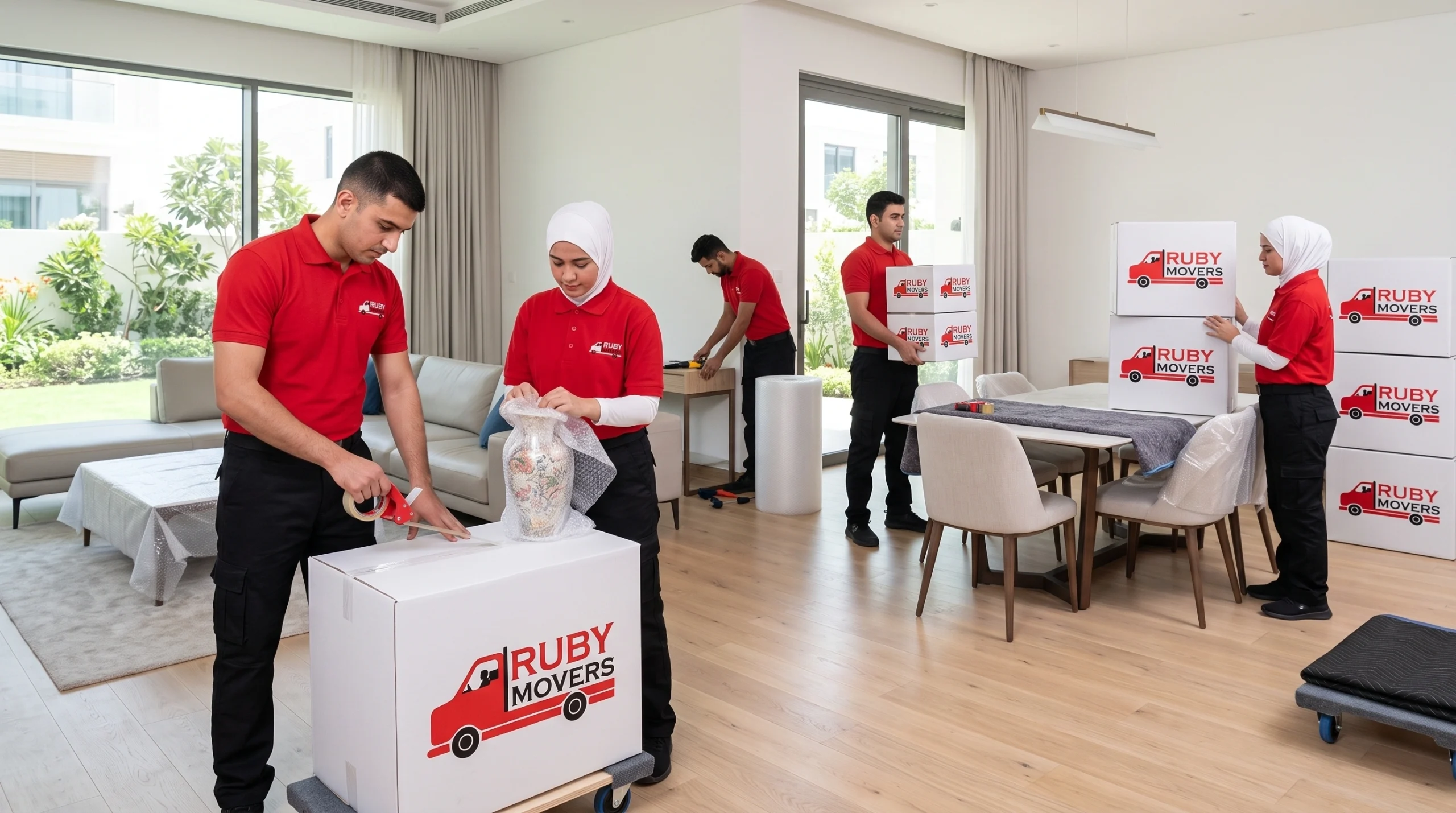
Flat pack furniture does not fail during transport. It fails during careless disassembly, rushed tightening, and undocumented rebuilds. In Sharjah moves, this is where wardrobes wobble, drawers jam, and warranty disputes begin. IKEA systems, custom cabinets, and local furniture all depend on controlled handling, correct torque, and verified alignment. Yet most moves still rely on guesswork instead of measurable standards.
This guide explains how professional furniture movers in Sharjah manage IKEA flat pack moves and local furniture rebuilds using torque control, evidence logs, and quality checks. It breaks down real failure risks, practical tightening limits, rebuild acceptance tests, and warranty documentation.
What benefits come from reading this article?
- It gives a controlled workflow for flat pack disassembly and rebuild with torque control and QA evidence.
- It also gives a tenancy timing module that aligns move dates with Ejari renewal and Sharjah contract renewal windows using official sources.
What does “local furniture rebuild” mean in Sharjah moves?
Local furniture rebuild means reassembly and refit of non-IKEA furniture after transport. It often includes bed frames, wardrobes, cabinets, and custom joinery where fasteners and fittings vary by maker. The control point stays the same. Rebuild quality depends on fastener integrity, alignment checks, and evidence logs.
What is the difference between reassembly and rebuild?
Reassembly means rejoining the same parts in the same configuration. Rebuild includes corrective work such as replacing stripped screws, replacing damaged brackets, correcting hinge geometry, and realigning runners.
What does “furniture movers in Sharjah” mean when the load includes IKEA flat pack furniture?
Furniture movers in Sharjah handle transport, staging, and handling. Many projects also include disassembly, hardware control, reassembly, and rebuild QA for IKEA flat pack systems and local furniture. IKEA publishes item-level assembly instructions that set the baseline method per product.
What furniture types create the highest rebuild workload after moving?
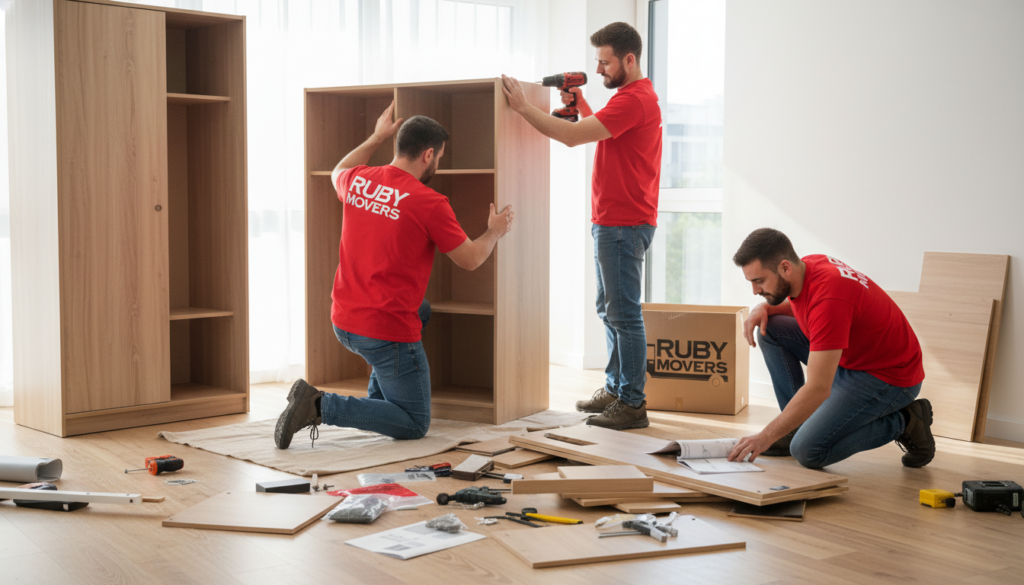
Flat pack furniture creates a rebuild workload because it uses connectors designed for repeated tightening within limits. The usual high-touch items include wardrobes, beds, drawer units, and media units. IKEA provides assembly guidance and shows that correct tightening and adjustment steps matter for stability and alignment.
What does “local furniture rebuild” mean in Sharjah moves?
Local furniture rebuild means corrective reassembly for non-IKEA items after transit, including hinge reset, runner calibration, bracket replacement, and fastener replacement after strip out.
What is an IKEA flat pack move in technical terms?
An IKEA flat pack move is a relocation that includes panelized furniture assembled with cams, dowels, screws, hinges, and runners that require controlled disassembly and controlled reassembly. The technical risk concentrates in three zones.
- Panel substrate: Particleboard, laminated faces
- Connector interfaces: Cams, bolts, screws, hinges, runners
- Geometry: Squareness, door gaps, drawer travel, anchor alignment
What connectors control risk in flat pack systems?
Cams and cam bolts control joint clamping in many IKEA products. The connector locks by turning and capturing a bolt head, and the mechanism has a correct lock and unlock sequence.
What errors convert disassembly into panel damage?
Over-tightening and misalignment convert disassembly into damage because particleboard and MDF faces strip around screw threads and cam housings when torque exceeds material limits. IKEA guidance warns against incorrect assembly behaviors and promotes correct tightening technique and periodic retightening where relevant.
What torque specs mean for flat pack furniture?
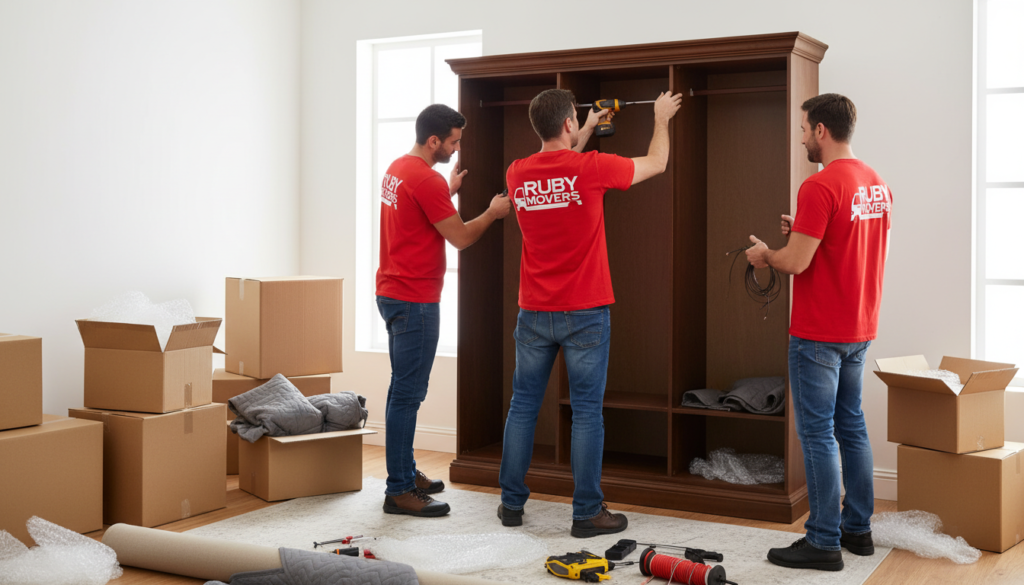
Torque specs describe the tightening level that secures a connector without stripping the substrate. In particleboard, the torque gap between seating and stripping exists in published datasets.
What torque ranges exist in particleboard screw driving research?
A peer-reviewed study in the Wood and Fiber Science journal reports these ranges for particleboard screwdriving.
- Mean seating torque: 0.66 to 1.94 N m
- Mean stripping torque: 2.03 to 6.51 N m
- STT to SET ratios: 2.5 to 5.0
This data set gives a measurable difference between safe seating and destructive strip-out.
What torque control looks like in field assembly
Torque control in flat pack assembly uses two controls.
- A driver with clutch control, set low
- A final hand finish for seated contact and alignment stability
This approach matches the low N m scale reported in particleboard research.
A commercial torque screwdriver example shows adjustable ranges in the 1 to 6 Nm band, which matches the scale of published particleboard torque research.
Torque control logic for flat pack connectors
| Connector type | Dominant risk | Torque control signal | Acceptance check |
|---|---|---|---|
| Cam and bolt | cam housing crush, cam slip | seated lock feel, no over-rotation | joint closes without panel gap |
| Wood screw into particleboard | strip out, spin out | stop at seating behavior | screw head flush, no spin |
| Hinge screws | thread strip, door sag | low clutch, hand finish | door gap uniformity |
| Runner screws | misalignment, binding | controlled seating | drawer travel smooth |
The torque concept sits inside a broader screw assembly principle. BioResources emphasizes that torque induces clamping force and that torque requirements vary by application.
What is the practical torque rule for flat pack systems?
The practical torque rule is simple. Tightening stops at seated contact and stable joint behavior. Tightening does not continue into material crush or spin out. IKEA also warns against incorrect tightening outcomes by using assembly guidance and adjustment tips rather than force.
What does “torque specs” mean when IKEA does not publish Nm per product?
Torque specs still exist as an engineering control even when a brand manual does not provide a numeric value. The numeric control comes from material studies and tool calibration ranges, and then the final acceptance comes from stability and alignment checks.
What quality checks confirm a correct rebuild after moving?
A correct rebuild is confirmed by objective checks, not by appearance.
What checks confirm stability and geometry?
These checks produce pass fail outcomes.
- Frame stability under directional push
- Squareness check at panel corners
- Door gap consistency and hinge alignment
- Drawer runner travel and end stop behavior
- Anchor points installed where the design includes anchoring
What are the minimum acceptance checks for flat pack rebuild?
Minimum acceptance checks include stability, squareness, door alignment, drawer runner travel, and anchor points, where included. IKEA guidance includes adjustment steps for hinges and shows that alignment is a standard post-assembly action.
What evidence supports acceptance in a rebuild warranty workflow?
Evidence supports acceptance by proving the condition before disassembly, the condition after rebuild, and the scope executed. Evidence also separates transit damage from pre-existing defects.
What QA fields support a rebuild warranty scope?
A rebuild warranty becomes enforceable when the project includes a consistent evidence dataset.
- Item ID and room ID
- Pre-disassembly condition photos
- Hardware bag ID and count
- Reassembly timestamp
- Post-rebuild alignment photos
- QA sign-off fields and signatures
What does a rebuild warranty mean in furniture assembly in Sharjah?
A rebuild warranty is a documented commitment to the workmanship scope and limits. Warranty disputes reduce when the scope is defined, evidence exists, and the acceptance checklist is signed.
What does the rebuild warranty cover in operational terms?
Coverage often includes workmanship outcomes such as correct reassembly, alignment, and fastener seating. It often excludes pre-existing damage, missing parts, and substrate stripping out that predates the rebuild scope.
What evidence reduces warranty disputes?
Evidence reduces disputes by separating three categories.
- Pre-existing defects captured before disassembly
- Transit damage captured at delivery staging
- Rebuild outcomes captured after reassembly
What is the end-to-end workflow for IKEA flat pack moves in Sharjah?
The workflow is a sequence with gates. Each gate produces evidence.
Step 1: What happens in pre-inventory and scope lock?
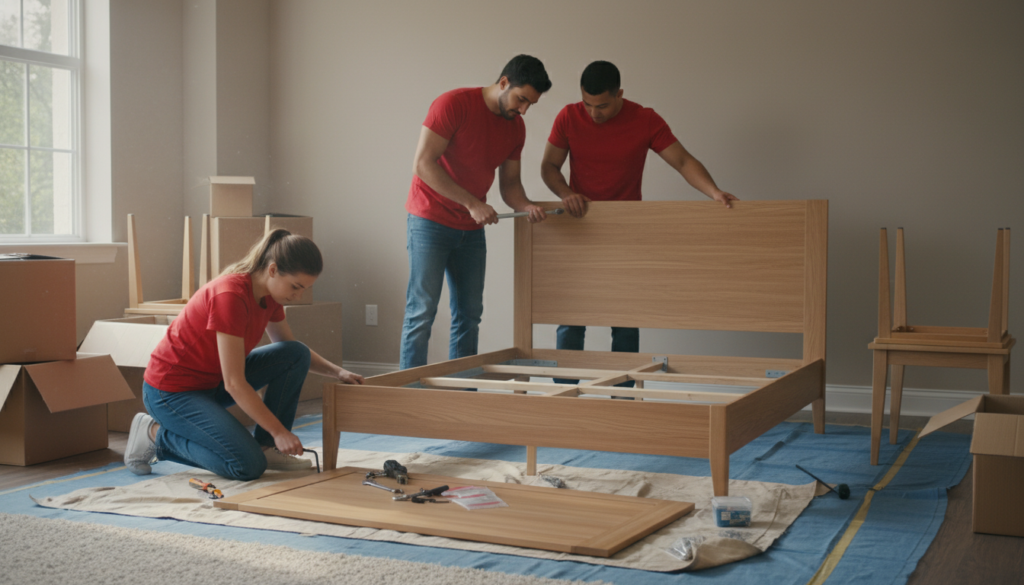
Pre-inventory converts the move into a defined assembly scope.
Inventory fields
- Product name and series when known
- Item group: wardrobe, bed, drawer, TV unit
- Connector type: cam, dowel, hinge, runner
- Defect flags: wobble, sag, missing screws
- Photo set ID
Step 2: What happens in controlled disassembly?
Controlled disassembly uses containerized hardware per item. The method prevents fastener mixing.
Hardware control rules
- One bag per item per stage
- One label per bag with item ID
- Photo of bag contents for high-risk items
Step 3: What happens in packing and panel protection?
Panel protection reduces edge crush. Flat panels pack face-to-face with protective interleaves. Hardware packs separately to prevent puncture.
Step 4: What happens in rebuild and torque-controlled tightening?
Rebuild uses a tightening sequence that maintains geometry.
- Fit panels and connectors without final tightening
- Set the square and level on the frame
- Tighten in sequence with low torque control
- Adjust hinges and runners after tightening
The particleboard torque study supports the existence of a seating range and a striping range. That fact supports controlled tightening as a measurable control.
Step 5: What happens in QA sign-off and handover?
QA sign-off captures acceptance photos and the check results. The delivery is an evidence pack that supports rebuild warranty conversations.
What are the most common pain points in furniture assembly in Sharjah moves?
Pain points concentrate on repetitive work and disputes.
What pain point causes the highest rework rate?
Fastener strip-out causes the highest rework rate. Strip out occurs when screws lose bite in particleboard or MDF, and the joint no longer holds preload.
What pain point causes the most disputes?
Scope ambiguity causes the most disputes. A rebuild warranty has no operational value without an evidence pack.
What is a procurement grade checklist for furniture movers in Sharjah with assembly scope?
A procurement checklist is a decision framework that compares vendors on controls, not on slogans.
What questions identify real flat pack competency?
These questions isolate capability.
- What torque control tool exists, and what range does it cover?
- What evidence fields exist per item
- What acceptance checklist exists for hinges and runners
- What exclusions apply to pre-existing damage
- What rebuild warranty scope exists for workmanship
A torque tool range example and torque concepts documentation show that torque is measurable and controllable in low ranges.
Risk segmentation for flat pack items in Sharjah move projects
| Item group | Typical connectors | Dominant failure mode | Evidence field | QA check |
|---|---|---|---|---|
| Wardrobes | cams, dowels, hinges | door sag, cam wear | hinge photos, cam count | door gap uniformity |
| Beds | bolts, brackets, slats | frame flex, noise | bracket close-ups | fastener retorque check |
| Drawer units | cams, runners | runner bind, tilt | runner alignment photos | smooth travel test |
| TV units | cams, anchors | tilt, anchor failure | anchor evidence | stability and level |
IKEA provides hinge adjustment and assembly guidance that makes door and runner checks part of normal QA.
What is the rebuild warranty evidence pack for claims and liability control?
An evidence pack is a structured dataset.
What fields belong in a rebuild warranty evidence pack?
These fields support audit and dispute resolution.
- Item ID and room ID
- Pre-disassembly condition photos
- Disassembly timestamp and crew identifier
- Hardware bag ID and count
- Reassembly timestamp
- Torque tool type and range used
- Alignment acceptance photos
- Customer signs off with a timestamp
Torque control concepts emphasize tool use, correct torque, and avoiding over-tightening in safety-critical contexts. The same principle applies to furniture fasteners, scaled down to lower torque.
What is the timeline for a flat pack move with rebuild and QA in Sharjah?
A timeline is a planning module that prevents rushed rebuilds.
What is a realistic stage sequence?
The stage sequence is stable across projects.
- Pre-inventory and evidence capture
- Disassembly and fastener labeling
- Panel protection packing
- Transport and staging
- Reassembly and torque-controlled tightening
- Alignment and adjustment
- QA sign off and evidence archive
IKEA includes a concept of adjustment and retightening as part of longer-term stability management.
What mistakes cause flat pack rebuild failures after moving?
Mistakes are predictable and preventable.
Mistake 1: Hardware mixing across items
Hardware mixing increases mismatch risk. It also increases the risk of stripping out in particleboard.
Mistake 2: Driver torque set too high
High driver torque increases the risk of strip-out. The particleboard study quantifies stripping torque ranges above seating torque.
Mistake 3: No geometry check before final tightening
A geometry check before final tightening protects squareness and door gap alignment.
Mistake 4: No QA sign-off fields
No QA fields convert a rebuild warranty into an opinion argument. Evidence fields convert it into a documented scope.
Closing Thoughts: Rebuilds Don’t Need Guesswork, They Need Controls
Flat pack furniture does not become unstable because of distance. It becomes unstable when hardware gets mixed, panels are rushed, and tightening turns into force instead of control. The fix is not a stronger drill or a faster crew. The fix is a controlled rebuild system: item-level inventory, bagged hardware discipline, torque-limited tightening, and geometry checks before final tightening. Then you close the job with a documented QA sign-off that proves what was done.
If your Sharjah move includes IKEA systems and local furniture, treat it as a rebuild project with clear gates and evidence, not a simple transport service. When a mover can explain their torque-control method, show their acceptance checks for hinges and runners, and offer a rebuild warranty backed by an evidence pack, outcomes change. Wardrobes stay square. Drawers run clean. Disputes are reduced because the scope is defined and the before-and-after condition is documented. You do not just get furniture delivered. You get stability, accountability, and a move you can close without callbacks.
FAQs
Do furniture movers in Sharjah assemble IKEA furniture after moving?
What is the difference between IKEA reassembly and “local furniture rebuild”?
Why do wardrobes wobble after a move, even if nothing looks broken?
Do I need torque specs if IKEA doesn’t publish Nm values?
What causes the most rebuilds and rework on flat pack items?
How do movers prevent losing IKEA screws and fittings?
What should be included in a rebuild warranty?
What quality checks should I ask for after reassembly?
How can I reduce disputes about “damage during the move”?
How long does a flat pack move with rebuild and QA usually take?
Bilal Al-Madani
Bilal Al-Madani is a logistics professional specializing in residential relocations and supply chain optimization. With deep experience in the moving industry, he excels in ensuring transit safety, implementing advanced packing methods for high-value items, and managing transport fleets efficiently. He is committed to simplifying the moving process through careful planning, delivering each relocation with precision, reliability, and exceptional attention to detail.