
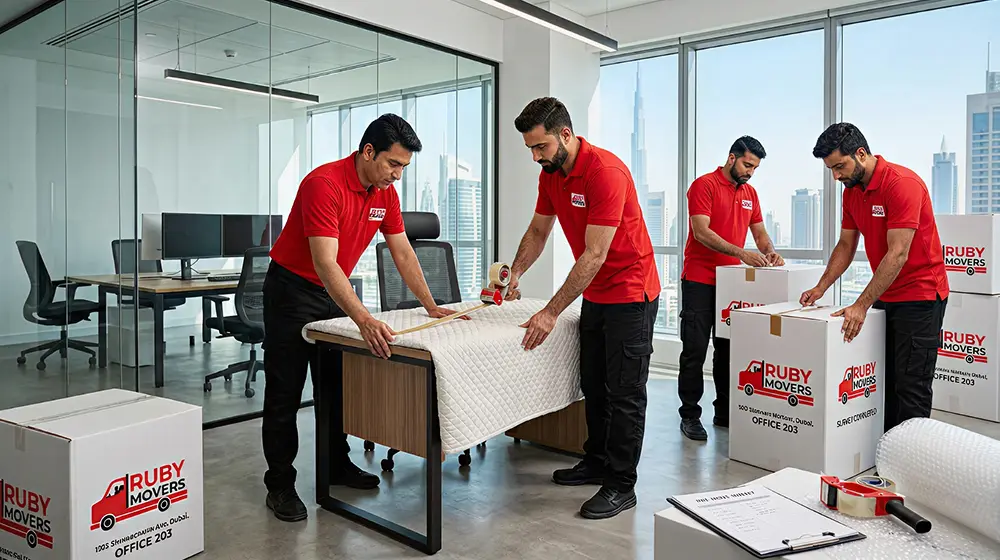
Office furniture movers in Dubai manage the planned movement of desks, chairs, workstations, cabinets, meeting tables, reception furniture, storage units, and related office items from survey to final placement. The service includes inspection, inventory, dismantling, packing, loading, transport, unloading, reassembly, placement, and handover checks.
The practical value of professional office furniture movers is not limited to trucks and labour. The value sits in controlled sequencing. A proper office furniture moving service protects furniture, lift panels, lobby walls, access corridors, IT-linked workstations, tenant handover conditions, and staff return-to-work timing.
This guide explains what office furniture movers in Dubai include from survey to final placement. It also gives facility managers, procurement teams, business owners, and office administrators a practical checklist for comparing office furniture moving services.
What does an office furniture moving service include?
An office furniture moving service includes survey, inventory, dismantling, packing, loading, transport, unloading, reassembly, final placement, and handover documentation. The exact scope depends on furniture volume, access rules, floor level, building controls, and move timing.
A complete office furniture move starts before move day. Your mover inspects the old office and, where possible, the new office. The survey checks furniture types, lift access, loading area, truck access, packing requirements, dismantling complexity, and placement instructions.
What is the difference between office movers and office furniture movers?
Office movers handle wider workplace relocation, while office furniture movers focus on desks, chairs, workstations, cabinets, tables, and furniture systems. Many companies offer both services, but the scope is different.
Office movers may handle:
| Comparison point | Office movers | Office furniture movers |
| Main scope | Handle complete workplace relocation | Handle office furniture relocation |
| Service focus | Full office move, including non-furniture items | Furniture dismantling, packing, moving, and placement |
| Typical items handled | Documents, archive boxes, IT equipment, pantry items, signage, office supplies, employee crates, plants, artwork, and appliances | Desks, chairs, workstations, filing cabinets, storage units, tables, reception counters, waiting-area furniture, shelving, and lockers |
| Best for | Businesses moving an entire office from one location to another | Businesses moving, replacing, rearranging, or reinstalling office furniture |
| Procurement meaning | A request for office movers usually implies a full workplace move | A request for office furniture movers usually focuses on the furniture layer only |
| Risk if wording is unclear | Furniture handling, IT items, files, or supplies may be misunderstood | Non-furniture items may be excluded from the quotation |
| RFQ advice | Use this term when the move includes furniture, files, IT assets, supplies, and general office contents | Use this term when the job is limited to desks, chairs, cabinets, workstations, and other furniture systems |
This distinction matters in procurement. A request for “office movers” may imply a full workplace move. A request for “office furniture movers” focuses on the furniture layer. Use exact wording in your request for quotation to prevent scope gaps.
What happens during the pre-move survey?
The pre-move survey records furniture quantity, item condition, dismantling needs, access limits, lift route, packing requirements, and final placement instructions. This survey turns a moving request into a measurable work plan.
A useful survey captures these details:
| Survey point | What the mover checks | Why it matters |
| Furniture quantity | Desks, chairs, cabinets, tables, sofas, shelves | Calculates labour, packing, and truck space |
| Furniture condition | Scratches, weak joints, loose panels, glass damage | Prevents post-move disputes |
| Dismantling scope | Workstations, tables, shelves, panels, brackets | Controls reassembly time |
| Access route | Doors, lifts, corridors, basement, loading bay | Prevents blocked movement |
| Packing need | Glass, veneer, laminate, metal, fabric | Matches material to protection |
| Destination layout | Room codes, department zones, desk numbers | Speeds final placement |
| Handover notes | Damage exceptions, disposal needs, client sign-off | Supports audit and closure |
The survey also identifies what the mover does not handle. Fixed joinery, wall-mounted cabinets, electrical points, floor boxes, data devices, partitions, and fire-safety-linked systems may require specialist contractors or building approvals.
What does access planning include?
Many commercial buildings manage contractor access tightly. A building may request vehicle plate numbers, worker names, Emirates ID details, trade licence documents, insurance details, and approved timing before the move begins. These requirements vary by building, free zone, tower, and landlord.
Access planning checks 8 physical points:
- Office entrance width
- Corridor turning space
- Service lift size
- Lift booking time
- Basement height
- Loading bay distance
- Truck parking position
- Destination floor access
A furniture-only move may not require the same approval as fit-out work. The mover still needs to respect building access rules. This difference matters because furniture movement, fit-out work, electrical work, partition change, and authority-approved modification are separate scopes.
What does furniture dismantling cover?
Furniture dismantling covers the controlled removal of detachable parts, panels, legs, brackets, screens, shelves, drawers, and connecting hardware. The purpose is safe handling without damaging the furniture structure.
Office furniture movers dismantle items according to construction type. Modular workstations often have shared legs, modesty panels, cable trays, desk screens, brackets, and joining plates. Executive desks may have hidden fasteners. Storage cabinets may need shelf removal before lifting.
A professional team labels and bags small parts, including:
- Screws
- Bolts
- Brackets
- Hinges
- Cam locks
- Joining plates
- Allen keys
- Drawer keys
- Workstation connectors
This small step has high operational value. A desk without the right screw set cannot be reassembled on time. A workstation with mixed brackets can delay an entire row of seating.
Dismantling also reduces risk during movement. A long boardroom table may fit inside the room but not inside the service lift. Removing the top from the base improves weight control and reduces edge damage.
What packing materials do office furniture movers use?
Office furniture movers use stretch film, bubble wrap, moving blankets, corrugated sheets, labels, carton boxes, tape, and edge protectors according to furniture risk. The material depends on surface finish, weight, fragility, and travel distance.
Common packing materials include:
- Stretch film for surface covering
- Bubble wrap for delicate edges
- Moving blankets for desks and cabinets
- Corrugated sheets for flat protection
- Corner protectors for table edges
- Cartons for loose accessories
- Labels for room and department coding
- Tape for securing non-sensitive packing layers
Packing does more than protect furniture. It protects lifts, corridors, glass partitions, walls, and door frames. This is why professional office furniture movers treat packing as part of risk control, not just appearance.
How do professional office furniture movers handle IT-linked furniture?
Professional office furniture movers handle IT-linked furniture by separating furniture parts from data-carrying equipment. Your mover can handle desks, panels, cable trays, and monitor arms, while your IT team controls laptops, servers, routers, drives, and network devices.
The safest split is simple:
- Movers handle furniture.
- IT teams handle data devices.
- Electricians handle electrical connections.
- Network vendors handle active connectivity.
- Facility managers approve layout and access.
This boundary protects data custody. It also reduces blame if a device, cable, or network component fails after relocation. In finance, healthcare, legal, consulting, and technology offices, this separation is not a small detail. It is part of risk control.
What does transport planning include?
Transport planning includes vehicle selection, loading order, item segregation, route timing, truck access, parking position, and unloading sequence. The transport plan links the old floor plan to the new office layout.
A mover selects vehicle size according to volume, trip distance, loading-bay height, furniture size, and number of floors. Covered trucks are common for office furniture because they protect items from dust, heat, and weather exposure.
Transport planning also reflects Dubai’s business geography. Office furniture movers in Dubai often operate across Business Bay, DIFC, Jumeirah Lake Towers, Dubai Marina, Dubai Internet City, Dubai Media City, Deira, Al Quoz, Jebel Ali, and Dubai South. Each area has different access rules, traffic patterns, tower controls, and parking limits.
A good loading order follows placement logic. Items needed first at the new office often load last. Reception furniture, IT room cabinets, and priority department desks may require early unloading. This reduces double handling and keeps corridors clear.
What happens during loading and unloading?
Loading and unloading include inventory checking, safe lifting, route protection, truck stacking, weight balance, and condition observation. These stages carry the highest damage risk because furniture moves through tight spaces.
Good loading uses 5 controls:
- Place heavy items low.
- Keep glass and long panels supported.
- Separate loose accessories from furniture.
- Balance weight inside the truck.
- Keep destination-priority items accessible.
Unloading needs the same discipline. A desk for the finance room should not sit in the HR corridor. A filing cabinet for floor 24 should not land on floor 23. Room codes, colour labels, and floor maps help office furniture movers place items without repeated handling.
What does reassembly include?
Reassembly includes rebuilding dismantled desks, workstations, tables, storage units, screens, shelves, and furniture accessories with the correct labelled hardware. The quality of reassembly depends on the accuracy of dismantling.
Workstations require careful reassembly because parts connect across multiple desks. A shared leg, panel, or bracket can affect the alignment of the next unit. A mistake at the first desk can create a longer correction later.
Reassembly includes stability checks. The team checks whether tables rock, drawers close, cabinets sit level, workstation panels align, and meeting tables feel stable. These checks reduce complaints after employees return.
Reassembly can also include minor position adjustments. A boardroom table may need centring under lighting. Reception seating may need alignment with visitor movement. Storage units may need enough clearance for drawers and doors.
What does final placement mean?
Final placement means placing every furniture item in the correct room, department, workstation position, floor, or zone according to the approved layout. It is different from simply unloading furniture.
Office furniture movers place desks, chairs, storage cabinets, meeting tables, reception furniture, and sofas according to your floor plan. The placement plan can use room numbers, department names, colour labels, desk codes, or floor maps.
Final placement often reveals practical issues. A cabinet may block a power socket. A desk may reduce chair clearance. A meeting table may sit too close to a wall. A reception unit may not align with the visitor path.
Professional office furniture movers report these issues before forcing placement. This helps your facility team make quick layout decisions without damaging furniture or blocking access.
What permits or approvals can affect an office furniture move?
Permits and approvals can affect an office furniture move when the move involves building access, contractor entry, after-hours movement, fit-out changes, or waste disposal. A furniture-only move is different from a fit-out project.
Dubai Development Authority (DDA) states that a fit-out permit allows a contractor to start fit-out works for part of a building, including an office. DDA lists a delivery time of 2 working days for the permit. The fee is AED 0.90 per square foot, with a minimum of AED 200 and a maximum of AED 10,000, plus Knowledge Dirham and Innovation Dirham fees.
That information applies to fit-out work, not every basic office furniture move. The difference matters. Moving loose desks and chairs may only require building management approval. Changing partitions, services, fixed layouts, or MEP systems can require fit-out approval.
DIFC also provides no objection certificate (NOC) guidelines and procedures for work in the DIFC Master Community District. DIFC notes that third-party buildings may require building management or body corporate approval before certain works proceed.
Your office furniture mover should identify the boundary. Furniture movement, handyman work, fit-out work, and authority-approved modification are not the same service.
How does waste handling work after an office furniture move?
Waste handling covers unwanted furniture, packing waste, broken items, obsolete fixtures, and recyclable materials created during relocation. Disposal needs a legal route, not informal dumping.
Dubai’s Law No. 18 of 2024 defines waste management as collection, segregation, sorting, transportation, storage, reuse, recycling, treatment, and final disposal. The law also defines a waste producer as a person whose activity produces waste. A company clearing old office furniture can fall within that practical waste-producing context.
Dubai Municipality lists approved hazardous waste transporters, waste oil collectors, and hazardous and non-hazardous waste processing and recycling premises. This confirms that disposal channels matter when waste types differ.
For office furniture movers in Dubai, this affects unwanted desks, chairs, cabinets, partitions, shelves, packaging material, and electronic waste. Your quote should state whether disposal is included, whether recycling is available, and whether removal evidence is provided.
What affects the cost of office furniture movers in Dubai?
Office furniture moving cost increases with furniture volume, dismantling complexity, packing level, access difficulty, move timing, truck trips, storage, and disposal requirements. The survey identifies these cost drivers before quoting.
A 20-seat office with loose desks and chairs takes less labour than a 150-seat office with modular workstations, storage walls, glass tables, and multiple floors. The difference is not only item count. It is the amount of dismantling, packing, reassembly, and placement control.
Key cost drivers include:
- Number of desks, chairs, cabinets, and tables
- Number of workstation clusters
- Number of floors at origin and destination
- Service lift availability
- Basement height restrictions
- Long carrying distance
- After-hours or weekend work
- Packing material volume
- Number of truck trips
- Reassembly time
- Disposal or recycling requirement
- Short-term storage requirement
- Building approval complexity
Commercial market pressure also affects timing. A tight office market means more companies compete for fitted spaces, building slots, and move windows. Dubai continues to experience a supply shortage, with only 0.89 million sq. ft. of new office stock expected in 2025. Major upcoming projects include the Innovation Hub (2025), DIFC Square (2026), and Aldar’s Office Tower (2027). This explains why many occupiers plan moves around limited office availability rather than ideal operational timing.
How do you compare professional office furniture movers?
You compare professional office furniture movers by checking survey quality, scope clarity, access planning, packing standards, dismantling skill, disposal route, and handover records. The cheapest quote is not always the clearest quote.
Ask these questions before approval:
- Did the mover survey both the current and destination offices?
- Does the quote list furniture categories and quantities?
- Does the quote include dismantling and reassembly?
- Does the mover provide packing materials by item type?
- Does the mover coordinate service lift and loading-bay access?
- Does the mover protect lifts, walls, corridors, and floors?
- Does the mover separate furniture handling from IT custody?
- Does the mover provide disposal or recycling support?
- Does the mover provide a move supervisor?
- Does the mover provide handover documentation?
A professional quote reads like a method statement. It explains what the mover does, what your team does, what the building manager approves, and what remains outside scope.
What common problems do office furniture movers prevent?
Office furniture movers prevent furniture damage, access delays, missing hardware, misplaced items, downtime, unsafe lifting, and incomplete placement. Most office move problems come from weak planning rather than travel distance.
The most common problem is missing hardware. A workstation without screws, brackets, or joining plates cannot return to use. Professional movers label parts during dismantling and match them during reassembly.
The second common problem is poor destination labelling. Furniture may arrive at the right tower but land in the wrong room. Department labels, room codes, and floor maps reduce this risk.
Access delays create another problem. A truck can reach the building before security approval. A lift booking can expire before loading finishes. A basement can reject a truck because of height limits. Access planning prevents these delays before move day.
How do you prepare before office furniture movers arrive?
You prepare by approving the move plan, clearing personal items, backing up IT data, emptying cabinets, labelling departments, confirming access, and assigning one decision-maker. Preparation reduces downtime and prevents conflicting instructions.
Before move day:
- Assign one move coordinator.
- Confirm service lift booking.
- Share vehicle and worker details with building management.
- Empty filing cabinets and pedestal drawers.
- Remove personal items from desks.
- Back up data before IT disconnection.
- Label each department and destination room.
- Mark items for disposal or storage.
- Confirm destination cleaning and access.
- Keep a printed floor plan available.
Destination readiness matters. If the new office is not clean, accessible, labelled, and powered, final placement slows down. Your mover can place furniture, but your team controls the final business environment.
What is the final checklist for hiring office furniture movers in Dubai?
The final checklist covers survey depth, written scope, access approval, furniture protection, dismantling, reassembly, disposal, and handover evidence. Use this checklist before approving a deposit or purchase order.
Use this decision framework:
- Check whether the mover inspected item quantity, access, and destination.
- Check whether the quote lists included and excluded services.
- Check whether dismantling and reassembly are included.
- Check whether packing materials match furniture types.
- Check whether the mover coordinates service lift and loading-bay access.
- Check whether IT equipment responsibility is clearly separated.
- Check whether old furniture disposal follows a documented route.
- Check whether the mover provides inventory and placement confirmation.
- Check whether the mover provides exception notes for damage or missing items.
- Check whether final sign-off includes date, time, and representative name.
Office furniture movers in Dubai provide the highest value when the service ends with a usable office, not a truck emptied at the door. From survey to final placement, the process works best when every desk, chair, workstation, cabinet, and meeting table has a recorded route, a protected movement method, a destination label, and a final sign-off record.
Final thought: Choose the mover who leaves your office ready, not just relocated
Office furniture movers in Dubai do more than shift desks, chairs, cabinets, and workstations from one address to another. The real service begins with a measured survey and ends when every item sits in the right place, with the right hardware, the right label, and the right handover record.
For business owners, facility managers, and procurement teams, this detail matters. A rushed move can leave workstations unfinished, cabinets misplaced, lift access disputed, and staff waiting for usable desks. A planned move creates a cleaner handover. It protects office furniture, building areas, access windows, IT-linked furniture, and your return-to-work schedule.
The best office furniture movers in Dubai give you clarity before move day. They explain what is included, what is optional, what needs building approval, what your team must prepare, and what evidence you receive after completion. That is the difference between a basic furniture shift and a professional office furniture moving service.
If your move includes dismantling, packing, transport, reassembly, final placement, disposal, and handover checks, choose a mover who treats every stage as part of one controlled process. Your office is not truly moved when the truck is empty. Your office is moved when your team can walk in, find each item where it belongs, and start work without fixing yesterday’s mistakes.
FAQs
What should I confirm before booking office furniture movers in Dubai?
Confirm survey details, dismantling scope, packing materials, lift access, reassembly, final placement, disposal terms, and written handover records before booking.
Can office furniture movers move only selected departments?
Yes, office furniture movers can move selected departments if each desk, chair, cabinet, and workstation has clear labels and destination instructions.
Who labels office furniture before the move?
Your team usually confirms department names and destination codes, while the mover applies item labels during the survey or pre-move preparation.
Do office furniture movers handle heavy filing cabinets?
Yes, office furniture movers handle filing cabinets, but cabinets are usually emptied first to reduce weight, drawer movement, and lifting risk.
What happens if workstation parts go missing?
Missing workstation parts delay reassembly, so professional office furniture movers label and bag screws, brackets, keys, and connectors by item code.
Can office furniture movers work around business hours?
Yes, many office furniture movers can work after hours if your building permits night access, lift booking, contractor entry, and security clearance.
Do office furniture movers protect lifts and corridors?
Professional office furniture movers usually protect shared areas with lift padding, floor runners, corner guards, and door-frame protection where required.
Is office furniture disposal included in the moving quote?
Office furniture disposal is included only when the quote states removal, transport, disposal route, recycling option, and any disposal documentation.
What makes professional office furniture movers different from basic movers?
Professional office furniture movers provide survey records, dismantling control, packing standards, access planning, reassembly, placement checks, and handover evidence.
When is an office furniture move considered complete?
An office furniture move is complete when all listed items are delivered, reassembled, placed correctly, checked for exceptions, and signed off by your representative.
Bilal Al-Madani
Bilal Al-Madani is a logistics professional specializing in residential relocations and supply chain optimization. With deep experience in the moving industry, he excels in ensuring transit safety, implementing advanced packing methods for high-value items, and managing transport fleets efficiently. He is committed to simplifying the moving process through careful planning, delivering each relocation with precision, reliability, and exceptional attention to detail.