

A villa inventory changes the moving plan by turning rooms, furniture, cartons, storage areas, outdoor items, and fragile goods into measurable work. The record controls packing quantities, crew allocation, truck space, access planning, and quotation scope.
Moving estimates often change because the first inventory misses stored cartons, outdoor furniture, fragile items, or bulky pieces. A bedroom count cannot show the real packing volume inside a Dubai villa.
A detailed villa inventory turns household contents into measurable tasks. It connects item count with packing materials, crew hours, truck space, dismantling work, and property access.
This guide explains how movers record rooms, garages, storage areas, outdoor goods, fragile pieces, and high-value items. It also shows how residents can review the inventory before approving the moving plan.
By the end, you can identify missing items, question unclear quotation entries, and understand why two similar villas may require different moving resources.
A clear villa moving inventory Dubai record answers what moves and how much work the shipment creates. The inventory now becomes the working base for the moving plan.
What is a villa inventory for moving?
A villa inventory is a room-by-room record of goods included in a move, together with quantity, condition, dimensions, handling class, and service requirements.
The record has two stages. A survey inventory supports the quotation before packing. A shipment inventory identifies packed cartons and individual pieces during loading.
The pre-move survey covers the visit, results, quotation, allowances, restrictions, and prohibited items.
A usable villa inventory contains fields such as:
- Record the room or zone.
- State the item name.
- Enter the exact quantity.
- Add dimensions for bulky pieces.
- Mark packing responsibility.
- Note dismantling and reassembly.
- Flag fragile, valuable, heavy, or restricted goods.
- Record existing damage and access constraints.
An inventory is a detailed list showing each item’s number and condition. Its rules do not govern a local Dubai move. The definition still provides a useful documentation benchmark.
Which villa rooms create the inventory list?
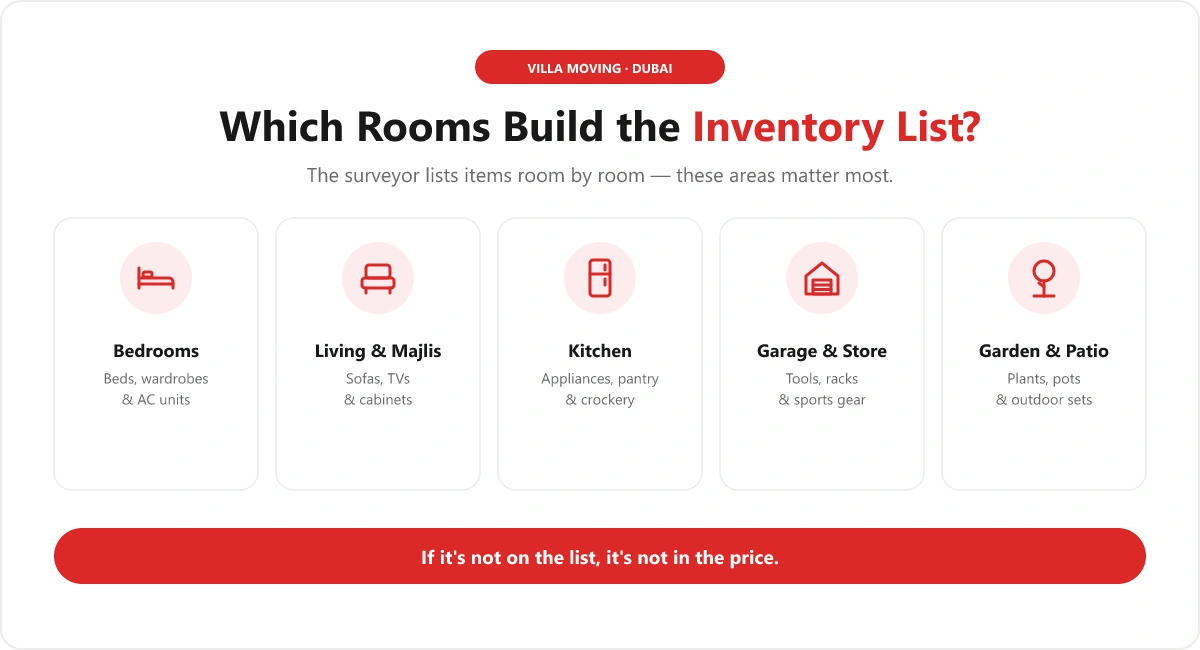
Every occupied room, service room, circulation area, balcony, garage, and store creates part of the villa inventory list.
Room count alone does not measure shipment volume. A lightly furnished five-bedroom villa can contain less cargo than a packed three-bedroom property with a majlis, library, garage, and garden store.
Use each room as a location code. Then count the contents within that code. Leave pictures on walls and glasses in cupboards during the survey. Their normal position helps the packing team inspect the complete contents.
The table connects common Dubai villa zones with the data that changes the moving plan.
| Villa zone | Inventory data | Planning result | Example |
| Bedroom | Beds, mattresses, wardrobes | Covers, cartons, dismantling | 4 beds create 4 mattress-cover entries |
| Kitchen | Crockery, pantry goods, appliances | Dish cartons, appliance preparation | 24 place settings require more packing than 6 |
| Majlis or living room | Sofas, rugs, artwork | Bulky volume, fragile handling | 2 sofas require 2 measured entries |
| Study | Books, files, monitors, desks | Strong cartons, cable labels | 8 shelves expose book volumes |
| Laundry and staff areas | Appliances, shelving, beds | Disconnection and extra cartons | 2 appliances create 2 preparation tasks |
| Hallways and landings | Mirrors, consoles, wall art | Stair carrying and protection | 6 framed pieces create 6 condition records |
A Dubai Hills villa may include an upstairs family lounge and ground-floor study. An Emirates Living villa may add a majlis, utility room, maid’s room, and covered garage. Each space adds categories that a bedroom count misses.
How are outdoor, garage, and storage items recorded?
Outdoor, garage, and storage items receive separate zone codes, item counts, dimensions, condition notes, and preparation instructions.
Do not record “garden set” as one line. Record one table, six chairs, two loungers, four planters, and one storage bench. Fourteen physical pieces require more wrapping and space than one vague entry suggests.
Garage records require the same precision:
- Count bicycles, ladders, tyres, toolboxes, and gym machines by unit.
- Measure cabinets, workbenches, shelving, and oversized planters.
- Separate loose tools into estimated carton groups.
- Mark items containing fuel, gas, paint, oil, or chemicals.
- Record whether fixed shelving stays with the property.
Use standard household shipment against packing paint, flammables, corrosives, perishables, alcohol, food products, and weapons. The exact restriction depends on the route and carrier.
An Arabian Ranches villa may include patio furniture and bicycles. A Palm Jumeirah villa may include pool loungers or large planters. A 95-centimeter planter cannot pass through a 90-centimeter gate without another route.
How are fragile and high-value items marked?
Fragile and high-value items receive an individual description, quantity, dimensions, current condition, photograph reference, packing method, and declared handling category.
The word “fragile” lacks enough detail. “Glass dining top, 220 by 110 centimeters, removable base, edge protection required” gives the surveyor usable information.
Use four handling codes:
- Mark breakables for cushioning, dividers, or rigid cartons.
- Mark artwork and mirrors for measured picture protection.
- Mark high-value goods for photographs and written value disclosure.
- Mark owner-carried goods for jewelry, passports, cash, medicines, and devices.
FMCSA guidance uses a numeric benchmark for extraordinary-value items in regulated United States interstate moves. The threshold exceeds USD 100 per pound. That figure does not set Dubai coverage, but it shows why “valuable items” creates weak documentation.
FMCSA also requires movers to record existing damage or unusual wear on the shipment inventory. Both parties sign each page under that system. Dubai residents can use the same review discipline without treating the American rule as UAE law.
How does inventory affect packing materials?
The inventory sets packing quantities by connecting item count, dimensions, weight, surface, and fragility with a specific protective material.
Cartons come from cupboard, shelf, drawer, and wardrobe contents. Furniture entries set blanket, stretch-film, corner-guard, and cover quantities. Measured artwork sets picture-carton or crate sizes.
One carton measuring 60 by 40 by 40 centimeters has a bounding volume of 0.096 cubic meters. Twenty cartons occupy 1.92 cubic meters before loading gaps and compression.
Material planning improves when the inventory separates four packing categories:
- “Mover packs” add labor and materials.
- “Owner packs” remove packing labor but retain loading volume.
- “Specialist crate” adds measured fabrication.
- “No move” removes the item from the shipment.
List every carton’s contents and avoid heavy boxes. Carriers commonly limit damage liability for owner-packed goods. That distinction belongs beside each inventory line.
How does inventory affect crew hours and truck space?
The inventory affects crew hours and truck space by converting each item into packing, dismantling, carrying, loading, unloading, and reassembly tasks.
Truck planning uses cubic volume, shape, weight distribution, and stackability. A rectangular carton stacks efficiently. A curved sofa, ladder, bicycle, or marble table consumes less predictable space.
A sofa measuring 2.2 by 0.9 by 0.85 meters has a 1.683-cubic-meter bounding box. Actual loaded volume varies because the shape leaves gaps. The measurement still gives the planner a starting point.
Crew time depends on handling steps rather than room labels. One wardrobe can require emptying, dismantling, hardware labeling, wrapping, carrying, loading, unloading, and reassembly. Eight steps sit behind one inventory line.
Access adds another time layer. Emaar Community Management requires a Move-in Permit for Emirates Living and Dubai Hills Estate. Tenants apply at least one business day before moving and upload three document groups: Ejari, Emirates ID, and passport with visa page. Access can be denied without the permit.
The inventory review records five property variables:
- Gate width
- Truck parking position
- Carrying distance
- Stair or lift route
- Permitted moving window
A long carry is an excessive distance between the vehicle and the residence. Stairs, elevators, storage, and specialized access are additional service factors. The terminology comes from United States regulation but the operating logic applies to villa surveys.
How should residents review the inventory?
Residents review the inventory by walking through every zone and matching item names, quantities, exclusions, condition notes, packing methods, and access details against the quotation.
Use this 10-point villa moving inventory checklist:
- Check every bedroom, kitchen cupboard, utility shelf and bathroom cabinet.
- Check the majlis, study, family lounge, corridors and landings.
- Check balconies, the garage, garden store and external cupboards.
- Confirm goods that stay, move, sell, donate or travel with you.
- Count furniture pieces instead of using set names.
- Measure oversized furniture, artwork, planters and gym equipment.
- Mark fragile, high-value, heavy, and owner-carried items.
- Confirm dismantling, disconnection, removal and reassembly tasks.
- Record gates, parking, stairs, carrying distance and permit status.
- Request an updated written quotation after a material change.
Customers need to accompany the inventory process, resolve condition questions, and note missing or damaged items before signing. It also requires a revised estimate when extra goods alter a regulated non-binding shipment before loading.
For a Dubai move, the commercial lesson is direct. Ten extra cartons, a newly purchased sofa, or an omitted garage cabinet changes volume and labor. Update the inventory before moving day.
A precise inventory creates a workable moving plan
A villa move becomes easier to control when the inventory reflects the property as it actually exists. Room count gives only a starting point. The real moving plan comes from item count, furniture size, storage density, fragile goods, outdoor contents, access conditions, and packing responsibility.
That detail affects every operational decision. It shapes carton quantities, crew allocation, dismantling time, truck space, specialist handling, and permit planning. A missed garage cabinet or ten extra cartons can change the scope more than an additional bedroom.
Residents protect the moving schedule by reviewing the inventory before packing starts. Count items carefully. Measure bulky pieces. Record fragile goods. Check every storage area. A complete villa inventory does not add paperwork for its own sake. It gives the move a plan that matches the real volume of work.
FAQs
Does every small item appear separately?
Small loose goods usually appear as estimated cartons by room. Furniture, appliances, outdoor pieces, and fragile objects receive individual entries.
Can a video survey create an accurate villa inventory?
A video survey works when you open cupboards, show every storage zone, provide measurements, and identify goods excluded from the move.
Why can two four-bedroom villas require different moving plans?
Room count describes property layout. Item count, furniture size, storage density, outdoor contents, access, and fragile categories determine the actual moving scope.
Does a move-in permit belong in the inventory?
The permit is an access record rather than a household item. The moving plan tracks permit status because denied entry stops the crew and truck.
When does the inventory require an update?
Update the villa inventory after purchases, disposals, room changes, added services, access changes, or any item that alters packing, labor or truck space.
Bilal Al-Madani
Bilal Al-Madani is a logistics professional specializing in residential relocations and supply chain optimization. With deep experience in the moving industry, he excels in ensuring transit safety, implementing advanced packing methods for high-value items, and managing transport fleets efficiently. He is committed to simplifying the moving process through careful planning, delivering each relocation with precision, reliability, and exceptional attention to detail.