
A Dubai villa move can finish in one day, but the financial risk can remain after the truck leaves. A fresh floor gouge, chipped doorframe, or damaged wall can trigger a security deposit dispute at handover.
The practical task is to separate tenant damage from mover damage before handover, then prove the difference. This article explains Dubai tenancy rules and common move-out practice, not case-specific legal advice.
This guide breaks down how wall and floor damage after a Dubai villa move affects the tenancy deposit. It covers wall anchors, TV brackets, floor scratches, doorframe chips, common-area damage, mover liability certificates, photo evidence, and the move-out inspection.
Who is liable for damage to the villa itself?
Three outcomes exist:
- The mover can be liable where its crew caused third-party property damage
- The tenant can be liable for tenant-responsible damage under the tenancy
- Nobody owes a deposit deduction where the condition is ordinary wear and tear
The landlord usually deals with you first because the security deposit belongs to the tenancy relationship. Article 20 links the deposit to maintenance when the lease ends.
Mover liability is separate. Sukoon Insurance’s UAE liability guidance defines public liability cover around an insured business’s legal liability for third-party property damage or personal injury arising from its operations.
When comparing villa movers in Dubai with full liability cover, check what the insurer actually covers, the policy period, the liability limit, exclusions, excess, and the claims process rather than relying on the phrase “fully insured” alone.
A public liability certificate does not automatically turn every floor scratch into an insurance payout. Fault, policy wording, exclusions, excess, claim procedure, and evidence still matter.
Article 17 also places responsibility on the landlord for defects, damage, deficiency, and wear and tear not attributable to the tenant. Article 21 protects ordinary wear at surrender.
A landlord can seek a deposit deduction. The tenant can separately pursue the mover if move-day evidence shows the crew caused the same damage.
Which move damage is charged to the deposit?
Deposit deductions depend on the property’s original condition, the tenancy terms, the nature of the damage, and evidence showing when the damage appeared.
The table below applies that distinction to common villa move out damage deposit Dubai scenarios.
| Damage type | Usual liable party | Evidence that decides it |
| Pre-existing floor scratch | Neither current tenant nor mover | Move-in inventory, dated photographs |
| Minor wear from normal use | No tenant deduction for ordinary wear | Condition report, before-and-after images |
| Fresh deep floor gouge during loading | Mover if causation is proved | Move-day photos, video, repair evidence |
| New doorframe chip during furniture removal | Mover if the crew caused it | Before-loading and after-loading photos |
| Unrestored wall anchors or bracket holes | Tenant in many cases, subject to consent and lease terms | Tenancy addendum, landlord approval |
| Wall plaster torn during bracket removal | Mover if move-day causation is proved | Close photos before and after removal |
| Existing wall holes recorded at tenancy start | Neither current tenant nor mover | Signed inventory, original photos |
| Damage caused by a building defect | Landlord-side responsibility where not attributable to tenant fault | Maintenance reports, inspection records |
| Gate, barrier, paving, or shared-door damage | Responsible party, potentially the mover | CCTV, community report, permit records |
The table does not create fixed legal outcomes. It identifies the evidence that usually decides the argument.
Deposit deduction examples
Use calculations to test the money at risk. These figures are examples, not standard Dubai repair prices.
An AED 6,000 deposit less AED 850 of supported tenant-responsible repairs leaves AED 5,150. The same deposit of AED 2,400 leaves AED 3,600.
If verified tenant-responsible damage costs AED 7,500 against an AED 6,000 deposit, the shortfall is AED 1,500. Dubai Land Department (DLD) says a tenant can remain responsible where repair costs exceed the security deposit.
A real Dubai case shows why proof matters. In 2020, the Rental Disputes Center through the DLD ordered the refund of an AED 6,000 security deposit where repair deductions had not been established. The Center said the full amount returns where no repair work supports a deduction.
Another point gets repeated inaccurately online. Article 20 does not set one universal 5% or 10% security deposit rate. The current DLD Ejari guide says the security deposit amount is specified in the tenancy contract.
Wall anchors, TV brackets and curtain rails
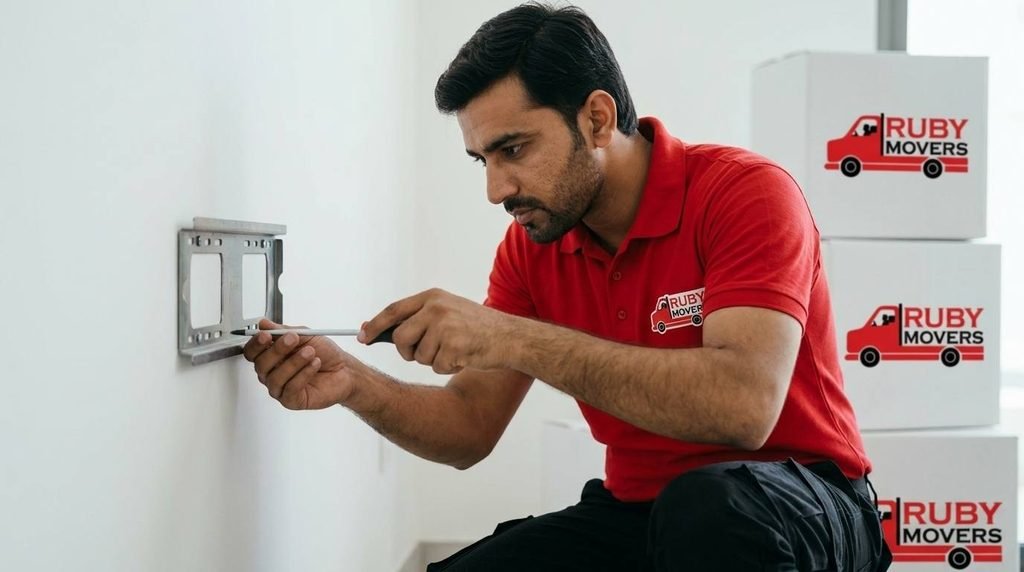
Wall anchors sit between tenant alterations and mover handling. The tenant can create the fixings. The mover can cause extra damage while removing it.
Article 19 of Dubai tenancy law says a tenant cannot make property changes or restoration works without landlord permission and any required official licences.
Take a TV bracket with 6 anchor points. The mover removes the television and bracket without widening the holes. The original alteration remains connected to the tenancy.
Change one fact. The crew pulls the bracket away with plaster attached and leaves a broken patch around two fixings. That fresh damage creates a separate mover-liability question.
Curtain rails work the same way. Existing screw holes are one condition. Fresh cracks or torn plaster created during dismantling are another.
For removing wall-mounted televisions and brackets, photograph the fixing area before dismantling and again immediately afterward so original anchor holes can be separated from fresh plaster tears, widened holes, or impact damage caused during removal.
DLD does not publish a dataset proving wall anchors are the single most common security deposit deduction. Presenting that ranking as an official Dubai statistic would be inaccurate.
The safer approach is evidence. Photograph the wall before any bracket or rail comes down. Take one wide image and one close image of each fixing zone.
Painting also needs a precise distinction. DLD says comprehensive interior-wall painting at departure is typically the owner’s responsibility under customary practice. A specific tenancy clause or actual tenant-caused damage can change the position.
Floor scratches, doorframe chips and stair damage
Floor damage depends on severity and cause, not the word “scratch” alone.
The DLD specifically gives minor scratches associated with ordinary daily use as an example that does not require tenant repair. Article 21 separately protects ordinary wear and tear.
A new gouge caused by dragging a refrigerator across flooring presents a different fact pattern. So does a chipped timber doorframe created while moving a wardrobe through a narrow opening.
Stair damage follows the same test.
The strongest evidence compares the surface immediately before the moving crew uses the route with the surface after loading ends. A photograph from six months earlier proves less about move-day causation.
Protective materials also matter commercially. Ask villa movers what floor, corner, stair, and doorway protection appears in the written scope before booking.
The purpose of protecting floors, walls and doorframes during a move is to reduce avoidable impact and drag damage along the carrying route, especially where large furniture must pass narrow doors, stairs, corners, tiled floors, or finished walls.
Do not rely on “fully insured” as the answer. Insurance describes a possible recovery route. It does not prove who damaged the floor.
Damage to community common areas
Common-area damage moves the dispute beyond the villa because the damaged asset can belong to community management rather than the landlord.
This is where the mover’s public liability certificate becomes especially relevant. Public liability can respond to established legal liability for third-party property damage where the policy applies.
Community rules also vary by location. Emaar Community Management’s Dubai Hills Estate guidance says its move policy exists partly so common-area damage can be recorded and addressed. Dubai Hills Estate requires a move-in or move-out permit at least one business day before the scheduled move. The same one-business-day requirement appears in current Emirates Living guidance.
Dubai Holding Community Management uses different timing. Its current guidance requires applications at least 48 hours before the move through the Community App or 72 hours before the move by email.
There is no single Dubai-wide move-permit timetable for every villa community.
Permit timing changes by community
A Wednesday application for a Thursday villa move can fit a one-business-day requirement but fall outside a 48-hour requirement.
The permit also creates a traceable event. Community security can connect the moving company, access time, vehicle, move date, and reported damage.
Photographs show pre-existing damage in shared areas before the crew uses them. Record gates, barriers, paving, loading points, shared doors, or other surfaces along the approved route.
Report new common-area damage through the community’s stated channel when it occurs. A delayed report makes the timing harder to establish.
How photo evidence decides a deposit dispute
Photo evidence connects the condition at move-in, the condition before the movers start, and the condition at handover.
That sequence matters because Article 21 compares the returned property with the condition in which the tenant originally received it.
The DLD’s Ejari guidance specifically recommends an inspection with the landlord or representative before requesting the deposit refund. It also recommends retaining proof of the refund.
One photo set rarely answers every question. Use a chronology.
What to photograph, when, and at which property
A photo evidence protocol is a timed record of property condition. Every villa tenant with a security deposit at risk can use it before loading, after loading, and at the new property.
Use 5 stages:
- Record the tenancy baseline. Keep the original inventory, snag list, move-in report, and dated photographs.
- Record the old villa before loading. Capture walls, floors, stairs, doors, frames, fitted items, and furniture-removal routes.
- Record the old villa after loading. Repeat the same angles before cleaners or maintenance workers change the scene.
- Record relevant common areas. Capture visible existing marks where the moving crew receives authorized access.
- Record the new villa before unloading. This protects the next tenancy deposit against damage already present.
Use a wide image and a close image for disputed marks. The wide image establishes location. The close image records the condition.
Keep original files where practical. Add a written note after an incident with the room, surface, approximate time, and mover contact.
Skipping this sequence creates a timing gap. A later photograph can prove damage exists without proving when the damage appeared.
Why the mover’s photographs are not enough
Mover photographs document the moving job. They do not automatically document the tenancy baseline.
A mover usually did not see the villa when your lease started. The mover therefore cannot prove whether an old tile mark existed when you received the property.
The same problem applies to landlord evidence taken only after you leave.
A strong evidence chain combines the original condition report, your photographs, mover records, written correspondence, landlord inspection evidence, and repair documentation.
This becomes important when causation is disputed.
The Rental Disputes Center lists correspondence, notices, bills, cheques, and other supporting documents among evidence that can support claims. Its current Payment Writ service also lists a filing fee of 3.5% of the claimed amount, subject to a minimum of AED 500 and a maximum of AED 15,000, including listed service charges.
That filing cost gives deposit documentation a direct financial value. A well-recorded handover can prevent a small damage disagreement from becoming a formal money claim.
What a move-out inspection actually checks
A move-out inspection compares the villa at handover with the condition documented when the tenancy began.
A villa tenancy handover inspection should therefore compare the documented starting condition with the final condition of walls, floors, doors, frames, stairs, fitted items, and any approved alterations before keys and deposit records are closed.
DLD’s Ejari guide sets out a three-part security deposit refund process:
- Inspect the property with the landlord or representative
- Request the refund after satisfactory handover
- Keep a document confirming the refund amount
The official guidance does not publish one universal room-by-room move-out inspection checklist for every Dubai villa.
In practice, the inspection focuses on evidence relevant to the tenancy condition:
- Compare walls with the starting condition and approved alterations.
- Compare floors with recorded pre-existing marks and ordinary wear.
- Check doors, frames, stairs and fitted items for fresh impact damage.
- Match landlord-owned items against the signed inventory.
- Record repair items before final key handover.
A light ceramic scratch from ordinary daily use can fall within DLD’s minor-wear example. A fresh doorframe chip created during furniture removal presents a different fact pattern.
Obtain written proof of property return. DLD advises tenants to prove that the property was returned to the owner.
End the handover file with 4 records:
- Condition
- Keys
- Date
- Deposit position
Where the mover’s liability certificate is explained
A mover’s liability certificate identifies the insured business and basic policy details. The full policy wording explains whether a specific incident falls within cover.
The mover’s public liability certificate should match the legal business you booked and show the policy dates, cover type, liability limit, and insurer details so any third-party property-damage claim can be checked against the actual policy.
Check 5 fields before the villa move:
- Match the insured name. Confirm the legal entity matches the company you booked.
- Check the policy dates. Confirm the moving date falls inside the policy period.
- Check the cover type. Look for public or third-party liability covering someone else’s property.
- Check the limit. Confirm the stated limit meets the applicable community requirement and job risk.
- Check exclusions and claims steps. The certificate summary does not replace the full policy wording.
Public liability and goods-in-transit cover are different. Public liability concerns legal liability for third-party property damage or injury. Goods-in-transit cover concerns belongings being transported.
Mover licensing gives another useful check. The Dubai Roads and Transport Authority (RTA) furniture-removal activity card classifies New & Used Furniture Removal under activity code 602322. The current card lists AED 1,000 for a new permit and AED 1,000 for renewal. It also requires vehicles used for the authorized activity to be registered in Dubai.
The wider commercial transport sector is large. In 2025, RTA reported 16,917 licensed commercial transport companies, up from 12,100 in 2024. Registered vehicles exceeded 500,000, while direct economic contribution exceeded AED 8.4 billion. These figures cover the broader commercial transport sector, not household movers alone.
Those numbers do not identify which villa mover handles a staircase carefully. The buying check is narrower.
Verify the mover’s legal identity, furniture-removal activity, community access, property-protection scope, public liability evidence, and incident procedure before loading.
The tenancy deposit follows your landlord-tenant relationship. The liability certificate follows the mover. Your photographs connect the two when something goes wrong.
That distinction protects the money at handover when wall and floor damage appears after a villa move.
Protect the deposit before the moving crew arrives
Wall and floor damage after a Dubai villa move becomes expensive when nobody can prove when the damage happened. The landlord sees the final condition. The mover sees only the moving job. Your evidence connects both sides.
Treat the security deposit and mover liability as separate financial issues. The tenancy deposit belongs to the landlord-tenant relationship, while the mover’s liability cover relates to damage caused through the moving operation.
Document the villa before loading starts. Photograph floors, walls, doorframes, stairs, wall fixings, and the furniture route. Repeat the same photographs after loading and before handover. The article’s evidence protocol also records the tenancy baseline, common areas, and the new villa before unloading.
Do not accept “fully insured” as enough. Check the mover’s legal name, policy dates, public liability cover, exclusions, and claim procedure before move day.
FAQs
Yes. The landlord can address the deposit through the tenancy, while you can separately pursue the mover where evidence proves the crew caused the damage.
No. Public liability addresses covered third-party liability; it does not automatically reimburse or guarantee your tenancy deposit.
Before-and-after photographs taken from the same location provide the clearest timeline when supported by the move-in record and written communication.
Pre-unloading photographs separate existing damage from new move-day damage and create the starting condition record for the next tenancy.
Bilal Al-Madani
Bilal Al-Madani is a logistics professional specializing in residential relocations and supply chain optimization. With deep experience in the moving industry, he excels in ensuring transit safety, implementing advanced packing methods for high-value items, and managing transport fleets efficiently. He is committed to simplifying the moving process through careful planning, delivering each relocation with precision, reliability, and exceptional attention to detail.