
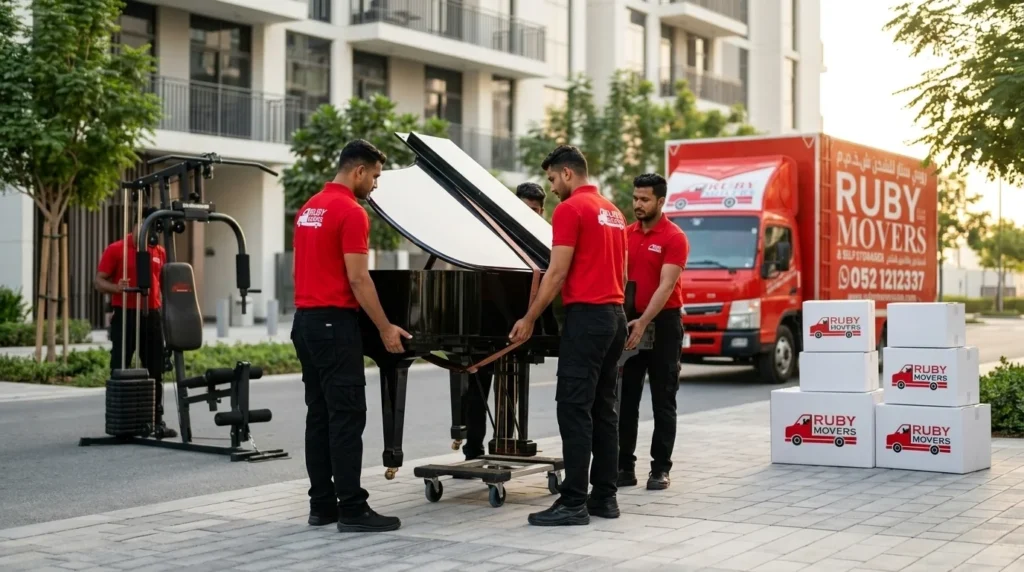
A grand piano can have enough movers around it and still be impossible to carry down a villa staircase. The same problem affects treadmills, multi-station gyms, safes, pool tables and marble tops. Weight matters, but dimensions, turning space, floor loading and dismantling points often decide whether the move is physically possible.
That is why choosing villa movers in Dubai for heavy items requires more than checking manpower. Piano movers in Dubai, gym equipment movers in Dubai, safe moving specialists and pool table movers need the right handling equipment, measured access and a clear plan for stairs, doors, landings and upper floors.
For unusually heavy or awkward loads, specialist villa movers in Dubai should base the moving plan on verified item weight, measured access, dismantled dimensions and the mechanical equipment required at each stage. This becomes particularly important when a piano, safe, marble top or gym machine must pass through narrow gates, internal stairs or an upper-floor route.
This guide explains
- Which heavy villa items need specialist handling?
- How different item classes are dismantled and moved?
- Where staircase limits create a hard stop?
It also covers piano handling, gym equipment dismantling, safe access, external lifting and the measurements that determine whether a heavy item can actually leave one villa and enter another.
Which villa items need specialist heavy handling?
For this guide, 170 kg marks the specialist-handling trigger because a four-person team handling more than 170 kg enters the highest HSE risk band. This is a risk-assessment threshold, not a legal safe-lifting limit.
The Health and Safety Executive Manual Handling Assessment Charts classify team loads above 85 kg for two workers, 130 kg for three workers, and 170 kg for four workers in the purple band. HSE describes that band as a potentially serious injury risk requiring improvement. For teams of five or more, HSE calls for a full risk assessment.
There is no universal safe lifting weight. The Health and Safety Executive manual-handling guidance explains that load shape, grip, posture, frequency and workspace alter risk. Team handling itself triggers more detailed assessment.
That matters because several villa items cross the 170 kg planning point before packing begins:
- A Yamaha U1 upright piano weighs 228 kg.
- A Yamaha C1X grand piano weighs 290 kg.
- A Life Fitness Integrity+ treadmill weighs 197 kg.
- A Liberty Home SE safe weighs 582 lb, about 264 kg.
- A current Life Fitness G7 specification lists 445 kg.
- An Imperial 8-foot slate pool table has an approximate shipping weight of 900 lb, or 408 kg.
A lighter item can still require specialist handling. A broad marble slab, for example, presents edge and flexural risks even below 170 kg.
Where the construction of an item allows it, dismantling heavy furniture can reduce its largest rigid dimensions and make controlled movement through restricted access more practical. Label, protect, and keep removable tops, legs, frames, brackets, and other detachable components with their corresponding hardware for reassembly.
What each heavy item class requires
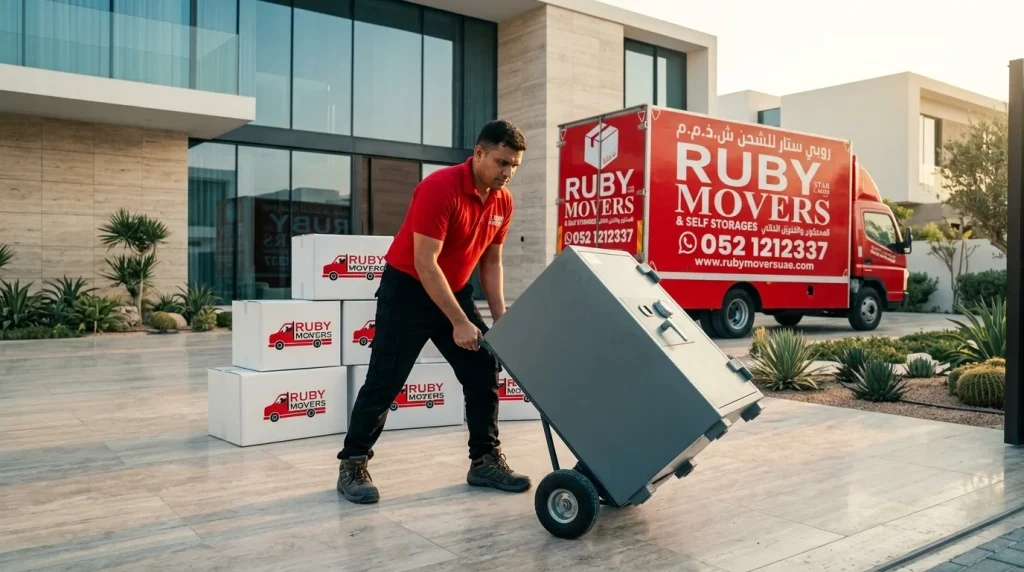
Heavy-item specifications help define the first handling plan. They do not replace an on-site survey because models, modifications and access conditions differ.
The table uses current manufacturer examples and HSE team-handling bands. The crew column therefore shows a planning signal, not a universal crew prescription.
| Item | Typical weight | Crew | Equipment | Dismantling required | Staircase feasible |
| Upright piano | 228 to 246 kg for Yamaha U1 and U3 | 4-person manual load exceeds HSE 170 kg purple threshold; mechanical aid and fuller assessment required | Piano dolly, rated straps, padding, floor protection | Usually limited | Yes, only after a measured route check |
| Grand piano | 290 to 320 kg for Yamaha C1X to C3X | Above the four-person HSE manual threshold, a specialist plan is required. | Grand skid board, dolly, straps, padding | Yes, normally legs and pedal lyre | Conditional |
| Multi-station gym | 327 to 445 kg across current regional Life Fitness G7 specifications | Do not plan as one assembled manual carry | Dollies, hand tools, labelled hardware storage | Yes | Usually feasible only as smaller modules |
| Treadmill | 193 to 197 kg for current Life Fitness Integrity models | Above the four-person HSE 170 kg threshold | Rated trolley, straps, floor protection | Model dependent | Conditional because of length |
| Safe | About 264 kg for Liberty Home SE | Above the four-person HSE 170 kg threshold | Rated safe dolly, suitable stair equipment, floor protection | Contents removed; safe body remains intact | Conditional |
| 8-foot slate pool table | About 408 kg shipping weight for Imperial Oslo | Assess dismantled components, not the assembled table | Slate carriers, dollies, tools, leveling equipment | Yes | Usually feasible after dismantling |
| Marble top | About 98 kg at 20 mm or 147 kg at 30 mm for a 1.8 m by 1.0 m example | Exact crew depends on slab size and grip; large sheets remain awkward | Rigid support, trolley, edge protection | Detach from furniture base | Conditional |
Yamaha gives the U1 and U3 at 228 kg and 246 kg, both 153 cm wide. Its C1X, C2X and C3X grand pianos weigh 290 kg, 305 kg and 320 kg. Their lengths increase from 161 cm to 186 cm.
The gym category changes even more by model and market. The Life Fitness G7 specification lists 445 kg, including two 73 kg weight stacks. A current European shop specification lists another G7 configuration at 327 kg. Exact model identification therefore comes before crew planning.
Marble illustrates another useful calculation. Research by Istanbul University and Dokuz Eylül University reports Marmara Marble has a dry bulk density of 2.715 g/cm³. A 1.8 m by 1.0 m slab therefore weighs about 98 kg at 20 mm thickness and 147 kg at 30 mm.
Weight tells you how much mass the crew controls. Dimensions tell you whether that mass can leave the villa.
How are upright and grand pianos moved differently?
An upright piano normally travels as one protected cabinet, while a grand piano usually requires removal of vulnerable supporting components before controlled movement.
A Yamaha U1 measures 153 cm wide, 121 cm high, and 62 cm deep and weighs 228 kg. The U3 keeps the same width but reaches 131 cm high, 65 cm deep, and weighs 246 kg.
Those dimensions make the upright comparatively compact in depth. The crew can place the cabinet on a rated piano dolly where the route permits.
A grand creates a different geometry. The Yamaha C1X, C2X, and C3X measure 161 cm, 173 cm, and 186 cm long. Each model is 149 cm wide before moving preparation.
That long rigid body becomes the main staircase problem. Adding more movers does not shorten it.
Before booking, declaring value on a piano or specialist item gives the mover a documented reference for the item’s stated value and helps the customer check what level of carrier liability or optional cover applies. The declared figure should reasonably reflect the item’s value, especially for high-value instruments and custom specialist pieces.
Leg and pedal removal on a grand
Grand-piano preparation removes the pedal lyre and required legs before the protected body goes onto a grand skid board.
The sequence begins with the lid, music desk and keyboard area secured. The team supports the body before releasing a leg. Small hardware stays labelled by position.
The pedal lyre deserves separate attention. Piano Technicians Guild discussions describe removing the lyre during grand-piano moving and warn against treating the lyre as a structural pivot. One technical discussion specifically notes that the lyre is not designed for that stress.
The protected piano body then travels on its side using the selected skid and dolly system. The legs, lyre, and removable components travel separately.
This reduction changes the moving envelope. A fully assembled grand might fail a doorway immediately. The dismantled body may pass, but the staircase turn still requires measurement.
Climate and tuning after the move
A piano needs a stable destination environment before tuning because relative humidity changes the wooden soundboard and string tension.
The Piano Technicians Guild humidity guidance explains that higher humidity makes the soundboard swell and raise pitch. Lower humidity makes it shrink and lowers pitch. PTG identifies 42% relative humidity as an ideal target for piano humidity-control systems.
PTG also lists an optimal room condition of about 68°F (roughly 20°C) with 42% relative humidity. Stable conditions matter more than an arbitrary waiting period after transport.
Place the piano in its final indoor position first. Keep it away from direct air-conditioning discharge, frequently opened doors and direct sunlight.
Then let a qualified piano technician judge tuning stability. A fixed claim such as “every piano needs tuning exactly 48 hours after moving” has no universal technical basis.
How is multi-station gym equipment dismantled?
Multi-station gym equipment moves in documented modules because assembled frames can combine several hundred kilograms with cables, pulleys and tall rigid structures.
The Life Fitness G7 Home Gym provides a useful reference. One current specification measures 124 cm by 177 cm by 211 cm and weighs 445 kg. Its two weight stacks total 146 kg.
That 211 cm assembled height already exceeds many domestic door openings. Dismantling solves part of the dimensional problem before any stair movement starts.
Use a controlled sequence:
- Record the exact model and serial number.
- Photograph cable routes, pulley positions and frame connections.
- Remove accessories and unload weight-stack components methodically.
- Label bolts, spacers, cables and brackets by original location.
- Separate frame sections according to the manufacturer’s assembly structure.
- Reassemble using the recorded configuration and product documentation.
The Life Fitness Manuals and Resources Hub provides owner, operation and assembly documentation. Life Fitness also says recent strength-equipment assembly manuals generally contain cable-routing instructions.
Cable routing matters. One misplaced cable can change pulley travel or load behavior after reassembly.
Treadmills present another problem. The Life Fitness Integrity+ Treadmill specification gives 209 cm length, 92 cm width, 142 cm height and 197 kg weight. The machine may clear a wide flight yet fail to rotate on the landing.
That is why gym equipment moving in a Dubai villa starts with component dimensions, not just machine weight.
How are safes and heavy security items handled?
Safe moving requires controlled access, mechanical handling and a separate floor-loading check. The owner or authorized representative keeps the safe key, combination or electronic code. The moving crew never retains security credentials.
The Liberty Home SE specification gives a useful domestic example. The safe weighs 582 lb (about 264 kg) and measures 60.5 by 28 by 20 inches. Liberty specifies a 22-inch minimum doorway for that model.
Liberty also reports that 98 percent of its customers choose professional installation. Its installation process uses specialist equipment and includes leveling and internal bolting.
Remove movable contents before transport. Confirm whether floor bolts or wall anchors exist before the crew applies lifting force.
Before removing anything fixed or anchored to a rented villa, the resident should confirm whether it forms part of the fixtures that belong to the landlord under the tenancy or handover arrangements. Built-in gym structures, anchored safes, fixed cabinets and similar installations should only be removed once ownership and permission are clear.
Floor loading requires more than dividing weight by room area. A 264 kg Home SE has a nominal 28 by 20-inch footprint. Spread evenly over that footprint, its static pressure is roughly 7.2 kPa.
That figure does not prove that an upper floor can support the safe. Casters, feet and anchoring points can create higher local forces.
The Dubai Building Code structural section requires engineers to account for concentrated and uniform loads in structural design. Upper-floor safe placement therefore needs structural confirmation when load capacity remains uncertain.
Which heavy items cannot go up or down a villa staircase
A heavy item cannot use a villa staircase when its protected rigid dimensions cannot clear the narrowest width, headroom, doorway or turning area on the route.
This is a measurement problem with a yes or no result.
The Dubai Building Code, Part K for villas sets a 1,000 mm minimum clear width for villa stairways. It also sets villa corridors at a 1.0 m minimum clear width with 2.3 m clear headroom.
The code also defines a minimum stair tread depth of 280 mm and allows handrail projections up to 100 mm under specified conditions. These are building-design measurements, not proof that an individual heavy item fits.
Use this staircase feasibility guide before committing the crew:
| Route measurement | Pass condition | Common failure |
| Straight stair width | The protected cross-section remains below the measured clear width | Piano or safe leaves insufficient hand clearance |
| Door opening | The item clears the actual door after padding and required handling equipment | The door leaf or frame reduces the usable opening |
| 90-degree landing | Full rigid length can rotate without striking the wall, rail or ceiling | Long treadmill stalls mid-turn |
| 180-degree return | The item can reverse orientation within both flights and landing | The grand piano body cannot rotate |
| Headroom | Tilted item stays below measured ceiling or soffit | Tall gym frame contacts ceiling |
| Upper-floor destination | The floor structure accepts items and handles loads | Safe or gym equipment creates an unresolved concentrated load |
A treadmill demonstrates why this test matters. Its 920 mm width appears compatible with a 1,000 mm code-width villa stair. That leaves only 80 mm before allowing for padding, hands, rails and real construction tolerances.
More importantly, the treadmill is 2,090 mm long. A 1,000 mm stair does not prove that a 2,090 mm rigid machine can rotate through a landing.
The same principle applies to a grand piano. Measure the protected body after planned leg and lyre removal. Compare that envelope with every turn, landing and opening.
If one required rotation fails, the staircase route fails.
When a heavy item needs external lifting access
A heavy item needs external lifting access when dismantling cannot reduce it enough for a controlled internal route.
The alternative can involve lifting through a balcony, terrace, large opening or other suitable external access point. A crane or hoist changes the operation from carrying to engineered lifting.
Measure four variables before planning the lift:
- Confirm the lifted item’s actual mass.
- Measure the protected lifting dimensions.
- Record horizontal reach between crane position and landing point.
- Check the receiving opening and controlled landing area.
Road occupation adds a Dubai-specific constraint. The Roads and Transport Authority Right-of-way permit service covers temporary occupation of footpaths, parking areas and hard shoulders for activities that include loading and unloading. Permit fees vary by permit type and include an AED 20 Knowledge and Innovation fee.
A crane can also require a mobility permit. The Roads and Transport Authority crane mobility permit service lists a one-working-day service time and AED 70 per vehicle per month, including the AED 20 fee component.
These rules apply where the planned operation enters the relevant road or Right-of-Way conditions. A lift entirely within private property can involve different approvals.
The important distinction remains physical. More labor cannot solve a failed staircase envelope. External lifting becomes the route solution when internal geometry does not work.
Where villa access constraints are assessed
Villa access constraints are assessed at the collection villa and destination villa before the mover fixes the crew and equipment plan. The survey follows each heavy item between its exact start and final positions.
Measure the item first. Then record front doors, corridors, staircase flights, landings, ceilings, gates and driveway access. Add protective packing thickness and trolley dimensions.
The survey should also document stairs, doorways and long carry constraints before the crew and equipment plan is finalized. A route may appear open but still become impractical when a long rigid item must rotate on a landing, pass through a reduced door opening or travel a considerable distance between the villa and the loading vehicle.
The survey also records floor surfaces, slopes, steps, carrying distance and final placement. For safes, add floor loading and anchoring. For pianos, add destination climate conditions.
When comparing villa movers in Dubai, ask for 5 documented answers:
- Confirm the verified item or component weight.
- Record the largest rigid dimension after dismantling.
- Measure the narrowest point on the complete route.
- Identify the rated mechanical aid used for movement.
- Define the alternative route if the staircase fails.
Ruby Movers says its villa survey considers item volume, access requirements and special items before the move. Its current pages place pianos, safes, gym equipment, marble tops and pool tables within its published scope.
That survey turns heavy villa items into an execution plan. Specialists handle matches, verified weight, dismantled geometry, staircase clearance, floor conditions and lifting equipment before the first lift starts.
Heavy villa items need a measured moving plan
Moving a piano, treadmill, multi-station gym, safe, pool table or marble top is not a normal furniture task. The decisive question is not whether enough movers can lift the item. The real question is whether the item can be controlled safely through the exact villa route.
Weight confirms the handling risk. Dimensions determine whether doors, corridors and staircases work. Dismantling changes the moving envelope. Floor loading matters for safes and heavy gym equipment. When the internal route fails, external lifting becomes a separate operation that requires its own access and equipment plan.
Do not approve a heavy-item move from photographs and estimated weight alone. Require the mover to confirm the item model, verified weight, dismantled dimensions, narrowest access point, staircase turns and mechanical handling equipment before fixing the move plan.
For heavy villa items, measurement comes before manpower.
If you are comparing villa movers in Dubai, request an on-site heavy-item survey before accepting the final quotation. Ask for the planned route, specialist handling equipment, and alternative access methods in writing. That single step exposes access problems before the crew arrives.
FAQs
No. Additional manpower cannot overcome a doorway, landing or staircase that is physically smaller than the protected item.
Provide the exact model, verified weight, dimensions, floor level, staircase measurements and final placement location.
No. Dismantling reduces the moving envelope, but the remaining rigid components still need to clear every landing, doorway and turn.
Consider external lifting when measured internal access cannot accommodate the dismantled item or when controlled stair movement is not physically feasible.
Bilal Al-Madani
Bilal Al-Madani is a logistics professional specializing in residential relocations and supply chain optimization. With deep experience in the moving industry, he excels in ensuring transit safety, implementing advanced packing methods for high-value items, and managing transport fleets efficiently. He is committed to simplifying the moving process through careful planning, delivering each relocation with precision, reliability, and exceptional attention to detail.