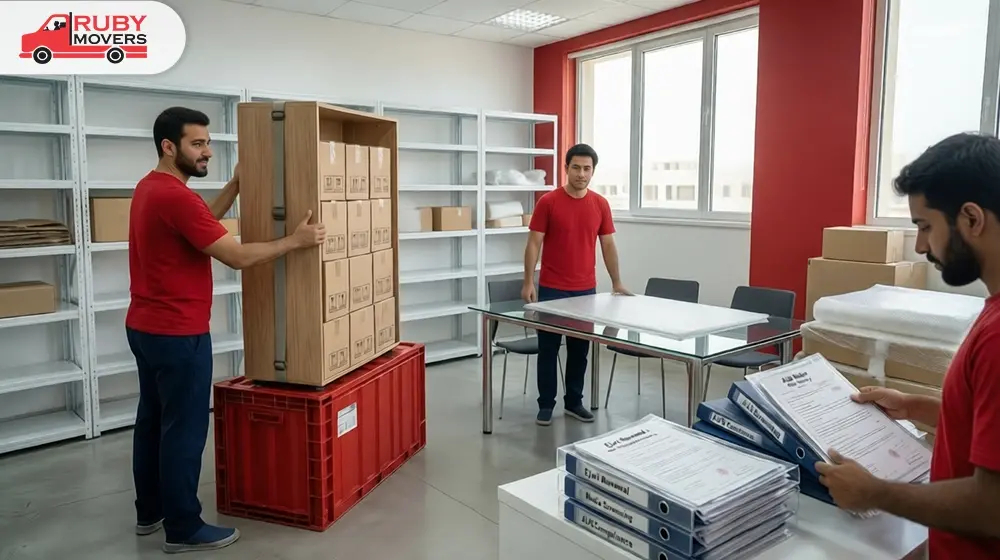
Weekend apartment moves in Al Ain fail for predictable reasons, not bad luck. A weekend move in Al Ain reaches a predictable outcome when access, lift time, parking distance, packing controls, and evidence logs match the building’s real constraints. In Al Jimi, Al Towayya, and Al Muwaiji, the first breakdown usually starts with access proof, lift-time mismatch, or truck parking that forces long carry routes. The result is queue time, rushed packing, surface damage exposure, and cost escalation that appear only after the crew arrives.
What benefits come from reading this guide?
This guide explains why weekend moves go wrong and provides a fix list built on measurable controls. It covers lift trip math, carry-distance bands, packing material standards, heat and timing constraints, quote scope variables, and evidence packs for claims and handover.

Why do weekend moves in Al Ain fail more often than weekday moves?
Weekend moves fail more often because the schedule compresses packing, lift access, loading, driving, unloading, and handover into fewer workable hours, while demand for movers and service lifts rises at the same time. This combination raises queue risk and increases handling errors under time pressure.
In Al Ain, residential demand spans districts such as Al Jimi, Al Towayya, and Al Muwaiji, each with active apartment inventory and managed housing layouts, so weekend moves concentrate into similar building access patterns.
Heat exposure adds a second layer of weekend risk in warmer months because outdoor loading, carrying, and truck work occur in high ambient temperatures, reducing pace stability and increasing fatigue-driven error rates. Al Ain summer conditions regularly exceed 41°C for maximum temperatures across June to September in the UAE climate summaries.
Quantified weekend compression
- Same inventory, fewer usable hours: Packing + loading + driving + unloading occurs inside tighter windows than weekday scheduling.
- Higher contention: Lift demand and parking contention rise when more households move on weekends.
- Higher handling rate: More lifts, turns, and door passes per hour increase impact exposure.
Which failure mode causes the first hard stop at the gate or lobby?
The first hard stop is usually an access mismatch between the move plan and the building’s controls, such as a missing tenancy verification step or an unbooked service elevator slot. In Abu Dhabi emirate processes, tenancy contracts connect to Tawtheeq registration under the Department of Municipalities and Transport ecosystem, so tenancy proof becomes a standard verification anchor in managed housing workflows.
Tenancy administration in Abu Dhabi uses formal registration services, and these records commonly act as an authority anchor for housing workflows. In practice, a resident-facing evidence set speeds up security decisions. Tawtheeq processes appear on TAMM services, and local guidance lists fee items such as AED 50 per year for a new tenancy contract registration and AED 900 for property registration.
Fix list for gate and lobby failures
- Fix 1: Evidence pack at arrival
A single folder or PDF containing tenancy proof, resident ID copy as permitted, inventory summary, lift booking confirmation, and mover company trade license copy reduces gate negotiation time because every stakeholder sees the same evidence set.
- Fix 2: Slot confirmation timestamp
A screenshot or email timestamp for lift access provides an audit trail that prevents “no booking found” disputes during weekend peak arrival windows.
- Fix 3: Single point of contact
A named resident contact and a named site supervisor reduce handoffs and conflicting instructions at the lobby desk. This is a process control commonly used in logistics quality programs.
Why do service lifts create the biggest weekend delay?
Lift delay becomes the dominant bottleneck because every carton and bulky item depends on the same vertical path.
Packaging and transit test frameworks describe distribution hazards as repeated shock, vibration, and handling events. These events increase when elevator cycles repeat under time pressure. ISTA test procedures explicitly include random vibration, drop events, and conditioning profiles, which map to the same hazard classes seen in move-day handling.
Fix list for lift booking and lift-time math
Replace “rooms” with “trips.”
Step 1: Convert inventory into lift trips
Use a simple trip model:
- 1 trip = 8 medium cartons, or 4 medium + 1 wardrobe carton, or 1 bulky item + 2 cartons.
- Add a fragile buffer: +1 trip for every 12 fragile cartons.
Step 2: Convert trips into minutes
- Average cycle time per trip in apartments often falls into 6–10 minutes when doors, turns, and staging exist.
Use a planning band:
- Low friction: 6 minutes per trip
- Typical friction: 8 minutes per trip
- High friction: 10 minutes per trip
Example
- 48 cartons + 6 bulky items
- Trip estimate: 48 cartons ÷ 8 = 6 trips, plus bulky items 6 ÷ 2 = 3 trips
- Total: 9 trips
- Minutes: 9 × 8 = 72 minutes lift time
This model stays simple and converts uncertainty into a measurable booking window.

Why do parking and carry distance break schedules in Al Jimi, Al Towayya, and Al Muwaiji?
Carry distance multiplies handling events, and handling events increase drop and corner-impact probability.
Manual material handling research consistently ties overexertion and repetitive handling to injury exposure and productivity loss. Public health and labor reporting show the scale of workplace incident patterns and time-loss cases in private industry, reinforcing why handling controls matter.
Carry distance bands
- Band A: 0–25 meters
- Band B: 26–60 meters
- Band C: 61–120 meters
Fix list for parking and carry distance
- Fix 1: Route map in photos
Take 3 photos: Parking point, corridor turn, lift lobby.
- Fix 2: Staging zone
Stage cartons at a defined point within 5 meters of the lift lobby.
- Fix 3: Batch policy
Move in batches of 8–12 cartons per trolley cycle to reduce corridor dwell time.
Time impact estimator
Use a walking factor:
- Band A: +0 minutes per trip
- Band B: +2 minutes per trip
- Band C: +4 minutes per trip
Add this to the lift cycle minutes.
Which packing failures create the highest damage rate on weekends?
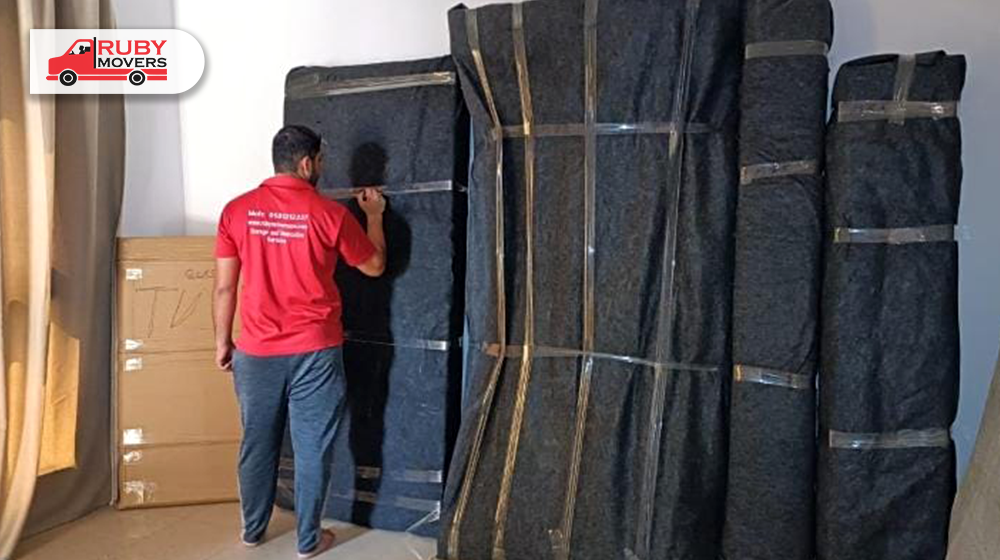
Damage rises when packing fails, including compression, void-fill stability, and edge protection, especially during fast loading.
ISTA procedure descriptions highlight vibration and drop characteristics as core distribution hazards, and packaging strength literature shows measurable performance differences across corrugated designs and reinforcement choices.
Fix list for packing material controls
Carton tiers
- Tier 1: Standard cartons for textiles and low-density items
- Tier 2: Reinforced cartons for books, cookware, dense loads
Seal standard
- Tape passes per carton: 3 (one center seam, two edge seams)
- Fragile cartons: Add 2 vertical straps or extra tape bands
Void-fill rule
- Target void space: 0% for fragile cartons
- Target void space: Under 10% for non-fragile cartons
Labeling rule
- Weight band label: Under 10 kg, 10–20 kg, over 20 kg
- Fragile count label: Number of fragile items in that carton
Why do weekend moves trigger more worker strain and handling incidents?
Manual material handling raises musculoskeletal disorder exposure because repetitive lifting, pushing, and pulling create overexertion and repetitive trauma pathways. The U.S. Bureau of Labor Statistics (BLS) identifies musculoskeletal disorders (MSDs) as a major class of workplace injuries, and BLS MSD reporting frames overexertion and repetitive motion as primary drivers.
In incident breakdown research on manual materials handling, pushing and pulling, and lifting and lowering account for large shares of injury causation in a dataset, with pushing and pulling reported as the highest proportion in one study. This maps directly to moving tasks such as pushing trolleys, pulling loads, and lifting cartons.
Fix list for handling safety and pace control
- Fix 1: Weight labeling by thresholds
Label cartons in three bands, such as “under 10 kg,” “10–20 kg,” and “over 20 kg,” to drive correct team lifts and trolley use. This reduces unknown load events that drive overexertion.
- Fix 2: Tooling standardization
A defined minimum kit, such as dollies, straps, corner guards, and floor runners, reduces improvisation. Quality systems use standardized tooling to reduce variance.
- Fix 3: Heat exposure segmentation
In hot months, segment heavy loading earlier in the day and reserve light unpacking for later periods, because heat reduces work capacity. UAE heat reporting shows sustained extreme conditions in inland areas during peak months.
Why does heat change affect performance in Al Ain?
Heat reduces steady handling pace and increases fatigue-driven handling errors during outdoor loading and long carry routes.
In summer 2025, UAE weather reporting described inland extremes, including 51.8°C in Sweihan, Al Ain, and a reference to the national record 52.1°C set in 2002.
The UAE also runs an official Midday Break policy that restricts outdoor work under direct sunlight between 12:30 pm and 3:00 pm, effective 15 June to 15 September each year, and official announcements confirm the same window for 2025.
Fix list
- Fix 1: Heavy-load window
Put high-mass items into the early hours.
- Fix 2: Midday compliance window
Use indoor tasks during 12:30–3:00 in peak season where relevant.
- Fix 3: Hydration and micro-break schedule
Break pattern: 10 minutes recovery per 50 minutes high-intensity carry cycles during peak heat periods.
What quote gaps trigger cost escalation on weekend moves?
Cost escalation often comes from omitted variables: carry distance band, lift booking minutes, disassembly count, and packing tier.
Market sizing sources show logistics services operate within measurable cost structures. For context, IMARC estimates the UAE logistics market at USD 54.5 billion in 2024 with a forecast to USD 95.2 billion by 2033 and a 5.7% CAGR. This supports the procurement view that service scope drives cost.
Fix list for scope clarity
Require a quote structure that lists variables.
Minimum quote variables
- Cartons: Medium carton count, wardrobe carton count
- Bulky items: Count and categories
- Carry band: A, B, or C
- Lift minutes booked: Numeric minutes
- Disassembly list: Beds, wardrobes, desks, appliances
- Protection scope: Floor runners, corner guards, door jamb padding
- Crew size: Numeric crew count plus supervisor presence
Common escalation triggers and controls
| Escalation trigger | Measurable signal | Control item |
|---|---|---|
| Carry distance underestimated | The band differs at the site | Band A/B/C photos |
| Lift time underestimated | Trips exceed plan | Trip math sheet |
| Packing tier mismatch | Carton type differs | Carton tier list |
| Disassembly omitted | Item list incomplete | Disassembly log |
| Access delay | Gate negotiation time is high | Evidence pack |
Which documentation gaps create the biggest dispute risk after move-in?
Disputes expand when inventory identifiers, condition photos, and handover records do not exist.
Tenancy registration frameworks exist to formalize records and reduce ambiguity in housing administration. Official UAE information services and TAMM guidance illustrate the role of registration records in property workflows.
Fix list for claims, liability, and evidence packs
Inventory signifiers
Use item signifiers with attributes:
- “Sofa, 3-seater, fabric, beige”
- “TV, 55-inch, brand, serial photo”
- “Washing machine, model label photo”
Condition coding
- A: No visible marks
- B: Minor scuff
- C: Visible dent or crack
- D: Functional issue noted
Photo protocol
- High-value items: 4 angles
- Appliances: 1 serial label photo
- Rooms: 1 wide shot before loading
Handover record
- Checklist count: 10 items minimum
- Signature method: Resident + supervisor name and time stamp
What engineering controls reduce damage in corridors, lifts, and doorways?
Damage concentrates at edges, corners, and contact points because these features carry stress under impact and vibration. Edge and corner protectors target those load paths directly, so they function as a simple engineering control against crush and abrasion.
Transit testing frameworks treat packaging and protection as a system that reduces damage under repeated hazards. ISTA’s test procedure concept centers on simulating distribution hazards to predict damage risk, which aligns with corridor and lift protection controls in apartment moves.
Fix list for material and surface controls
- Fix 1: Floor runners plus corner guards
Floor runners protect tile and vinyl from trolley wheels, and corner guards protect wall corners at turns.
- Fix 2: Door jamb protection
Door frames experience repeated contact during sofa and wardrobe moves. Jamb padding reduces paint and plaster damage exposure.
- Fix 3: Strap discipline
Straps reduce load shift during trolley movement and truck loading. Load shift functions as a major damage pathway in distribution hazard models.

How does traffic congestion affect weekend move timing in Al Ain?
Traffic affects move timing when route choice, school zone peaks, and urban congestion create variable travel times that break lift booking windows. Al Ain congestion research uses crowd-sourced traffic data from platforms such as HERE and Google Maps to analyze congestion patterns, confirming that congestion monitoring exists as a formal study area in Al Ain.
School zone congestion management research in Al Ain uses peak spreading as a mitigation method, which indicates that timing changes measurably alter congestion outcomes. This supports move planning that avoids peak windows near school zones and major corridors.
Fix list for route and window control
- Fix 1: Window buffer math
Set a buffer equal to 20–30% of the typical travel time for the route, so a lift slot still aligns during moderate congestion.
- Fix 2: Two-route plan
A primary route plus a secondary route reduces single-point failure during incidents or congestion spikes.
- Fix 3: Staged departure
Depart after lift loading reaches a stable threshold rather than waiting for full completion, so unloading prep begins at the destination while packing finishes at the origin.
How does local housing turnover relate to weekend demand?
Weekend demand rises when rental inventory and population growth support ongoing residential movement.
Abu Dhabi statistics reporting shows the emirate population at about 4.14 million in 2024, up 7.5% from 2023, and up about 51% from 2014. This provides context for sustained housing activity in the emirate that includes Al Ain.
For local intent, active apartment inventory around Al Towayya and nearby sub-communities supports ongoing move activity across districts such as Al Jimi and Al Muwaiji.
What does a weekend move timeline look like when it stays under control?
A controlled timeline uses fixed checkpoints tied to evidence, access, and packing completion rather than relying on “finish by evening” estimates. Checkpoints reduce ambiguity and improve predictability.
The timeline below uses a two-day pre-window because building access and tenancy proof systems reward early confirmation and reduce last-minute refusals. Tawtheeq guidance frames tenancy registration as a formal process under government platforms, which supports early paperwork completion as a practical control.

Timeline control (example)
| Time checkpoint | Output artifact | Failure prevented |
|---|---|---|
| T minus 48 hours | Inventory list plus fragile map | Under-scoped crew and cartons |
| T minus 24 hours | Lift slot confirmation screenshot | Lift refusal and queuing |
| T minus 12 hours | Packing tier confirmation | Crush and breakage variance |
| Move day arrival | Evidence pack at the gate | Access delay at security |
| Loading complete | Condition photos for high-value items | Post-move claims ambiguity |
| Post-unload | Handover checklist signed | Missing item disputes |
Evidence pack logic aligns with transit testing and quality documentation practices used in logistics and packaging control programs.
Which risk segmentation model fits apartment movers in Al Ain on weekends?
Risk segmentation classifies items by damage sensitivity, handling complexity, and evidence value. This converts “fragile” into categories that drive packing materials and handling steps.
Manual handling research supports segmentation because lifting, pushing, and pulling tasks contribute to incident pathways, so load category influences handling method and labor requirements.
Risk segmentation list
- High-surface items: Glossy cabinets, lacquer tables, glass partitions
- High-fragility items: TVs, mirrors, framed art, glassware
- High-mass items: Fridges, safes, treadmills, large sofas
- High-evidence items: Appliances with serial numbers, electronics, leased property fittings
- High-assembly items: Beds, wardrobes, modular desks
Each category becomes a packing and handling rule set rather than a single label.
What gets misunderstood about weekend apartment moves in Al Ain?
Myth: “A weekend move finishes faster because everyone is available.”
Reality: Weekend demand increases competition for lifts and crews, so access variance rises and packing variance rises.
Myth: “Fragile equals bubble wrap.”
Reality: Packaging strength and cushioning properties vary by design, so carton structure and void fill consistency determine outcomes as much as wrap type.
Myth: “A lower quote indicates efficiency.”
Reality: Lower quotes often omit measurable variables such as carry distance and protection scope, which reappear as change items on the day.
Conclusion: The Practical Fixes That Prevent Weekend Move Rework in Al Ain
Weekend moves in Al Jimi, Al Towayya, and Al Muwaiji fail when the move plan stays descriptive instead of measurable. The fix list in this guide converts the biggest breakdown points into controls that can be checked and repeated. Access proof and lift booking prevent the first hard stop. Trip math converts cartons and bulky items into minutes, so lift time matches reality. Carry-distance bands turn parking variance into a pricing and staffing variable. Packing tier rules reduce crush, impact, and vibration exposure that transit frameworks already classify as predictable hazards. Heat windows and timing limits protect pace and reduce handling errors, especially in peak season when official working constraints apply. The result is a weekend move that holds schedule, reduces surface damage exposure, and produces a clean evidence trail for handover and claims.