
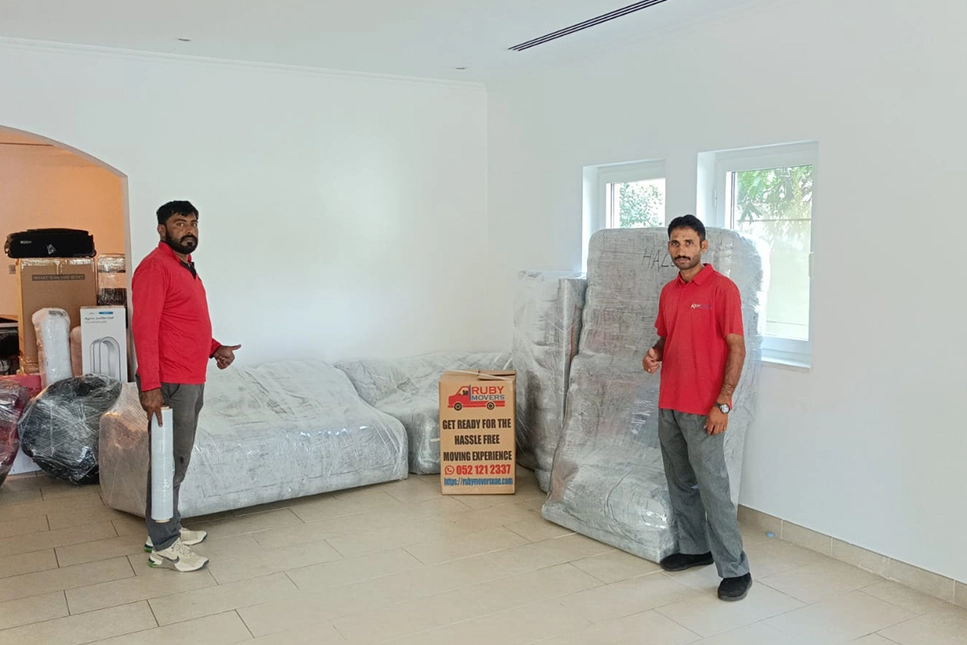
Apartment moving in Dubai looks simple until the hidden moving layers start showing up. The truck is only one part of the job. Your real move also depends on BHK size, building permit rules, lift access, security gate checks, Ejari timing, and DEWA setup. That is why many tenants compare apartment movers in Dubai by price first, then face delays, extra charges, or blocked entry on move day.
Apartment moving in Dubai depends on 4 variables:
- BHK size
- Building access
- Permit timing
- Utility admin
Your mover quote is only one part of the real budget. Your real moving cost also includes Ejari, DEWA timing, building approval, and security-gate compliance.
This guide explains how apartment moving services in Dubai actually work from a practical, cost-first angle. You will see what apartment moving can cost by BHK, which admin fees sit outside the mover quote, how permit and access systems affect the move, and what security gate controls can stop a crew from entering. If you are comparing apartment movers, planning a 1 BHK, 2 BHK, or 3 BHK move, or trying to avoid last-minute access problems, this blueprint gives you the facts, the process, and the checkpoints that matter most.
What does apartment moving in Dubai actually include?
Apartment moving in Dubai is the relocation of household items from one apartment to another, with packing, loading, transport, unloading, and often dismantling and reassembly layered around building access rules. Many Dubai pricing guides tie the final quote to home size, distance, packing scope, volume, manpower, and access difficulty, such as high-rise towers or gated communities.
For tenants, apartment moving services in Dubai also connect to a second workflow. Dubai Land Department handles lease registration and cancellation through Ejari and Dubai REST, while DEWA links move-in activation to Ejari issuance and links residential move-out prompts to Ejari cancellation in applicable cases. In practice, apartment moving starts as a logistics job and ends as an access-controlled admin job.
What makes apartment moving in Dubai more than a truck booking?
Apartment moving in Dubai is a controlled-access project. You do not only move furniture. You also move through a regulated chain of lease registration, utility activation, building approval, access control, and gate verification. Dubai Land Department uses Ejari for tenancy registration and renewal. DEWA ties residential utility activation to Ejari. Managed communities, then add move-in permits, move-out permits, access cards, and third-party entry controls.
The official legal base sits under Ejari. Dubai Land Department’s tenancy guide states that Ejari records tenancy contracts in the Emirate of Dubai and that tenancy contract registration through Ejari is mandatory, under the Dubai tenancy framework built around Law No. 26 of 2007 and Law No. 33 of 2008. That makes Ejari a move document, not only a leasing document.
The practical meaning is simple. Apartment movers can load your items. Apartment moving services cannot override a community portal, a tower service-lift booking, or a security desk that asks for a permit letter and crew IDs. If your paperwork is late, your move is late.
How much does apartment moving in Dubai cost by BHK?
There is no single official tariff for apartment movers in Dubai. What you can verify are published market guides and posted package prices. Those sources agree on the pattern: price rises with BHK size, cubic volume, truck count, worker count, packing depth, dismantling, floor level, lift restrictions, and community access rules.
A studio or 1 BHK often sits inside a one-truck move. A 2 BHK usually pushes you into two trucks or more labor time. A 3 BHK apartment pushes labor, truck count, and time hard enough that access control becomes a price variable, not a side issue.
Here is the clearest BHK-by-BHK cost picture from the published guides:
| Apartment size | Market range | Package example |
| Studio | AED 750 to AED 1,200 | AED 749 |
| 1 BHK | AED 1,000 to AED 1,600 | AED 1,049 |
| 2 BHK | AED 1,800 to AED 2,800 | AED 1,699 |
| 3 BHK apartment | AED 3,000 to AED 4,500 | AED 2,599 |
The price spread exists for a reason. Dubai moving guides repeatedly tie quote growth to volume, distance, manpower, number of vehicles, packing scope, dismantling, floor level, lift access, and gated-community controls. In other words, BHK count starts the quote, but access complexity finishes the quote.
For apartment moving, the most expensive surprises usually come from four conditions. Packing adds labor. Restricted loading access adds waiting time. High-rise or security-gate rules compress move windows. Large furniture adds dismantling and reassembly work.
What usually raises the quote?
Five factors raise apartment moving costs faster than tenants expect:
- Add packing, because material use and handling time rise.
- Add dismantling, because carpentry time increases.
- Add waiting time if the building delays truck entry or lift access.
- Add truck count when a 1 BHK exceeds one standard truck or a 2 BHK requires two standard trucks.
- Add gate controls if a third-party crew needs a daily permit, stamped IDs, or a company trade license.
Some Dubai relocation guides also warn that the total cost of changing homes often reaches three times the moving quote once you add deposits, activation fees, painting, and related charges. That multiplier is not a government rule, but it is a useful warning against comparing apartment moving services on truck price alone.
Which costs sit outside the mover quote?
Your mover quote is not your full moving budget. The fixed-fee layer comes from tenancy registration, DEWA services, access-card rules, and community access controls. Those fees are easier to verify than mover prices because they sit on official portals.
What does the admin layer cost?
| Admin item | Fee | What it means for your move |
| Ejari registration via app or website | AED 177.75 total | This is your main tenancy registration cost online |
| Ejari registration via the trustee center | AED 220 total | Higher channel cost for in-person processing |
| Ejari cancellation via app or system | Free | Useful at move-out if the property is vacated |
| Ejari cancellation via the trustee center | AED 40 + VAT | In-person cancellation cost |
| DEWA apartment security deposit | AED 2,000 | Refundable flat deposit for move-in |
| DEWA activation fee, small meter | AED 155 total | AED 125 activation plus AED 10 registration, AED 10 knowledge fee, AED 10 innovation fee |
| DEWA move-out fee, small meter | AED 145 total | AED 125 deactivation plus AED 10 knowledge fee and AED 10 innovation fee |
| Emaar access card issuance | AED 200 per card | Community-specific card cost |
| Nakheel move-in permit | No fee | Community move permit |
| Nakheel daily permit | Free | Third-party access permit remains free |
This table shows why apartment moving services look cheaper than the full move. Your truck quote can sit below AED 1,500 for a 1 BHK, but your fixed admin layer can still add AED 2,332.75 or more before you count deposits that later return, card replacements, painting, or chiller-related costs.
The practical budget lesson is simple. If you compare apartment movers only on transport price, you undercount the real move budget. A more accurate apartment moving budget includes a mover quote, DEWA move-in deposit, DEWA activation fee, DEWA move-out fee, and any community-specific access or paperwork conditions.
Which permit sequence keeps your apartment move on schedule?
The safest move sequence is Ejari first, DEWA second, building permit third, third-party access pass fourth, and truck slot last. That order follows how Dubai’s official and community systems already work.
What is the tenancy layer?
The tenancy layer is your Ejari registration, renewal, or cancellation. Dubai Land Department states that registering or renewing a tenancy contract online costs AED 177.75 and runs instantly on the mobile app channel after the review flow, while trustee-center processing takes 7 minutes, excluding waiting time. Dubai Land Department also states that canceling an expired and vacated tenancy contract is free online and instant through the app or system.
You need this layer early because DEWA and many communities use Ejari as the identity document for occupancy. If Ejari is missing, your next step stalls.
What is the utility layer?
The utility layer is your DEWA move-in, move-out, or move-to request. DEWA states that tenants need Ejari for move-in, that a valid Ejari can remove the need to submit extra documents online, and that DEWA can create your account automatically after Ejari issuance through integrated channels. DEWA also states that the apartment security deposit is AED 2,000, move-in activation for a small meter is AED 155, and power and water connections are available within 15 working hours after payment.
For move-out, DEWA states that you must clear previous bills before the request, that deactivation for small meters costs AED 145, and that deactivation and final bill processing happen within 24 working hours from the selected date and time.
If you are moving from one Dubai apartment to another, DEWA’s Move-To service can simplify the process. DEWA states that the service combines move-in and move-out in one interaction, that your security deposit transfers if it is sufficient, and that you only pay the difference if the new premises require a higher deposit. DEWA also states that outstanding dues must be settled first and that Ejari for the new premises is mandatory.
What is the building permit layer?
The building permit layer is your move-in permit, move-out permit, or equivalent building approval. Emaar Community Management states that a move-in permit is required and that access is denied without it. Emaar asks tenants to apply at least one business day before the scheduled move and upload Ejari, Emirates ID, and a passport copy with a visa page.
Nakheel recommends that you submit a move-in permit request 3 to 4 working days before move-in because approvals typically take 1 to 2 days. Nakheel also states that move-in permits are free of charge.
What is the security gate layer?
The security gate layer is your physical proof at entry. Nakheel states that, at the physical security point, you must show the move-in permit confirmation letter, and that the third-party moving company must show Emirates ID copies with the Nakheel security stamp for employees entering the community. Nakheel also states that a third-party mover must submit a daily pass request 1 to 2 working days before the required date, that daily permits are free, that one application can cover up to 5 applicants, and that the permit can run for 1, 2, or 3 days.
Gate rules also affect timing. Nakheel’s cited move-in timings are Monday to Saturday, 9 am to 5 pm, and Sunday, 10 am to 1 pm. If your apartment movers in Dubai arrive outside the approved window, a low quote stops helping.
How do access and security gate controls work in Dubai towers?
Security gate control starts at the document check, not at the truck bay.
Official community guidance is clear on this point. Emaar Community Management states that access is denied without a move-in permit. Nakheel states that, at the physical security point, the resident shows the move-in permit confirmation letter, and the third-party moving company shows employee Emirates ID copies with the security stamp for personnel entering the community.
Access control continues after entry. Emaar Community Management states that access cards are issued to the occupant residing in the property, that lending access cards to outsiders is not allowed, and that access cards are deactivated after a move-out permit is issued, after the move-out date. That single rule matters because a late truck and an already-deactivated card can break the final lift and lobby sequence.
Timing control also sits inside the access system. Nakheel recommends submitting move-in and move-out permit requests 3 to 4 working days before the moving date because approvals typically take 1 to 2 days. Nakheel also publishes move-in timings of Monday to Saturday, 9 am to 5 pm, and Sunday, 10 am to 1 pm.
Some communities move faster. Residents can get a move-in permit in one business day after the online submission flow on that community page. That difference matters when you compare apartment moving services. The same moving crew can work well in one building and fail in another building if the permit lead time is wrong.
What is the BHK-by-BHK move blueprint?
The best apartment moving blueprint is not one generic checklist. The best apartment moving blueprint changes with BHK size because volume, labor, access, exposure, and packing time change with BHK size. Current Dubai price guides tie those exact variables to the final cost.
How do you plan a studio or 1 BHK move?
Plan a studio or 1 BHK around time control. A one-truck move looks simple, but it loses margin fast if the building rejects the crew or delays the lift. Keep your inventory lean. Confirm your Ejari and DEWA dates first. Confirm your move-in permit next. Then confirm whether your apartment moving services provider needs a gate pass. The current posted packages show a studio at AED 749 for 7 hours with 3 workers, and a 1 BHK at AED 1,049 for 8 hours with 4 workers, which means lost hours matter.
How do you plan a 2 BHK move?
Plan a 2 BHK around truck logic and furniture handling. Current posted packages show 2 trucks and 6 workers for a 2 BHK at AED 1,699 and 9 hours, while market guides place standard 2-bedroom pricing around AED 1,800 to AED 2,800 and volume at 30 to 40 CBM. That usually means you need stronger labeling, clearer dismantling lists, and a tighter loading window.
How do you plan a 3 BHK apartment move?
Plan a 3 BHK apartment around access risk. A current posted package shows 3 trucks, 8 workers, and 10 hours at AED 2,599, while a published 2026 guide places standard 3-bedroom moves at AED 3,000 to AED 4,500 and premium moves above AED 5,500. At this size, pre-move survey quality, permit timing, furniture volume, and truck staging shape your final price more than the first quote does.
The repeating logic is simple. Confirm the tenancy record. Confirm the utility timeline. Confirm the building permit. Confirm the third-party pass. Confirm the gate document set. That sequence protects both cost and access.
How do you choose apartment movers in Dubai without getting the wrong quote?
Choose apartment movers in Dubai on document readiness, access readiness, and scope clarity, not on headline price alone.
Start with the building-facing documents. In communities that require third-party access approval, the moving company may need a trade license, named personnel records, or gate-pass data. Nakheel’s official guidance explicitly asks third-party companies for trade licenses and identity documents in daily permit workflows. If a moving company cannot provide the building-facing document pack early, the moving company is not ready for a controlled-access apartment move.
Then check the scope. Ask for a written scope that separates packing, transport, dismantling, reassembly, and access waiting time. Many Dubai guides show that the final price changes with each of those variables. A quote without scope detail is not a low price. A quote without scope detail is an incomplete price.
Then check schedule alignment. Your building does not care that your mover is available at 8 am if the permit window starts at 9 am. Your building does not care that your mover is cheap if the truck crew reaches the security gate without the correct daily pass. For apartment moving services in Dubai, schedule alignment is part of service quality.
Which document pack keeps you dispute-ready?
Keep one evidence pack for the full apartment moving cycle. The pack is simple, but it saves time when a gate denies entry, a landlord disputes handover timing, or a building asks for proof.
- Keep Ejari and your tenancy contract details together. Dubai REST lets tenants manage registration, renewal, cancellation, and rental dispute follow-up in one platform.
- Keep DEWA records, including activation receipt, final bill, and clearance certificate timing. DEWA sends these through its move-in and move-out flows.
- Keep building approvals, including move-in permit letters, move-out permit letters, and access-card records. Emaar and Nakheel both require formal move permits in the cited workflows.
- Keep third-party entry proof, including daily permit confirmation, company trade license, and crew ID copies, where the community asks for them.
- Keep a handover record with meter photos, room photos, and inventory notes. This step is operational advice, but it aligns with the official requirement to clear utility and access records on time.
What mistakes raise cost and cause access failure?
There are 5 recurring mistakes in apartment moving.
- Booking movers before the permit approval: Access control can stop the crew at the gate.
- Ignoring DEWA timing: Utility activation and deactivation have official processing windows and fee stacks that affect key handover timing.
- Treating BHK as the only pricing factor: Access, packing, and volume change the price.
- Sending a third-party crew without the gate document set: Some communities require daily pass data, ID records, or a company trade license.
- Leaving move-out admin until the last day: Access cards can deactivate after move-out permit issuance, and DEWA final-bill closure follows the official move-out process.
Decision point: Apartment moving in Dubai works when cost, permits, and access move together
Apartment moving in Dubai stops being difficult when you treat it as a sequence instead of a single booking. The move starts with your BHK size, but the final outcome depends on permit timing, utility timing, building access, and security gate clearance. That is the point many tenants miss. The truck arrives last. The paperwork decides whether the truck can work at all.
The most useful takeaway is simple. Do not compare apartment movers in Dubai on transport price alone. Compare apartment moving services on four checks: BHK-based scope, admin cost exposure, permit readiness, and gate access readiness. A quote can look affordable and still become expensive when waiting time, rejected entry, extra labor, or repeated trips start adding up. Your moving cost changes fast when a 1 BHK turns into a delayed tower move, or when a 2 BHK needs more trucks, more labor, or a tighter lift slot.
If you want a cleaner move, keep the order clear. Register for Ejari early. Align DEWA with the move date. Apply for the building permit before you lock the truck. Confirm whether the mover needs a daily pass, stamped IDs, or trade license details. Then move inside the approved access window. That sequence protects your budget, your timing, and your handover record. In Dubai, the best apartment moving plan is not the cheapest quote. The best apartment moving plan is the one that reaches the building, clears the gate, and finishes on schedule.
Frequently Asked Questions (FAQs)
A cheap quote becomes expensive when waiting time, lift restrictions, packing, dismantling, or gate delays add labor hours and extra trips.
Both matter, but building access often decides the final cost because access restrictions change time, labor, and truck use.
Ejari is the first key document because DEWA and many managed communities use it as the base occupancy record.
Not always, because some communities also ask the moving crew for daily-pass approval, ID records, or trade license details.
Studio and 1 BHK moves still face delays because a small load does not remove lift booking, permit timing, or gate-check requirements.
The DEWA move-in deposit is the highest overlooked cost because an apartment activation usually starts with a refundable AED 2,000 deposit.
A 2 BHK starts feeling larger when furniture volume, truck count, dismantling work, and loading-window pressure all increase at the same time.
Late paperwork breaks a move faster because a truck can wait, but a building or security gate can still deny entry.
A move-out date matters because some communities deactivate access cards after move-out permit issuance and the approved exit date.
The safest way is to compare the written scope, permit readiness, gate document readiness, truck plan, labor plan, and timing alignment together.
Bilal Al-Madani
Bilal Al-Madani is a logistics professional specializing in residential relocations and supply chain optimization. With deep experience in the moving industry, he excels in ensuring transit safety, implementing advanced packing methods for high-value items, and managing transport fleets efficiently. He is committed to simplifying the moving process through careful planning, delivering each relocation with precision, reliability, and exceptional attention to detail.