
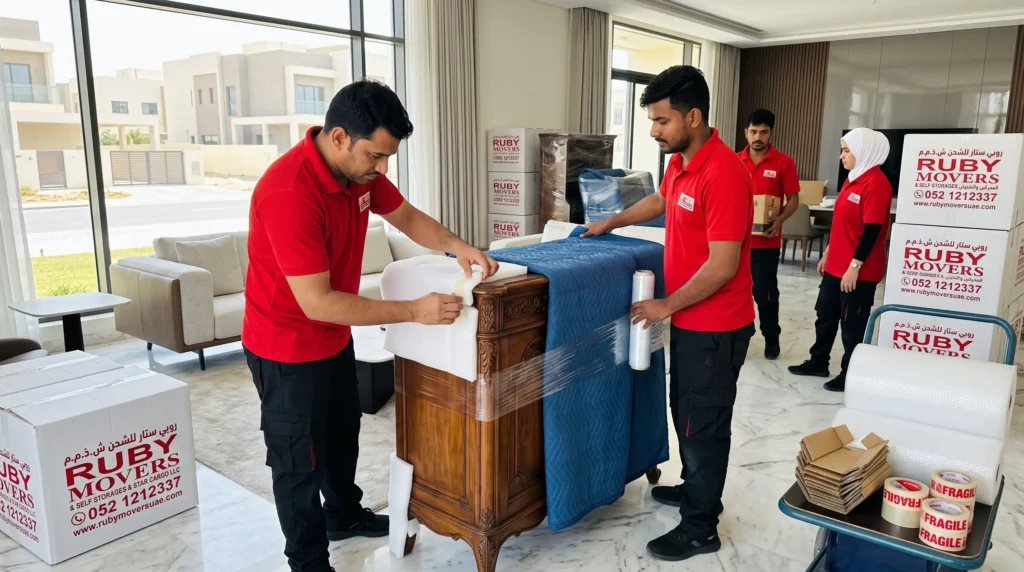
A scratched marble floor, cracked mirror, or damaged doorway can turn a villa relocation into a costly dispute. Most damage does not come from one major mistake. It develops through rushed access, weak packing, poor lifting decisions, loose truck loading, or incomplete condition records.
Damage prevention during villa relocation addresses those risks before the first item leaves the property. Dubai community permits can also affect the schedule, route setup, vehicle access, and time available for safe handling.
This guide explains how movers protect floors, walls, doorways, fragile items, and heavy furniture. It also examines truck padding, inventory checks, insurance evidence, and practical standards for comparing damage free villa movers in Dubai.
How can you assess damage prevention during villa relocation?
Damage prevention works as a documented risk-control process across the complete villa move. The mover identifies hazards, assigns controls, records item condition, and checks the same evidence after delivery.
Dubai access timing forms part of that process. The Nakheel resident security guide asks Palm Jumeirah residents to apply 24 hours before moving. Owners can register up to five vehicles and submit the moving company’s trade license and Emirates ID. Emaar Community Management states that Emirates Living residents can receive a move-in permit in one business day.
Late approval can reduce time for safe packing, route protection, and condition checks. A credible villa relocation plan treats permits as a safety dependency.
The table defines the main damage risks and measurable controls.
| Move stage | Main risk | Control | Reference point |
| Access planning | Rushed handling | Confirm permits, vehicles, crew, and time | Palm Jumeirah asks for 24 hours’ notice and permits up to 5 vehicles |
| Fragile packing | Shock and abrasion | Cushioning, rigid containers, and void filling | CCI recommends at least 50 mm cushioning |
| Heavy handling | Drops and strain | Reduce weight, use equipment, and assess lifts | NIOSH prefers a Lifting Index at or below 1.0 |
| Truck loading | Sliding and tipping | Padding, blocking, straps, and load zoning | Benchmark: 0.8 g forward and 0.5 g rearward or lateral |
| Delivery check | Missing items or disputed condition | Numbered inventory and photographs | Every carton and uncartoned item receives an identifier |
| Insurance claim | Weak evidence | Policy review, written notice, and images | Sanadak uses 15 calendar days in stated cases |
The figures help you compare villa movers and packers in Dubai through evidence rather than broad claims.
How are floors, walls, and doorways protected?
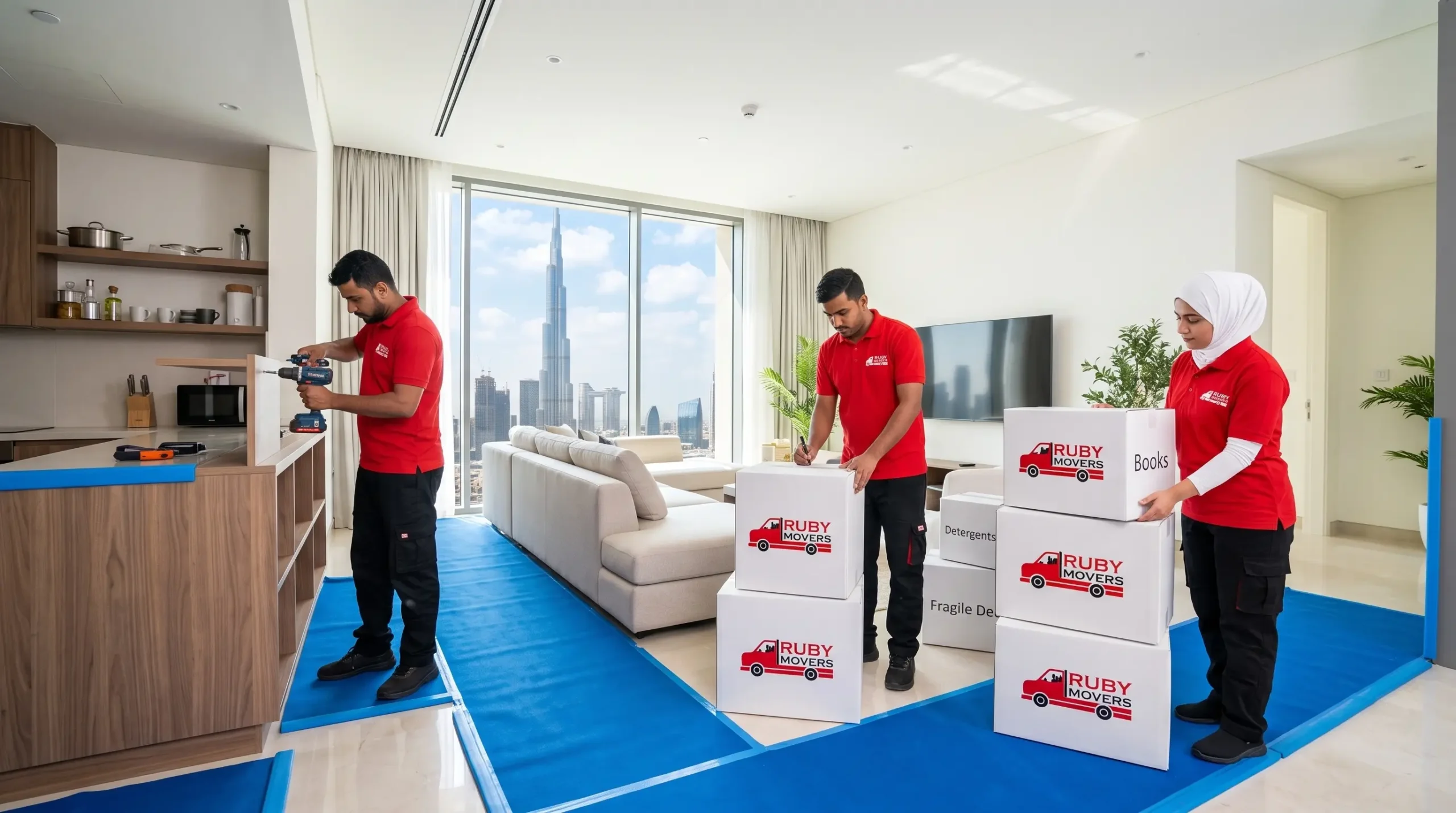
Floors, walls, and doorways are protected by measuring one carrying route and covering every likely contact point. The crew completes this work before moving furniture.
Non-slip runners or rigid sheets protect marble, tile, parquet, and timber. Fitted stair covers reduce slipping. Corner guards protect wall turns, while padded jamb covers protect door frames.
The route also requires clearance data. A sofa may clear the front door but fail at a stair turn. Measure, dismantle, wrap, protect the corner, and move each section separately.
The Nakheel Community Rules allow remediation costs and deposit deductions for contractor damage to common areas. The rules also let management remove or block contractors connected with a breach.
A Palm Jumeirah villa may include polished stone floors, a narrow entrance, and landscaped access. Rigid floor sheets, wheel checks, corner guards, and a spotter reduce contact across that route.
How are fragile items protected before loading?
Fragile items are protected through surface wrapping, fitted cushioning, rigid packaging, void control, and correct orientation. Each layer controls a different physical force.
The Canadian Conservation Institute shipment guidance recommends at least 50 mm of cushioning. It raises the range to 75 mm or 100 mm for fragile items in higher-hazard shipping networks.
Cushioning depth changes shock exposure. A Canadian Conservation Institute physical-force table records about 92 g for a 60 cm drop under one package condition. Adding 50 mm cushioning reduced the value to about 37 g, a reduction of nearly 60%.
That figure is not universal. Item weight, foam density, package fit, drop direction, and fragility change the result. Correct cushioning extends impact time and lowers peak force.
Use packing material according to the item:
- Separate glassware with cells so glasses cannot strike each other.
- Cover framed art with a non-abrasive layer and rigid face protection.
- Support stone tops vertically in padded frames.
- Remove chandelier parts and place labeled components in fitted boxes or crates.
- Bag fittings and connect each bag to the item’s inventory number.
Fragile packing fails when the object moves inside the carton. Void filling and fitted supports keep the item stable.
How are heavy items moved safely?
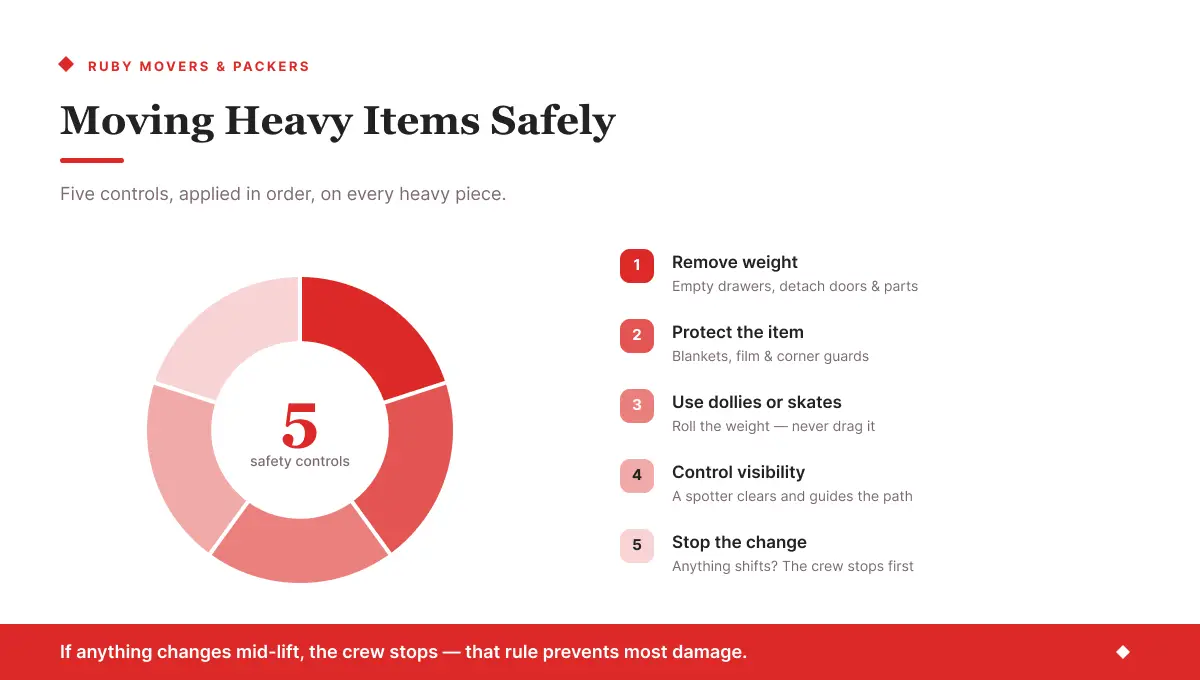
Heavy items are moved safely by reducing weight, checking the route, using mechanical aids, and assigning one person to direct movement. Trained handling protects the item and crew.
The Health and Safety Executive recorded 59,219 employer-reported non-fatal injuries in Great Britain during 2024/25. Handling, lifting, or carrying caused 17%, while same-level slips and trips caused 30%.
The Revised NIOSH Lifting Equation assesses seven inputs, including weight, hand position, travel distance, twisting angle, frequency, duration, and grip. NIOSH recommends a Lifting Index or Composite Lifting Index of 1.0 or lower.
OSHA heavy-lifting guidance advises mechanical aids or more than one person for loads above 50 pounds (about 22.7 kilograms).
Use this handling sequence:
- Remove weight. Take out drawers, shelves, glass tops, doors, and detachable bases.
- Protect the item. Place padding under straps and contact points.
- Choose equipment. Use dollies, skates, ramps, stair climbers, or lift gates.
- Control visibility. Keep the route and hand positions visible.
- Stop the change. Reassess when grip, balance, clearance, or floor level changes.
For a stone dining table in Emirates Living, the crew can separate the slab and base. A padded frame and trolley reduce tipping and edge impact.
How does truck padding reduce transit damage?
Truck padding reduces transit damage by separating surfaces and absorbing minor contact. Blocking, straps, and tight load placement control movement that blankets cannot stop.
The Canadian Conservation Institute transport bulletin identifies road transport as a major vibration source. Vibration changes with speed, vehicle condition, suspension, and cargo position.
Moving blankets protect finishes. Foam pads protect edges. Mattress covers isolate fabrics. Dunnage fills gaps. Load bars and straps divide the truck into stable zones.
United States cargo rules provide a useful engineering reference. 49 CFR 393.102 specifies 0.8 g forward deceleration and 0.5 g rearward or lateral acceleration for securement-system strength. These figures are not Dubai household-moving laws, but they explain why furniture requires restraint.
A padded cabinet can still tip when a gap remains beside it. Truck padding protects finishes; blocking and restraint prevent movement.
How does inventory support damage checks?
An inventory supports damage checks by linking each item to its identity, original condition, package, room, and delivery result. The record separates pre-existing wear from move-related damage.
The Federal Motor Carrier Safety Administration (FMCSA) inventory rule requires a written, itemized inventory for covered household-goods shipments. Every carton and uncartoned item receives a matching identification number before or during loading.
Use this villa move damage-prevention checklist:
- Photograph furniture, artwork, electronics, appliances, and existing property marks.
- Record serial numbers for televisions, computers, appliances, and audio equipment.
- Number each carton and match it to a room-based inventory.
- Mark fragile, upright, heavy, owner-carry, and open-first items.
- Link dismantled fittings to the correct inventory number.
- Photograph each secured truck zone before closing the doors.
- Compare delivered items against the inventory before final sign-off.
- Record wet cartons, broken seals, missing items, or new damage immediately.
The FMCSA moving checklist tells customers to note damaged or missing items before signing documents. Its loss-and-damage guidance recommends photographs before loading and after unloading.
A useful entry reads: “Oak dining table, item 047, existing 3 cm scratch on left leg.” “Dining table, one item” lacks enough condition detail.
How does insurance support damage prevention?
Insurance supports damage prevention through declared values, evidence requirements, exclusions, and financial accountability. Insurance does not stop impact, abrasion, drops, or load movement.
Ask whether cover applies during packing, carrying, loading, transit, unloading, and unpacking. Check the deductible, total limit, per-item limit, owner-packed exclusions, valuable-item declarations, depreciation method, and claim notice period.
The Central Bank of the UAE Rulebook requires insurance companies to process claims under the contract and applicable law. A full or partial rejection requires written reasons.
Article 148 states that certain committee decisions involving AED 100,000 or less are final against the bank or insurance company. Larger disputes can face different appeal rules.
Sanadak’s complaint process asks consumers to complain to the insurer first. Eligibility can arise after 15 calendar days when no written response arrives or the response remains unsatisfactory.
Keep the policy, quotation, photographs, signed inventory, repair estimate, invoice, delivery note, and correspondence together. These records connect damage prevention during villa relocation with insurance and claims.
What turns damage prevention into proof?
A protected villa move does not depend on wrapping alone. It depends on decisions made before loading starts: approved access, a measured route, suitable packing, controlled lifting, stable truck zones, and clear condition records. Each control closes a different path to damage.
The strongest moving plan also leaves evidence behind. Photographs, numbered inventory entries, signed delivery notes, policy terms, and written exceptions show what happened at each stage. That record matters when a scratch, missing carton, broken fitting, or insurance dispute appears after delivery.
For clients comparing damage free villa movers in Dubai, promises carry less weight than process. Check how the mover protects the property, handles fragile and heavy items, secures the truck, and records condition. Damage prevention becomes credible when every step can be explained and verified.
FAQs
Can villa movers guarantee a damage-free move?
No mover can remove every hazard. “Damage-free villa movers Dubai” is a commercial term, not a measurable guarantee. Compare written controls, equipment, inventory, and insurance evidence.
What packing material protects villa furniture?
Moving blankets protect finishes, foam protects edges, rigid sheets protect faces, fitted cartons limit movement, and crates support fragile or high-value items.
When does a Palm Jumeirah move permit require action?
The Nakheel security guide asks residents to apply 24 hours before the move and provide the listed documents.
When do you record damage?
Record visible damage during delivery and before signing the inventory. Photograph the item, packaging, room, and inventory number in the same sequence. The FMCSA checklist supports this delivery-check practice.
Does moving insurance prevent physical damage?
No. Moving insurance limits financial loss when covered damage occurs. Packing material, floor protection, wall protection, truck padding, and trained handling reduce physical risk.
Bilal Al-Madani
Bilal Al-Madani is a logistics professional specializing in residential relocations and supply chain optimization. With deep experience in the moving industry, he excels in ensuring transit safety, implementing advanced packing methods for high-value items, and managing transport fleets efficiently. He is committed to simplifying the moving process through careful planning, delivering each relocation with precision, reliability, and exceptional attention to detail.


