
Moving high-value furniture in Abu Dhabi is not just about transport. It is about what is acceptable when the piece is taken apart and put back together. Italian lacquered cabinetry, UAE-made modular systems, and antiques fail in different ways, yet most disputes happen because expectations were never measured or documented. Scratches, misaligned doors, missing hardware, or fit drift after reassembly often surface at handover, when it is already too late.
This guide explains specialized furniture handling acceptance criteria used by professional furniture movers in Abu Dhabi. It shows how to define pass-and-fail conditions before disassembly begins, how to control risk during reassembly, and how to build evidence that protects both clients and movers.
Benefits of reading this guide
- A measurable acceptance-criteria checklist for Italian, UAE-made, and antique pieces that procurement teams can attach to a scope of work.
- A claims-ready evidence pack structure that reduces ambiguity during handover and post-move dispute resolution.
What does “acceptance criteria” mean in specialized furniture handling in Abu Dhabi?
Acceptance criteria mean measurable pass and fail conditions for disassembly and reassembly outputs, written before execution and verified at handover.

Acceptance criteria include:
- The item condition baseline
- The disassembly method constraints
- The hardware traceability rules
- The reassembly tolerances and function checks
- The documentation required for sign-off
Why do Italian, UAE-made, and antique pieces require different disassembly and reassembly acceptance criteria?
Italian, UAE-made, and antique pieces differ by finish chemistry, joinery, and hardware systems. Those attributes change failure modes, inspection points, and evidence requirements.
Category differences that change acceptance criteria
- Italian pieces: Lacquer systems, thin veneers, tight reveals, concealed hinges, precision drawer runners.
- UAE-made pieces: Engineered core panels, cam locks, confirmat screws, modular fit.
- Antique pieces: Aged timber, brittle finishes, historic glues, non-standard or original hardware.
Wood dimensions and fit change with humidity and temperature. Abu Dhabi’s climate includes high humidity variability. Statistics Centre Abu Dhabi reports average minimum and maximum relative humidity values for the emirate, including values around 33.1 % minimum and 78.1 % maximum in its climate datasets.
What are the main failure modes during disassembly and reassembly in Abu Dhabi?
The main failure modes are hardware mismatch, finish damage, joint deformation, fastener strip-out, and alignment drift.
A damage profile appears consistently across relocation contexts: consumer insurance and survey data identify moving-related damage and replacement costs as material household losses, highlighting why measurable controls matter even outside museum-grade handling.
In specialized furniture handling, failure modes cluster into five categories:
- Hardware integrity loss
- Surface and edge finish damage
- Structural deformation at joints and panels
- Reassembly tolerance failure
- Evidence gaps that block claims or remediation
What facts and figures justify strict acceptance criteria in disassembly and reassembly?
Specialized handling reduces measurable loss drivers: damage claims, disputes, and rework.
Damage and dispute signals
- A U.S. Department of Defense Inspector General audit found 21 % of domestic household goods shipments had at least one damage claim filed in fiscal 2018.
- A GAO report on the household goods moving industry highlights FMCSA’s use of complaint data, including complaint categories such as loss or damage across multiple years.
- FMCSA consumer-facing materials report thousands of complaints and include figures such as more than 5,900 moving fraud complaints in 2018.

These datasets justify the business case for measurable acceptance criteria in any market where high-value items and tight timelines create disputes.
What is the acceptance-criteria stack used by furniture movers in Abu Dhabi?
The acceptance-criteria stack is a linear control sequence from survey to handover.
Acceptance-criteria stack
- Survey classification and item register
- Condition report baseline
- Disassembly method statement
- Component labeling and hardware traceability
- Packing specification and surface protection
- Transport orientation and restraint checks
- Reassembly sequence and torque discipline
- Tolerance measurement and function testing
- Evidence pack and sign-off
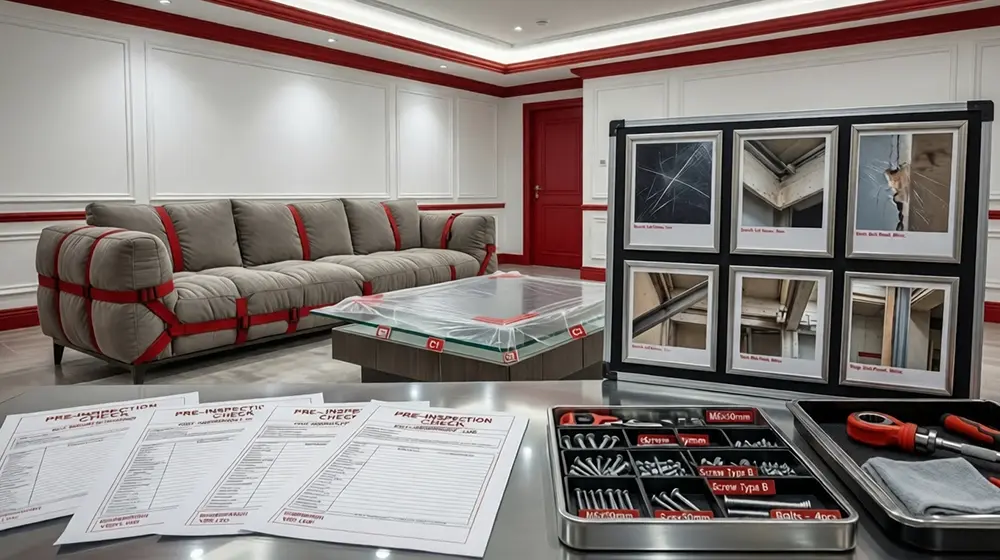
Condition reporting provides a documented baseline. A condition report includes a written description and photographic documentation.
What acceptance criteria define “pass” for disassembly and reassembly outcomes?
A pass outcome includes completeness, fit, function, finish condition, and evidence completeness.
Pass criteria
- Completeness: Every component listed in the inventory exists at delivery and handover.
- Fit: Gaps and flushness fall within a defined tolerance band.
- Function: Doors, drawers, and moving parts operate without binding, rubbing, or drifting.
- Condition: No new damage relative to the pre-move condition record.
- Evidence: Photos, labels, and sign-offs match each item and component set.
Architectural woodwork standards publish measurable tolerances for gaps and flushness at field joints. For example, AWI installation aesthetic criteria describe maximum gaps at joints by grade, including values such as 0.4 mm for Premium wood to wood at flat surfaces and higher limits for other material interfaces.
Those tolerances provide a defensible measurement model for rebuilt cabinetry-style furniture and fitted units.
What tolerances fit “acceptance criteria” for joints, gaps, and flushness after reassembly?
The Architectural Woodwork Institute (AWI) publishes aesthetic installation requirements that include measurable limits for field joints.
AWI states:
- Wood-to-wood gaps at flat and shaped surfaces: Premium 0.4 mm, Custom 0.8 mm, Economy 1.2 mm.
- Wood-to-wood flushness variations at flat surfaces: Premium 0.4 mm, Custom 0.8 mm, Economy 1.2 mm.
- Gap length rule: gaps do not exceed 30 % of a joint’s length in that requirement section.
These standards apply to architectural woodwork. Procurement teams often adapt the measurement logic to fit wardrobes, wall units, and cabinetry-style furniture, because those items share similar reveal and joint aesthetics.
Tolerance-based acceptance criteria for reassembly inspection
| Inspection item | Acceptance criterion | Measurement tool | Evidence item |
|---|---|---|---|
| Gaps at wood-to-wood joints | Target band aligned to AWI grade, Premium 0.4 mm, Custom 0.8 mm, Economy 1.2 mm | Feeler gauge | Close-up photo with gauge |
| Flushness at wood-to-wood joints | Target band aligned to AWI grade, Premium 0.4 mm, Custom 0.8 mm, Economy 1.2 mm | Straightedge + gauge | Photo at the joint edge |
| Gap length distribution | Gap segments within AWI 30 % rule | Tape + photo markup | Annotated joint photo |
| Door alignment | Consistent reveal and level lines across the door set | Level + gauge | Photo of full elevation |
| Drawer glide function | Smooth travel, no rub marks, no stop failure | Manual test | Video clip or photo series |
What acceptance criteria control humidity-driven fit drift in Abu Dhabi?
Humidity drives wood moisture equilibrium and dimensional change. USDA Forest Products Laboratory explains that wood moisture content relates to the surrounding air relative humidity and temperature when wood remains protected from liquid water.

Practical acceptance criteria for climate exposure
- Exposure window log: Record disassembly time, loading time, storage time, and reassembly time.
- Packaging barrier rule: Document barrier layers for lacquer, veneer, and antique surfaces with photos.
- Reassembly inspection timing: Perform tolerance checks after the piece stabilizes to indoor conditions, then record the results.
USDA moisture guidance supports the idea that moisture equilibrium affects dimensional behavior.
What are the best acceptance criteria for labeling, hardware segregation, and traceability?
The best criteria create a one-to-one mapping between each furniture unit and its parts. Traceability prevents the most common specialized handling failure: mixed hardware sets.
Traceability acceptance criteria
- Unique ID per unit: One code per cabinet, wardrobe, bed frame, credenza, or antique chest.
- Sub-ID per component: Door, drawer, shelf set, hinge set, runner set.
- Hardware packaging: One sealed bag per sub-ID, with duplicate labeling: bag label plus inventory line item.
- Photo link: One photo showing the labeled bag next to the component.
Museum and conservation handling guidance emphasizes preventive conservation, careful handling, and environmental control during transport and storage of objects. Those principles translate directly to antique pieces where original integrity defines value.
What acceptance criteria apply to fasteners, screw holding, and engineered-core panels?
The criteria focus on strip resistance and holding integrity after reassembly. Particleboard standards include performance testing concepts for face and edge screw holding capacity using defined test methods, which highlights why repeated removal and reinsertion can degrade holding.
Fastener integrity acceptance criteria
- No stripped holes: Zero stripped holes observed during reassembly.
- No mixed fastener substitution: Fastener types match the manufacturer’s system for that unit.
- No drywall screw substitution in cabinetry-style installs: Installation standards explicitly restrict certain fastener types in woodwork installation contexts.
What acceptance criteria protect Italian finishes and veneer edges?
Italian pieces often include lacquered finishes and thin veneer edges that show damage quickly.
Finish protection acceptance criteria
- Edge protection coverage: 100 % coverage on exposed edges before lift.
- No tape contact with original finish: Tape contacts protective layers only.
- Layer sequence documented: One photo per vulnerable edge showing the protection stack.
Preventive conservation references treat handling and environment as primary damage drivers. These principles transfer to high-value furniture surfaces.
What acceptance criteria define antique handling in Abu Dhabi?
Antique handling focuses on condition integrity, reversibility, and documentation depth.
Antique acceptance criteria
- No forced separation: Joints separate under controlled method, not prying force.
- Original hardware completeness: Keys, escutcheons, screws, pulls, and brackets accounted by sub-ID.
- Condition report depth: Written description plus photos for existing defects, repairs, and surface wear.
- Change tracking: Post-move condition report matches the baseline structure for comparison.
Museum and conservation sources define condition reporting and emphasize its role in documenting changes.
What documentation makes acceptance criteria enforceable and claims-ready?
Enforceable acceptance criteria use evidence packs, not verbal descriptions. Evidence makes acceptance criteria enforceable. Evidence reduces ambiguity during damage disputes.
Evidence pack components
- Pre-move condition set: Minimum 8 photos per large unit, covering corners, edges, hardware, and any existing defects.
- Component inventory: Line-item list with unit IDs and sub-IDs.
- Hardware mapping: Photo of each bagged set and its matching component.
- Reassembly inspection sheet: Gap, flushness, and function checks recorded.
- Sign-off workflow: Survey sign-off, delivery sign-off, final handover sign-off.
A condition report is commonly defined as a detailed record of an object’s condition, including a written description and photographic documentation of damage or changes.
What procurement-ready acceptance criteria clauses fit a scope of work in Abu Dhabi?
A procurement-ready scope defines outcomes, measurement methods, and evidence requirements.
Clause set for specialized furniture handling
- Tolerance reference: Declare the tolerance method and grade. AWI provides numeric bands for gaps and flushness.
- Traceability rule: One sealed bag per sub-ID, photo linked to item ID.
- Condition reporting rule: Pre- and post-condition reports with written notes and photos.
- Functional testing rule: Doors, drawers, and locks tested and recorded.
- Nonconformance handling: Define remediation options and evidence thresholds for disputes.
What moisture and indoor condition targets apply to interior wood furniture?
Targets are expressed as recommended moisture content ranges associated with typical indoor humidity levels.
A published indoor-humidity reference citing U.S. Forest Products Laboratory recommendations reports interior wood used for furniture and woodwork at an average of about 8 % moisture content under typical indoor conditions.
Wood-moisture relationships guidance explains moisture content response to ambient conditions, supporting the idea that moisture targets remain context-dependent and linked to relative humidity.
Acceptance criterion framing: The criterion is not “a universal moisture number.” The criterion is documented indoor condition range plus measured fit outcomes, such as reveal stability and joint alignment.
How does Ejari renewal timing fit into a specialized furniture handling plan for Abu Dhabi?
Ejari renewal timing matters when the move intersects a Dubai tenancy renewal window, while the destination is Abu Dhabi, or when storage bridges two dates.
Dubai tenancy law includes a 90-day notice requirement for amending lease terms unless parties agree otherwise. The law text states notification no less than ninety days before lease expiry for amendments.
Dubai Land Department provides a register or renew the Ejari service pathway for tenancy contract registration and renewal processes.
Ejari timing acceptance criteria for the moving timeline
- Date alignment record: A documented pair of dates linking move-out, move-in, and tenancy renewal dates.
- Storage bridge decision: A documented decision on storage duration when renewal dates and handover dates do not align.
- Evidence continuity: Inventory and condition records cover storage entry and storage exit.
Abu Dhabi uses Tawtheeq registration through the Dari, and Dari’s help center states no fixed timeframe for the renewal period.
This split matters operationally. Dubai renewal compliance and Abu Dhabi registration workflows create different administrative timelines.
What is the recommended timeline model for disassembly and reassembly in Abu Dhabi?
A timeline model uses three decision points:
- Survey
- Disassembly window
- Handover window
Timeline acceptance criteria
- Survey window: Item classification, condition reporting, and hardware mapping.
- Disassembly window: Traceability, packing, load sequencing.
- Handover window: Measurement checks, functional checks, evidence sign-off.
This structure limits uncontrolled rework cycles, especially on engineered-core systems and antiques.
What is the step-by-step acceptance criteria workflow for furniture movers in Abu Dhabi?
A workflow provides consistent declarations and clean semantic separation.
1) Survey and classification
- Create an item register with Italian, UAE-made, antique tags.
- Capture dimensions, material, hardware type, and finish type.
2) Condition report baseline
- Record written notes and photos for corners, edges, surfaces, and moving parts.
- Record existing defects with close-ups.
3) Disassembly method controls
- Document the disassembly sequence per unit.
- Record special tools for concealed hardware and fragile joints.
4) Packing and surface protection
- Apply edge and corner protection.
- Document barrier stack with photos.
5) Hardware traceability
- Bag hardware by sub-ID.
- Photograph each bag with its components.
6) Reassembly and inspection
- Follow the recorded sequence.
- Measure gaps and flushness using AWI-style tolerances and record results.
7) Handover evidence pack and sign-off
- Assemble the evidence pack.
- Complete sign-off with item IDs and inspection results.

Final Thoughts: Make Handover Claims-Ready, Not Argument-Ready
In Abu Dhabi, the move itself is rarely the hard part. The hard part is the moment the last panel goes back on, the doors are rehung, and everyone stands there deciding whether the job is “done.” That decision should not rely on opinion, pressure, or rushed handover. It should rely on pre-agreed acceptance criteria, measured checks, and a clean evidence trail.
The Italian finishes by punishing small handling mistakes. UAE-made modular systems punish weak hardware discipline. Antiques punish force and shortcuts. When you define the baseline condition, control disassembly limits, enforce traceability, and verify reassembly tolerances, you do something simple but powerful: you remove ambiguity.
Use this guide as a procurement tool, not a reading exercise. Attach the checklist to the scope of work. Demand the evidence pack at handover. Then your move ends the right way: with a clear sign-off, fewer disputes, and furniture that looksand functionslike it never left the room.