
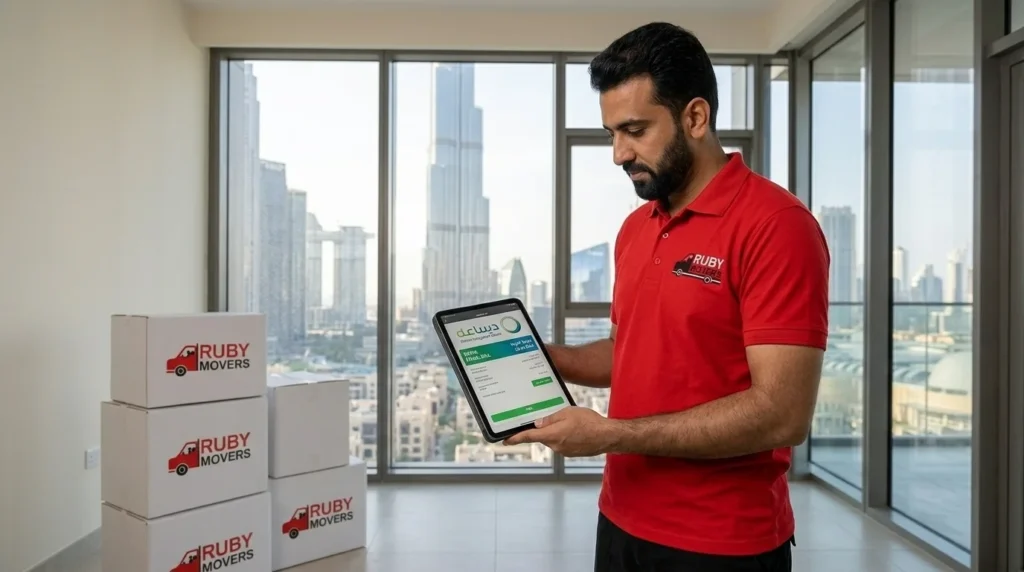
A service lift is booked per slot, and the slot length limits how many trips a moving crew can complete. During high-rise apartment moving in Dubai, even a confirmed moving date can run into problems when the loading bay is unavailable, lift access is restricted, or furniture must travel through long corridors.
Dubai towers have specific moving rules. For example, Emaar Community Management requires at least 48 hours’ advance permission for bulk removals in its covered communities. Missing an access requirement can delay unloading and disrupt your moving schedule.
This guide covers:
- Service lift booking in Dubai
- Loading bay arrangements
- Carry distance
- Protective padding
- Permitted moving hours
- Shared-lift restrictions
It also explains how lift slots affect crew allocation and furniture trips, helping you assess moving quotations and plan access before moving day.
How does a service lift booking work for a Dubai tower move?
A service lift slot reserves elevator access for an approved move, while the booking window limits the crew’s available trips. Confirm the permit, allocated hours, cabin capacity and designated loading route with tower management before scheduling vehicle arrival and unloading.
A service lift is a designated elevator used to transport furniture and bulky belongings between floors. Emaar Community Management’s Al Murad Towers regulations require furniture movements through designated service elevators.
The booking connects three arrangements: permission to enter, permission to unload and access to the elevator. Confirm each arrangement rather than assuming the moving permit covers everything.
Before choosing apartment movers that book the service lift, ask whether the company secures the reservation or helps coordinate a booking that you must submit.
1. Booking request
A booking request asks building management to allocate elevator access on a specified moving date. You need the confirmed arrangement before your contractor arrives.
Start with the building’s permit procedure. Nakheel’s official moving guidance directs residents to its online services or mobile application for move-in and move-out permits.
Nakheel also requires third-party moving companies to request daily access passes 1 to 2 working days before entry. The published approval period is 1 working day.
For service lift booking Dubai arrangements, confirm six details:
- Submit your apartment number, moving date and permit confirmation.
- Identify the designated service elevator and its rated capacity.
- Confirm the available lift hours and booking conditions.
- Check loading bay access, vehicle clearance and unloading restrictions.
- Provide moving contractor details and required identification.
- Request written confirmation of protective materials and access arrangements.
Missing information can delay entry. Emaar’s community regulations allow management to deny bulk removal access when residents fail to obtain the required advance permission.
2. Slot length and cancellation
A service lift slot defines the time available for transporting furniture. Its duration determines how many complete elevator cycles fit into the reservation.
Ask management whether protection installation and final cleanup count toward the allocated period.
A four-hour booking equals 240 minutes. Allowing 30 minutes for preparation and clearance leaves 210 minutes for furniture movement.
These 30 minutes are an illustrative planning allowance, not a published Dubai tower requirement.
Cancellation arrangements also differ. Nakheel’s rescheduling guidance requires residents to request a revised moving date by email, subject to community management approval and availability.
Confirm the replacement lift slot before changing the truck booking. Skipping this confirmation creates a risk that the revised moving date has no available elevator reservation.
Why is the loading bay the bottleneck in a tower move?
The loading bay becomes a bottleneck when the crew cannot transfer furniture between the truck and elevator quickly enough.
A loading bay is a designated unloading area connecting delivery vehicles to the building’s internal transport route.
Emaar’s vertical-community regulations require bulk furniture deliveries to use designated loading bays where available. The rules prohibit leaving vehicles unattended or obstructing access with belongings.
The same regulations limit temporary commercial-vehicle parking within the community to four hours. That parking limit does not guarantee a four-hour lift booking.
Why does truck arrival time matter?
The Dubai Roads and Transport Authority (RTA) September 2026 announcement confirms updated truck restrictions effective October 1, 2026.
Affected urban roads include 3 daily restricted periods:
- Morning: 6:30 a.m. to 8:30 a.m.
- Afternoon: 1:00 p.m. to 3:00 p.m.
- Evening: 5:30 p.m. to 8:00 p.m.
Other specified roads have longer restrictions, including a 16-hour period between 6:00 a.m. and 10:00 p.m.
These restrictions apply to specified truck categories and roads, not automatically to every moving vehicle.
The RTA’s November 2025 traffic assessment recorded 37 traffic incidents in 2025, compared with 75 in 2024, following restrictions on monitored routes. The authority also reported vehicle-speed improvements of 26 km/h on Emirates Road.
Check the transport route before confirming the loading bay arrival time.
How many trips can one service lift complete in four hours?
Consider a planning example with one lift, two loaded trolleys per trip and a five-person moving crew.
Assume each complete cycle takes 12 minutes. This includes loading, upward travel, unloading and returning the elevator.
A comparison of how many movers each apartment size needs should account for furniture volume, carrying distance and the number of lift trips. The five-person crew used in this example is an illustrative arrangement, not a standard staffing requirement for every apartment.
| Operational measure | Calculation | Result |
| Total booking | 4 × 60 minutes | 240 minutes |
| Preparation and clearance | Assumed allowance | 30 minutes |
| Available moving time | 240 − 30 | 210 minutes |
| Trips per hour | 60 ÷ 12 | 5 trips |
| Complete lift trips | 210 ÷ 12 | 17 trips |
| Trolley loads | 17 × 2 | 34 loads |
This model provides 34 trolley loads across 17 complete lift cycles. The 12-minute cycle is an illustrative assumption. Actual trip duration and trolley capacity require verification through a building-specific operational assessment.
A possible crew split assigns two workers to loading, one to lift coordination and two to apartment unloading.
That arrangement keeps the truck and apartment teams active. However, additional workers cannot increase the elevator’s mechanical trip rate.
For a 15-minute cycle, the same 210-minute operating period accommodates 14 trips. This reduces the theoretical trolley total to 28 loads.
How do movers protect lifts, corridors and lobby floors?
Movers protect shared areas using approved lift padding, floor coverings and temporary corner protection. Each method addresses a different surface along the furniture route.
Emaar Community Management’s official regulations require residents to safeguard common areas during moving activities. Residents also remain responsible for damage caused by furniture transportation.
Inspect the moving route before unloading. Identify vulnerable finishes and existing damage while access areas remain clear.
1. Lift wall padding
Lift wall padding consists of temporary protective coverings fitted inside an elevator. You need management-approved padding when transporting furniture through protected lift interiors.
Ask management which materials and attachment methods it permits. Install coverings before the first furniture load enters the cabin.
Measure the lift doorway, interior width and usable depth. A wardrobe might fit inside the cabin but fail to pass through its narrower entrance.
Do not cover controls, ventilation openings or emergency equipment.
Without suitable protection, furniture contact can damage lift finishes. Emaar’s community rules place responsibility for transportation-related building damage on residents.
2. Floor protection runners
Floor protection runners are temporary coverings placed along approved transportation routes. They protect vulnerable floors during repeated trolley movements.
Use coverings compatible with the surface finish. Secure their edges without blocking doors or pedestrian access.
The UK Health and Safety Executive (HSE) identifies floor condition, obstacles and narrow passages as relevant risks during trolley movement.
Inspect lift thresholds and lobby entrances before placing runners. These areas can require careful trolley positioning.
Remove protective materials after unloading and check the floor condition.
Skipping protection increases the risk of surface damage. Loose coverings can also obstruct trolley wheels.
3. Corner guards
Corner guards protect exposed wall edges during furniture transportation. You need them where cabinets, tables or appliances turn through restricted passages.
Identify tight corners before moving day. Fit approved guards to vulnerable surfaces without reducing essential access clearance.
The HSE’s materials-handling guidance recommends direct routes and unobstructed movement areas.
If furniture cannot negotiate a corner safely, assess dismantling or another approved handling method.
Without suitable corner protection, hard furniture edges can damage painted walls and decorative finishes.
How does carry distance from the lift to the door change the crew plan?
Longer carry distance increases the ground that workers and trolleys cover for every load. It can reduce the furniture volume handled inside a fixed lift slot.
Carry distance describes the transport route between handling points. For tower moving, measure the truck-to-lift route separately from the lift-to-apartment route.
The HSE’s carrying-task guidance identifies carry distance and route obstacles as manual-handling factors. It recommends reducing distances and using appropriate handling aids.
Consider two illustrative apartments:
- Apartment A is 20 meters from the service elevator.
- Apartment B is 80 meters from the service elevator.
Apartment B adds 60 meters each way. A complete return journey adds 120 meters.
Across 17 return journeys, one worker following that route travels an additional 2,040 meters, or 2.04 kilometers.
These figures demonstrate the distance difference. They do not represent measured productivity or a standard moving crew’s walking speed.
Long corridors can also slow trolley returns. A crew receiving furniture far from the lift may leave the cabin waiting for available handlers.
One possible adjustment is to assign workers separately to lift unloading and apartment placement.
The HSE’s team-handling guidance recommends reducing carrying distances, keeping routes direct and providing suitable mechanical aids.
Before requesting a quotation, record:
- The distance between the loading bay and service lift.
- The corridor distance between the lift and apartment entrance.
- Door widths, turning points and floor-level changes.
- Restrictions affecting trolleys, ramps or temporary holding areas.
For longer routes, request a crew plan based on actual inventory and access measurements.
Additional crew numbers are not fixed by distance alone. Furniture dimensions, trolley capacity and corridor restrictions also influence the plan.
What time windows do towers allow and what happens when the window ends?
Dubai towers follow building-specific moving hours. Your reserved lift period must fit within the community’s permitted schedule.
The Emaar Al Murad Towers regulations permit bulk deliveries and removals from 10:00 a.m. to 6:00 p.m., Monday through Saturday. Public holidays are excluded.
Nakheel’s official community guidance publishes different hours: 9:00 a.m. to 5:00 p.m., Monday through Saturday, and 10:00 a.m. to 1:00 p.m. on Sunday.
These schedules demonstrate that tower moving rules Dubai residents encounter are not uniform.
1. Morning and afternoon windows
Morning and afternoon windows are management-approved periods for moving activity. You need a confirmed booking before scheduling the contractor’s arrival.
Check whether the allocated period includes unloading, protection installation and final clearance.
A tower operating until 6:00 p.m. does not automatically accept a new lift booking at 5:00 p.m.
For a practical comparison, assume a move requires 18 complete lift cycles, each lasting 12 minutes. Add 30 minutes for preparation and clearance.
The total estimated requirement becomes 246 minutes.
2. Booking duration versus calculated overrun
The table compares how different service lift booking windows affect available moving time and potential overruns. Calculations assume 18 lift trips at 12 minutes each, with 30 minutes allocated for preparation and clearance.
| Booked window | Usable minutes | Complete trips possible | Calculated overrun |
| 2 hours | 90 | 7 | 126 minutes |
| 3 hours | 150 | 12 | 66 minutes |
| 4 hours | 210 | 17 | 6 minutes |
The table uses one consistent workload and illustrative trip duration.
A four-hour booking falls 6 minutes short of the modeled requirement. Actual trip times, lift availability and approved extensions require confirmation with building operations.
3. Overrun charge
An overrun charge is an additional amount applied when moving activity exceeds an agreed period.
Ask building management whether late completion permits an extension, requires a replacement booking or results in a separate fee.
No verified uniform service lift overrun tariff applies across every Dubai residential tower.
Published permit charges also differ from contractor charges. Nakheel’s official guidance confirms that its move-in and move-out permit applications are free.
That AED 0 permit charge does not establish elevator overtime costs.
Request building fees and moving contractor overtime terms separately. Confirm the amount in AED before work begins.
Skipping this check leaves the cost of additional time unresolved.
How do movers handle a shared lift or no service lift?
Movers handle shared-lift and no-service-lift buildings by obtaining permission for an alternative route and adjusting the handling plan.
A shared passenger lift is not automatically available for furniture transportation. Emaar’s official vertical-community regulations prohibit furniture transport through passenger elevators without prior written consent.
When moving within the same building, you might not need a moving truck, but the transfer may still require a permit, an approved lift reservation and protection for shared corridors.
1. Passenger lift rules
Passenger lift rules determine whether furniture can travel through elevators primarily intended for residents.
Emaar’s vertical-community regulations prohibit furniture transport in passenger elevators without prior written consent from the community manager.
Request permission before including passenger lift use in the crew plan.
Provide the item dimensions, expected number of movements and proposed protection measures.
Shared passenger traffic reduces predictable elevator availability. A 12-minute dedicated-lift cycle cannot automatically apply to a lift serving other residents.
Without written approval, building management may reject furniture transportation through the passenger elevator.
2. Stair carry and extra crew
Stair carrying means transporting furniture manually between floors through an approved staircase. You need this arrangement when furniture cannot use an available lift.
Inspect the number of floors, landing dimensions and furniture turning requirements before accepting the job.
The HSE’s carrying-task guidance recommends avoiding steps and steep slopes where suitable mechanical alternatives exist.
Its manual-handling risk assessment framework also evaluates lifting, carrying and team handling as separate activities.
Extra crew allocation therefore depends on the furniture inventory and approved route, not simply the number of floors.
Keep evacuation routes clear. Emaar’s common-area regulations prohibit storing belongings and trolleys in evacuation stairwells.
Where stair transportation is unsafe or prohibited, arrange another approved furniture handling method.
How long does building approval take before the lift can be booked?
Approval timing depends on the community. Emaar Community Management publishes one-business-day move-in permit processing, while its tower regulations require 48 hours’ advance permission for bulk removals.
Nakheel recommends applications 3 to 4 working days ahead, with approvals generally taking 1 to 2 days. An approved permit clears the administrative requirement; confirm the separate lift slot before unloading begins.
When reviewing the move-in permit and NOC by developer, check the application channel, supporting documents and applicable notice period for your particular community.
Confirm tower access before moving day
A confirmed moving date means little if your truck cannot access the loading bay or your crew misses the service lift slot. For high-rise apartment moving in Dubai, secure building approval and confirm both access arrangements before finalizing your moving schedule.
Give your moving contractor the exact lift dimensions, carry distances, permitted moving hours and furniture inventory. These details help determine crew size, trolley movements and the time required for unloading.
Request a written moving plan covering lift protection, loading arrangements and potential overtime charges. Do not accept a quotation that overlooks restricted access or long carrying routes.
Before confirming your booking, make sure the moving permit, service lift reservation and loading bay access match your scheduled arrival. This prevents avoidable delays and gives your crew a clear plan for moving day.
FAQs
Bilal Al-Madani
Bilal Al-Madani is a logistics professional specializing in residential relocations and supply chain optimization. With deep experience in the moving industry, he excels in ensuring transit safety, implementing advanced packing methods for high-value items, and managing transport fleets efficiently. He is committed to simplifying the moving process through careful planning, delivering each relocation with precision, reliability, and exceptional attention to detail.