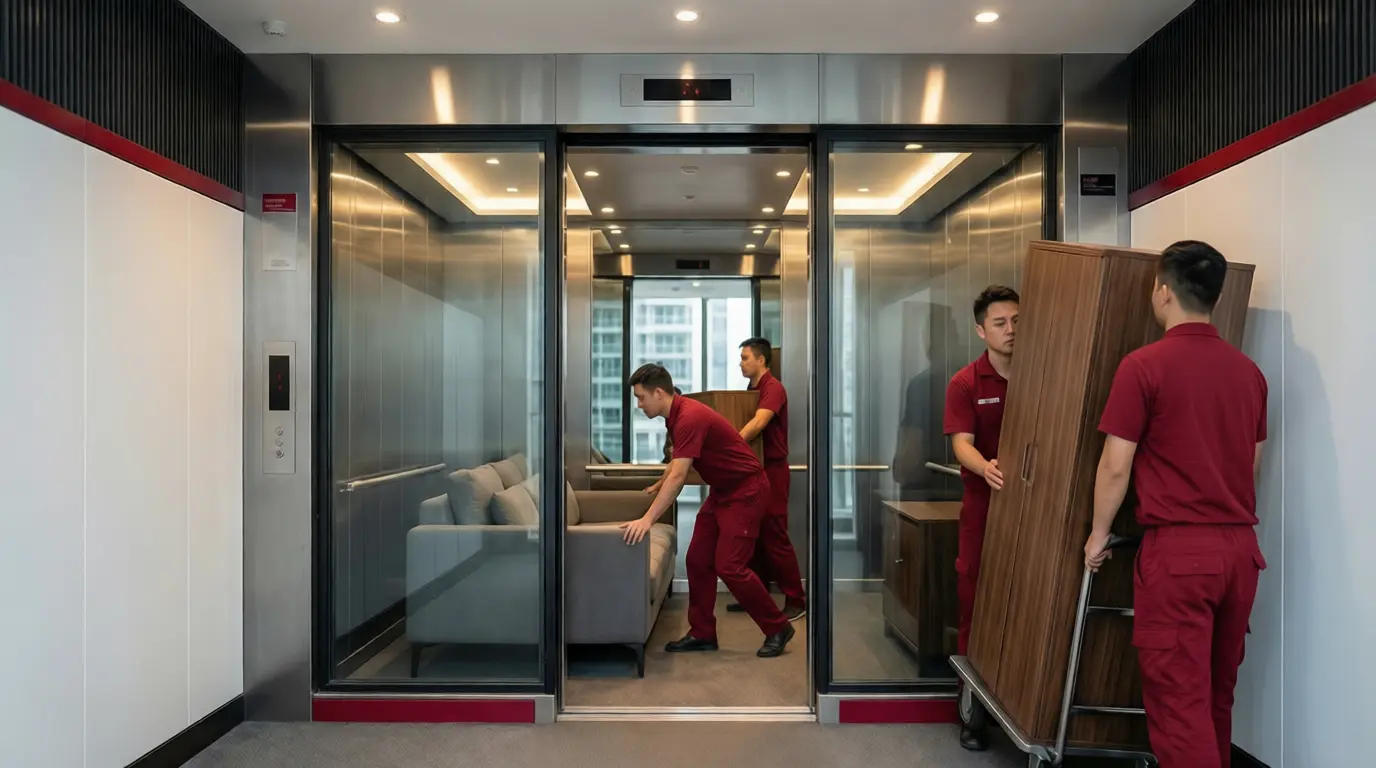
Expats reduce fine exposure during relocations in Abu Dhabi by controlling 5 scheduling variables: building approvals, elevator and loading bay slots, tenancy registration timing, traffic restrictions, and evidence-grade move logs.
This guide provides a slot-based checklist and a timing framework that reduces access refusals and penalty events.
Benefits of reading this guide
- A slot-based schedule model that aligns permits, elevator windows, and restricted road periods, reducing access refusals and penalty events.
- A document timing map that aligns Tawtheeq in Abu Dhabi with Ejari renewal timing in Dubai, stabilizing cross-emirate move dates and handovers.
What does “fine exposure” mean during a home move in Abu Dhabi?
Fine exposure refers to financial penalties and chargebacks caused by schedule violations in controlled premises and regulated roads. Fine exposure also includes deposit deductions and rebooking fees that occur after a failed slot attempt.

Common fine and penalty channels
- Building management charges linked to missed booking windows, unapproved elevator use, or corridor damage logs.
- Schedule breakage costs such as additional labor hours, second trip fees, and slot rebooking charges.
- Dispute costs tied to missing evidence in handover and condition reporting.
For expats using home movers in Abu Dhabi, fine exposure behaves like a timing risk. The strongest control is a schedule that locks approvals and slots before packing intensity increases.
What are the top 5 scheduling mistakes expats make with home movers in Abu Dhabi?
The five scheduling mistakes are:
- Fixing the move date before confirming permit lead times at both buildings
- Treating elevator booking and loading access as move-day tasks
- Misaligning tenancy registration timing and renewal timing, including Ejari renewal timing
- Routing trucks through restricted windows that increase late-arrival risk
- Ending the schedule at truck departure instead of completing the handover chain and evidence log
Mistake 1: Fixing a move date before verifying the move permit lead times at both buildings
This mistake triggers fines because the move permit acts as the schedule gate. A moving date without permit readiness becomes a high-risk placeholder.
Which entities control permit timing in Abu Dhabi?
The entities that commonly gate the permit timeline are:
- Building management office
- Community management or facilities operator
- Security team controlling access rosters
- Concierge desk controls service elevator booking rules
Which attributes define permit readiness?
Permit readiness depends on:
- Submission lead time in days
- Clearance status for building dues
- Contractor registration details
- Vehicle plate registration details
- Slot eligibility for the service elevator and loading bay
Which official tenancy elements affect permit readiness?
Abu Dhabi tenancy registration connects to Tawtheeq through official services. TAMM describes lease registration guidance and lists fee elements associated with Tawtheeq registration and tenancy contract registration.
DARI’s lease registration fee guidance states:
- Service fee: 50 AED per contract
- Municipality fees: 5 % for non-local tenants, with a minimum of 450 AED
Those fee attributes affect timing because payment readiness influences transaction completion and document availability.
What control converts a moving date into an executable schedule?
A two-layer lock reduces failure:
- Document readiness first
- Slot booking second
Permit-first scheduling control
- Confirm move-out permit requirements for the current building.
- Confirm move-in permit requirements for the destination building.
- Fix the permit submission deadline.
- Fix the permit confirmation checkpoint.
- Book the elevator and loading windows after permit eligibility.
Document bundle often requested by buildings
- Tenancy proof
- Resident identification proof
- Mover staff list for access rosters
- Vehicle plate list for entry rosters
- Booking request form with time window
Mistake 2: Treating service elevator booking and loading access as move-day tasks
This mistake triggers fines because towers allocate service lifts and loading areas by slot windows. Slot breaches generate penalties because shared infrastructure has capacity limits.
Why do slot systems generate penalties?
Slot systems reduce congestion, protect common areas, and control damage risk. Towers apply penalties when:
- A crew arrives after the slot start time
- The elevator exceeds the booked window
- Corridors remain blocked beyond clearing time
- Protective controls are absent, and damage logs appear

Which micro-schedules cause the most breaches?
High-impact micro-schedules include:
- Gate arrival time
- Security clearance completion time
- Loading bay staging time
- Protective setup completion time
- First lift trip time
- Last lift trip time
- Corridor clearing time
What KPI model makes slot risk measurable?
A KPI model converts “late” into minutes and creates a usable audit trail.
Slot KPI dashboard for high-rise moves
| KPI | Unit | Target state | Risk signal |
|---|---|---|---|
| Arrival variance | Minutes | Arrival before the slot start | Arrival after the slot start |
| Security processing time | Minutes | Clearance within the buffer | Clearance exceeds buffer |
| Elevator setup time | Minutes | Set up before the first trip | Setup consumes slot time |
| Trips per hour | Trips | Stable cadence | Cadence collapses |
| Slot overrun | Minutes | Zero overrun | Any overrun |
| Corridor clearance lag | Minutes | Clearance at the slot end | The corridor is blocked after the end |
What controls reduce slot penalties for home movers in Abu Dhabi?
Slot controls
- Confirm slot duration in writing from building management.
- Allocate protective setup time as a defined block.
- Sequence heavy items early to preserve trip cadence.
- Set a “last elevator trip time” that precedes the slot end.
- Capture timestamped photos at the loading bay signage and the service lift lobby.
Load sequencing example
- Group 1: Wardrobes, beds, sofas
- Group 2: Dining sets, appliances
- Group 3: Cartons, fragile cartons segregated
Mistake 3: Misaligning tenancy registration and renewal timing, including Ejari renewal timing
This mistake triggers schedule failure when tenancy status blocks approvals or handover sequencing. Abu Dhabi uses Tawtheeq processes. Dubai uses Ejari processes. Cross-emirate schedules break when the two are treated as identical.
What tenancy system governs Abu Dhabi moves?
TAMM lease registration guidance lists Tawtheeq-related fees, including:
- Tawtheeq registration property fee: AED 900 per property
- AED 5 per unit
These figures influence scheduling because document readiness depends on successful processing and fee settlement.
What is Ejari renewal timing, and why does it matter in Abu Dhabi schedules?
Ejari renewal timing matters when the move includes a Dubai tenancy leg. Dubai Land Department provides the official service pathway to register or renew Ejari contracts.
The maximum period to register or renew an Ejari contract ranges from less than a year to 10 years. This matters because some expats align renewal windows with handover and utility timelines.
What controls align Tawtheeq timing and Ejari renewal timing?
Abu Dhabi tenancy timing controls
- Confirm Tawtheeq and lease registration requirements through TAMM guidance.
- Confirm DARI fee attributes, including the 5 % municipality fee minimum.
- Set a document-ready date before fixing elevator slots.
Dubai Ejari renewal timing controls
- Confirm the Ejari register or renew pathway via the Dubai Land Department.
- Map the Ejari action date to the Dubai move-out inspection date.
- Map the Ejari action date to the Abu Dhabi move-in permit date.
Mistake 4: Scheduling truck movement inside restricted windows, creating late arrivals and slot breaches
This mistake triggers fines because truck restrictions compress feasible arrival windows. Late arrival then breaks building slots.

Which official restriction data matters for Abu Dhabi move routes?
As part of its ongoing efforts to enhance road safety and improve traffic flow on key routes across Abu Dhabi, the Integrated Transport Centre (ITC) announced the enforcement of a decision to ban the movement of heavy vehicles on Sheikh Maktoum bin Rashid Road (E11) and Al Raha Beach Road (E10). Truck movement will be prohibited during peak hours along Al Rawdah Road in the Musaffah area (from the Bridges Complex to the Truck Bridge in both directions on the E30), effective Monday, 1 December 2025.
To ensure the smooth traffic flow and enhance road safety in the Emirate of Abu Dhabi, it has been decided to ban the movement of heavy vehicles on the roads of Abu Dhabi city from Monday to Thursday between 06:30 and 09:00 in the morning; similarly, between 15:00 and 19:00 in the evening. These time windows shape route feasibility for larger moving trucks.
What controls reduce restriction-related late arrivals?
Restriction-aware route controls
- Select an elevator slot that avoids overlap with restriction windows for the relevant route segment.
- Use a staging plan measured in minutes, not general labels.
- Add a buffer block that absorbs clearance delays at gates and loading bays.
Restriction-aware route scheduling sheet
| Variable | Data type | Value example | Scheduling effect |
| Restriction effective date | Date | 1 Dec 2025 | Policy applies after the date |
| Peak restriction window | Time range | 06:30 to 09:00 | Slot selection avoids overlap |
| Evening restriction window | Time range | 15:00 to 19:00 | Arrival planning shifts |
| Restricted roads list | Named roads | Per Abu Dhabi Mobility notice | Route selection changes |
Mistake 5: Ending the schedule at truck departure instead of completing the handover chain and evidence log
This mistake increases financial loss through deposit deductions and disputes. The move remains incomplete until the unit return chain closes.
What defines the handover chain?
The handover chain includes:
- Pre-handover inspection booking
- Reinstatement tasks scheduling
- Condition evidence capture
- Key return and access deactivation
- Final acknowledgment and closure logs
What evidence reduces disputes and deductions?
Evidence reduces disputes when it links time, condition, and responsibility.
Evidence pack
- Timestamped condition photos of walls, floors, doors, and balcony thresholds
- Elevator cabin condition photos before and after use
- Inventory list with carton counts
- Loading bay arrival and departure timestamp photos
- Signed handover checklist or written acknowledgment
What are the five scheduling mistakes ranked by risk category?
Scheduling risk segments into three classes: fine risk, delay risk, and dispute risk. Each of the five mistakes maps to at least one class.
| Mistake | Fine risk | Delay risk | Dispute risk | Primary trigger |
|---|---|---|---|---|
| Booking date before permit lead time | High | High | Medium | Access refusal |
| Elevator and loading bay treated as day-of tasks | High | High | Medium | Slot breach |
| Tenancy timing mismatch, including Ejari renewal timing | Medium | High | Medium | Document unavailability |
| Truck arrival inside restriction windows | Medium | High | Low | Late arrival |
| Handover chain missing | Medium | Medium | High | Deposit deduction and chargebacks |
Fine risk and penalty forms vary by building management policy and contract terms, so the ranking reflects operational frequency rather than fixed statutory fine amounts.
How do scheduling rules differ across high-rise towers, compounds, and villas in Abu Dhabi?
Scheduling differs across building types because access control, shared infrastructure, and risk profiles differ.

High-rise towers: What changes in scheduling for expats using home movers in Abu Dhabi?
High-rise scheduling centers on controlled slots and shared corridors. Fine exposure concentrates around lift booking windows and loading bay compliance.
Tower-specific scheduling variables
- Service elevator slot duration
- Loading bay operating hours
- Contractor roster registration deadline
- Corridor protection requirements
High-rise tower scheduling map
| Control point | Typical dependency | Fine exposure channel | Practical scheduling artifact |
|---|---|---|---|
| Service lift booking | Permit approval | Slot breach penalties | Slot confirmation record |
| Loading bay booking | Vehicle details | Dock overrun penalties | Arrival log photo |
| Corridor protection | Material readiness | Damage log charges | Protection checklist |
| Security roster | Staff list | Access refusal | Roster submission proof |
Slot durations vary by tower. Treat any duration as building-specific, not universal.
Compounds: What changes in scheduling for expats using home movers in Abu Dhabi?
Compounds often emphasize gate access protocols, community quiet hours, and internal road controls. Fine exposure concentrates around gate compliance and internal circulation.
Compound-specific scheduling variables
- Gate access pre-approval process
- Internal road weight and parking controls
- Community quiet hours and move-time windows
- Visitor parking allocation for moving crews
Compound scheduling map
| Control point | Typical dependency | Fine exposure channel | Practical scheduling artifact |
|---|---|---|---|
| Gate access approval | Vehicle list | Access refusal | Vehicle plate submission |
| Quiet hours | Community policy | Noise penalties | Time window plan |
| Internal parking | Space allocation | Obstruction penalties | Parking assignment |
| Security checks | ID verification | Delays and slot loss | ID list and roster |
Villas: What changes in scheduling for expats using home movers in Abu Dhabi?
Villas shift risk from elevators to driveway access, loading footprint, and packing controls. Fine exposure concentrates around neighbor impact, street parking controls, and property protection.
Villa-specific scheduling variables
- Street parking feasibility and permit limits
- Driveway protection for heavy loads
- Gate and fence clearance for large items
- Waste disposal timing for packing debris
Villa scheduling map
| Control point | Typical dependency | Fine exposure channel | Practical scheduling artifact |
|---|---|---|---|
| Truck parking plan | Local restrictions | Parking penalties | Staging plan |
| Property protection | Material readiness | Damage cost | Protection checklist |
| Gate clearance | Item dimensions | Rehandling costs | Clearance measurement sheet |
| Debris disposal | Pickup timing | Complaints and charges | Waste plan |
What scheduling checklist reduces fine exposure for expats hiring home movers in Abu Dhabi?
A fine-resistant schedule uses five milestone gates: tenancy proof, permit approval, slot booking, road-compliant arrival, and evidence-grade handover. Each gate includes entities, documents, and time windows.
Gate 1: Tenancy proof readiness
- Tawtheeq contract status confirmed via Dari workflow outputs
- Residential fee attributes understood for non-local tenants, including the 5 % municipality fee rule and minimum value cited on the service page
Gate 2: Building permits and access approval
- Move-out permit requested
- Move-in permit requested
- Security access roster approved
Gate 3: Elevator and loading bay slot locking
- Service elevator slot booked
- Dock slot booked
- Corridor protection plan approved
Gate 4: Road-compliant truck arrival
- The route plan avoids restricted windows cited in Abu Dhabi truck restrictions reporting.
- Buffer time set in minutes
Gate 5: Handover chain completion
- Condition report completed
- Key return documented
- Deposit and reinstatement reconciliation scheduled
What is the decision framework for expats selecting time slots with home movers in Abu Dhabi?

The simplest decision framework uses 3 decisions:
- Slot priority
- Buffer size
- Evidence depth
Each decision aligns with a fine exposure mechanism.
Decision 1: Which slot receives priority?
Priority belongs to the building slot, not the mover availability slot. Building slots govern elevator and loading access, which determines whether the move proceeds without penalty events.
Decision 2: What buffer size fits the route constraints?
Buffer size equals the time gap between the truck arrival and the slot start. Buffer size increases during restriction windows or event days referenced in Abu Dhabi mobility restrictions reporting.
Decision 3: What evidence depth fits the dispute profile?
Evidence depth depends on asset value, unit condition sensitivity, and deposit size. Higher asset value and higher deposit exposure justify higher evidence depth.
What is the document-by-timing matrix for home movers in Abu Dhabi, including Ejari renewal timing?
A document timing matrix converts administrative steps into schedule gates.
Document timing matrix
| Document or approval | System owner | Scheduling dependency | Authority anchor |
|---|---|---|---|
| Tawtheeq registration fee context | Abu Dhabi tenancy | Document readiness | TAMM fee guidance |
| Lease registration fee rules | Abu Dhabi tenancy | Payment readiness | DARI fee guidance |
| Move-out permit | Building management | Slot eligibility | Building policy |
| Move-in permit | Building management | Slot eligibility | Building policy |
| Elevator slot booking | Building management | Permit confirmation | Slot policy |
| Dock access booking | Building management | Vehicle details | Slot policy |
| Truck restriction compliance | Abu Dhabi Mobility | Arrival feasibility | Abu Dhabi Mobility, WAM |
| Ejari renewal timing | Dubai tenancy | Dubai leg schedule stability | DLD service |
| Handover evidence log | Tenant and manager | Deposit and dispute control | Evidence policy |
What cost model links each scheduling mistake to measurable exposure?
A cost model turns scheduling mistakes into cost drivers. The goal is cost visibility and controllability, not a universal price.
What are the main cost drivers triggered by scheduling failures?
- Idle labor time from access refusal and late starts
- Rebooking costs after slot forfeiture
- Second-trip costs from the schedule collapse
- Damage and reinstatement charges from missing protection blocks
- Deposit deduction exposure from weak handover evidence
Mistake in cost exposure mapping
| Scheduling mistake | Primary cost driver | Secondary cost driver | Common trigger |
|---|---|---|---|
| Permit lead time ignored | Slot rebooking | Idle labor | Access refusal |
| Slot booking delayed | Overrun penalties | Additional labor hours | Missed slot start |
| Tawtheeq and Ejari timing misaligned | Admin rework | Handover delays | Document not ready |
| Restricted routing ignored | Late arrival costs | Slot forfeiture | Restriction overlap |
| Handover chain missing | Deposit deductions | Dispute escalation | Missing evidence |
What does a Dubai to Abu Dhabi move schedule look like when Ejari renewal timing becomes a dependency?
A Dubai-to-Abu Dhabi move schedule stabilizes when the Dubai tenancy leg and the Abu Dhabi access leg operate as separate tracks with a single synchronization point.

What is the two-track schedule structure?
Two tracks reduce cascading delays:
- Track A: Dubai tenancy actions and handover actions, including Ejari renewal timing
- Track B: Abu Dhabi tenancy documentation and building slot actions
Case schedule example: Dubai-to-Abu Dhabi relocation with synchronized gates
This is a planning pattern, not a statutory calendar.
Track A: Dubai leg actions
- Confirm the Ejari register or renew pathway via the Dubai Land Department.
- Confirm Ejari contract maximum registration or renewal period options, up to 10 years.
- Fix the Dubai inspection and the key return slot.
Track B: Abu Dhabi leg actions
- Confirm Tawtheeq registration context and fees via TAMM guidance.
- Confirm DARI fee elements, including a 5 % municipality fee, minimum 450 AED for non-local tenants.
- Confirm move-in permit requirements and service lift booking policy.
Synchronization point
Set one date where:
- Dubai key return completes
- Abu Dhabi move-in permit eligibility exists
- Truck routing avoids restricted windows in Abu Dhabi
This structure limits rebooking costs and slot forfeiture events.
Schedule First, Pack Second: The Fine-Resistant Relocation Rule
In Abu Dhabi, most relocation “fines” don’t feel like fines at first. They show up as a missed service-lift window, a security desk refusing entry because a plate number wasn’t pre-registered, a loading bay overrun charge, or a deposit deduction that you can’t challenge because nothing was documented. And the frustrating part? These losses usually come from scheduling, not from packing quality.
If you remember one thing from this guide, make it this: your move is only as real as the approvals and slots that support it. The moment you set a date before you lock permits, elevator windows, and access rosters, you’re betting your budget on everything going perfectly. Abu Dhabi’s high-demand residential environment, especially in towers and managed communities, written confirmations, buffers measured in minutes, and evidence that closes the handover chain cleanly.
So plan like a professional: Permit-first, slot-second, route-aware, evidence-complete. When those five gates are locked, the move stops being stressful guesswork and becomes a controlled execution. That’s how you protect your time, your deposit, and your peace of mindwhile your neighbors, building management, and movers all see the same thing: a move that was handled properly.