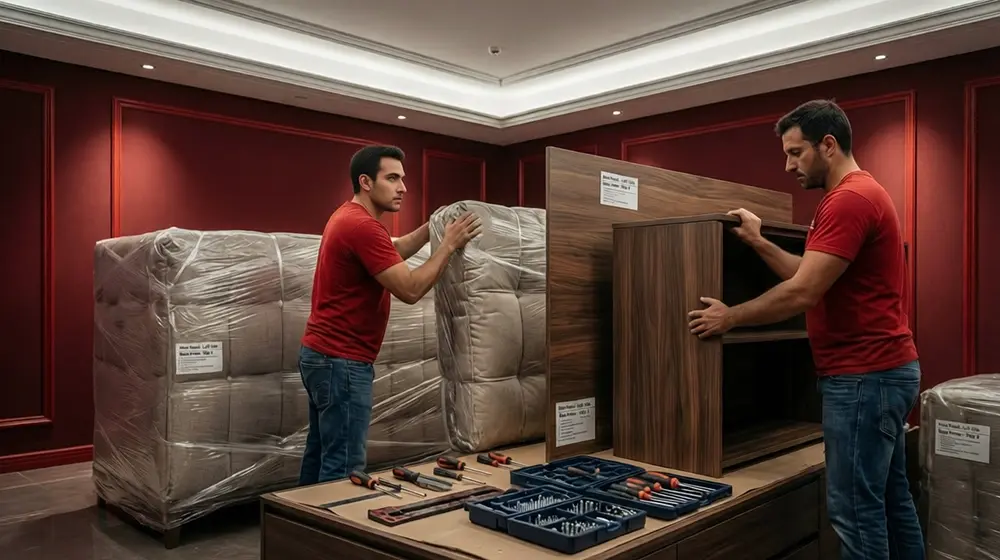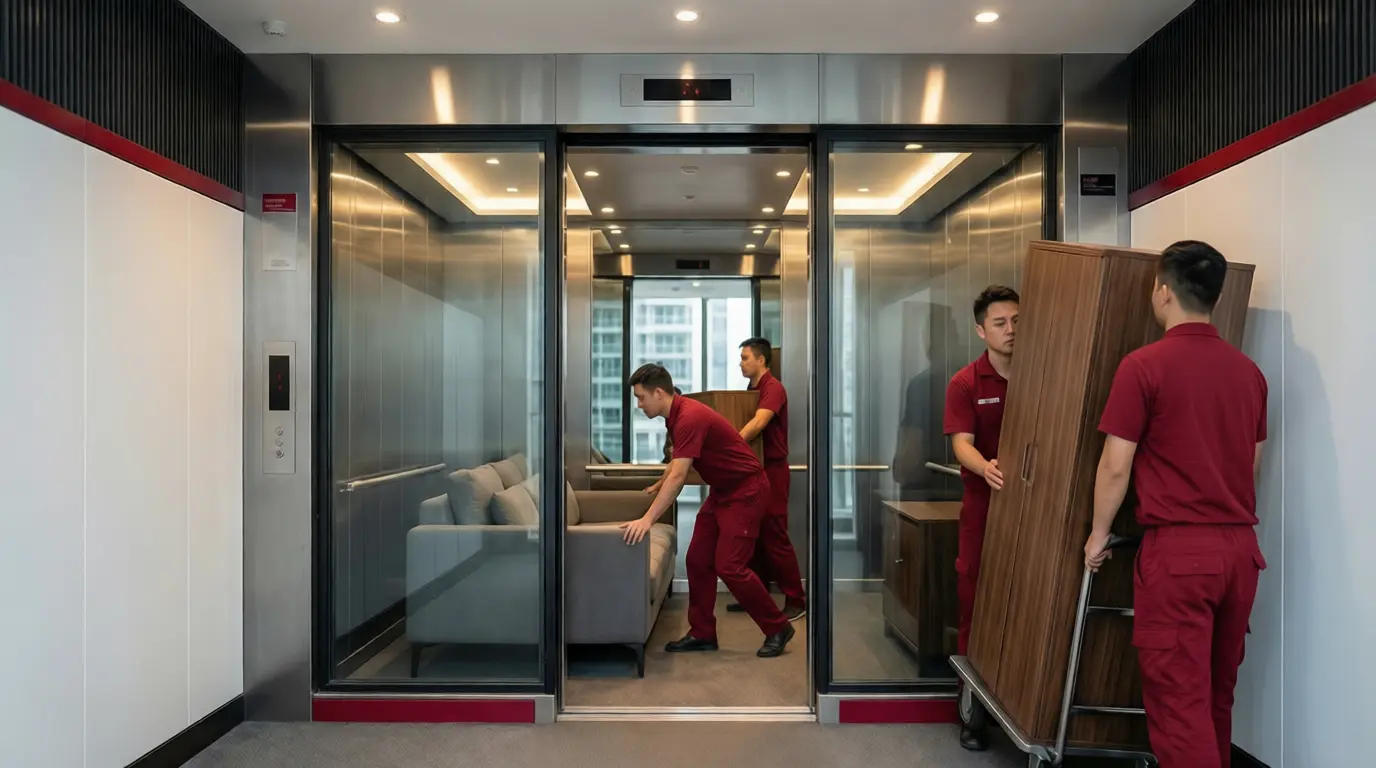
Move-in day delay rarely starts with “slow movers.” Move-in day delay usually comes from a sequence breakdown. Sequence breakdown appears when cartons flood circulation paths before the first functional room reaches a usable state. Majlis-first setup fixes that pattern by converting the majlis into the first measurable deliverable.
This article explains why home movers in Al Ain who execute the majlis first setup cut that delay by turning the majlis into the first measurable deliverable.
Benefits from this article
- Faster family-ready occupancy by defining a majlis usability milestone with acceptance criteria.
- Lower claims friction by using photo evidence and inventory reconciliation as an audit trail.
What is the “family-ready majlis” acceptance criteria set?
Family-ready acceptance criteria are a checklist that defines usability, safety, and cleanliness in objective terms.
Acceptance criteria examples:
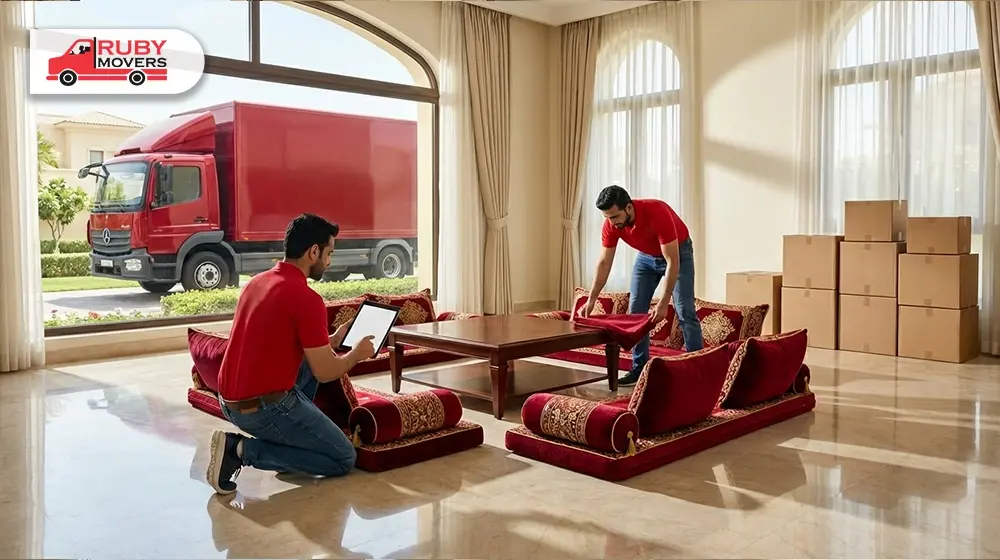
- Usability: Seating capacity restored to the agreed number of seats.
- Safety: Walk path from entry to majlis clear of cartons and tools.
- Finish protection: Floor protection installed at the highest-traffic lines.
- Stability: Rugs flattened with edges secured where movement occurs.
- Cleanliness: Packaging debris removed from majlis footprint.
Acceptance criteria enable contract alignment. Contract alignment reduces dispute probability.
What is a “handover evidence pack” for a majlis-first move?
A handover evidence pack is a structured bundle of proofs that the majlis-first scope was delivered as defined.
Evidence pack contents:
- Before photos: Majlis condition at origin, focusing on high-value and high-risk surfaces.
- Protection photos: Floor and corner protection installed at the destination.
- Placement photos: Seating layout and rug placement in the final state.
- Inventory reconciliation: A list of majlis items delivered and placed.
- Sign-off sheet: Acceptance criteria checklist, dated and signed.
Evidence pack discipline matters because claim resolution rates can be low in practice, and documentation quality becomes a differentiator in dispute resolution.
What does “majlis-first setup” mean in a home move in Al Ain?
Majlis-first setup means the moving plan assigns the majlis the first completion milestone, so seating, rugs, and core layout become usable before broad unpacking begins.
Majlis-first setup is a sequence control. Sequence control reduces downstream congestion. Congestion appears when cartons occupy circulation paths and block access to large pieces, tools, and protective materials.
Majlis-first setup is measurable. Measurable means a defined “done” state:
- Cleared circulation: Entry path and majlis perimeter remain open.
- Placed furniture: Seating placed per the agreed layout.
- Protected finishes: Floor protection and corner protection installed.
- Rug set: Rug positioned, flattened, and protected where traffic starts.
Which delays dominate move-in day performance?
Move-in delays cluster around packing and unpacking volume, cost volatility, and disputes.
Angi survey reporting, summarized by Better Homes and Gardens, identified:
- 55.6% of respondents described packing as the hardest part of moving.
- Nearly 25% reported unpacking as the hardest part.
Those two figures map directly to delay risk, because cartons and unpacking decisions create the most on-site branching tasks.
Complaint and claims data add a second quantified pattern: disputes and loss events.
FMCSA consumer-protection infographic highlights:
- 14 million households move each year in the U.S.
- 16.1 million households move each year in the U.S.
- Less than 1 in 4 claims reach settlement.
- The average interstate move cost is shown as $5,630 in the 2016 infographic.
- 57% of complaints report overcharges in the updated infographic.
- More than 5,900 moving fraud complaints were filed with FMCSA in 2018, according to the updated infographic.
Defense household goods data adds a claims frequency benchmark:
- A new analysis shows that 21% of all domestic Defense Department household goods shipments in 2018 had at least one damage claim.
These figures do not describe Al Ain directly. They do describe how delay, damage, and dispute show up at scale in regulated moving systems. The controls remain transferable: acceptance criteria, evidence, and sequence discipline.
Why does the majlis-first setup reduce move-in day delay?
Majlis-first setup reduces delay because it blocks three time drains: congestion, rework, and search time.
1) Congestion
Congestion appears when cartons occupy the same space as heavy-item placement. Congestion increases waiting time in many movement systems, including move-in operations studied through discrete-event simulation.
2) Rework
Rework appears when a sofa moves twice, or when rugs get rolled back because cartons occupy the perimeter. Each extra handling cycle increases both time and surface risk.
3) Search time
Search time appears when majlis-critical items get buried in mixed cartons. Mixed cartons multiply “hunt time,” then compress the remaining timeline.
What is the fastest controlled majlis-first setup sequence?
The Majlis-first setup sequence is a controlled sequence of deliverables. Deliverables stay measurable. Measurable states compress ambiguity.

Phase 1: Protect surfaces and routes
- Install floor protection from the entry to the majlis footprint.
- Install corner protection on turns and door frames.
- Stage tools and fasteners outside family circulation.
Control target: 1 protected route, 1 protected room footprint, 0 cartons inside the majlis center during protection placement.
Humidity control also matters for textiles. EPA guidance states indoor humidity stays below 60%, ideally 30% to 50%, to reduce moisture conditions associated with mold.
Phase 2: Place anchor furniture first
- Place majlis seating in final layout positions.
Placement-first reduces double-handling. Double-handling increases the probability of finishing contact and schedule drift.
Phase 3: Stabilize rugs and high-contact points
- Position rugs and flatten edges.
- Apply anti-slip layers where specified.
- Fit felt pads or floor guards for seating bases.
Humidity and condensation risk stay relevant for rugs and textiles. EPA mold training states that relative humidity (RH) above 60% increases condensation risk, which supports mold growth.
Phase 4: Open only majlis-critical cartons
- Open cartons tagged “Majlis Priority.”
- Place cushions, essential decor, and immediate-use items.
- Remove packaging waste from the majlis footprint.
Phase 5: Verify and sign off on majlis readiness
- Verify the acceptance criteria checklist.
- Capture photo evidence set.
- Record sign-off time.
Majlis-first acceptance criteria in measurable terms
| Acceptance item | Measurement method | Evidence artifact |
|---|---|---|
| Circulation clear | Walk path from entry to seating | 2 wide-angle photos |
| Seating placed | Layout matches the agreed plan | 4 corner photos |
| Rug stabilized | Edges flat, traffic lines protected | 2 close-ups + 1 wide |
| Finish protection | Protection is visible at high-contact zones | 3 photos of protection |
| Waste removed | No cartons or wrap inside the footprint | 1 wide photo |
| Inventory reconciled | Item list matches delivered items | Inventory line items |
The table functions as a procurement-grade acceptance tool, not a marketing claim.
What ergonomic facts reduce handling incidents and time loss?
Ergonomic facts reduce risk and delay. Handling incidents creates stoppages, and stoppages create schedule drift.
NIOSH lifting equation manual defines a load constant of 23 kg (51 lb) as a reference maximum under ideal conditions. Real tasks reduce that limit via multipliers.
CCOHS explains the same equation form: LC x multipliers equals Recommended Weight Limit (RWL), with LC = 23 kg.
Musculoskeletal disorder data adds operational urgency. BLS reports musculoskeletal disorders (MSDs) occur at an annualized incidence rate of 25.3 per 10,000 FTE workers in the 2022 data release.
Practical controls in majlis-first handling:
- Assign team lifts for bulky seating modules.
- Use dollies for long carries.
- Reduce carry distance via staging near the final layout.
- Avoid twisting lifts by aligning paths and placement angles.
Ergonomics protects people and the schedule. Handling incidents creates stoppages. Stoppages create a delay.
Which documentation reduces claims friction in a majlis-first move?
Documentation reduces friction by creating an audit trail that supports dispute resolution.
U.S. Surface Transportation Board guidance explains that a mover bears responsibility for loss or damage in general, and claim filing initiates compensation attempts.
FMCSA infographic highlights “less than 1/4 of claims reach settlement,” indicating poor outcomes when documentation and process fail.
Household goods data shows 21% damage claim filing frequency in a large system, strengthening the value of condition logging and evidence packs.
Evidence pack components for majlis-first setup
- Inventory list with room code “MAJLIS” and item IDs.
- Condition log with time-stamped photos of high-value items.
- Protection log showing floor and corner protection.
- Placement log showing final seating layout and rug state.
- Exceptions log listing pre-existing marks, dents, or stains.
These controls map to consumer-protection themes highlighted by transportation oversight bodies, including the importance of understanding documents and maintaining clear records when disputes arise.
Evidence pack “minimum viable proof” by risk tier
| Risk tier | Examples | Evidence count target |
|---|---|---|
| Tier 1 fragile high value | Mirrors, framed art, specialty decor | 2 before + 2 after each |
| Tier 2 heavy high mass | Sofas, large tables, seating modules | 1 before + 2 after each |
| Tier 3 finish sensitive | Polished floors, wall corners, and door frames | 6 protection photos |
| Tier 4 time critical | Rugs, cushions, essential seating | 6 readiness photos |
Evidence count targets keep the pack practical and auditable.
How do access windows and security gates translate into delay risk?
Access windows translate into a delay risk because they compress unloading time and increase peak congestion.
In the UAE, move-in or move-out permits and coordination with property management are common in many communities and buildings. A UAE relocation provider notes that many apartment complexes require permits, elevator booking, and sometimes NOCs or refundable deposits.
A real estate platform guide describes move-in or move-out permits as a standard procedural requirement in Dubai communities, reflecting the region-wide pattern of time-slot governance and building management controls.
Operational implications for Al Ain moves:
- Permit friction increases start-time uncertainty
- Elevator booking compresses vertical transport availability
- Gate checks reduce buffer time for staging
Majlis-first setup reduces the impact of compressed time windows by prioritizing a single high-value deliverable early.
What are the top delay drivers, and which controls map to each?
This section keeps the topic bounded to delay reduction through majlis-first setup, not general moving advice.

Delay driver 1: Carton volume expands early
Control set:
- Limit cartons staged inside the majlis footprint during phases 1 to 3.
- Label “Majlis Priority” carton range, for example, MAJ-01 to MAJ-12.
Delay driver 2: Mixed cartons create search time
Control set:
- Segment cartons by room code plus sequence code.
- Separate the essentials carton count, for example, 2 cartons.
Packing and unpacking remain dominant reported stressors, at 55.6% and nearly 25%, respectively.
Delay driver 3: Damage checks stop the flow
Control set:
- Protect surfaces before heavy placement.
- Record the condition before and after.
Delay driver 4: Rework multiple handling cycles
Control set:
- Place anchor furniture first.
- Lock layout before opening non-critical cartons.
Which material controls protect majlis rugs, seating, and decor?
Material controls are protected by reducing abrasion, puncture, crush, moisture exposure, and static effects.
Humidity control is a practical risk control for textiles and leather. Indoor air guidance varies by authority, yet multiple sources converge on controlling high humidity to reduce microbial and mold risk.
ASHRAE technical guidance recommends controlling relative humidity in occupied spaces to less than 65% to reduce conditions that can lead to microbial growth.
Relative humidity of 45% reduces electrostatic effects in many materials, but wool and some synthetic materials may require a higher relative humidity. Static effects increase dust attraction and handling friction for textiles.
In UAE environments, indoor air quality guidance exists at the municipal level. Dubai Municipality’s indoor air quality technical guidelines provide performance-oriented parameters for healthy indoor environments, supporting the broader practice of defined controls for indoor conditions.
Practical material controls for majlis-first setup:
- Wrap control: Stretch wrap for upholstered edges, not for long-term sealing where trapped moisture risk exists.
- Corner control: Rigid corner protectors on framed items and table edges.
- Crush control: Double-wall cartons for dense decor.
- Moisture control: Sealed poly layers for items moving through outdoor staging in humid periods.
- Abrasion control: Clean moving blankets between hard surfaces.
What are the most common process failures that delay the majlis-first setup?
The most common failures are mislabeling, mixed cartons, missing tools, and uncontrolled staging.
Process failures and controls:
- Mislabeling: Room codes plus item IDs reduce search time.
- Mixed cartons: Carton zoning prevents scatter.
- Missing tools: Tool kit staging prevents idle labor.
- Uncontrolled staging: The staging map keeps pathways open.
Moving advice sources consistently flag poor access to essentials as a source of delay and stress. Essential discipline is a simplified version of the same principle.
What is the majlis-first timeline that reduces branching?
A majlis-first timeline stays linear. Linear flow reduces decision friction.
0 to 30 minutes: Route and protection
- Protection installed on the entry to the majlis path
- Corner protectors on turns
- Tools staged outside circulation
30 to 90 minutes: Anchor placement
- Seating positioned according to the layout
- Tables placed after seating alignment
90 to 150 minutes: Rug stabilization and readiness cartons
- Rug positioned and edges stabilized
- Majlis priority cartons opened
- Packaging removed from footprint
150 to 180 minutes: Verification and sign-off
- Acceptance criteria verified
- Evidence photos captured
- Inventory reconciled for majlis items
What does “cost escalation” look like when delays occur?
Cost escalation includes direct costs and indirect costs.
The FMCSA reports an average cost of $5,630 for an interstate move in the 2016 edition, illustrating the financial exposure when disputes and loss events occur.
Angi survey reporting indicates nearly 68% of respondents prioritize saving money over time, so cost volatility is a central decision driver.
A practical cost escalation model:
- Overtime cost: Crew hours beyond the planned window
- Second-day cost: Return visit plus travel and access coordination
- Damage cost: Repair or replacement plus dispute time
- Occupant productivity cost: Lost work time due to delay
Majlis-first setup targets the largest visibility cost: a household without a usable social room at move-in.
What is a risk segmentation map for majlis-first moves?
Risk segmentation map classifies items and tasks by probability of incident and impact of incident.
Risk tiers:
- Tier 1, high value fragile: Framed art, mirrors, specialty decor.
- Tier 2, high mass: Seating modules, heavy tables.
- Tier 3, high surface sensitivity: Polished floors, wall corners, delicate finishes.
- Tier 4, time-critical: Items needed to achieve family-ready status early.
Controls connect to tiers:
- Tier 1 uses rigid protection and dedicated handling.
- Tier 2 uses team lift and mechanical aids.
- Tier 3 uses surface protection and route control.
- Tier 4 uses priority labeling and staging.
What is the QA checklist for a majlis-first setup?
A QA checklist is a short, auditable list that confirms the deliverable state. QA checklist:
- Confirm circulation is clear from the entry to the majlis seating.
- Confirm seating is stable and aligned to the layout.
- Confirm rug flat, edges controlled, and protected at traffic lines.
- Confirm high-contact corners are protected during the remaining unpacking.
- Confirm waste removed from majlis footprint.
- Confirm evidence pack created and sign-off recorded.
Which competitive differentiators matter in Al Ain for majlis-first movers?
Competitive differentiators that matter are operational, not promotional.

Differentiators:
- Documented scope and acceptance criteria
- Labeled inventory with room codes and item IDs
- Condition logging with time-stamped photos
- Permit and access coordination capability
- Crew flow plan that prevents bottlenecks
Regulatory and consumer protection discussions in moving sectors emphasize documentation, transparency, and complaint reduction as indicators of operational maturity.
What is the final procurement checklist for hiring home movers in Al Ain for the majlis-first setup?
The procurement checklist is the shortest set of decision points that predicts execution quality.
Decision points:
- Acceptance criteria listed in writing
- Evidence pack included in deliverables
- The inventory method described with a labeling scheme
- Access coordination described, including permits and elevator booking where applicable
- Ergonomic controls described for heavy items aligned to NIOSH task guidance
- Humidity and surface protection approach stated, referencing recognized indoor environment guidance
Next Steps: Confirm Majlis Acceptance Criteria Before Booking Movers
Move-in day delay usually comes from sequence breakdown, not effort. Majlis-first setup prevents early congestion by protecting circulation, placing anchor furniture, stabilizing rugs, and limiting carton sprawl until the majlis reaches a measurable “family-ready” state. The control point is the acceptance criteria. Acceptance criteria convert expectations into verifiable deliverables. Evidence packs convert delivery into audit trail proof. Claims outcomes can be weak, so documentation strength becomes a practical safeguard, not an administrative step.
Before booking home movers in Al Ain, confirm these next steps:
- Define the family-ready majlis checklist and sign-off sequence.
- Specify the majlis-first SOP, including protection-first and anchor placement-first.
- Lock the “Majlis Priority” carton range and labeling logic.
- Require a handover evidence pack with time-stamped photos and inventory reconciliation.
- Confirm indoor condition controls for rugs and textiles, including humidity targets below 60% RH.
These steps keep the majlis usable first, keep the timeline linear, and keep the handover dispute-ready.