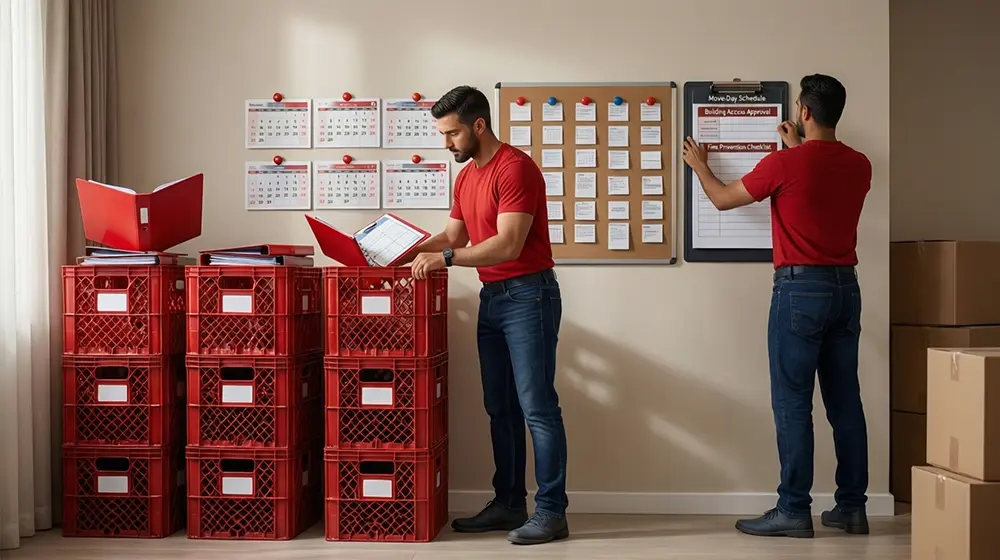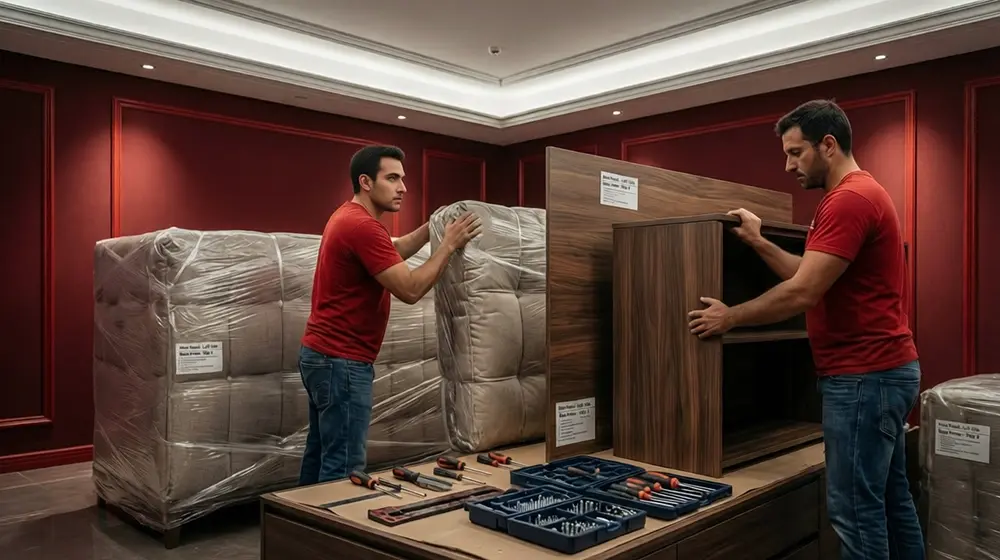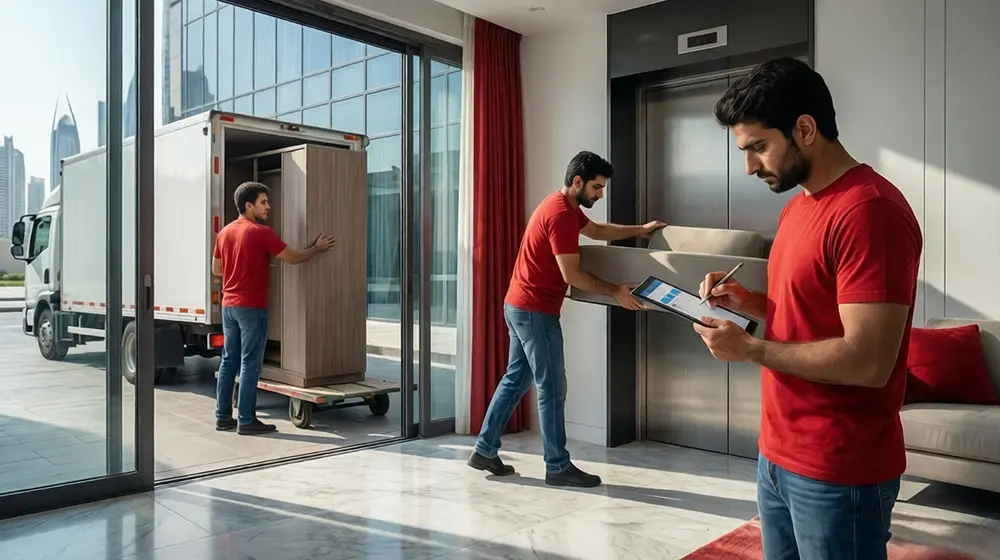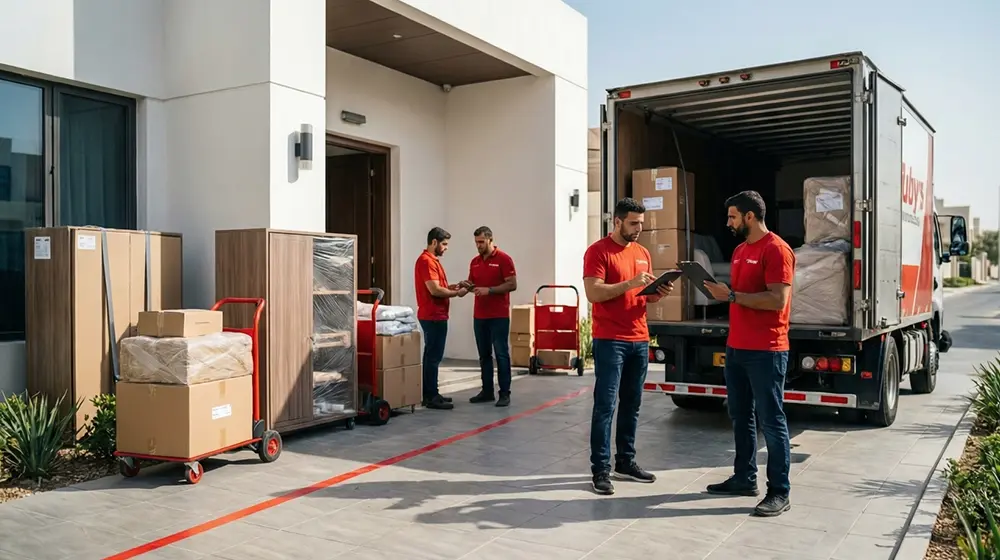
Moving a villa in Al Juraina or Al Yarmook is rarely about packing boxes. It is about access. Narrow staircases, tight door turns, uneven outdoor paving, and long carry distances often block trolleys and force heavy manual handling. When routes are not planned, fatigue rises, damage risk increases, and delays multiply.
This guide explains how professional villa moves in these neighborhoods are controlled using site method statements. It shows how carry routes are measured, how trolley plans are matched to surfaces, and how lift alternatives are chosen when rolling access fails.
What benefits come from reading this article?
- Lower re-handling and delay exposure by converting access constraints into a measured carry-route plan with trolley deployment, staging nodes, and lift-alternative decision rules.
- Lower dispute friction by using a site method statement that defines evidence gates, inventory controls, and sign-offs that align with claim review logic.
If manual carry dominates your move, this article shows how to turn constraints into a predictable, auditable plan.
What is the core problem when moving villas in Al Juraina and Al Yarmook?
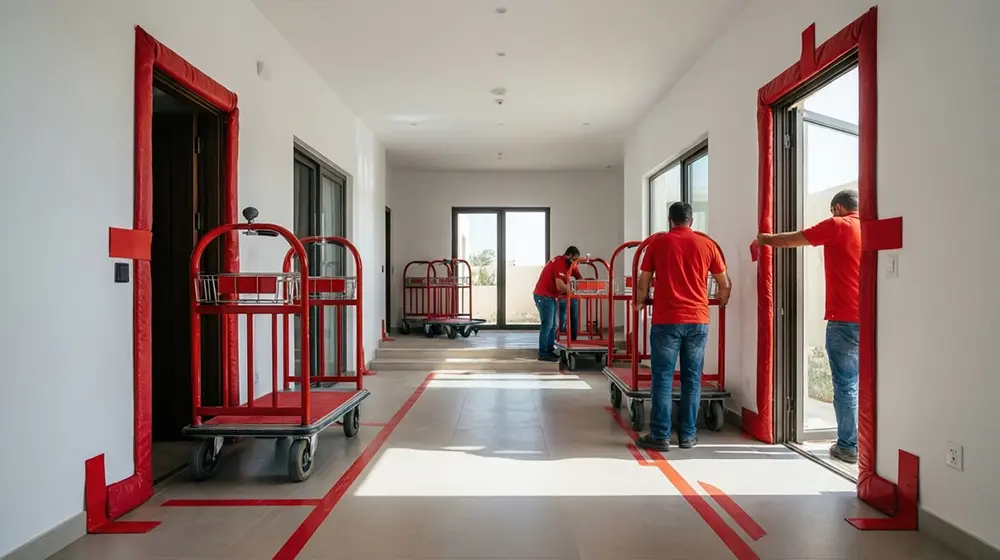
The core problem is access geometry. Manual carry dominates villa moves when access geometry blocks direct trolley travel or lift usage. That geometry includes narrow door clearances, tight staircase turns, uneven outdoor pavers, and long carry distances from room to truck staging. Local access profiles in Al Juraina also vary by block and villa layout, with a mixed villa and low-rise pattern.
Why does manual handling planning matter for villa moves?
Manual handling drives musculoskeletal disorder exposure and drives a measurable portion of workplace injury burden. HSE guidance treats manual handling as a major contributor to musculoskeletal disorders, especially back pain.
Manual handling also links to measurable injury burden. In Great Britain, 543,000 workers reported work-related musculoskeletal disorders in 2023–2024, with 7.8 million working days lost attributed to MSDs. HSE’s latest key figures also report 511,000 workers suffering from work-related MSDs in 2024–2025, showing a sustained scale of exposure.
A 2025 UK defence manual handling guide reports manual handling as about 17 % of non-fatal, work-related injuries reported to HSE. EU-OSHA summaries also report higher musculoskeletal disorder reporting in roles involving frequent heavy load handling.
Higher carry distance and higher trip count raise fatigue and handling error probability. Fatigue correlates with drops, corner impacts, stair slips, and floor scuffs. A method statement reduces that probability by reducing touchpoints and stabilizing load motion.
What facts quantify manual handling risk, and why does it matter for villa moves?
Manual handling is a defined risk category in safety guidance. HSE defines manual handling as transporting or supporting a load by hand or bodily force, including lifting, lowering, pushing, pulling, carrying, and moving loads.
What statistics quantify the scale of MSD exposure?
Use these figures as a risk baseline for high-carry moves.
- HSE “days lost” statistics report 7.1 million days lost to MSDs in 2024–2025, with an average of 14.0 days off per MSD case in that year.
- ILO notes MSDs as a major global occupational health topic and reports that MSDs represent 40 % of global compensation costs of occupational and work-related injuries and diseases.
- Nearly 3.0 million workers die every year due to work-related accidents and diseases, an increase of more than 5 % compared to 2015, according to new ILO estimates.
Longer manual carry routes and higher trip cycles raise fatigue exposure. Fatigue raises the probability of corner strikes, stair slips, drops, and surface scuffs. A method statement reduces exposure by reducing touchpoints and controlling flow.
What is a site method statement for moving villas in Al Juraina and Al Yarmook?
A site method statement is a documented execution plan that defines the move sequence, route controls, equipment controls, and evidence controls for each stage of handling. It links the site survey to risk controls and sign-off points, so the move operates as a controlled process instead of an improvised carry cycle.
What makes a villa move site method statement complete?
A complete method statement contains six blocks.
- Site context and constraints
Access points, truck approach, route obstacles, stair geometry, surface types, and staging zones.
- Load classification and handling rules
Load class definitions, high-risk item classes, and touchpoint reduction rules.
- Manual carry route map
Carry segments, distance estimates, trip counts, and bottleneck controls.
- Trolley plan and floor protection plan
Trolley type selection by load class and surface type, plus floor protection layers.
- Lift alternatives plan
Stair solutions, external hoisting criteria, and exclusion list for unsafe item classes.
- Evidence and sign-off plan
Condition records, photo log points, inventory trace, and release confirmation.
How does a site survey map manual carry routes for moving a villa in Al Juraina and moving a villa in Al Yarmook?
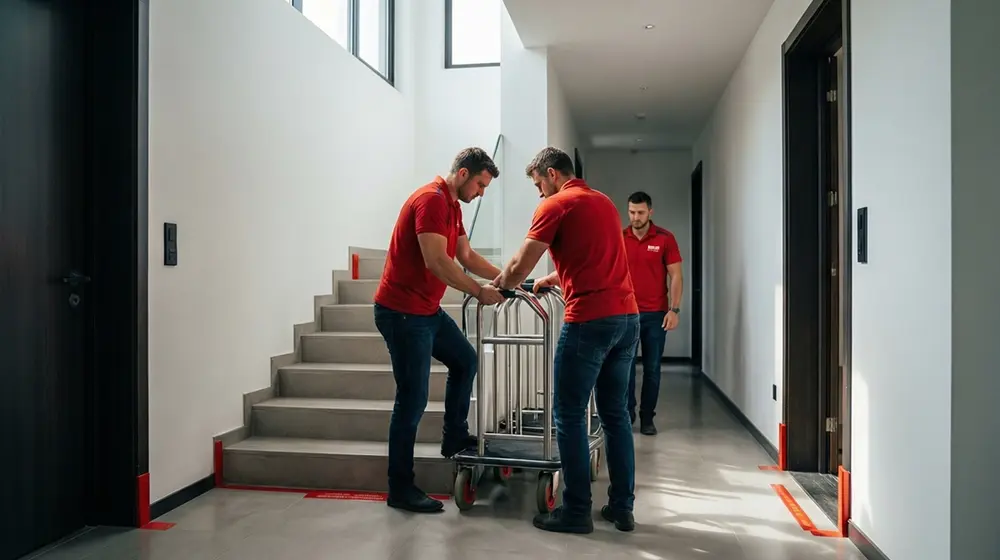
A site survey maps the move as a route network, not a room list. Each segment has measurable attributes. Measurement supports planning accuracy and reduces re-handling loops.
Which route attributes matter most?
Route quality depends on eight attributes.
- Clearance width at doors and corridors
- Turn geometry at corners and stair turns
- Stair specification, including riser consistency and landing depth
- Surface type such as tile, marble, textured paver, or concrete
- Slope at driveway transitions
- Carry distance per segment
- Staging capacity at each node
- Truck interface, including loading height and approach constraints
How is carry distance translated into trip counts?
Trip count equals the number of load movements required to clear a room, multiplied by the number of route cycles per load. A practical method statement uses a room-based inventory count and assigns each item to a load class. Each load class maps to a handling method.
Example load classes
- Class A, hand carry small: Cartons, small appliances, décor
- Class B, trolley capable: Packed wardrobes, book cartons, small cabinets
- Class C, two-person carry: Sofas, bed frames, dining tables
- Class D, high-risk fragile: Mirrors, glass tops, marble tops, art
- Class E, high mass appliances: Fridge, washer, range
A route map links each class to a route and a staging node. The map then gives a controllable sequence that reduces cross traffic on stairs.
How is carry distance converted into time, labor minutes, and trip cycles?
This section provides a measured model that procurement teams and villa movers in Sharjah can use to compare quotes on a common basis.
What is a practical carry-route productivity model?
A simple model uses five inputs.
- D = one-way distance in meters for the segment
- v = walking speed under load in m/s
- Tt = handling time per item for pick, place, door negotiation, and corner control in seconds
- n = item count for the segment
- k = congestion multiplier based on stair and landing traffic
Cycle time per item = (2D / v) + Tt
Total time = n × cycle time × k
What numbers fit a villa context without guessing?
The model uses measured inputs during the site survey. The statement avoids invented speeds. The survey records:
- D using a measuring wheel or laser distance
- n using room-based inventory counts
- k using access tier rules defined later
Quantified output example format for the method statement
- Ground-floor corridor segment: D = 18 m, n = 42 cartons, k = 1.1
- Stair segment to first-floor bedrooms: D = 12 m plus 16 steps, n = 28 cartons, k = 1.4
- Truck interface segment: D = 25 m across driveway, n = 65 cartons, k = 1.2
This approach creates comparable labor-minute estimates across vendors because it measures route, not claims.
What trolley plans fit villas in Al Juraina and Al Yarmook?
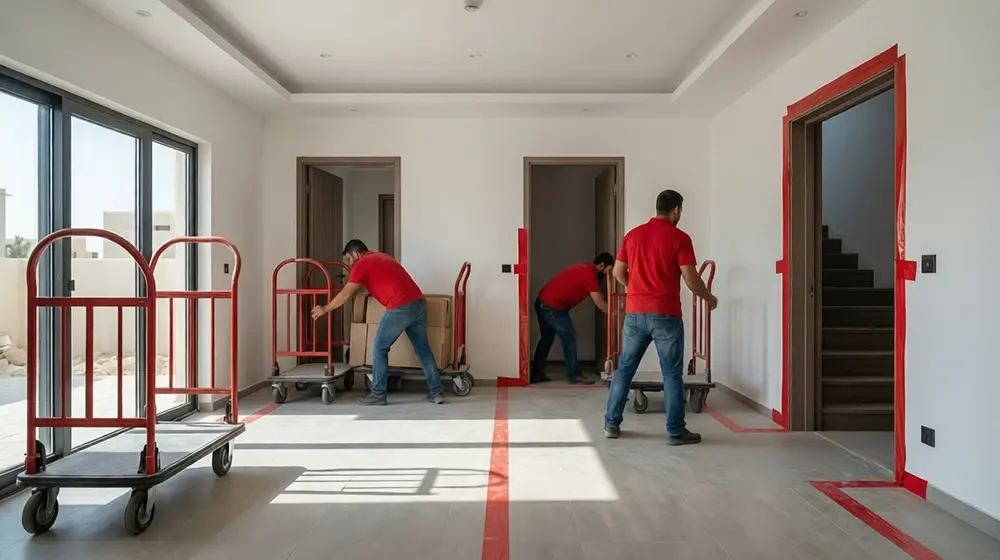
A trolley plan assigns trolley type, wheel type, and load limits by surface type and load class. HSE manual handling guidance frames pushing, pulling, and carrying as part of the manual handling category.
What trolley types cover most villa move scenarios?
A practical villa kit uses three trolley families.
- Platform trolley
Use case: Cartons and stable loads on flat interior paths
- Appliance dolly with straps
Use case: Tall high-mass items with center-of-gravity control
- Stair-capable trolley or stair strategy
Use case: Stair segments that block rolling travel
What wheel properties reduce scuff risk on tile and marble?
Wheel selection links to rolling resistance and marking risk.
- Non-marking compound reduces streak probability on light tile
- Larger diameter wheels reduce vibration over grout lines
- Soft tread reduces micro-slips on polished surfaces
A method statement records wheel type in the equipment plan and links it to floor protection requirements.
Trolley selection matrix for villa movers in Sharjah
| Load class | Example items | Dominant risk | Preferred trolley plan | Surface control |
|---|---|---|---|---|
| Class A | Cartons, small appliances | Drops, misplacement | Platform trolley for flat segments | Runner paths, threshold guards |
| Class B | Totes, small cabinets | Tip-over at turns | Platform trolley with spotter on corners | Corner guards, door jamb padding |
| Class C | Sofas, tables | Corner strikes, stair congestion | Limited trolley, two-person carry plus staging | Landing buffer rules |
| Class D | Gass, mirrors, art | Edge impact, flex | Rigid protection, two-person carry | “no-stack” zone, photo gates |
| Class E | Fridge, washer | Back strain, tip | Appliance dolly with straps | Tread covers on stairs |
What floor protection controls reduce claims on villa interiors?
Floor protection in villas often requires layered controls.
- Entry protection at thresholds, especially metal strips and raised sills
- Runner paths along high traffic corridors
- Stair tread covers for stair-dominant routes
- Corner guards on tight turns
The method statement links these protections to the route map. It also links them to photo log points in the evidence plan.
What lift alternatives apply when lift access is absent or unsuitable?
Lift alternatives include stair-only handling systems and external hoisting systems. The correct option depends on load mass, geometry, and risk tolerance.
What lift alternative fits stair-dominant villas?
A stair plan uses stepwise staging.
- Landing staging that keeps each landing below congestion thresholds
- Two-person control for Class C and Class D items
- Spotter role on turns to prevent wall strikes
- Rest cadence tied to trip cycles to control fatigue
NIOSH ergonomic guidance discusses that effective ergonomic interventions reduce physical demands in manual material handling tasks.
When does external hoisting function as a lift alternative?
External hoisting fits bulky items that exceed safe stair geometry constraints. It also fits items with fragile surfaces that risk edge damage on corners. The method statement uses criteria instead of assumptions.
Hoisting suitability criteria
- Balcony or large window access exists
- Anchor points or hoist system access exist
- Drop zone control exists
- Weather exposure remains manageable
- Item geometry supports stable rigging
The method statement also defines excluded items when the rigging risk exceeds the stair risk.
What are the highest risk points on manual carry routes, and how does a method statement control them?
Risk concentrates at route transitions. Transitions include door thresholds, stair entry points, landing turns, and truck loading edges.
What failure modes dominate villa move damage and delay?
Five failure modes dominate.
- Re-handling loops
Items move multiple times due to missing staging zones.
- Corner strikes
Tight turns cause edge damage on walls and furniture.
- Stair congestion
Mixed traffic blocks landings and increases trip time.
- Floor scuff events
Wheel compounds and grit create streaks on tile or marble.
- Load instability
Tall loads tip on uneven surfaces or step edges.
What controls reduce these failure modes?
Controls align with each failure mode.
- Re-handling loops: Staging zones, room sequencing, label logic
- Corner strikes: Spotter role, corner guards, turn rehearsal
- Stair congestion: One-way traffic windows, landing buffer rules
- Floor scuff: Clean sweep protocol, runner placement, wheel control
- Instability: Strap points, center of gravity control, two-person rule
This structure keeps subject areas clean. It also creates consistent declarations.
What documentation prevents disputes during villa moves in Al Juraina and Al Yarmook?
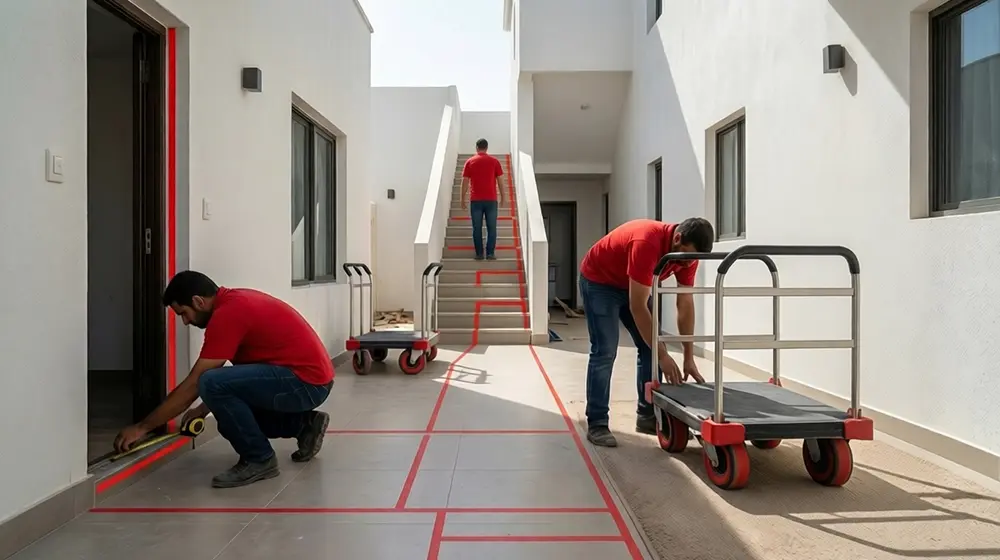
Disputes usually start from evidence gaps. Evidence gaps appear as missing condition records, weak inventories, and unclear custody boundaries.
What evidence pack supports condition disputes and missing item disputes?
A claims-oriented evidence pack includes five records.
- Room-based inventory with unique IDs
- Pre-move condition photos for high-value and high-risk items
- Route risk photos that show access constraints and protections
- Loading photos that show the packed condition and wrapping state
- Delivery sign off by room and item class
This evidence structure aligns with dispute reduction practices used across logistics custody chains.
What sign-off points create an audit trail from pickup to placement?
Audit trail strength increases when sign-offs occur at consistent process gates.
- Pre-pack sign off for high-risk, fragile, and high-value items
- Load completion sign off for count and condition
- Unpack placement sign off for room placement and visible damage check
- Final completion sign off with the exception list
A method statement lists these sign-off points and defines who signs and what gets recorded.
Evidence gates and sign-offs for villa moves in Al Juraina and Al Yarmook
| Gate | Evidence artifact | Primary purpose | Typical dispute prevented |
|---|---|---|---|
| Pre-pack | Condition photos + item ID | Baseline condition | “Damage existed earlier” |
| Post-pack | Sealed label + photo | Packing integrity | “Packing was insufficient” |
| Load complete | Count reconciliation | Custody proof | “Missing cartons” |
| Delivery room placement | Room-by-room list | Placement proof | “Wrong room, missing item” |
| Final close-out | Exception log | Closure clarity | “Unfinished scope” |
What indicators correlate with a higher risk of manual handling tasks?
Safety authorities quantify MSD burden and days lost on a large scale. In a villa move context, higher exposure aligns with measurable indicators.
Indicator set used in site method statements
- Trip cycles per hour increase
- Stair flights increase
- Tight turns increase
- Carry distance exceeds the site’s trolley-viable portion
- High-mass count increases
Why the indicators matter: MSD-related work absence averages 14.0 days per case in HSE days-lost statistics for 2024–2025. That figure supports a business case for route control and touchpoint reduction in labor-heavy moves.
How do villa movers in Sharjah price jobs when manual carry routes dominate?
Price correlates with labor minutes and handling complexity. Manual carry routes increase labor minutes by increasing trip count and limiting trolley productivity.
What line items correlate with carry distance and trip cycles?
Quotes commonly reflect these drivers.
- Number of crew members
- Hours on site
- Packing materials volume
- Special handling for fragile and high-mass items
- Access constraints that increase manual handling time
Public pricing references for UAE moves show wide bands based on scope and complexity. For example, one 2026 guide reports average costs for smaller local moves in Dubai at around AED 1,100 for a one-bedroom and AED 2,500 for a two-bedroom, with higher total relocation costs once deposits and ancillary fees enter the picture.
Another UAE relocation budgeting reference gives a broad AED 1,000 to AED 5,000 plus range for typical apartment moves, depending on scope and distance.
A route map with a trip model supports transparent pricing logic. It also makes scope boundaries auditable.
How does Ejari renewal timing affect villa move scheduling between Dubai and Sharjah?
Ejari matters when a household holds a Dubai tenancy contract while relocating to Sharjah, or when a Dubai unit remains active during overlap accommodation. Ejari registration and renewal sit under the Dubai Land Department services for tenancy contract registration and renewal.
What is the 90-day timing rule that affects renewals and change requests?
Many Dubai tenancy changes rely on a 90 days notice window for changes to lease terms. A legal commentary from Al Tamimi states that changes to lease terms for the renewal period require at least 90 days’ notice.
A 2025 report also notes a 90 days notice requirement for rent increases under the updated index.
Dubai Law No. 33 of 2008, Article (14), states that unless otherwise agreed, a party intending to amend lease terms notifies the other party no less than 90 days before contract expiry.
This timing rule affects relocation scheduling when a household moves from Dubai to Sharjah and manages tenancy overlap.
What scheduling integration works for Al Juraina and Al Yarmook moves?
A practical timeline model uses three windows.
- Renewal decision window
Contract review and negotiation start around the 90 days mark before expiry for any changes that require notice.
- Move execution window
Packing and route survey align with handover dates and access slots.
- Registration window
Ejari renewal or registration aligns with the renewed tenancy contract.
This model reduces overlap rent burn and reduces last-minute administrative friction.
Trolleys, Staging Nodes, and Lift Alternatives: The Operational Finish Line
Al Juraina and Al Yarmook villa moves fail for one reason more than any other: the route is treated like an afterthought. When door clearances, stair turns, driveway texture, and truck interface are not measured, the job turns into repeated hand-carry cycles. That is where fatigue builds, corners get clipped, floor finishes get marked, and “missing item” arguments start. A site method statement fixes this by converting geometry into a managed workflow. It defines carry segments, staging nodes, trolley deployment by surface type, and lift-alternative rules when rolling access is not viable. Most importantly, it adds evidence gates, inventories, and sign-offs that match how disputes are reviewed. The outcome is simple: fewer touchpoints, fewer delays, and a move that stays predictable from pickup to placement.