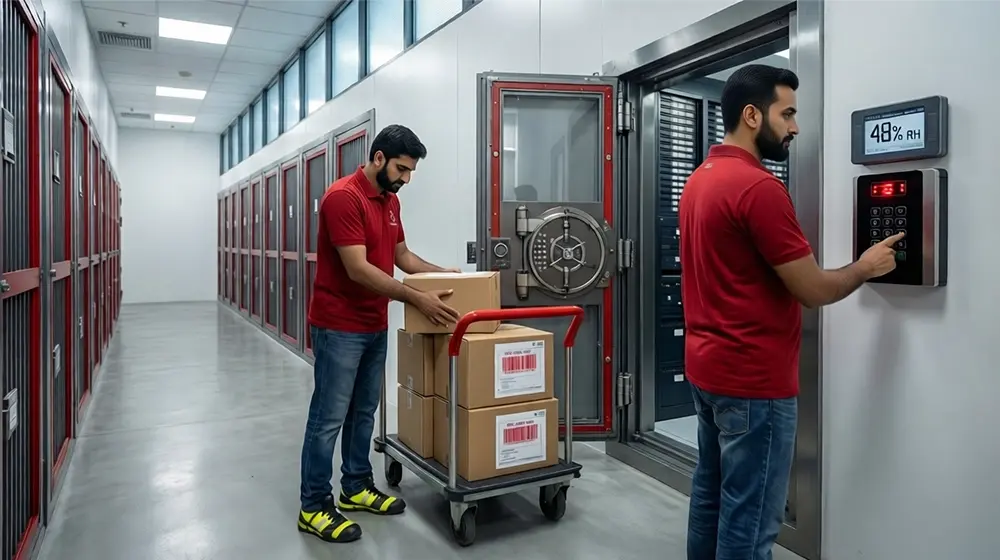
Office movers in Al Ain face a different problem set when a UAEU or Al Hosn staff housing transfer runs through a controlled security gate. One missing ID. One unregistered vehicle plate. One missed booking window. The result becomes a queue, a re-approval loop, and a higher final cost.
This article explains how security gate access rules shape outcomes in staff housing transfers, and how permits, visitor lists, vehicle validation, and time-slot controls connect into a single access plan.
Benefits of reading this article
- Reduce gate rejections by converting IDs, permits, and booking windows into a single access plan with verifiable checkpoints.
- Reduce delay cost by mapping road restrictions and on-site time slots into measurable dispatch buffers backed by evidence records.
What makes UAEU and Al Hosn staff housing transfers different from standard office relocation in Al Ain?

Restricted access changes the move from a transport task into a controlled-entry workflow. Staff housing sites run identity verification, visitor logging, vehicle validation, and time-slot enforcement. These controls resemble commercial transport compliance logic, where permits and accountability define activity permission. Abu Dhabi Mobility describes the Asateel platform as a permit and accountability system for commercial transport in the Abu Dhabi Emirate.
Office movers in Al Ain who treat staff housing transfers as “arrive and unload” face predictable friction. The gate team prioritizes safety, resident privacy, and shared-area protection. The move plan succeeds when it aligns with those constraints.
What are “security gate access rules” for office movers in Al Ain on staff housing transfers?
Security gate access rules are the site’s documented controls for who enters, when entry occurs, and what proof supports entry. These rules usually include identity checks, vehicle details, time-slot validation, and restrictions on loading zones.
A controlled site usually applies 3 filters:
- Identity filter: The person matches the approved visitor list.
- Authorization filter: The unit has a validated request from the occupant or admin office.
- Scheduling filter: The arrival time matches the booking window and resource plan.
Access rules exist because staff housing properties operate like critical facilities in one aspect: they control perimeter entry and shared infrastructure. Elevators, loading bays, corridors, and parking lanes function as shared assets that require scheduling discipline.
The visitor management scale provides a measurable context. Industry analysts estimate the global visitor management system market value at USD 1.7 billion in 2024, with growth expectations through the next decade. This market growth reflects widespread adoption of digital visitor logs, ID workflows, and compliance records.
Which permits matter for office movers in Al Ain on UAEU and Al Hosn staff housing transfers?
Permits are split into 2 categories:
- Transport permits
- Site access permissions
1. What transport permits cover?
Transport permits are tied to vehicles, and access permissions are tied to the property. Abu Dhabi’s commercial transport environment includes digital permit frameworks for commercial transport activity via the Integrated Transport Centre’s platforms, including Asateel. Transport permits also relate to commercial transport authorization for regulated activities.
Asateel documentation describes the platform as a registration and permits application environment for companies, vehicles, and drivers active in regulated segments.
2. What site permissions cover?
Site permissions govern building entry, loading zones, service elevator use, and booking windows. These approvals often take the form of:
- Move-in or move-out approval reference
- Community or building NOC
- Pre-registered visitor list and vehicle plate list
In Abu Dhabi, tenancy formalization commonly uses Tawtheeq, an attested contract approved by the municipality, which often functions as the tenancy record used in administrative checks.
Practical implication for office movers in Al Ain: Treat “permits” as a bundle, not a single document. Vehicle compliance and site permission operate independently. A compliant truck still faces gate rejection if access approval and the booking window are missing.
Which access controls matter most for UAEU and Al Hosn staff housing transfers?
Perimeter access controls matter most because they decide whether the move starts at all. The highest-impact controls are identity verification, authorization verification, and booking window validation.
United Arab Emirates University (UAEU) employee services messaging indicates formal administrative documentation as a baseline requirement for lawful residence and employment processes. That administrative culture typically carries into housing-related workflows, including who can authorize access and how authorization is recorded.
Tawtheeq’s role as an attested, municipality-approved contract provides another anchor for administrative verification in Abu Dhabi tenancy contexts.
Which IDs and documents do gates typically verify for staff housing transfers?

Gates verify identity and authorization. The exact list varies by site policy, but the logic stays stable.
Identity documents
- Identity: Emirates ID or passport-based ID for visitors, depending on site policy.
- Authorization: Tenant authorization letter or admin approval reference linked to the unit.
- Tenancy record: Tawtheeq record reference where tenancy verification is part of the workflow.
- Mover credentials: Company trade license copy and vehicle plate details, where sites request contractor validation.
Authorization and occupancy documents
- Tenancy proof reference used by the administration, often linked to Tawtheeq in Abu Dhabi contexts
- Unit authorization message or letter from the occupant or staff housing admin
- Move request confirmation from the building or community portal where used
Company and vehicle documents
- Company trade license copy, where requested by site policy
- Vehicle plate details pre-registered for the booking window
- Driver details tied to the registered vehicle where commercial transport compliance applies
What are booking windows, and why do they control staff housing transfers?
Booking windows are pre-approved time slots for arrival, loading, and shared resource use. They control outcomes because they allocate scarce shared assets: service elevators, loading bays, corridor clearance, and security staffing.
Booking windows connect directly to cost escalation. Labor hours increase when a crew waits outside the gate. Vehicle idle time increases. Internal teams lose time coordinating re-entry approvals.
Booking windows also support documentation consistency. Gate teams reconcile the arrival with the approved request. A mismatch triggers rejection or delay.
Visitor management adoption trends provide a quantitative backdrop. Mordor Intelligence reports that software represented 71.40% of the visitor management system market share in 2025, and cloud held 66.34% in 2025, showing the dominance of digital workflows in access control.
Digital workflows make gate checks faster, but they also reduce flexibility. A digital slot mismatch becomes visible immediately.
Which road restrictions affect arrival timing for office movers in Al Ain?
Road restrictions affect arrival timing when vehicles use restricted corridors. Abu Dhabi Mobility announced a ban on truck movement on Sheikh Maktoum bin Rashid Road (E11) and Al Raha Beach Road (E10), with additional peak-hour restrictions on Al Rawdah Road (E30 segment), effective December 1, 2025.
News reporting confirms the rerouting statement and effective date.
Operational implications for booking windows
- Route variability increases near restricted corridors.
- Arrival buffers become measurable risk controls.
- Late arrival increases missed slot probability, and missed slots amplify gate friction.
If a move plan ignores corridor restrictions, the move shifts from controlled to reactive. That shift creates rework in gate approvals and increases labor standby.
How does a security gate plan integrate with a permit plan?
A combined plan treats permits and access as two layers with one timeline.
Combined plan logic
- Permit layer: Commercial transport permit compliance for regulated activity in Abu Dhabi via Asateel.
- Site layer: Building or community access permission, visitor registration, and booking window.
The combined plan prevents “compliance gaps.” A transport-compliant vehicle still faces denial without access approval. A fully approved booking still faces late arrival if route restrictions disrupt timing.
What is the fastest access plan that reduces gate rejection for office movers in Al Ain?
A fast access plan is a documented chain that links occupant authorization, visitor identity, vehicle details, and booking window proof.

Access plan in 9 steps
- Identify the approving authority for the unit and common areas.
- Confirm booking window rules for gate entry and elevator use.
- Collect visitor identities for all crew members.
- Create a visitor list with names matching ID documents.
- Collect vehicle identifiers: plate, vehicle type, driver name.
- Submit an access request using the site’s preferred channel.
- Archive approval evidence: email, portal confirmation, or reference number.
- Create an arrival buffer aligned to road restrictions and site opening times.
- Prepare the evidence pack for handover and claims control.
Facilities management checklists support the same planning-first logic. IFMA’s relocation preparation checklist includes early identification of what moves, technology coordination, and structured preparation steps.
What cost drivers appear when a crew misses a booking window?
A missed booking window creates measurable cost drivers. These drivers often appear as time blocks, not as “damage” events.
Common drivers
- Labor standby time: Crew paid hours increase while access is pending.
- Vehicle idle time: Truck time increases without productive movement.
- Re-entry cycle time: Admin coordination time increases for re-approval.
- Operational downtime: Internal teams lose scheduled hours for handover.
Downtime statistics provide a relevant comparator for the value of time controls. Industry reporting on downtime often cites high rates of service impact during downtime events, such as 46% of companies reporting the inability to deliver services during downtime. This is not a moving-specific figure. It is a planning benchmark for how time loss converts into service impact.
What causes cost escalation in staff housing transfers even when the move is “simple”?
Cost escalation starts when access friction increases labor hours and repeat trips. The main drivers are waiting time, re-entry approvals, elevator conflicts, and restricted loading availability.
Cost escalation patterns also track broader relocation disruption patterns. Employee experience research and workplace transition reporting frequently point to disruption and productivity loss during office moves, which translates into indirect costs even when the physical move is short.
Cost escalation triggers
- Gate rejection due to a mismatched visitor list.
- Vehicle mismatch against the booking request.
- Arrival outside the booking window.
- On-site rule conflicts, including loading bay restrictions.
- Missing sign-off at handover, increasing claim processing time later.
Which gate rejection reasons happen most often in restricted-access moves?
Gate rejection reasons cluster into a few repeat categories. Each category has clear control.
Top rejection categories and controls
- Visitor mismatch: Visitor list differs from arriving crew.
Control: Approved list with exact names and ID type.
- Vehicle mismatch: Plate differs from the booking record.
Control: Submit plate and driver details, and avoid last-minute substitution.
- Slot mismatch: Arrival occurs outside the booking window.
Control: Dispatch buffer with route constraints logged.
- Authorization gap: Unit approval absent or unclear.
Control: Admin confirmation record tied to unit.
- Resource conflict: Service elevator not booked.
Control: Elevator booking reference and on-site coordinator.
Visitor management market share data supports why digital logs amplify mismatch detection. Cloud-based visitor management holds a majority share in many analyses, which increases reliance on pre-registration and validation.
What maps access documents to gate checks and booking windows?
| Gate control | Document or data element | Attribute values that pass checks | Common failure mode | Control artifact |
|---|---|---|---|---|
| Identity verification | Visitor list + ID | Full name match, ID type recorded | Name variation, missing ID | Visitor list with ID type |
| Unit authorization | Approval reference | Unit number, date, approver contact | No approver trace | Email or portal reference |
| Vehicle validation | Vehicle plate + driver | Plate matches booking, driver name logged | Plate substitution | Vehicle sheet attached to the request |
| Time-slot validation | Booking window proof | Slot start time, slot end time, resource details | Late arrival | Dispatch buffer record |
| Commercial transport compliance | Permit registration record | Company, vehicle, driver registered where applicable | Unregistered vehicle | Asateel permit workflow record |
What is the minimum “evidence pack” that reduces claim friction after staff housing transfers?

The minimum evidence pack is 4 elements:
- Inventory IDs
- Condition photos
- Exception notes
- Signed acceptance
This pack reduces disputes because it links item identity to condition at two points in time.
Claims and dispute readiness depend on factual documentation, not narrative. A well-structured pack creates a short chain of proof. It also avoids ambiguous language in incident reporting.
Evidence pack checklist
- Inventory ID sheet: Cartons and assets, numbered.
- Photo log: Close-range damage-prone surfaces, time-stamped.
- Exception register: Missing items, scratches, dents, access delays, signed by the receiving party.
- Acceptance sign-off: Unit number, date, receiver name, signature.
This approach aligns with quality assurance logic. A consistent record set supports audit trail quality and reduces ambiguity.
What are the most common pain points for admin teams coordinating UAEU and Al Hosn staff housing transfers?
The most common pain points are schedule mismatch, missing documentation, and last-minute access changes. These pain points create escalation loops: gate rejection causes delays, delays cause missed bookings, missed bookings cause re-approval cycles.
Facilities and workplace relocation research repeatedly frames relocation as a multi-stakeholder coordination problem that requires alignment between facilities and real estate perspectives.
In practice, the “coordination” bottleneck appears at the gate because that is where policy meets real-world timing.
What does an inventory system look like for staff housing transfers?
A quantified inventory system assigns IDs and counts to items and cartons. It creates measurable control points.
Inventory fields
- Carton count by room: Bedroom, living, office, corner, storage.
- Asset IDs: Laptops, monitors, printers, docking stations, chairs.
- High-risk item flags: Fragile, glass, electronics, confidential files.
- Handling method: Two-person lift, trolley, crate.
Example
- 42 cartons total
- 11 IT cartons
- 6 fragile cartons
- 2 printers
- 14 chairs
Inventory quantification supports controlled loading inside limited booking windows. It reduces time spent searching and recounting at the gate or lobby.
Which engineering and material controls reduce damage in narrow booking windows?
Material controls reduce damage by reducing handling events and stabilizing loads.
Packing and handling controls by item class
- IT equipment: Anti-static protection, labeled cartons, sealed inventory log.
- Monitors and screens: Rigid corner protectors and upright orientation.
- Desks and cabinets: Edge protection and surface wrap to prevent abrasion.
- Appliances: Immobilized components and tilt limits marked on cartons.
Short booking windows increase handling intensity. Material controls reduce rework by reducing damage probability and inspection time.
What timeline reduces delays for office movers in Al Ain handling staff housing transfers?
A timeline reduces delays when it locks admin approvals before dispatch. A practical planning window uses days, not hours.

Below is a timeline model aligned to booking logic and road restrictions that affect truck movement timing in Abu Dhabi.
7-step timeline
- Day 7 to Day 5: Tenancy authorization confirmed and admin contact locked.
- Day 5 to Day 4: Visitor list and vehicle list collected.
- Day 4 to Day 3: Booking window requested and confirmed.
- Day 3 to Day 2: Inventory ID plan and condition logging plan finalized.
- Day 2 to Day 1: Route and timing aligned to corridor restrictions where applicable.
- Move day: Gate entry timestamps recorded, exceptions logged in real time.
- Day +1: Handover sign-off validated, claim exceptions closed or escalated with evidence pack.
Conclusion: Gate Access Controls Decide the Move Outcome
Office movers in Al Ain who handle UAEU and Al Hosn staff housing transfers succeed when access is treated as a controlled system, not a last-minute admin step. Security gate rules convert small mismatches into hard delays. Visitor identity, vehicle plate validation, permits, and booking windows form one operating chain. When that chain is documented, gate rejection risk drops. When it is incomplete, queue time rises, costs escalate, and handover quality declines.
This guide mapped the control points that matter most: perimeter entry checks, permit layers, digital visitor workflows, and time-slot enforcement. It also defined the minimum evidence pack that reduces claim friction through inventory IDs, condition logs, exception notes, and signed acceptance. The outcome stays predictable when approvals, arrivals, and handover evidence remain linked to the same record trail.