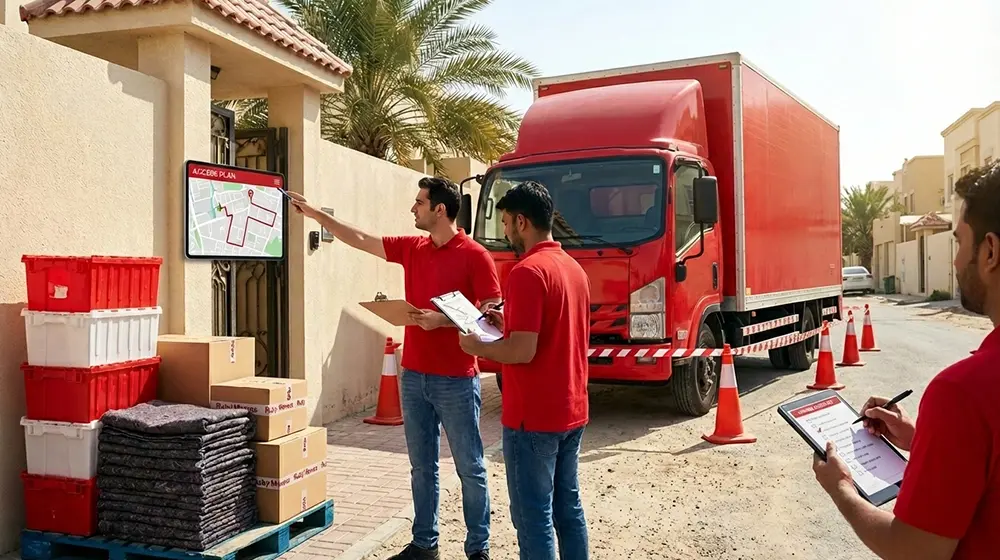
Downtown Dubai office moves do not fail because a truck is late. They fail because one missed access slot, one untracked firewall, or one bad cutover step turns a night move into a business outage. In towers with strict loading bay rules and limited service lift windows, the margin for error is thin. Add IT security, and the stakes jump again, because laptops, servers, switches, and backup media carry confidentiality and availability risk.
This guide breaks down what “zero downtime” actually means in measurable terms, then shows the seven proof points serious office movers use to deliver after-hours relocations safely. Expect checklists, evidence packs, acceptance tests, and red flags you can use to select a vendor with confidence.
What benefits come from reading this guide?
- Faster vendor selection using a proof-based checklist tied to downtime cost, cyber controls, and Dubai compliance artifacts.
- Lower outage risk by converting “IT secure office move” language into measurable controls, evidence packs, and testable acceptance criteria.
Downtown Dubai office relocations compress risk into a narrow time window. Building access constraints, elevator allocation, loading bay rules, and tenant operations create a logistical boundary that favors after-hours execution. IT security raises the bar further because devices, storage media, and identity systems carry confidentiality, integrity, and availability obligations.
What does “zero downtime” mean in an after-hours IT secure office move?

Zero downtime means 0 minutes of unplanned outage across the agreed cutover window for agreed critical services.
Zero downtime definition in operational metrics
| Metric | Definition | Target example |
| Planned cutover window | Time slot approved for changes | 22:00 to 06:00 |
| Unplanned outage minutes | Minutes outside the approved plan | 0 minutes |
| Critical service list | Systems that define “business open” | Core network, internet, VoIP, identity, ERP |
| Acceptance test | Tests that prove service restoration | Ping, DNS, VPN, SaaS login, VoIP call test |
| Rollback trigger | The event that ends the move attempt | Packet loss threshold, auth failure, switch fault |
What makes the Downtown Dubai office moves unusually sensitive to downtime?
Downtown Dubai office moves run inside a tight supply, high-occupancy market that increases operational pressure and reduces scheduling flexibility. Prime office occupancy sits above 95 % in core districts such as DIFC and Business Bay, and Dubai’s H2 2024 average office lease rates rose 9.1 % across key submarkets.
Key market constraints that directly affect move planning:
- High occupancy corridors: Occupancy rates in the DIFC, Downtown Dubai, and Business Bay currently range between 95 % and 99 %, driven by tenant demand and limited new space. which increases elevator conflicts, loading bay contention, and access window competition.
- Rents and fit-out cycles: Business Bay rents rose by an average 46 % in the cited market update, which often compresses handover timelines and creates tight cutover windows.
- Institutional grade occupancy: CBRE tracked 94.0 % average occupancy for institutional grade buildings in Q1 2024, which aligns with a “flight to quality” pattern and heavier building governance.
Quick evidence map for office movers in Downtown Dubai
| Proof point | What the mover states | What a procurement or IT team asks for | What the proof looks like | Red flag signal |
| 1. Verifiable legal identity | “Licensed office movers” | Trade licence identity, activity scope, issuing authority | Licence reference, activity list, legal name match across quote and invoice | Quote name differs from the licence entity |
| 2. After-hours access readiness | “After-hours move available” | Access window plan, loading bay booking, and lift reservation method | Method statement with timestamps and building touchpoints | “We manage access” with no written plan |
| 3. Chain of custody for IT | “IT secure handling” | Serialized inventory, transfer log, seal control | Chain-of-custody log with dates, times, and handlers | Boxes move without serial capture |
| 4. ESD and hardware protection | “Server handling expertise” | ESD program basis and packaging controls | ESD handling SOP aligned to recognized standards | Loose packing, no anti-static controls |
| 5. Cutover engineering | “Zero downtime” | Cutover runbook, rollback plan, validation tests | Runbook, test evidence, sign-off gates | No rollback or no test checkpoints |
| 6. Confidentiality and data protection | “NDA available” | NDA plus data handling policy alignment | NDA, data access constraints, secure disposal path | Shared credentials, informal access |
| 7. Closeout audit | “Move completed” | Reconciliation, discrepancy handling, and post-move KPI report | Final asset reconciliation and incident register | No reconciliation report |
Proof Point 1: How do office movers in Downtown Dubai prove legal identity and authorized scope?
Proof starts with a licence lookup that matches the invoice entity name, activity scope, and contact identity. This step reduces dispute friction and clarifies liability.
Dubai’s licensing infrastructure includes the Dubai Unified Licence (DUL) framework, described as a “business identity” concept used to streamline business interactions. Invest in Dubai describes DUL as a unified identifier for businesses.
Verification actions:
- Match the legal entity name across the quote, contract, and invoice.
- Confirm the licence issuer and licence number via official lookup channels.
- Check the licensed activity scope against “moving,” “relocation,” “packing,” or relevant logistics activities.
- Confirm VAT registration identifiers on the tax invoice, when applicable.
Evidence artifacts that scale well:
- Trade licence copy with issuing authority details.
- Company stamp and authorized signatory ID on the contract signature page.
- Insurance certificate holder details aligned with the licensed entity.
Downtown Dubai nuance: High-value fit-out and premium tower environments raise reputational exposure. Knight Frank reports prime office occupancy above 95% in key districts such as DIFC and Business Bay, with 1.28 million sqft of new office demand in 2024. High occupancy correlates with tighter operational scheduling for building services, including move windows.
Proof Point 2: How do office movers in Downtown Dubai prove after-hours execution readiness?
After-hours readiness equals a timed access plan that aligns people, loading bay flow, lift allocation, and noise constraints. A mover proves this with a written method statement that shows time stamps and dependencies.
Downtown Dubai buildings vary by owner and management rules, so the proof focuses on process, not promises. A credible plan names each control point.
Control points that appear in strong after-hours plans:
- Loading bay entry time.
- Security desk registration method.
- Service lift booking reference.
- Floor protection and corridor protection plan.
- Waste removal and packaging disposal routing.
Noise governance also matters in mixed-use zones. Dubai Development Authority Circular 613 states construction activities are permitted 7:00 AM to 8:00 PM and references residential noise limits of 45 to 60 dBA during those hours. Office relocation differs from construction, yet the circular shows that regulated time windows and noise constraints exist in Dubai operations planning.
After-hours documentation bundle:
- Method statement with minute-level timeline.
- Risk assessment tied to lift, glass, marble, and corridor constraints.
- Crew roster with role mapping and supervisor escalation.
Operational pain point this solves: Elevator bottlenecks. A schedule without lift allocation becomes a downtime amplifier because IT cutover depends on physical arrival times.
Proof Point 3: How do office movers in Downtown Dubai prove an IT secure chain of custody?
IT security during a move requires traceability for every device handoff from rack to rack. A mover proves it with serialized inventory, sealed containers, and documented transfers.
NIST OSAC draft guidance states that evidence collection and preservation practices focus on maintaining integrity by preventing tampering, alteration, or loss, and defines chain of custody as chronological documentation that records transfers, including dates, times, and both parties. These principles adapt well to enterprise IT moves because the goal stays the same: traceability and integrity.
Chain-of-custody design for IT-secure office moves:
- Serialize assets at the device level, not the box level.
- Seal crates and totes with tamper-detection tape or seals.
- Log every transfer event with handler identity and timestamp.
- Separate high-risk assets such as firewalls, domain controllers, backup media, and privileged laptops.
Inventory fields that support audits:
- Device class: Server, switch, firewall, storage, laptop.
- Origin: Rack and U position or desk identifier.
- Destination: Rack and U position or desk identifier.
- Seal number and tote ID.
- Asset tag or serial number.
Downtime linkage: ITIC reports security as a top-ranked downtime cause in its survey results, with high percentages attributing outages to security issues and human error. Treat custody as a downtime control, not only a loss prevention control.
Proof Point 4: How do office movers in Downtown Dubai prove ESD and hardware protection for IT assets?
Hardware protection equals controlled handling plus ESD controls for sensitive electronics. A mover proves this by aligning procedures with recognized ESD program standards and by showing packaging discipline.
The IEC describes IEC 61340-5-1 as an ESD control program requirements document. The ESD Association notes that IEC 61340-5-1 is technically equivalent to ANSI/ESD S20.20 and frames both as ESD control program standards.
ESD handling controls that belong in an IT move SOP:
- Anti-static packaging for ESD-sensitive devices.
- Grounding and personnel control inside staging zones.
- Controlled unpacking zones inside the destination office or data room.
- Shock and vibration control for storage arrays and blade chassis.
Packaging proof signals:
- Anti-static materials for components and accessories.
- Foam-in-place or engineered cushioning for servers and storage.
- Upright handling labels for devices with transport orientation constraints.
- Climate and humidity considerations for prolonged staging, when staging exceeds a few hours.
Common failure mode: Accessory loss. Missing rails, SFP modules, and power cords trigger delays that translate directly into cutover slippage. Chain-of-custody plus ESD packaging reduces that risk.
Proof Point 5: How do office movers in Downtown Dubai prove “zero downtime” cutover engineering?
Cutover engineering equals a runbook with checkpoints for service continuity, validation, and rollback. A mover proves it through integration with the client’s IT team and by producing execution evidence.
Uptime Institute reports that third-party provider issues account for nearly one in ten outages in 2023, reflecting dependence on cloud and hosting. A relocation interacts with third parties such as ISPs, cloud access, and colocation cross-connects. Cutover planning treats those dependencies as scheduled controls.
What does a credible zero-downtime runbook contain?
A credible runbook contains a timeline, owners, validation tests, and rollback triggers. It also defines the “no impact” boundary in business terms.
Example cutover timeline
| Time block | Activity | Owner role |
| T minus 14 days | Asset discovery and application dependency map | Client IT lead |
| T minus 7 days | ISP readiness confirmation and IP plan | Network engineer |
| T minus 3 days | Backup verification and snapshot evidence | Systems admin |
| T minus 1 day | Staging labels and seal register | Move lead + IT |
| Cutover window start | Parallel run activation | IT operations |
| Mid-window gate | Service validation tests | App owners |
| Cutover window end | User access confirmation | Service desk |
| Post window + 24h | Exception reconciliation | IT + mover |
What validation tests fit “office movers in Downtown Dubai” scenarios?
Validation targets identity, connectivity, and data integrity. These three categories reflect the fastest failure modes after a physical move.
- Identity: SSO login and MFA flow for a test user group.
- Connectivity: VPN, office LAN, Wi-Fi, and VoIP registration checks.
- Integrity: Sample file access, database read checks, and backup job status.
Downtime economics lens: ITIC reports that the “hourly cost of downtime exceeds USD 300,000” for a large majority of firms. A single hour of slippage changes the cost basis of the move more than most packing cost deltas.
Proof Point 6: How do office movers in Downtown Dubai prove confidentiality alignment with data protection obligations?
Confidentiality proof equals contractual controls plus operational controls for data exposure pathways. A mover proves it with NDA coverage, access restriction design, and documented handling procedures.
Data protection obligations vary by jurisdiction and zone. DIFC has its own Data Protection Law framework. The UAE also enacted a federal personal data protection law (Federal Decree-Law No. 45 of 2021) accessible via the official legislation portal.
IBM’s 2024 report reports a global average breach cost of USD 4.88 million, and shows the Middle East average breach cost at USD 8.75 million in the country or region table. This places confidentiality controls inside a financial risk frame, not only a legal frame.
Confidentiality controls that map to move operations:
- Restricted access to server rooms and IT closets via a named personnel list.
- Badge or ID logging during after-hours access.
- “No photography” and “no personal device use” rules in sensitive zones.
- Secure containment for backup media and removable storage.
Contract artifacts that support governance:
- An NDA that covers subcontractors, not only the primary vendor.
- Subcontractor disclosure list with role scope.
- Incident reporting clause with notification time parameters.
Proof Point 7: How do office movers in Downtown Dubai prove closeout quality, audit readiness, and dispute resilience?
Closeout proof equals reconciliation against the baseline inventory and a documented exception workflow. A mover proves it with a final asset register, discrepancy log, and sign-off gates.
NIST chain-of-custody guidance emphasizes documenting transfers and maintaining traceability. The same logic supports closeout: reconciliation confirms possession, location, and integrity.
What does a strong closeout pack contain?
A strong closeout pack contains a reconciled inventory, an incident register, and a KPI summary. It also contains evidence that the mover returned access badges, keys, and temporary passes.
Closeout:
- Asset reconciliation: Delivered, missing, damaged, quarantined.
- Seal reconciliation: Seals issued, seals broken, seal exceptions.
- Incident report: Root cause, corrective action, preventive action.
- Timeline adherence: Planned versus actual by milestone.
- Photo evidence: Limited to infrastructure context, excluding sensitive screens and documents.
Downtown Dubai reality factor: Premium buildings prefer rapid restoration of common areas. Closeout documentation helps align building management expectations with tenant governance.
What does a Downtown Dubai after-hours office relocation timeline look like?
A usable timeline uses checkpoints every 15 to 30 minutes and assigns one owner per checkpoint. That structure reduces decision ambiguity under time pressure.
| Time | Phase | Owner | Output |
| 20:30 | Final user comms | IT lead | Banner and comms sent |
| 21:00 | Freeze non-essential changes | CAB owner | Change freeze logged |
| 22:00 | Begin pack down | Move lead | Asset scan complete |
| 23:30 | Transit to the new site | Security lead | Chain of custody intact |
| 00:30 | Rack and patch | Network lead | Uplinks live |
| 02:00 | Service validation | App lead | Acceptance tests pass |
| 03:00 | User pilot access | Service desk | Pilot group green |
| 06:00 | Closeout | Program lead | Sign off complete |
What procurement questions expose real IT secure capability from office movers in Downtown Dubai?
The highest signal questions request evidence, not reassurance.
- What downtime model do you use, and what inputs define hourly cost in this project scope?
- What dependency map format do you deliver, and who signs it?
- What chain of custody fields appear in your handling log?
- What privacy and security obligations apply, and what controls map to each obligation?
- What ESD controls do you apply for drives and modules, and what standards do you reference?
- What building access artifacts do you obtain for Downtown Dubai, and what time windows define the method statement?
- What acceptance tests define “zero downtime” sign off, and what rollback triggers stop the cutover?
What legal identity checks reduce vendor risk in Downtown Dubai office moves?
Legal identity checks reduce dispute risk by tying the invoice entity to a searchable licence identity.
Invest in Dubai provides a license search interface that supports searching by license number, Dubai Unified License number, and business name. The Dubai Unified Licence summary describes one official identity with a single license number and QR code across services, applying to mainland and free zone companies.
Practical licence verification workflow
- Collect the license number and Dubai Unified Licence number from the quotation header.
- Match the legal name on the quote to the license record.
- Match the bank account beneficiary name to the licensed entity name.
- Match the invoice issuer to the same legal entity name.
What are the highest probability failure modes in after hours zero downtime office relocation?
The most common failure modes cluster around human error, incomplete dependencies, and uncontrolled handoffs. Uptime Institute’s estimate places human error as a contributor in two-thirds to four-fifths of downtime incidents, so the plan has to reduce procedure gaps and execution drift.
High signal red flags
- No dependency map: No port map, no IP plan, no service owner list
- No chain of custody: No serial scan at handoff, no seal IDs
- No rollback thresholds: No hard stop rules, only vague escalation
- No acceptance tests: No documented pass fail criteria
- Unclear legal entity: Quote and invoice names differ, license record unclear.
Key Takeaways: Downtime Is a Metric, So Your Mover Must Be Measurable
A Downtown Dubai after-hours office move is a controlled cutover, not a transport job. When buildings run tight lift windows, security checkpoints, and loading bay constraints, every missing document becomes a time leak. In that environment, “zero downtime” only stays real when the mover can prove readiness before the first crate moves. The seven proof points in this guide convert sales language into a procurement-grade standard: a verifiable legal entity, a minute-mapped access plan, a device-level chain of custody, ESD safe handling, a signed runbook with rollback thresholds, confidentiality controls that match UAE and DIFC expectations, and a closeout audit that reconciles every asset and seal.
If you take only one idea from this guide, make it this: select movers the same way you select critical suppliers. Ask for artifacts, not assurances. When the evidence is complete, the move window becomes predictable. When it is not, the hidden cost shows up as outage minutes, incident tickets, and recovery calls after sunrise.