Moving an outdoor kitchen is very different from moving a few garden chairs. A built-in BBQ may connect to gas, a pergola may be fixed into paving, and an outdoor fridge may need careful disconnection before villa movers can handle it safely.
For anyone comparing outdoor kitchen movers in Dubai, BBQ moving services, pool furniture movers, or garden equipment moving in Dubai, the real issue is knowing what can move and what must stay. Built-in masonry, gas lines, structural fixings, landlord-installed features, and heavy outdoor furniture all require different handling.
This guide explains how outdoor kitchens, BBQ units, pool loungers, pergolas, shade structures, outdoor fridges, and other fixed or semi-fixed items are assessed, disconnected, dismantled, cleaned, packed, and documented during a villa move. It also addresses one question that often causes confusion: whether a tenant-installed outdoor kitchen can actually leave the property.
Which outdoor installations can and cannot be moved?
Freestanding outdoor furniture and appliances can be moved after cleaning, disconnection, and packing. Built-in masonry, plumbed gas lines, fixed counters and structures tied into the villa fabric are different: movers do not simply lift them; ownership and specialist removal come first.
That distinction controls every later step in the outdoor moving plan.
A built-in versus freestanding table helps separate standard pool furniture moving from construction, utility, or tenancy issues.
| Outdoor item | Freestanding or built-in | Normal moving treatment | Main constraint |
| Pool lounger | Freestanding | Clean, dry, wrap and load | Water, chlorine residue, loose wheels |
| Portable BBQ | Freestanding | Cool, clean and secure components | LPG cylinder stays off the moving truck |
| Outdoor fridge | Usually freestanding or under-counter | Empty, disconnect, dry and secure | Power, water line, ventilation clearance |
| Modular outdoor cabinet | Semi-fixed | Remove fixings, label modules and pack | Anchors, worktop joints, wall connections |
| Pergola | Often fixed or semi-fixed | Assess fixings before dismantling | Anchors, roof load, wiring, structure |
| Masonry BBQ island | Built-in | Leave unless removal is agreed and feasible | Gas, stonework, services, landlord position |
| Paved kitchen counter | Built-in | Normally remains in place | Forms part of the villa fabric |
The key test is not weight. A 50 kg freestanding table may be simpler to move than a lighter cabinet anchored into masonry.
Look for four connections during the site survey: wall or floor fixings, gas, electricity and water. Any connection changes the job scope. Villa movers can pack and transport a released appliance, but utility disconnection may sit outside the moving crew’s work.
Dubai summer conditions also affect outdoor staging. Dubai Municipality’s heat-stress guidance says shade can reduce radiant heat load by at least 10°C. The guidance calls for a 10°C to 15°C difference between work and shaded recovery areas.
For a villa move, this supports early outdoor staging and shaded dismantling. Metal frames, fixings and tools also become difficult to handle after prolonged direct sun exposure.
For villa moving in Dubai summer heat, schedule the most exposed garden, pergola and BBQ handling earlier in the day and keep dismantled components in shade instead of using the driveway as long-term staging space.
What happens to a built-in outdoor kitchen?
A built-in outdoor kitchen is divided into permanent construction and removable equipment before dismantling starts.
Record the BBQ body, worktop, cabinets, sink, fridge, electrical outlets, gas connection and floor fixings separately. One photographed “outdoor kitchen” entry does not show which parts can legally or technically leave.
When comparing villa movers in Dubai, confirm that the survey distinguishes removable appliances from masonry, fixed services and structural components so the moving quote covers only the parts that can actually be released and transported.
- Fixed masonry and what stays with the property
Fixed masonry normally stays with the villa unless the lease, owner and technical assessment support removal.
Blockwork bases, tiled counters, stone slabs bonded to supports and permanently fixed service points differ from ordinary furniture. Removing them becomes closer to alteration or demolition than household packing.
For rented villas, the tenancy position deserves attention before a mover loosens a fixing. Dubai Land Department’s real estate legislation states in Article 19 of Law No. 26 of 2007 that tenants cannot make changes or restoration works without landlord permission and required licences. Article 20 links the security deposit to property maintenance.
Article 21 adds another useful test. A tenant returns the property in the condition received, apart from ordinary wear or damage outside the tenant’s control. More directly, Article 23 says a tenant cannot remove tenant-made leasehold improvements when vacating unless the parties agree otherwise.
That does not mean every BBQ cabinet automatically belongs to the landlord. Classification depends on the installation, agreement and facts. It does mean a resident who built an outdoor kitchen cannot safely treat every installed part as movable property.
The practical sequence is:
- Check the tenancy contract and any fit-out approval.
- Photograph the outdoor kitchen before removing anything.
- Ask the landlord in writing which tenant-installed elements may be left.
- Record any restoration requirements, including holes, paving, or utility points.
- Release the moving crew only after the fixture question is settled.
This is practical landlord ownership guidance, not individual legal advice. A disputed installation belongs in a landlord, property manager or legal conversation before moving day.
The Dubai Land Department unified tenancy contract also requires written landlord approval for amendments or additions and makes tenants responsible for resulting damage.
- Appliances that can be removed
Removable appliances can travel after their fixed utility connection has been safely released.
Common examples include grill inserts, outdoor refrigerators, beverage coolers and removable ice makers. The appliance model matters because installation and transport requirements vary.
For an outdoor fridge, emptying it is only the first step.
GE Appliances instructs owners to switch the refrigerator off before moving, disconnect power, remove food and secure loose shelves or trays. GE also recommends upright transport where possible. Some compact, French-door and bottom-freezer models require upright transport.
That changes packing. Shelves do not remain loose inside the cabinet. Doors stay secured without damaging the finish. Water or ice-maker lines are isolated before the appliance reaches the moving crew.
A removable BBQ insert follows the same principle. Release the service connection first. Pack the appliance second.
How are gas-connected BBQ units handled?
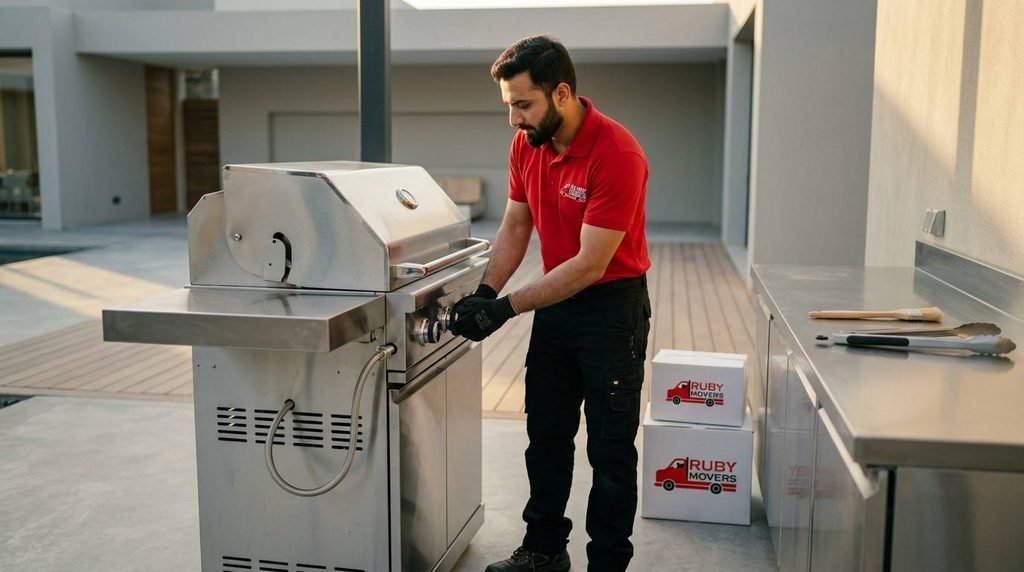
Gas-connected BBQ units require gas isolation before movers touch the appliance, and a household moving truck is not the place for an LPG cylinder.
Gas safety note: Treat a plumbed villa gas connection as specialist work. Dubai Civil Defence maintains a category for approved companies that install and maintain gas systems. Use the relevant approved gas-system technician for fixed gas-line disconnection.
A cylinder-fed BBQ needs a different plan. Close the cylinder valve, separate the fuel source according to the appliance instructions and keep the cylinder out of the household removal load.
Dubai Municipality’s LPG cylinder safety guideline requires competent supervision during cylinder handling. The guideline also requires upright positioning, protected valves and protection from dropping, rolling or dragging. Cylinders above 13 kg capacity cannot be stacked.
Transport is also regulated. Dubai Roads and Transport Authority conducted 4,322 household-gas distribution inspections across 2023, 2024 and the first half of 2025. The campaigns produced 1,098 violations and involved a regulatory committee containing 15 entities.
RTA identified unauthorized gas transport among serious violations and impounded about 170 non-compliant vehicles. RTA also instructed gas distributors to use licensed vehicles.
For BBQ moving in Dubai, the operational rule is therefore clear: arrange cylinder collection, exchange, or compliant transport separately. Do not place the cylinder among furniture in an ordinary moving vehicle.
The BBQ itself still needs preparation. Allow the unit to cool fully. Remove grease trays, cooking grates and loose internal parts before wrapping.
A manufacturer example supports this separation. Weber’s moving guidance requires LPG disconnection before moving a gas barbecue. Its manuals also instruct users to close the cylinder valve before regulator disconnection.
How are pool loungers, pergolas and shade structures dismantled?
Pool loungers require limited disassembly, while pergolas require a fixing-by-fixing dismantling plan.
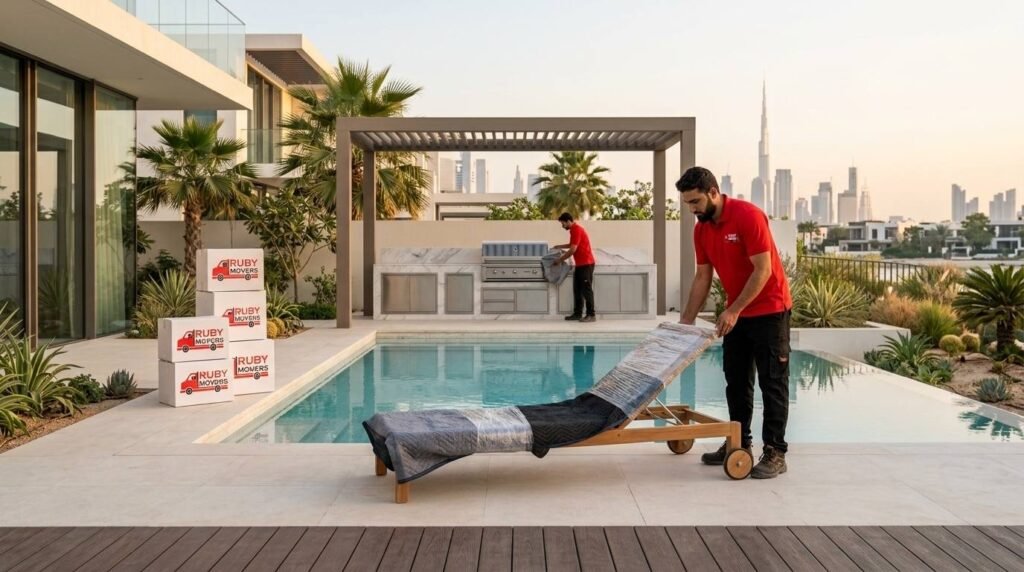
Start with freestanding pool furniture. Remove cushions, glass tops, umbrellas, detachable wheels and loose hardware. Drain hollow in-pool furniture before wrapping.
Label hardware by the item it came from. “Lounger 4 left arm” gives the reassembly crew more information than a bag marked “pool screws.” Pergolas require another method because the fixings carry structural load.
Plan dismantling and reassembly as one linked task: photograph the assembled item, label each section and fixing, and confirm that the destination can accept the same components before dismantling starts.
Photograph the complete structure first. Record posts, cross-members, roof sections, wall brackets, floor anchors and electrical accessories. Then determine whether the structure can actually be removed.
A pergola bolted through paving remains semi-fixed only if approved removal does not damage the villa or compromise the structure. A pergola integrated into a wall, roof or electrical system moves into the fixed-installation category.
Long sections also create a bulk problem. Measure the longest dismantled beam against the villa gate, loading path and truck body before removing it. A relatively light beam can become harder to transport than a much heavier chair. Dubai heat makes this outdoor stage more sensitive.
The MOHRE Occupational Heat Stress Prevention Policy has operated for more than two decades and reported over 99% compliance for several consecutive years in its 2025 announcement.
For villa movers, the useful point is scheduling. Outdoor pergola and garden-equipment dismantling involves more time in direct sun than loading sealed indoor cartons.
This is where garden equipment moving in Dubai and indoor furniture moving are operationally separate. Heavy and awkward outdoor items require their own dismantling window.
How are outdoor items cleaned before loading?
Outdoor items are cleaned, dried and staged separately so sand, pool chemicals, insects and moisture do not enter the wrapped household load.
Treat outdoor furniture and garden packing as a separate preparation stream, with cleaning, drying, pest checks and labeled hardware completed before these items are wrapped with the indoor household inventory.
Start with dry contamination. Brush or vacuum sand from chair joints, cabinet tracks, pergola channels and BBQ storage compartments. Sand trapped beneath stretch wrap can abrade painted, powder-coated or polished surfaces during vibration.
Poolside furniture needs a fresh-water rinse when its material permits one. Dubai Municipality requires private pools to use chlorine or bromine feeding or another automatic disinfectant system. Its pool-plan guideline also specifies one filtration device, two pumps and a maximum four-hour water turnover for a private pool.
Those controls confirm that pool furniture operates around chemically treated water. Cleaning advice then depends on the furniture manufacturer.
For example, POLYWOOD’s care guidance tells owners of in-pool furniture to rinse away chlorine, salt and residue, then allow the furniture to dry completely. Its deep-clean instructions cap pressure washing at 1,500 psi and specify at least 12 inches between the nozzle and furniture.
Do not apply those pressure figures to another brand automatically. Use the item’s own care instructions.
Drying matters before wrapping. Trapped water can sit inside hollow loungers, umbrella bases and tubular frames. Drain these pieces first.
Pest transfer creates another reason for separate staging. Dubai Municipality’s Public Health Pest Control Section monitors pests including mosquitoes, flies and rodents across Dubai and regulates pest-control providers.
Inspect storage boxes, folded covers, hollow furniture bases, and rarely moved planters before loading. Evidence of active infestation needs treatment outside the moving truck, not concealment beneath packing film.
Which outdoor installations belong to the landlord?
An outdoor installation may remain with the landlord when it forms part of the villa or qualifies as a tenant-made leasehold improvement. Ownership, therefore, depends on more than who bought the BBQ, counter, pergola or cabinets.
Document fixtures and the tenancy handover together so the landlord’s written position, approved alterations, removable components, and any reinstatement work are settled before the moving crew starts taking fixed items apart.
This is the information gap that causes trouble during outdoor kitchen moves.
A tenant may have paid AED thousands for an outdoor kitchen and still face a removal restriction. The key question is whether the installed work became a leasehold improvement.
Dubai Land Department Article 23 provides the clearest starting point: unless the parties agree otherwise, a tenant cannot remove tenant-made leasehold improvements when surrendering the property.
Article 20 also allows a landlord to hold a security deposit for property maintenance at lease expiry. Article 21 links handover to the condition in which the tenant received the property.
For move planning, use a four-part fixture test:
- Attachment: Does removal disturb masonry, paving, walls or structural anchors?
- Approval: Did the landlord approve the installation or later agree to removal?
- Services: Does the item connect to fixed gas, power, drainage or water?
- Reinstatement: What remains after removal, including holes, pipework and damaged finishes?
A portable BBQ normally falls on the movable side. A grill permanently inserted into a stone island requires a closer look.
The same distinction applies to pergolas. A freestanding shade frame differs from a structure anchored into the villa and connected to lighting.
Get the landlord’s position in writing before dismantling disputed fixtures. This avoids asking the moving crew to make an ownership decision at the property.
Again, this is practical moving guidance rather than individual legal advice.
Where outdoor and garden packing is documented
Outdoor and garden packing belongs on its own moving inventory because outdoor kitchens, pool furniture and fixed installations carry different disconnection, cleaning and dismantling requirements.
Record each item during the villa survey rather than adding “garden furniture” as one line.
A useful inventory entry contains the item name, location, ownership status, dimensions, connection type, dismantling requirement and destination. Add photographs for fixed items and unusual fixings.
For example:
- Outdoor fridge: Freestanding, electrical connection, dry before packing, upright transport.
- Built-in BBQ: Gas-connected, specialist isolation required, grill insert removable after release.
- Pool loungers: Six units, cleaned and dried, cushions packed separately.
- Pergola: Anchored structure, dismantling subject to ownership and fixing assessment.
- BBQ cylinder: Excluded from household moving truck and handled through the appropriate gas channel.
The inventory also records tasks that belong outside the mover’s scope. Gas disconnection, structural alteration and disputed fixture removal remain separate work orders.
That separation gives villa movers a clean loading list. It also tells the resident what still needs approval before moving day.
Outdoor kitchens are therefore not handled as one large piece of furniture. A villa move separates permanent construction, removable equipment, regulated gas components and ordinary outdoor furniture before anything reaches the truck.
Plan the outdoor move before moving day
Outdoor kitchens, BBQ units, pergolas and pool furniture cannot be treated as one group of garden items. A villa move works better when each item is classified before packing begins as freestanding, semi-fixed or built-in.
Start with the outdoor survey. Record gas, power, water, drainage, structural fixings, dimensions and ownership status. Gas-connected BBQs require specialist isolation, while LPG cylinders stay outside the ordinary household moving load.
Resolve landlord questions before anyone removes masonry, pergola anchors or tenant-installed outdoor kitchens. Dubai tenancy rules can restrict removal of leasehold improvements unless the parties agree otherwise.
FAQs
No. A moving survey should separate masonry, appliances, cabinets, gas connections and removable components because each part requires different handling.
Reusable fixings can travel when they remain undamaged, but the new installation needs fixings suitable for the destination surface and pergola specification.
Prepare the outdoor fridge before packing by emptying it, disconnecting utilities, removing loose internal parts and allowing wet surfaces to dry fully.
Photograph fixing points, gas or electrical connections, assembled structures, existing damage, and labeled components so reassembly and property-condition checks remain traceable.
Bilal Al-Madani
Bilal Al-Madani is a logistics professional specializing in residential relocations and supply chain optimization. With deep experience in the moving industry, he excels in ensuring transit safety, implementing advanced packing methods for high-value items, and managing transport fleets efficiently. He is committed to simplifying the moving process through careful planning, delivering each relocation with precision, reliability, and exceptional attention to detail.