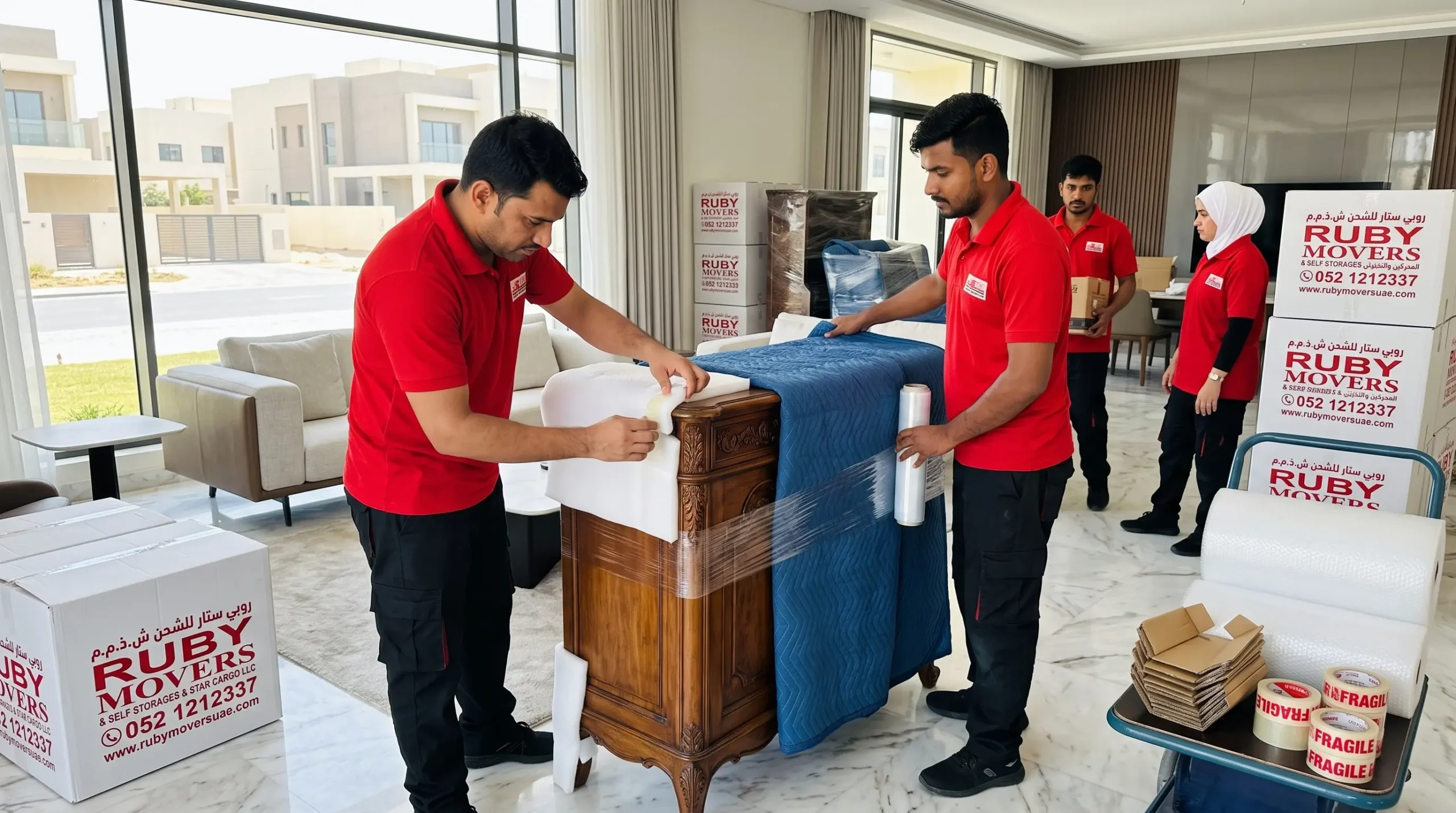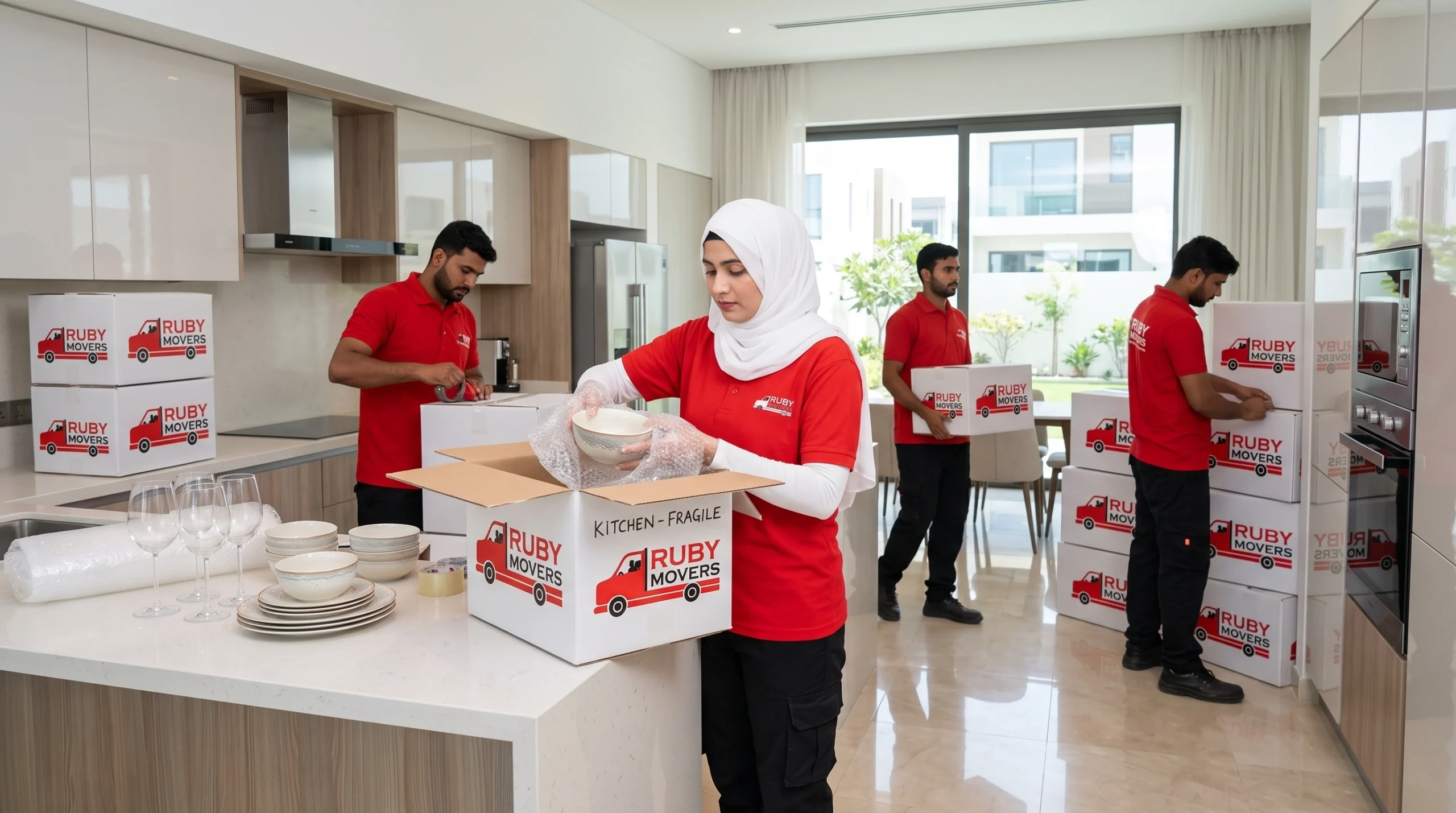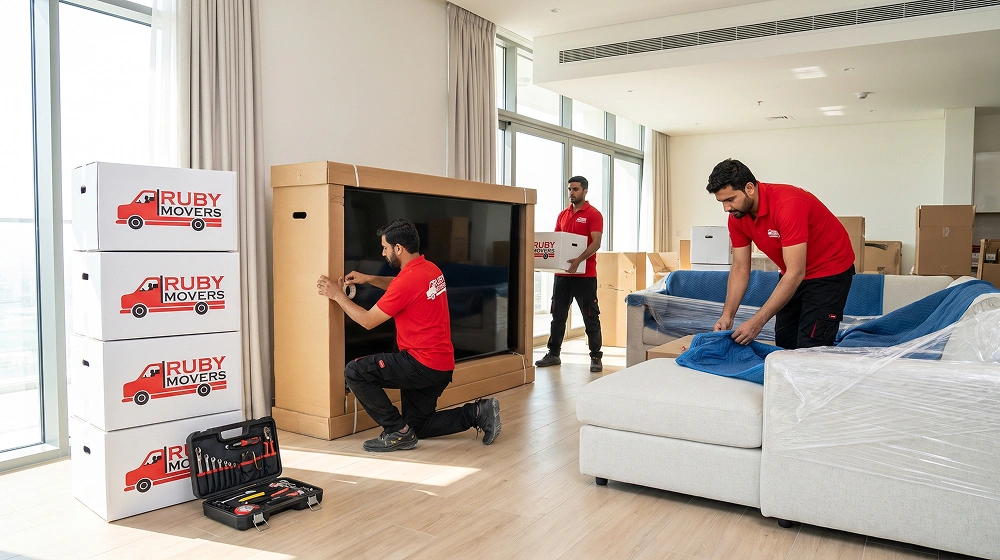
Two four-bedroom villas can receive very different moving quotes. The difference often sits behind cupboard doors, inside storage rooms, or across the garden.
Packing volume measures the actual space your boxed and protected belongings occupy. It affects carton quantities, bubble wrap, wardrobe boxes, fragile packing, labor hours, truck capacity, and trip planning. A bedroom count alone cannot capture those details.
This guide explains how packing volume changes a villa moving quote in Dubai. It covers the rooms that create the most volume, the link between cubic meters and box count, the effect on crew hours and truck size, and the extra space required for outdoor or fragile items. It also shows how to reduce unnecessary volume before requesting a villa packing cost Dubai estimate.
What is packing volume in a villa move?
Packing volume is the external cubic space occupied by packed belongings, protected furniture, cartons, crates, and wardrobe boxes.
The measurement uses length multiplied by width multiplied by height. A box measuring 0.60 by 0.40 by 0.50 meters occupies 0.12 cubic meters. Ten identical boxes occupy 1.20 cubic meters.
According to the National Institute of Standards and Technology (NIST), one cubic foot equals exactly 0.028316846592 cubic metres. This conversion compares carton specifications in cubic feet with Dubai quotes in cubic meters.
Packing volume differs from bare item volume. Bubble wrap, corrugated board, corner guards, blankets, and crates enlarge external dimensions. Dismantling may reduce the furniture cube, but it adds labor hours.
A regulated household-goods tariff defines a cube sheet as an inventory with cubic footage for each item. It also requires local estimates to state personnel, vehicles, and expected hours. These rules do not set Dubai prices, but they show what a measurable quote can contain.
The tariff uses at least 7 pounds per cubic foot for some weight estimates. That equals about 112.1 kilograms per cubic meter using NIST conversions. Treat this as an industry reference, not a Dubai rate.
Which rooms create the highest packing volume?
Kitchens, fitted wardrobes, garages, stores, and formal living rooms create the highest packing volume when they contain many separated or protected items.
Two 4-bedroom villas may have equal built areas but different pantry stock, clothing, books, artwork, garden furniture, and stored equipment.
Dubai villa comparison block
These calculations use official carton capacities as measurement units. They are worked examples, not standard room allowances.
- Kitchen: Eighteen 3-cubic-foot cartons plus six 5-cubic-foot dish packs equal 84 cubic feet, or 2.38 cubic meters.
- Bedroom wardrobes: Eight wardrobe boxes plus six 6-cubic-foot linen cartons equal 116 cubic feet, or 3.28 cubic meters.
- Garage: Twelve 6-cubic-foot cartons equal 72 cubic feet, or 2.04 cubic meters, before bicycles or shelving.
- Majlis: Carton volume may stay low, while mirrors, lamps, and display cabinets increase fragile packing.
The Washington Utilities and Transportation Commission lists 3, 4.5, and 6-cubic-foot cartons. It lists dish packs at 5 cubic feet or more and wardrobe cartons at 10 cubic feet or more.
It is advised for residents to leave goods in their original rooms and decide what travels before packing. This helps the surveyor assess each room instead of estimating a mixed pile.
A Dubai survey also needs the maid’s room, roof area, external store, garage cabinets, and garden. A missed storage area removes its cartons and handling work from the initial quote.
How does packing volume affect box count?
Packing volume affects box count through carton size, item density, weight distribution, fragility, and protective space.
The table converts recognized household-goods carton capacities into cubic meters. It shows how larger cartons change the surveyed cube.
| Packing unit | Capacity | Metric volume | Ten units occupy |
| Standard carton | 3 cubic feet | 0.085 m³ | 0.85 m³ |
| Medium carton | 4.5 cubic feet | 0.127 m³ | 1.27 m³ |
| Large carton | 6 cubic feet | 0.170 m³ | 1.70 m³ |
| Dish pack | 5 cubic feet | 0.142 m³ | 1.42 m³ |
| Wardrobe box | 10 cubic feet | 0.283 m³ | 2.83 m³ |
The tariff provides the capacities, while NIST provides the exact conversion. The table does not reproduce tariff prices or suggest Dubai charges.
Consider this worked villa packing schedule:
- Twenty-four 3-cubic-foot cartons
- Eighteen 4.5-cubic-foot cartons
- Twelve 6-cubic-foot cartons
- 8 wardrobe boxes
- 6 dish packs
These 68 packages occupy 335 cubic feet, or 9.49 cubic meters. The figure excludes sofas, beds, appliances, garden items, loading gaps, and furniture wrapping.
This explains why “about 70 boxes” gives an incomplete home packing estimate. The same count can occupy very different volumes when carton sizes change.
Books need smaller cartons to control lifting weight. Bedding uses larger cartons and consumes vehicle cube faster. Box count and cubic volume therefore require separate quote lines.
How does packing volume affect crew hours?
Packing volume increases crew hours because every packed unit requires preparation, wrapping, sealing, labeling, carrying, and loading.
A universal cartons-per-hour figure would mislead you. The United Kingdom Health and Safety Executive links manual-handling risk with load weight, carrying distance, frequency, posture, floor conditions, and equipment.
The agency recommends smaller loads, shorter carrying distances, handling aids, and staffing changes where repetitive carrying creates risk.
Compare 2 quotation structures:
- 5 workers for 7 hours equal 35 crew-hours.
- 4 workers for 9 hours equal 36 crew-hours.
The second quote has fewer workers but nearly the same labor input. Compare total crew-hours, not crew size alone.
Twelve linen cartons follow one repeated method. Twelve framed artworks require measurement, corner protection, surface protection, labeling, and controlled placement.
Ask the mover to separate packing, dismantling, carrying, loading, and destination setup. A single “full-service crew” line hides which task changes when packing volume rises.
How does packing volume affect truck size?
Packing volume affects truck size by setting the minimum internal cargo capacity required for the packed load.
Truck tonnage does not state cubic capacity. Vehicles with similar weight ratings can have different body dimensions. Your quote needs usable cubic meters.
Use this calculation:
- Carton cube + protected furniture cube + irregular-item cube = surveyed packed volume
Suppose carton volume equals 9.49 cubic meters and protected furniture adds 14.00 cubic meters. The subtotal becomes 23.49 cubic meters.
A 22-cubic-meter body cannot carry 23.49 cubic meters in one trip. The mover changes the vehicle, adds a trip, or reduces the scope.
Dubai route timing can affect that plan. The Roads and Transport Authority (RTA) restricts trucks on part of Emirates Road towards Sharjah between 5:30 p.m. and 8:00 p.m. The restriction started on 1 January 2025.
RTA later reported incidents falling from 75 to 37 on assessed corridors. Average speeds rose by 26 kilometers per hour on Emirates Road and 19 kilometers per hour on Sheikh Mohammed bin Zayed Road. Route timing therefore affects crew hours and trip planning.
A villa move between Arabian Ranches and Jumeirah may fit one truck by volume. The route and loading window still determine whether one shift works.
How do outdoor and fragile items increase volume?
Outdoor and fragile items increase volume because protective shells enlarge dimensions and prevent tight stacking.
A bare mirror measuring 1.80 by 1.00 by 0.05 meters occupies 0.09 cubic meters. Add a 5-centimeter allowance around each dimension, and the external cube becomes about 0.31 cubic meters.
That protected mirror occupies about 3.5 times its bare volume. The allowance illustrates geometry, not a packing specification.
Official tariff categories show the same effect. Dish packs use at least 5 cubic feet. Wardrobe cartons use at least 10 cubic feet. Crates use gross external cubic footage, including the container.
Garden chairs may nest, but planters, barbecue units, parasol bases, bicycles, and play equipment leave unusable gaps. Crews cannot stack normal cartons on unstable items.
Replace vague descriptions with counted inventory:
- Record 8 chairs instead of “garden set.”
- Record 4 framed artworks instead of “wall decor.”
- Record 3 planters with dimensions instead of “plants.”
- Record 1 dismantled treadmill instead of “gym equipment.”
These details improve fragile packing, bubble wrap quantities, truck planning, and the villa moving quote.
How should residents reduce unnecessary packing volume?
Residents reduce unnecessary packing volume by removing unwanted belongings before the survey, not by reducing essential protection.
Use this pre-quote checklist:
- Open every wardrobe, kitchen cupboard, store, and garage cabinet.
- Separate items for moving, donation, sale, recycling, return, or disposal.
- Count packed cartons and record their external dimensions.
- Measure mirrors, planters, exercise equipment, and dismantled furniture.
- Photograph fragile items and restricted access points.
- Confirm cartons, bubble wrap, wardrobe boxes, crates, and mattress covers.
- Request cubic meters, crew hours, truck capacity, trip count, and exclusions.
- Update the mover after any material inventory change.
FIDI recommends deciding on travel early and keeping items in their normal rooms for professional packing. Both actions protect room-by-room packing accuracy.
Do not reduce the quote by overloading boxes. Load weight, shape, grip, carrying distance, and frequency affect manual-handling risk.
A smaller inventory reduces carton cube directly. Thinner protection around a fragile item changes the agreed packing standard rather than removing unnecessary volume.
Measure the load before comparing the price
A villa moving quote becomes useful when it explains what the mover measured. Bedroom count alone cannot reveal full wardrobes, stocked kitchen cabinets, garage equipment, outdoor furniture, or fragile artwork.
Packing volume changes villa moving quote calculations through carton quantities, protective materials, crew hours, truck capacity, and possible extra trips. That chain matters more than a low headline price.
Before accepting a quote, check the surveyed cubic meters against the room inventory. Confirm the carton types, fragile packing, vehicle capacity, crew hours, exclusions, and variation terms. Open every storage area during the survey and report any inventory change before moving day.
The final AED amount deserves attention, but the scope behind that amount matters more. A properly measured load gives you a quote that reflects the villa you are actually moving.
FAQs
Is villa packing cost Dubai calculated only by box count?
Villa packing cost Dubai depend on carton sizes, fragile protection, labor hours, furniture cubes, access, vehicle capacity, and trip count.
Does a site survey produce a better villa moving quote?
A site survey records room contents, item dimensions, packing methods, access, and vehicle requirements before pricing.
How many cubic meters do ten wardrobe boxes occupy?
Ten 10-cubic-foot wardrobe boxes occupy about 2.83 cubic meters using the exact NIST conversion factor.
Why can two four-bedroom villas receive different quotes?
Two four-bedroom villas receive different quotes when cupboard contents, outdoor goods, fragile items, carton sizes, labor hours, or truck requirements differ.
What details make a villa packing quote easier to compare?
A comparable quote states carton types, packed cubic meters, labor hours, crew size, vehicle capacity, trip count, exclusions, and variation terms.
Bilal Al-Madani
Bilal Al-Madani is a logistics professional specializing in residential relocations and supply chain optimization. With deep experience in the moving industry, he excels in ensuring transit safety, implementing advanced packing methods for high-value items, and managing transport fleets efficiently. He is committed to simplifying the moving process through careful planning, delivering each relocation with precision, reliability, and exceptional attention to detail.