Short-term office storage in Sharjah becomes a control problem when records, IT media, and regulated documents leave daily custody and enter third-party handling. The risk concentrates in three areas: fire exposure, humidity exposure, and access exposure. The solution uses timeline gates, measurable specifications, and evidence logs.
Benefits of Reading This Article
- A timeline-gated storage workflow that reduces retrieval delays, scope variation, and evidence disputes during office moves and interim short-term office storage in Sharjah.
- A procurement-ready control checklist that links fire-rated vaults, document humidity control, and AIS-compliant access to measurable specifications, required documents, and verifiable acceptance criteria.
What is short-term office storage in Sharjah?
Short-term office storage in Sharjah is time-limited custody of office records, cartons, and assets inside a controlled facility with defined access rules, environmental parameters, and retrieval SLAs. The time window often ranges from 30 to 180 days because it aligns with fit-out schedules, phased relocation, and tenancy timing.

Which business scenarios drive office movers in Sharjah to use short-term storage?
Short-term storage typically links to relocation and continuity constraints.
- Phased relocation across floors or towers.
- Fit-out delay between handover and occupancy.
- Furniture reconfiguration and IT cutover windows.
- Contract, HR, and finance records kept offsite during renovation.
What does “timeline gates” mean in office storage?
Timeline gates are mandatory checkpoints that block progression unless evidence exists. A gate is a decision point with a documented input, a measurable standard, and a recorded output.
What is the practical gate logic used in procurement?
A gate works as a governance loop.
- Input: Scope, inventory baseline, classification, custody rules
- Standard: Fire rating class, RH range, access control model, SLA
- Output: Signed register, seal log, access record, retrieval proof
Why does Sharjah demand tighter storage governance now?
Sharjah demand increases when industrial and business activity expands, raising the frequency of office footprint changes and operational relocations.
Which quantified market signal supports higher churn and storage demand?
Sharjah industrial real estate reports show high utilization and significant rent growth, which indicates tighter space and more operational reconfiguration.
- A Savills Sharjah Market Report (2024) states that average industrial rents increased by about 101% over four years, and average occupancy reached 95% across Sharjah.
- The same report notes 2024 rent growth of 36.4% in Emirates Industrial City and Al Saja’a, with 28.6% growth across Sharjah Industrial Areas 2–18.
These figures support a simple operational implication: higher occupancy and rising rents correlate with more frequent re-layouts, consolidations, and interim storage events.
Why do fire-rated vaults matter for office records storage?
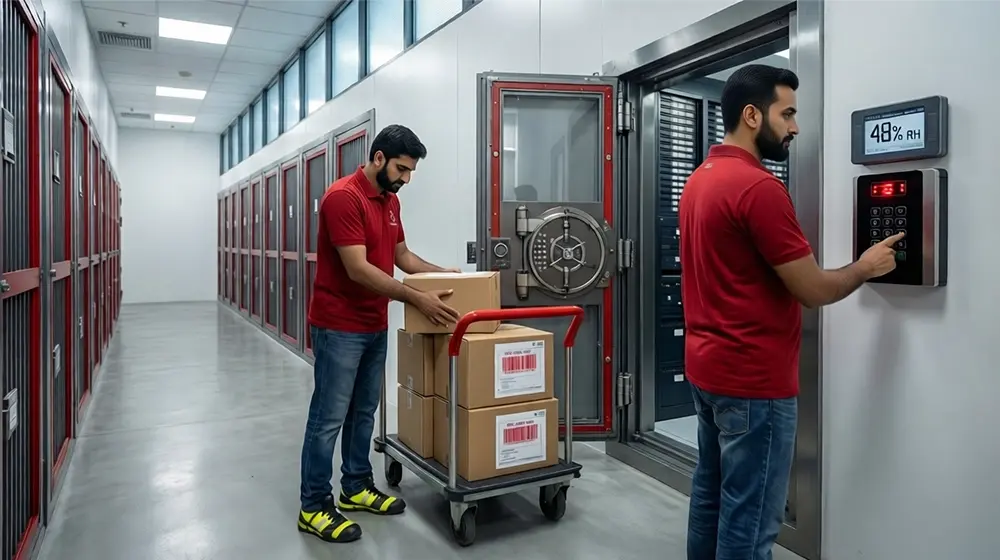
Fire-rated vaults matter because paper and media degrade under heat exposure and smoke contamination long before visible flame contact. Fire rating becomes verifiable only when a quote references a recognized test standard and class.
Which standards define fire resistance testing for record protection equipment?
Two widely used standard anchors exist.
- UL 72 covers fire resistance tests and classification for record protection equipment.
- EN 1047-1 covers fire-resistant storage units for data media and related protection classifications.
Which UAE regulatory anchor connects to fire safety governance?
UAE fire and life safety requirements exist under the UAE Fire and Life Safety Code of Practice, referenced by Dubai Civil Defence resources and UAE Civil Defence documentation.
What fields make “fire-rated vaults” procurement-grade?
A procurement-grade quote contains measurable fields.
- Standard reference, such as UL 72 or EN 1047-1
- Rating duration and class
- Stored media type and protection class
- Compartmentation and placement inside the facility
- Evidence of a maintenance and inspection regime
What is document humidity control in storage?
Document humidity control is continuous management of relative humidity to reduce mold risk, paper deformation, adhesive failure, and ink instability. Humidity control is a preservation control, not a comfort feature.
Reference framework
- ISO 11799 addresses requirements for document storage conditions and preservation in repositories.
Procurement implication
A storage provider describing “AC warehouse” does not equal document humidity control. Evidence includes RH logs, sensor placement, calibration records, and exception reports.
What evidence proves document humidity control inside short-term office storage in Sharjah?
Evidence replaces marketing terms such as “AC warehouse.”

- RH monitoring plan with sensor placement and sampling interval
- Monthly RH trend logs and exception notes
- Calibration records for sensors
- Alarm thresholds and escalation workflow
- Packaging method that avoids carton microclimates
What does AIS-compliant access mean for stored office records?
AIS-compliant access describes access governance that aligns with recognized security programs for sensitive account data, supported by PCI physical access controls and traceability.
Which authority anchors support AIS and physical access control expectations?
- Visa describes account information security (AIS) as an account information security program focused on safeguarding account data.
- PCI physical security guidance includes restricted entry, visitor controls, and authorization by job function for sensitive areas.
- UAE Information Assurance frameworks include physical security and access control themes that support controlled access models.
Office records often contain identifiers, banking references, payroll data, and contract signatures. Physical access becomes a control surface, not a convenience feature.
What are the minimum AIS-aligned access artifacts in a storage facility?
- Authorization matrix listing roles and named approvers
- Visitor management log with identity verification fields
- Access log export fields: person ID, timestamp, zone, reason code
- CCTV retention policy summary and incident handling procedure
- Exception reporting for denied access and after-hours attempts
Which UAE-level authority frameworks support access and physical security controls?
UAE entities often reference national information assurance frameworks that include physical security and access control principles.
- UAE Information Assurance Regulation references physical protection and access controls among control areas.
- The National Information Assurance Framework describes UAE IA standards and includes physical security requirements as part of the broader framework.
Storage relevance
A storage plan that includes controlled access zones, CCTV coverage, and environmental controls maps cleanly to these national control themes.
Where does Ejari renewal timing fit into a Sharjah office storage plan?
Ejari renewal timing fits when a business relocates from Dubai to Sharjah, or when a Dubai lease renewal intersects with a Sharjah fit-out schedule. Ejari remains a Dubai tenancy registration system managed through Dubai Land Department services for registering or renewing tenancy contracts.
Which verified Ejari statistics support tenancy timing relevance?
Dubai Land Department communications provide large-scale rental contract volume indicators.
- Dubai Land Department stated that in 2024, registered rental contracts exceeded 900,000, reflecting 8% growth compared to the previous year.
- A Dubai Land Department annual report shows total rental contracts reached 965,000 in 2024, up from 531,000 in 2020, an 81% increase over four years.
- Saeed Mohammed Al Tayer, MD and CEO of Dubai Electricity and Water Authority (DEWA), announced that DEWA received a total of 742,035 tenancy contract data in 2023, compared to 648,065 contracts in 2022, an increase of about 14.5%.
These contract volumes increase the probability of renewal-driven schedule constraints interacting with relocation timelines.
How does Ejari timing change storage duration in practice?
Ejari renewal timing influences move dates, handover dates, and interim storage duration when:
- Renewal negotiations delay exit timing
- A notice window shifts the move to the next billing cycle
- Fit-out completion and occupancy readiness drift
Timeline gate link
Ejari-linked schedule risk fits into a “storage extension approval gate” that triggers revised pricing, revised inventory snapshot, and updated retrieval SLA.
Which timeline gates control short-term office storage in Sharjah?
Timeline gates break the storage cycle into verifiable stages. Each stage produces evidence that prevents disputes and retrieval failures.
Timeline gate map
- Gate 0: Scope lock
- Gate 1: Risk segmentation and classification
- Gate 2: Pack, seal, and label
- Gate 3: Custody transfer and transport control
- Gate 4: Intake QA and reconciliation
- Gate 5: Environmental control verification
- Gate 6: AIS-compliant access activation
- Gate 7: Retrieval SLA execution
- Gate 8: Exit closeout and liability closure
Timeline gate table
| Gate | Purpose | Minimum evidence outputs | Common failure pattern |
|---|---|---|---|
| Gate 0 | Stop scope drift | Scope sheet, exclusions list, service matrix | “Store everything” ambiguity |
| Gate 1 | Separate high-risk records | Risk matrix, classification labels, handling SOP | Mixed records and general cartons |
| Gate 2 | Preserve integrity | Seal IDs, photo log, carton register | Unsealed cartons, no register |
| Gate 3 | Define custody | Signed handover form, vehicle log | Custody dispute over missing items |
| Gate 4 | Confirm intake | Receiving checklist, reconciliation report | Missing cartons discovered late |
| Gate 5 | Protect materials | RH logs, alarm plan, exception reports | Mold risk and paper deformation |
| Gate 6 | Control access | Authorization matrix, visitor log, and access log export | Unauthorized access claims |
| Gate 7 | Execute retrieval | Ticket, pick log, delivery proof | “Not found” retrieval events |
| Gate 8 | Close out | Final reconciliation, closeout report | Open exceptions and liability gaps |
What timeline gates reduce Ejari-linked schedule risk?
Ejari-linked schedule risk concentrates when a Dubai lease renewal date collides with a Sharjah fit-out timeline.

Three practical gates
- Gate A: 90-day planning gate
A planning window aligns with Dubai renewal change notice norms discussed in official legal references and widely cited practice, with supporting coverage in reputable local media.
- Gate B: Ejari registration gate
Registration or renewal uses the Dubai Land Department service channels for Ejari processes.
- Gate C: Storage extension approval gate
Extension triggers a revised SLA and a revised inventory snapshot.
Storage implication
A storage contract that lacks a controlled extension process often produces unapproved month-to-month charges.
What humidity control evidence is credible for document storage?
Humidity control becomes credible when monitoring, alarms, and exception handling exist.
Evidence pack for document humidity control
- RH monitoring plan with sensor placement and sampling frequency.
- Monthly RH trend chart and exception notes.
- Calibration records for sensors.
- Response procedure for out-of-band RH excursions.
- Packaging method that prevents microclimates in cartons.
Standards anchor
ISO 11799 covers document storage requirements and preservation conditions in repositories.
How do office movers in Sharjah integrate storage gates into a relocation plan?
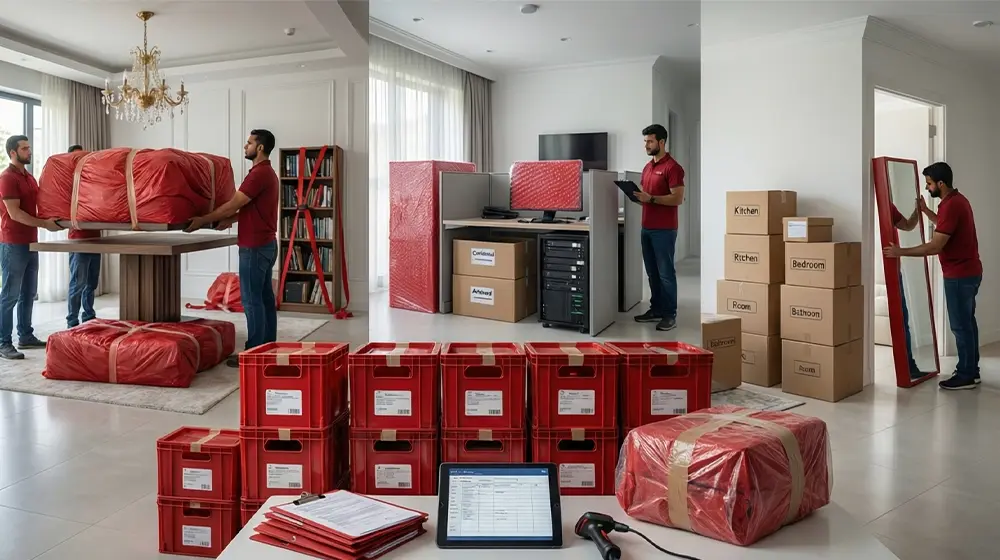
Office movers in Sharjah integrate storage gates by connecting packing, labeling, transport, and handover evidence into one custody chain. Storage becomes a controlled extension of the move, not a separate service.
What is the move-to-storage integration workflow?
- Pre-move survey ties each department to carton ranges and classification labels.
- The pack plan separates record cartons from general cartons using risk segmentation.
- Seal and label produce carton IDs, seal IDs, and photo evidence.
- Custody handover logs signatures at pickup and at receiving.
- Intake QA reconciles counts and issues non-conformance reports.
- Storage conditions start RH monitoring and exception reporting.
- Access governance activates role-based access and visitor logs.
- Retrieval SLA uses ticketing, pick verification, and proof of delivery.
Which records and assets require risk segmentation?
Risk segmentation prevents high-risk items from entering low-control storage. Segmentation uses classification based on confidentiality, legal impact, and media sensitivity.
Risk segmentation matrix
| Storage class | Examples | Core risk | Required controls |
|---|---|---|---|
| Class A: Regulated records | HR files, payroll, contracts | Unauthorized access, dispute risk | AIS-compliant access, logs |
| Class B: Financial evidence | invoices, audit files | Evidence integrity | Seal IDs, chain of custody |
| Class C: IT media | backups, drives | Heat and humidity sensitivity | EN 1047-1 class selection |
| Class D: Standard cartons | stationery, brochures | Low legal impact | standard racking, inventory |
| Class E: Furniture | desks, chairs | damage during handling | handling SOP, condition photos |
What are the most common quote traps in short-term office storage in Sharjah?
Quote traps appear when required specifications remain non-verifiable. The result is cost expansion and evidence gaps.
9 quote traps that create disputes
- Fire-rated vault claim without a standard reference, such as UL 72 or EN 1047-1
- Climate control claim without RH range, RH logs, and exception reporting
- Secure access claim without access logs and visitor controls
- Retrieval SLA described as “subject to availability”
- Inventory described as “approximate cartons”
- Missing non-conformance process for count mismatches
- No segregation method for high-risk records
- Insurance and liability language missing evidence requirements
- Exit closeout missing the final reconciliation and dispute closure process
Which KPIs predict retrieval failure and access disputes?
KPIs predict outcomes when they measure evidence completeness and exception handling.
KPI set for short-term office storage in Sharjah
- Inventory accuracy rate: Intake count match versus dispatch count
- Retrieval SLA compliance rate: Percentage of retrievals within SLA window
- Access exception rate: Denied attempts per month per zone
- RH excursion count: Number of out-of-band RH events per month
- Non-conformance closure time: Days to close intake or retrieval exceptions
Physical access monitoring and visitor control align with PCI physical security guidance.
What cost drivers shape short-term office storage in Sharjah?
Cost drivers map to risk controls and service levels, not only floor area.
Primary cost drivers
- Fire-rated vault classification and duration class
- Humidity monitoring maturity, sensor coverage, and alarm response
- AIS-aligned access governance, staffing, and log retention
- Retrieval frequency and SLA tier
- Intake QA depth and reconciliation detail
- Storage duration linked to tenancy timing and fit-out schedule
A higher control level often reduces downstream rework cost from missing items and retrieval delays.
Cost control table
| Driver | What raises the cost | What reduces the downstream cost |
|---|---|---|
| Driver | What raises the cost | What reduces the downstream cost |
| Fire-rated vaults | higher classification, longer duration | Reduced loss and dispute exposure |
| Humidity control | monitoring, alarms, exception handling | reduced deterioration and rework |
| Access governance | role-based access, logging, staffing | Reduced unauthorized access disputes |
| Retrieval SLA | faster response, higher staffing load | reduced operational downtime |
What does an audit trail look like for stored office records?
An audit trail is a record set that shows custody, conditions, and access.
Minimum audit trail documents
- Inventory register with unique IDs.
- Seal the log with photo evidence.
- Handover form with signatures.
- RH and temperature logs with exception notes.
- Access log and visitor log.
- Retrieval tickets and proof of delivery.
Framework alignment
UAE information assurance frameworks reference physical protection and access control themes that support this evidence approach.
Myth vs reality: What storage teams misinterpret?
Myth 1: Climate control equals document humidity control
Reality: Document humidity control requires measured RH, logs, alarms, and exception handling. ISO-based repository requirements guide conditions.
Myth 2: Secure access equals AIS-compliant access
Reality: AIS-compliant access maps to logged entry, visitor distinction, and authorization by role, similar to physical controls highlighted in PCI guidance.
Myth 3: Fireproof equals fire-rated
Reality: Fire-rated describes a test standard, classification, and duration, such as UL 72 record protection procedures.
Final Closeout: Timeline Gates That Protect Records, Budgets, and Retrieval Outcomes in Sharjah

Short-term office storage in Sharjah performs well when it operates as a controlled system, not a space rental. Timeline gates convert fire-rated vaults, document humidity control, and AIS-compliant access into measurable requirements with verifiable evidence. That structure limits ambiguity and reduces disputes.
A procurement-grade outcome comes from three baselines. A fire-rating claim ties to a named standard and class. Humidity control ties to logged RH performance and documented excursions. Access control ties to authorization, logging, and exception handling. Each baseline produces audit-ready outputs.
Ejari renewal timing adds a schedule layer that changes storage duration and retrieval pressure. A gated extension process keeps scope, pricing, and custody evidence aligned when tenancy dates and fit-out dates drift.
The storage plan remains defensible when the closeout stage reconciles every carton ID, seal ID, and retrieval record. That final reconciliation closes liability and preserves record integrity for legal, finance, HR, and IT stakeholders.