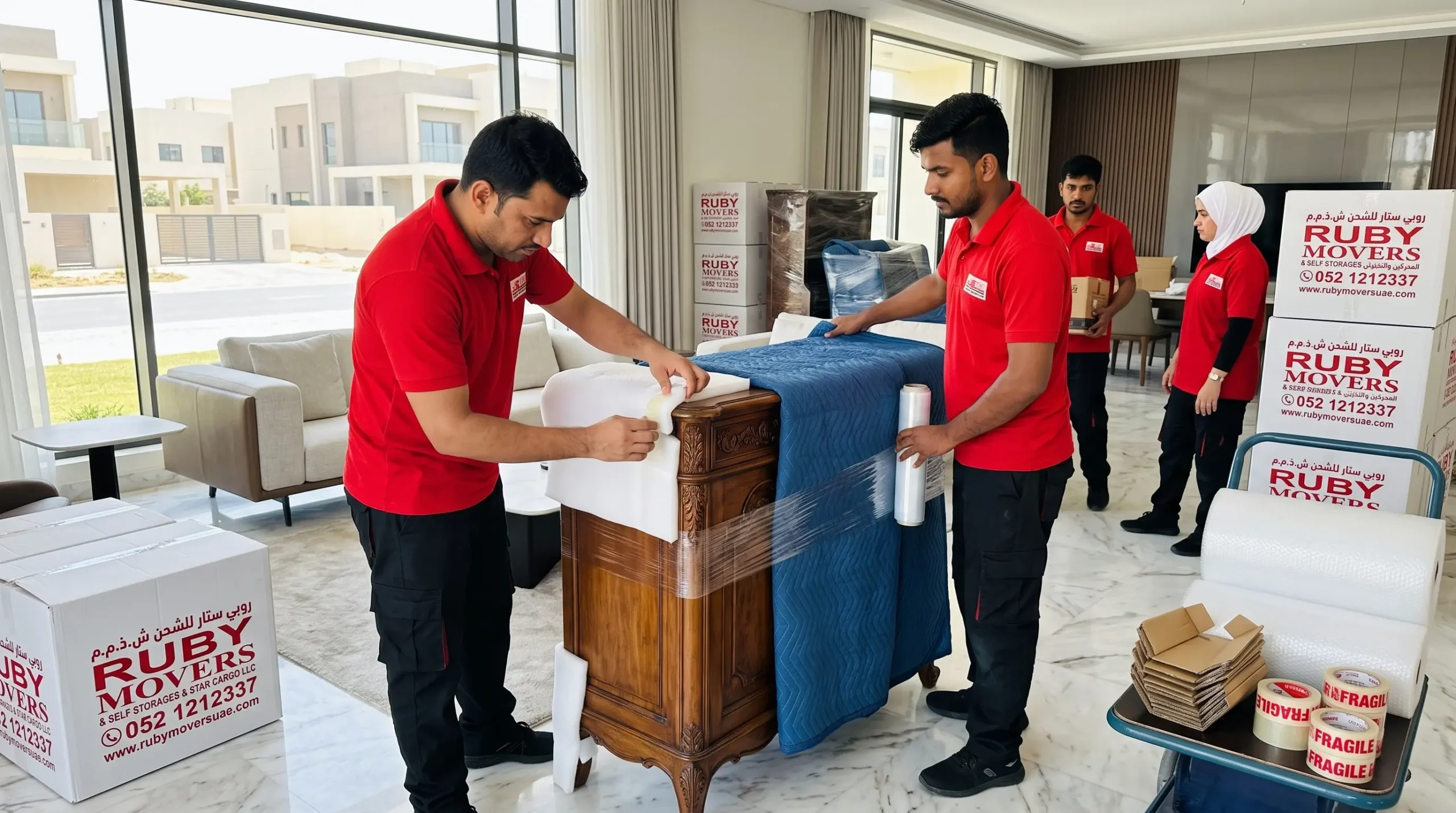
Storage during house shifting in Dubai helps tenants keep furniture, boxes, appliances, and documents safe when the move-out date and move-in date do not match. It is useful when Ejari, DEWA, building access, cleaning, handover, or renovation creates a timing gap.
As of October 2025, Dubai’s population has reached 4,036,863, marking a 5.43% annual increase—an addition of over 208,030 new residents in just one year. According to the Dubai Land Department (DLD), registered tenancy contracts overall rose 6 % in volume and 17 % in value compared to 2024, reaching 1.38 million contracts worth AED 126.4 billion, reflecting continued residential and commercial activity. These figures explain why tenants often face pressure around moving dates, storage availability, mover booking slots, and building access windows.
The benefit of this guide is practical. You get a storage and shifting checklist that protects your belongings, reduces last-minute costs, and supports cleaner move-out and move-in documentation.
What is storage during house shifting in Dubai?
Storage during house shifting in Dubai is a temporary space for household items between pickup from your old home and delivery to your new home. It connects packing, transport, custody, storage, and redelivery into one controlled moving process.
Tenants use storage when the new apartment or villa is not ready on the same day. This can happen because of Ejari registration, DEWA activation, building move permits, landlord handover, maintenance, painting, pest control, or cleaning.
Storage and shifting work together. Shifting moves your items from one property to another. Storage holds those items safely when direct delivery is not possible.
Storage during house shifting in Dubai is not only about space. It is also about evidence, access control, packing quality, insurance terms, and delivery timing.
Why does storage matter more in Dubai moves?
Storage matters in Dubai because tenancy movement is large, regulated, and time-sensitive. In 2025, Dubai’s real estate sector recorded 3.11 million transactions, including sales, leases, and real estate services, up 7 % from 2024.
Dubai’s rental sector also showed strong turnover. New tenancy contracts rose to more than 513,000 in 2025, up 10 %, while renewed tenancy contracts exceeded 514,000, up 3 %, according to the Dubai Land Department.
Storage gives you a buffer. It prevents your moving truck from becoming the backup plan when your new property is not ready.
Which entities affect storage and shifting in Dubai?
The main entities are tenant, landlord, Ejari, Dubai Land Department, Real Estate Regulatory Agency, Rental Disputes Center, Dubai Electricity and Water Authority, building management, community management, moving company, storage facility, furniture, inventory, insurance, handover report, move-out permit, and move-in permit.
Dubai Land Department’s Ejari service registers or renews tenancy contracts in the Emirate of Dubai.
- Step 1: Login to Ejari or the App and select the desired service
- Step 2: Fill in the required information and upload any necessary documents
- Step 3: Proceed to pay the service fees (if any)
- Step 4: An employee will review and approve the request through the system
- Step 5: Receive the e-Contract Registration Certificate by email
This makes Ejari a key document in tenancy administration and move-in readiness.
DEWA’s move-out service states that all previous DEWA bills must be paid in full before requesting move-out. DEWA also states that customer information is shared with the Dubai Land Department for electricity and water deactivation.
Rental Disputes Center describes itself as a specialized judicial system for rental disputes and conciliation procedures. This makes written evidence important when tenants face deposit, damage, access, or handover disagreements.
When do tenants need storage during house shifting in Dubai?
Tenants need storage when the old home must be vacated before the new home can receive furniture. The most common reason is a gap between move-out, handover, and move-in approval.
Storage is also useful for downsizing. A tenant moving from a villa to an apartment often needs time to sort furniture, sell large items, or measure room fit before redelivery.
What must tenants check before move-out?
Tenants must check:
- The tenancy end date
- DEWA move-out
- Building permit
- Storage booking
- Inventory, photo evidence
- Handover requirements before move-out
This prevents the most common timing and documentation problems.
Dubai Law No. (26) of 2007 states that the landlord and tenant relationship is regulated by a written lease contract that identifies the property, lease term, rent, and payment method. The same law also requires lease contracts covered by the law to be registered with the Agency.
Check the tenancy end date
Your tenancy end date controls your move-out timeline. Use the contract date, not a verbal date.
A one-day mismatch can create extra truck waiting time, temporary holding charges, or emergency storage fees.
Check DEWA move-out status
DEWA requires all previous bills to be paid before a move-out request. Tenants also request final bill settlement through the official move-out process.
These records help during handover because utility closure often connects to final settlement.
Check building move-out rules
Many buildings and communities require approval before movers enter. The rule can include service lift timing, loading bay access, security gate clearance, floor protection, and approved mover requirements.
Do this before packing day. A packed home is difficult to manage when the truck cannot enter.
What must tenants check before moving in?
Tenants must check:
- Ejari
- DEWA activation or transfer
- Move-in approval
- Access timings
- Room measurements
- Storage release date
- Elevator booking before move-in
Delivery from storage becomes risky when these items are incomplete.
Check Ejari registration
Ejari registration is a formal tenancy step in Dubai. Dubai Land Department describes the service as the registration or renewal of a tenancy contract in Dubai.
Ejari can affect move-in administration because many property-related services depend on formal tenancy records. Keep a digital copy and a printed copy ready.
Check DEWA activation or transfer
DEWA’s supply-management services include activation, deactivation, and transfer of electricity and water. Your appliances are hard to test without active power and water.
Release refrigerators, washing machines, dishwashers, and smart devices from storage after the DEWA status is clear.
Check move-in permit approval
Move-in approval protects building operations. It allows the facility team to manage lifts, security gates, loading zones, and common-area protection.
Ask for written approval before storage release. Send that approval to your movers and storage provider.
Check room and lift measurements
Large furniture needs measurement before redelivery. Measure doors, corridors, lift dimensions, stair turns, and room walls.
Storage gives you time to dismantle, sell, or redirect furniture that does not fit.
Which documents protect tenants during storage and shifting?
The key documents are the tenancy contract, Ejari certificate, DEWA records, move permits, storage agreement, mover quotation, inventory list, condition photos, insurance terms, and handover report. These documents create an evidence trail.
This table explains each document and its role.
| Document | What it proves | When to prepare | Storage and shifting value |
| Tenancy contract | Lease term and property details | Before booking movers | Confirms move-out and move-in dates |
| Ejari record | Registered tenancy status | Before move-in | Supports property administration |
| DEWA move-out proof | Utility closure request and settlement | Before handover | Supports final account closure |
| Move permit | Building access approval | Before truck arrival | Prevents gate or lift blockage |
| Storage agreement | Storage terms and charges | Before pickup | Confirms custody and access rules |
| Inventory list | Item count and identification | Before loading | Reduces missing item disputes |
| Photo evidence | Item condition before packing | Before wrapping | Supports damage claims |
| Insurance terms | Liability scope | Before payment | Clarifies claim limits |
| Handover report | Property condition at exit | After emptying the unit | Supports deposit discussions |
The table works as a tenant evidence pack. Store every file in one digital folder named with your property, move date, and unit number.
What items need climate-controlled storage in Dubai?
Wood furniture, leather sofas, electronics, artwork, mattresses, paper files, photographs, musical instruments, and high-value décor benefit from climate-controlled storage in Dubai. Heat and humidity can affect materials during longer storage.
The World Bank Climate Change Knowledge Portal provides the United Arab Emirates climate context using observed historical climatology from 1991 to 2020. This supports the basic storage point that Dubai’s hot climate makes indoor storage quality important.
The U.S. National Archives advises keeping family archives below 75 °F and relative humidity below 65 % to reduce mold growth and insect activity. This guidance applies directly to paper files, photographs, certificates, and archived documents.
Smithsonian furniture care guidance also identifies stable temperature and relative humidity as important for furniture preservation. Wood, veneer, leather, glue joints, and finishes react poorly to unstable storage conditions.
| Item | Storage risk | Practical control |
| Wood furniture | Warping, cracking, joint movement | Use stable indoor storage and furniture blankets |
| Leather sofa | Drying, cracking, staining | Use breathable covers and avoid direct heat |
| Paper documents | Mold, insects, brittleness | Use sealed document boxes and dry storage |
| Electronics | Dust, moisture, battery risk | Remove batteries and use dry cartons |
| Artwork | Frame distortion and surface marks | Use rigid packing and vertical placement |
| Mattresses | Odor, moisture, fabric contamination | Use mattress covers and clean storage |
| Musical instruments | Expansion, contraction, finish damage | Use climate-controlled storage |
Basic storage may suit plastic containers, metal items, outdoor furniture, and low-value household goods. Climate-controlled storage suits items where damage costs more than the storage upgrade.
How do tenants prepare furniture for storage?
Tenants prepare furniture for storage by cleaning, drying, dismantling, wrapping, labeling, photographing, and recording each item. This sequence protects the condition and creates a claim record.
Never wrap damp furniture in plastic for long storage. Moisture trapped under plastic can create odor, mold, or surface marks.
For beds and wardrobes, place screws and brackets in a sealed pouch. Label the pouch with the item number. Tape it to the furniture or keep it in a hardware box.
How do tenants create a storage inventory?
Create a storage inventory by assigning one unique number to every box, appliance, furniture item, and loose component. A strong inventory reduces missing item disputes after storage.
Use this format:
| Field | Example | Why it matters |
| Item ID | Box 01, Sofa 01, TV 01 | Creates traceability |
| Room | Master bedroom, kitchen, study | Speeds redelivery |
| Description | White ceramic plates, 24 pieces | Clarifies contents |
| Condition | Used, scratched, fragile, new | Records baseline |
| Packing type | Carton, crate, blanket, cover | Shows the protection level |
| Photo link | Image folder reference | Supports evidence |
| Delivery priority | Open first, deliver last | Supports move-in planning |
Keep one printed copy with the mover and one digital copy with you. Update the list at the storage entry and redelivery.
What items must stay with you?
Keep passports, Emirates IDs, tenancy documents, cheques, jewelry, medicines, laptops, hard drives, chargers, school documents, work files, and daily clothes with you. These items create personal, financial, legal, or work disruption if they go into storage.
Storage is useful for furniture and boxes. It is not suitable for documents or devices that you may need at short notice.
How do tenants compare storage services in Dubai?
Tenants compare storage services in Dubai by checking storage type, climate control, access hours, security, inventory process, insurance terms, redelivery notice, and prohibited items. The cheapest monthly rate does not show the real moving cost.
Compare the total cost from the old home pickup to the new home delivery.
| Storage type | Best use | Main advantage | Main risk |
| Self-storage unit | Boxes and items you access often | You control access | You handle packing and transport |
| Full-service storage | Whole-home storage | The provider manages pickup and delivery | Access may require notice |
| Climate-controlled storage | Sensitive furniture and documents | Better material protection | Higher monthly cost |
| Warehouse storage | Bulk furniture storage | Good for large volumes | Shared handling requires strong labeling |
| Short-term storage | Tenancy gaps | Useful days or weeks | Daily or weekly pricing can add up |
Ask each provider for written answers on storage charges, pickup charges, redelivery charges, packing materials, insurance, and cancellation.
What cost factors affect storage during house shifting?
Storage cost depends on volume, duration, handling, packing material, climate control, access complexity, insurance, and redelivery timing. The monthly fee is only one part of the real cost.
Ask for an itemized quote. Separate packing, transportation, storage, redelivery, dismantling, reassembly, and insurance.
What risks cause damage or delays?
The biggest risks are no permit, weak inventory, poor packing, unclear custody, wrong storage type, unpaid DEWA bills, and rushed redelivery. These risks create damage, delay, and dispute exposure.
Dubai’s official Rental Index service allows users to calculate rental increases and average rentals in the market by entering property details. This shows Dubai’s tenancy environment depends on formal records and official systems, not informal assumptions.
Use the same logic for storage and shifting. Record everything.
| Risk | Likely result | Prevention |
| No move permit | The truck is blocked at the gate | Confirm building approval before pickup |
| No inventory | Missing box dispute | Number every item and box |
| Poor wrapping | Scratches and broken corners | Use item-specific packing |
| No photo evidence | Weak claim support | Photograph before loading |
| Wrong storage type | Heat or humidity damage | Use climate control for sensitive items |
| Unpaid DEWA bill | Handover delay | Settle DEWA before the move-out request |
| Early redelivery | Furniture arrives before access | Release storage after permit approval |
This risk table helps tenants buy the right service, not only the cheapest service.
How does storage support tenancy handover?
Storage supports tenancy handover by emptying the home before cleaning, inspection, repair, and photo evidence. An empty home makes walls, floors, cabinets, appliances, and fixtures easier to inspect.
Dubai tenancy disputes can reach the Rental Disputes Center, which handles rental disputes and conciliation procedures. That makes handover evidence valuable for tenants and landlords.
Take photos after furniture leaves storage, after cleaning, and before the key return. This creates a dated visual record.
How do tenants protect electronics and data?
Tenants protect electronics by removing batteries, packing devices in dry cartons, labeling cables, keeping backups, and carrying confidential storage media personally. Electronics need both physical custody and data custody.
The National Fire Protection Association identifies lithium-ion battery fire risk in devices and batteries. During moving and storage, battery awareness matters for laptops, power banks, tools, toys, and rechargeable devices.
Do not store business-critical devices without checking insurance and access terms.
What is the best timeline for storage and shifting?
The best storage timeline starts 2 to 4 weeks before move-out for an apartment and earlier for villas, large families, and high-value furniture. Large moves require more packing, dismantling, access booking, and storage estimation.
The timeline reduces urgent decisions. Urgent decisions usually increase cost and damage risk.
What final checklist protects tenants?
This final checklist protects tenants before and after storage during house shifting in Dubai.
- Before move-out
- During storage
- Before move-in
This checklist keeps storage, shifting, tenancy administration, and handover evidence in one workflow.
Final thoughts
Storage during house shifting in Dubai is a planning tool for tenants, not only a place to keep furniture. It protects your belongings when tenancy dates, Ejari, DEWA, building permits, handover inspections, or maintenance work create a gap.
The safest approach is simple. Confirm documents first. Pack by material risk. Create photo evidence. Store with an inventory. Release items only after move-in access is approved.
Dubai’s rental market recorded 1.38 million tenancy contracts worth AED 126.4 billion in 2025, so tenants operate in a busy moving environment. A structured storage and shifting plan gives you better control over timing, cost, item safety, and deposit evidence.
FAQs
Storage during house shifting in Dubai is temporary storage for furniture, boxes, appliances, and documents between move-out and move-in. It helps tenants manage timing gaps, permits, utilities, and handover.
Short-term storage is useful when your old tenancy ends before your new home is ready. It also helps during cleaning, painting, maintenance, DEWA timing, and building permit delays.
Ejari is important because the Dubai Land Department uses Ejari to register or renew tenancy contracts in Dubai. Registered tenancy status supports formal property administration.
DEWA matters because all previous bills must be paid before requesting move-out. Final bill records also support handover and settlement documentation.
Wood furniture, leather sofas, electronics, artwork, paper files, mattresses, photographs, and musical instruments benefit from climate-controlled storage in Dubai.
Clean, dry, dismantle, wrap, label, photograph, and inventory every item before loading. Use climate control for sensitive materials.
Tenancy contract, Ejari, DEWA final bill, move permits, handover photos, cleaning receipts, inventory, storage agreement, and mover quotation protect a tenant.
The biggest mistake is releasing items from storage before confirming move-in approval, DEWA readiness, elevator booking, and new home access.
Bilal Al-Madani
Bilal Al-Madani is a logistics professional specializing in residential relocations and supply chain optimization. With deep experience in the moving industry, he excels in ensuring transit safety, implementing advanced packing methods for high-value items, and managing transport fleets efficiently. He is committed to simplifying the moving process through careful planning, delivering each relocation with precision, reliability, and exceptional attention to detail.