

A villa move can stall even when the moving date looks confirmed. The old tenancy may end before the new keys arrive. Renovation work may still block access. Community approval, utility activation, or downsizing can also prevent direct delivery.
Temporary storage solves that handover gap by holding an inventoried shipment between collection and final setup. This matters in Dubai, where delayed keys, staged delivery, permit rules, and active villa work can affect the moving schedule.
This guide explains:
- When does storage become necessary?
- Which villa items usually enter storage?
- How do movers pack them?
- How does storage change delivery and setup?
It also compares short-term and long-term storage, outlines booking checks, and explains why insurance requires attention once belongings leave direct transit.
Why do Dubai villa moves sometimes require short-term storage?
A villa move needs temporary storage when the confirmed move-out date comes before the villa’s confirmed delivery-ready date.
Dubai’s rental market creates a high volume of tenancy changes. The Dubai Land Department recorded 1.38 million registered tenancy contracts in 2025. More than 513,000 were new contracts, while new registrations increased by 10% from 2024.
Those figures do not measure storage demand. They do show the scale of lease starts, lease endings, property handovers, utility transfers, and residential moves across Dubai.
Temporary storage commonly solves 6 villa-moving problems:
- Delayed keys: The landlord, developer, or property manager has not released possession.
- Renovation: Flooring, painting, joinery, plumbing, or air-conditioning work remains active.
- Permit delays: Community security has not approved the vehicle, crew, or moving date.
- Downsizing: The new property has fewer rooms, smaller outdoor areas, or less built-in storage.
- Staged delivery: Essential furniture enters first, while lower-priority items remain stored.
- Property repairs: Water leaks, pest treatment, electrical work, or damaged surfaces restrict access.
Villa construction and handover activity also remain substantial. The Dubai Municipality processed more than 30,000 building permit applications during the first half of 2025, a 20% annual increase. Villas represented 40% of 5.5 million square meters of newly licensed built-up area, exceeding 2 million square meters.
A practical decision is simple. Use storage when your current villa must be empty but the next villa still lacks keys, security access, working utilities, completed rooms, or secure locks.
What is a handover date gap?
A handover date gap is the number of days between removing your belongings from one home and gaining usable access to the next home.
Consider a three-day example. Your tenancy ends on 31 August, but key collection occurs on 3 September. Direct delivery cannot take place, even though the new tenancy already exists.
A signed agreement does not always confirm physical readiness. Developer procedures may include final payments, identification, utility documentation, property registration, keys, and gate access.
The Emaar property handover checklist lists cleared payments, identification documents, land registration, and a Dubai Electricity and Water Authority deposit receipt among the handover requirements. Villa owners receive keys, a homeowner manual, and vehicle gate-pass stickers during the process.
Community permission creates a separate date dependency. Emaar Community Management states that Downtown Dubai residents submit personal details, property information, and supporting documents through its online move-in process. Its published permit period is one business day.
That one-day period applies to the cited community, not every Dubai development. Villa communities can set different document lists, notice periods, vehicle rules, working hours, and contractor controls.
Utility access also affects readiness. The Dubai Electricity and Water Authority (DEWA) provides separate move-in, move-out, and move-to services. The move-to service transfers electricity and water between premises within Dubai.
Confirm 5 dates before rejecting storage:
- Confirm the old villa’s final clearance date.
- Confirm the new villa’s key-release date.
- Confirm the community permit date.
- Confirm utility activation.
- Confirm contractor completion and room access.
Book storage during a villa move in Dubai when one of these dates remains uncertain.
Which villa items usually go into storage?
Villa storage shipments commonly include large furniture, appliances, outdoor equipment, fragile decor, seasonal belongings, and items that do not fit the new floor plan.
The storage inventory must separate immediate-use belongings from delayed-delivery items. This prevents beds, school materials, work equipment, and basic kitchen supplies from becoming inaccessible.
The table below connects common villa items with storage risk and delivery priority.
| Item group | Villa examples | Main storage risk | Suggested delivery stage |
| Bedroom furniture | Beds, mattresses, wardrobes | Compression, scratches, missing fittings | First |
| Living furniture | Sofas, tables, display cabinets | Fabric damage, glass breakage | First or second |
| Appliances | Refrigerators, washers, dryers | Moisture, mold, control-panel damage | First |
| Outdoor contents | Garden sets, tools, barbecues | Dust, corrosion, trapped moisture | Second |
| Fragile contents | Mirrors, artwork, glass shelves | Impact damage, poor stacking | Second |
| Excess contents | Spare chairs, cabinets, boxed items | Unnecessary volume and monthly cost | Review before storage |
A family moving from a five-bedroom villa in Arabian Ranches to a smaller townhouse may store spare wardrobes, a second dining set, garden loungers, and unused bedroom furniture.
A resident moving into a Jumeirah villa under renovation may store the whole shipment. Early furniture delivery can block flooring work, expose fabrics to dust, and force contractors to move heavy items between rooms.
Keep these items outside the general storage shipment:
- Passports and Emirates identification cards
- Tenancy and handover documents
- Medicines and medical equipment
- Cash, jewelry, and small valuables
- Keys and access cards
- Laptops and work devices
- Clothing and supplies for the storage period
How are items packed before storage?
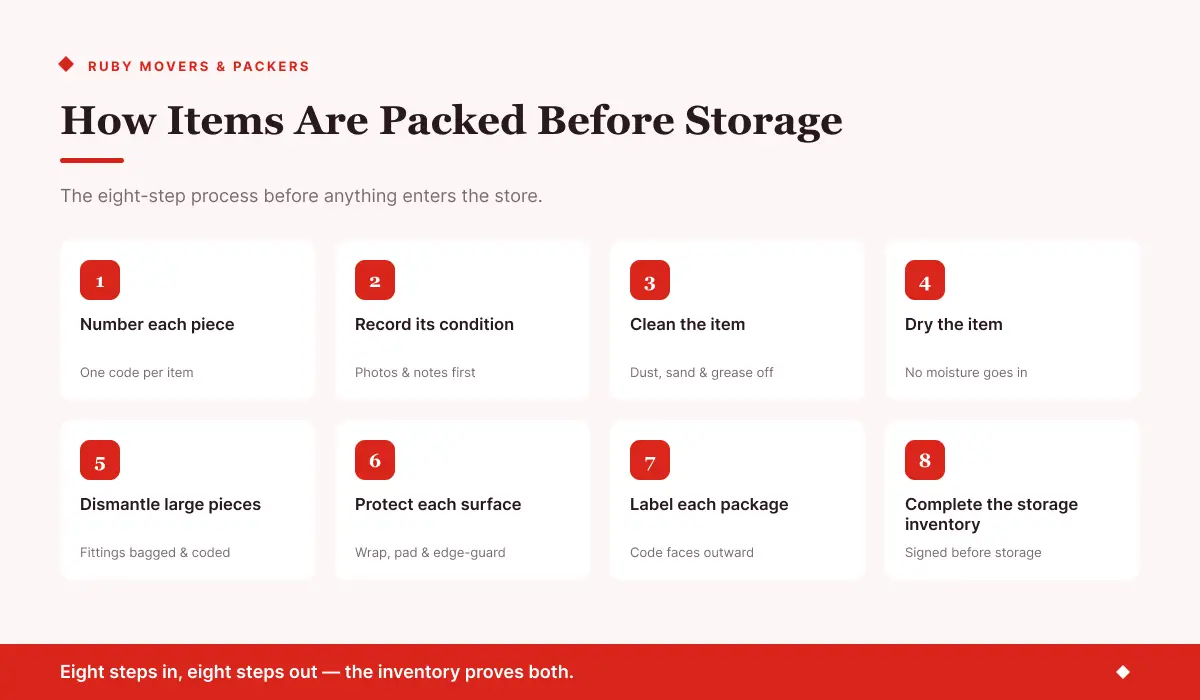
Storage items require numbered inventory records, surface protection, moisture control, safe dismantling, and labels that support later retrieval.
Direct moving protection covers a short journey. Storage protection must also manage stacking pressure, warehouse handling, extended wrapping, and a second transport stage.
Use this eight-step packing process:
- Number each piece. Give every carton and furniture item a unique inventory code.
- Record its condition. Photograph existing scratches, dents, cracks, and appliance serial numbers.
- Clean the item. Remove food, soil, grease, and loose dust.
- Dry the item. Do not seal moisture inside furniture, appliances, or outdoor equipment.
- Dismantle large pieces. Remove safe, detachable legs, shelves, rails, and headboards.
- Protect each surface. Use furniture blankets, cartons, edge guards, and suitable wrapping.
- Label each package. Record the room, contents, orientation, and delivery stage.
- Complete the storage inventory. Record quantity, condition, declared value, and warehouse entry date.
Dubai’s summer climate makes storage conditions a valid buying question. A July 2026 bulletin from the National Center of Meteorology recorded Dubai temperatures of 38°C to 42°C across its five-day forecast, with maximum relative humidity reaching 85%.
An enclosed warehouse does not match outdoor conditions. Still, the regional figures support questions about ventilation, climate control, pest management, and humidity monitoring.
Timber furniture, leather, artwork, books, electronics, and musical instruments require closer environmental control. Plastic garden furniture has different storage needs.
Drain washing machines before packing. Dry refrigerator interiors, secure electric cables, and protect appliance controls. Food, liquids, gas cylinders, flammable materials, and living plants require separate handling or exclusion under the storage contract.
How does storage change delivery and setup?
Temporary storage changes one direct move into a collection, warehouse, retrieval, and redelivery sequence.
Each additional stage creates another handling point. Accurate labels and a room-based inventory reduce misplaced cartons, duplicate handling, and setup delays.
Staged delivery allows essential items to arrive first. The first load may contain beds, basic seating, kitchen equipment, children’s belongings, and home-office items. A later load may contain artwork, outdoor furniture, spare cabinets, and cartons for unfinished rooms.
Consider a Dubai Hills Estate villa where ground-floor joinery remains incomplete. Movers can deliver bedroom furniture upstairs and keep dining-room contents in storage. This plan keeps work areas open and prevents the same furniture from moving twice inside the villa.
Complete this delivery checklist before releasing the stored shipment:
- Match room names with carton labels.
- Confirm the moving permit and security access.
- Finish painting, drilling, flooring, and wet work.
- Measure entrance doors, stairs, corridors, and gates.
- Mark clear furniture-assembly areas.
- Photograph floors, walls, and door frames.
- Give the crew one approved placement plan.
- Confirm which cartons belong in each delivery stage.
Release the shipment after the villa becomes ready. Do not rely on a contractor’s estimated completion time on delivery morning.
How do short-term and long-term storage differ?
Short-term storage covers a known handover gap. Long-term storage supports extended renovation, overseas absence, downsizing, or an uncertain property plan.
Short-term arrangements usually focus on rapid retrieval and one final delivery. Long-term arrangements place more weight on packing durability, environmental control, access charges, inventory reviews, and continuing insurance.
| Decision point | Short-term storage | Long-term storage |
| Main reason | Delayed keys or brief renovation | Downsizing or extended absence |
| Delivery plan | One final or staged delivery | Partial or repeated retrieval |
| Packing focus | Moving plus brief storage | Extended warehouse protection |
| Inventory detail | Item numbers and room labels | Numbers, condition, value, and review dates |
| Cost focus | Handling and redelivery | Monthly charges and access costs |
| Main concern | Changing handover dates | Rising cost and prolonged exposure |
Insurance deserves separate review because risk continues outside transit.
The Liva Insurance home policy wording defines furniture-in-transit cover as movement by professional removal contractors directly between two UAE homes. The same wording states that contents stored away from the insured home require each location and insured sum to appear in the policy schedule.
This policy example does not represent every insurer. It demonstrates why direct-transit cover cannot be assumed to continue inside a warehouse.
Ask the mover or insurer:
- Who covers the shipment during storage?
- What events does the policy include?
- What excess applies to each claim?
- What limit applies per item?
- Does depreciation reduce settlement?
- Which inventory and photographs support a claim?
Obtain the answer in writing. “Fully insured” has little value without limits, exclusions, and claim conditions.
When should residents book storage with movers?
Residents should raise the storage requirement when the move-out date becomes fixed but the delivery-ready date remains uncertain.
A four-week planning window gives time to survey the villa, estimate warehouse volume, source packing materials, check community rules, and review insurance. A shorter booking can work, but available space and preferred delivery dates may narrow.
Give the moving company these 9 details:
- Current villa size
- Collection address
- New villa address
- Approximate carton count
- Large furniture list
- Fragile or high-value items
- Expected storage period
- Community access rules
- Planned delivery stages
Request one written quotation that separates collection, packing, warehouse handling, storage, retrieval, redelivery, assembly, and Value Added Tax (VAT).
The Federal Tax Authority (FTA) defines VAT as a consumption tax applied at each stage of the supply chain and borne by the final consumer. Ask whether quoted moving and storage prices include the applicable tax.
A low monthly storage figure does not show the full cost. Compare these charges:
- Initial packing and collection
- Warehouse intake
- Minimum storage period
- Monthly storage
- Partial-access fees
- Retrieval labor
- Final delivery
- Furniture assembly
- Date-change charges
Compare the total door-to-door price in UAE dirhams, not the warehouse rate alone.
Plan storage before the handover gap becomes a moving problem
Temporary storage makes sense when your villa must be cleared before the next property is ready. Delayed keys, unfinished renovation, permit issues, downsizing, and staged delivery all create the same practical problem: your belongings need a secure place between collection and final setup.
The strongest storage plan starts before moving day. Confirm the handover date, prepare a numbered inventory, separate essential items, check warehouse conditions, and review insurance in writing. Storage risk continues after transit, so vague promises about cover or access are not enough.
A documented temporary storage during villa move plan connects the old villa, storage facility, and new home through one controlled process. Clear dates, packing standards, retrieval rules, delivery stages, and charges prevent a short handover gap from becoming a costly delay.
FAQs
Can movers collect furniture before the villa keys arrive?
Yes. Movers can collect and store furniture before key release when the written service covers packing, inventory, warehouse handling, insurance, and later delivery.
Does temporary storage help during renovation?
Yes. Temporary storage keeps furniture away from dust, wet finishes, drilling, contractor traffic, and repeated movement inside unfinished rooms.
Can residents retrieve one carton from storage?
Partial retrieval depends on the contract and inventory system. Confirm the notice period, handling charge, carton-location method, and minimum access fee before booking.
Does home insurance cover stored furniture?
Home insurance does not automatically cover a commercial warehouse. The Liva Insurance policy wording requires off-site contents and insured values to appear in the policy schedule.
Does storage help when downsizing?
Yes. Storage gives you time to measure rooms, select suitable furniture, sell excess items, and arrange a staged delivery without overcrowding the new villa.
Bilal Al-Madani
Bilal Al-Madani is a logistics professional specializing in residential relocations and supply chain optimization. With deep experience in the moving industry, he excels in ensuring transit safety, implementing advanced packing methods for high-value items, and managing transport fleets efficiently. He is committed to simplifying the moving process through careful planning, delivering each relocation with precision, reliability, and exceptional attention to detail.


