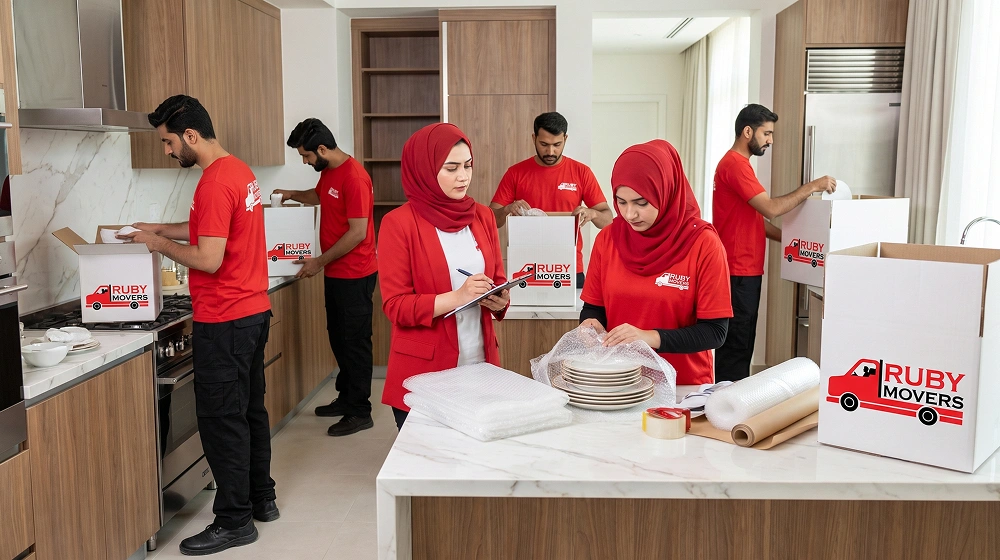
A villa kitchen can disrupt an entire move when glassware, pantry liquids, heavy cookware, chilled food, and appliances enter the same packing stream. Each category carries a different risk. Dubai’s heat adds another concern because perishable food cannot remain unrefrigerated during a long loading schedule.
Proper villa kitchen packing in Dubai separates fragile, heavy, electrical, consumable, and first-day items before any carton is sealed. This reduces breakage, leakage, misplaced appliance parts, and delays at the new property.
This guide explains how plates and crockery are protected, how pantry stock and cookware are sorted, how small appliances are prepared, and how fragile boxes are labeled. It also covers unpacking order, food-temperature controls, resident responsibilities, and practical examples for multi-kitchen villas in Dubai.
How is a villa kitchen packed before moving day?
A villa kitchen is packed zone by zone after you separate daily essentials, perishables, valuables, and items that require technical disconnection.
The 6-step packing sequence
- Map every kitchen zone. Record the main kitchen, pantry, utility kitchen, breakfast station, outdoor kitchen, and appliance store where present.
- Remove non-packable contents. Separate chilled food, medicines, documents, gas cylinders, chemicals, and leaking containers.
- Pack low-use items first. Start with serving dishes, baking equipment, spare crockery, and seasonal appliances.
- Create category-specific cartons. Keep glassware, pans, pantry liquids, and electrical items in separate kitchen packing boxes.
- Assign destination codes. Connect each carton to a cabinet, counter, pantry shelf, or secondary kitchen.
- Seal the first-day kit last. Keep water, mugs, cutlery, bin liners, dish soap, and one pan accessible.
The table gives each category a measurable packing control. These figures act as handling references rather than universal box specifications.
| Kitchen contents | Main control | Reference | Practical box label |
| Crystal, glasses, ceramics | Cushion every side and stop movement | 7.6 cm cushioning benchmark | Kitchen, fragile, upright |
| Plates and bowls | Pack vertically with separators | One item per wrapped position | Kitchen, crockery, heavy |
| Cast iron and canned food | Limit carton weight | Single-person lift below 22.7 kg | Kitchen, heavy |
| Chilled food | Maintain cold temperature | 4.4°C or colder | Cooler, open first |
| Pantry liquids | Keep closures upright | One sealed inner bag per bottle | Pantry, liquids, upright |
| Appliances with tanks | Drain and dry before packing | Zero retained liquid | Appliance name, accessories |
FedEx packaging guidance recommends at least 3 inches, about 7.6 centimeters, of cushioning around fragile products.
How are glassware, plates, and crockery packed?
Glassware, plates, and crockery are wrapped separately, divided by type, and locked inside rigid cartons without empty movement space.
Pack plates by edge
Place plates vertically, like records in a file. Flat stacks transfer pressure through each plate’s center. Edge packing separates the load across wrapped positions.
Wrap every plate before creating the row. Add a base cushion, side protection, and a top pad. Leave space below the closing line.
A practical crockery sequence uses 5 layers:
- Reinforced box base
- Cushioning pad
- Individually wrapped plates
- Filled side gaps
- Top cushioning layer
The box fails its packing check when the contents shift during a gentle movement test. Add paper or another cushioning material until the row stays fixed.
Protect stems, handles, and rims
Wine glasses, teacups, jugs, and serving dishes fail first at thin sections. Build extra padding around every stem, handle, rim, and spout.
FedEx uses a 3-inch cushioning benchmark for breakables and recommends filling every void. Its guidance also recommends H-taping across the center seam and both edge seams. The H pattern closes the primary seam and four exposed flap edges.
Use double boxing for crystal, heirloom porcelain, glass shelves, or high-value sets. Place the first sealed carton inside a larger cushioned box.
Fragile kitchen packing also requires weight separation. Do not place a cast-iron pan above wine glasses, even when both items fit inside the same box.
How are pantry items and cookware sorted?
Pantry items and cookware are sorted by expiry, temperature, leakage risk, weight, material, and first-week use.
Audit food before buying boxes
The United Nations Environment Programme recorded 1.05 billion tonnes of food waste in 2022. That equals 132 kilograms per person and 19% of consumer-available food.
A pantry audit stops opened, expired, or duplicate products from entering the move. Use four groups:
- Keep: Sealed dry food within date.
- Use first: Opened food suitable for meals before moving day.
- Donate: Unopened products accepted by an appropriate local organization.
- Dispose: Expired food, damaged packaging, leaks, pests, or uncertain storage history.
Pack oils, sauces, syrups, and cleaning liquids upright. Tighten each closure, cover the opening, and place each container inside a sealed secondary bag.
Do not pack food and cleaning chemicals together. A leaking bottle can contaminate flour, rice, spices, pet food, and cardboard packaging.
Control cookware weight
Nest saucepans, trays, and bowls after placing paper between finished surfaces. Bag lids, knobs, valves, and removable handles for the cookware set.
Place cast iron, stone cookware, canned food, and glass jars inside smaller cartons. Large boxes encourage overloading and create poor handholds.
Do not treat 22.7 kilograms as a packing target. Stairs, long carries, poor grip, and twisting reduce practical limits.
How are small kitchen appliances packed?
Small kitchen appliances are cleaned, dried, photographed, and packed with every removable part assigned to the correct machine.
Use a 5-part appliance method
- Unplug the unit. Let hot appliances cool before cleaning.
- Remove food and water. Empty crumbs, beans, oil, ice, grounds, and reservoirs.
- Photograph the setup. Record cables, attachments, and water connections.
- Bag the parts. Label blades, bowls, lids, trays, filters, seals, and screws.
- Cushion the machine. Protect controls, plugs, glass jugs, and projecting parts.
Keep power cords loose enough to avoid sharp bends. Keep plugs away from painted or polished housings.
Use the original appliance box when it remains dry, rigid, and complete. Otherwise, select a box that allows protective material around every side without excessive empty space.
A blender requires separate protection for the motor base, glass jug, blade assembly, lid, and sealing ring. An espresso machine requires an empty water tank, dry drip tray, clean bean hopper, and secured steam attachment.
Drain water-connected appliances
Water-connected appliances require extra attention. Samsung directs users to drain the water line because retained water can support mold growth. The same preparation principle applies to coffee machines, ice makers, water dispensers, and countertop dishwashers.
Use a qualified technician for built-in ovens, gas hobs, dishwashers, and plumbed refrigerators involving gas, fixed wiring, water lines, or warranty conditions.
How are fragile kitchen items labeled?
Fragile kitchen items are labeled with six details: room, zone, contents, risk, orientation, and unpacking priority.
A useful label reads: “Kitchen, breakfast cabinet, six wine glasses, fragile, upright, box K-F-03.” The code connects the carton to the inventory.
Use a simple box-code system
- “K” means kitchen.
- “F” means fragile.
- “P” means pantry.
- “A” means appliance.
- 01, 02, 03 show the carton sequence.
Place the full label on the top and two adjacent sides. A side label remains readable when villa movers stack cartons.
Use “open first” only for genuine priority boxes. Too many priority labels remove the distinction and slow the unloading sequence.
“Fragile” does not replace correct fragile kitchen packing. FedEx tells shippers to wrap breakables individually, fill voids, seal every seam, and mark the carton.
How does kitchen packing affect unpacking speed?
Kitchen packing affects unpacking speed because destination labels remove a second sorting stage at the new villa.
A carton marked “kitchen” still requires inspection. A carton marked “main kitchen, breakfast cabinet, mugs and tea, open first” has one clear destination.
Consider a 24-carton villa kitchen divided across six zones. Random labels create up to 24 placement decisions. Zone coding groups the cartons into six destinations, averaging four boxes per zone.
Set the opening order before loading
Use this destination order:
- Refrigerator and freezer access
- Drinking water and first-day carton
- Daily crockery and cutlery
- Basic cookware
- Pantry staples
- Decorative and occasional-use items
In Emirates Hills, separate the show kitchen from the preparation kitchen. In Arabian Ranches, label barbecue equipment apart from indoor cookware.
In Jumeirah Golf Estates, identify upstairs beverage stations separately. A villa with a utility kitchen also requires a separate code for cleaning equipment and secondary appliances.
This sequence completes villa kitchen packing before moving day and carries the same room codes into wardrobe and bedroom packing.
What should residents remove before kitchen packing?
Residents remove perishables, medicines, valuables, hazardous products, wet materials, and final-day essentials before kitchen packing services close the room.
Resident removal checklist
- Remove passports, cash, jewelry, keys, and confidential papers.
- Remove prescription medicines and temperature-controlled health products.
- Remove food without a verified cold-transport plan.
- Remove wet cloths, used sponges, open rubbish, and food residue.
- Remove gas cylinders, fuels, corrosive products, and leaking chemicals.
- Remove one meal kit for the final evening and moving morning.
- Remove the first-day carton from the general loading stream.
- Remove valuable collections unless the survey records separate handling.
Apply the one-hour Dubai heat rule
Bacteria grow most rapidly in the range of temperatures between 40°F and 140°F, doubling in number in as little as 20 minutes.
Whenever the room (or outdoor) temperature the food is exposed to exceeds 90°F (32°C), it is advisable to reduce the exposure time to 1 hour.
Visit Dubai reports a 35°C average during July and August. That figure exceeds the USDA one-hour threshold. Use insulated coolers, frozen packs, air-conditioned transport, and immediate refrigeration.
Do not treat a closed refrigerator as a moving-day cooler. The Food and Drug Administration reports about four safe hours during an outage when the refrigerator door stays closed.
Moving involves opening, emptying, tilting, and disconnecting the appliance. The four-hour figure does not replace controlled cold transport.
A well-packed kitchen sets up the rest of the move
Villa kitchen packing works when every item follows a clear handling route. Glassware needs cushioning and rigid cartons. Cookware needs controlled box weight. Pantry liquids need sealed, upright packing. Appliances need cleaning, drainage, and labeled accessories.
Dubai’s heat makes timing just as important as wrapping. Chilled food requires cold storage, while valuables, medicines, hazardous products, and first-day essentials remain with the resident.
Clear box codes complete the process. A label that identifies the kitchen zone, contents, handling risk, and opening priority reduces searching at the new villa. The family can reach drinking water, basic cookware, and daily crockery without opening every carton.
Once the kitchen is secure, the same inventory and labeling system can continue into wardrobe and bedroom packing. Good preparation does more than protect belongings. It keeps the entire villa move in order.
FAQs
How many days before moving can a villa kitchen be packed?
Pack low-use items three to five days early. Keep one meal kit, daily crockery, cleaning items, and chilled food outside sealed cartons.
What box weight works for cookware?
Keep cookware boxes comfortably below 22.7 kilograms. Reduce the weight further for stairs, long carrying distances, awkward shapes, or limited grip.
Can movers pack opened pantry food?
Pack stable opened food inside rigid, leak-resistant containers. Remove chilled products, damaged packets, and anything with uncertain storage history.
Does every fragile kitchen box require bubble cushioning?
Every fragile item requires suitable cushioning. Paper, cellular wrap, foam, dividers, and double boxes protect different shapes and values.
What belongs in the first-day kitchen box?
Pack water, mugs, basic cutlery, paper towels, bin liners, dish soap, one pan, pet bowls, and food linked to medical or dietary needs.
Bilal Al-Madani
Bilal Al-Madani is a logistics professional specializing in residential relocations and supply chain optimization. With deep experience in the moving industry, he excels in ensuring transit safety, implementing advanced packing methods for high-value items, and managing transport fleets efficiently. He is committed to simplifying the moving process through careful planning, delivering each relocation with precision, reliability, and exceptional attention to detail.