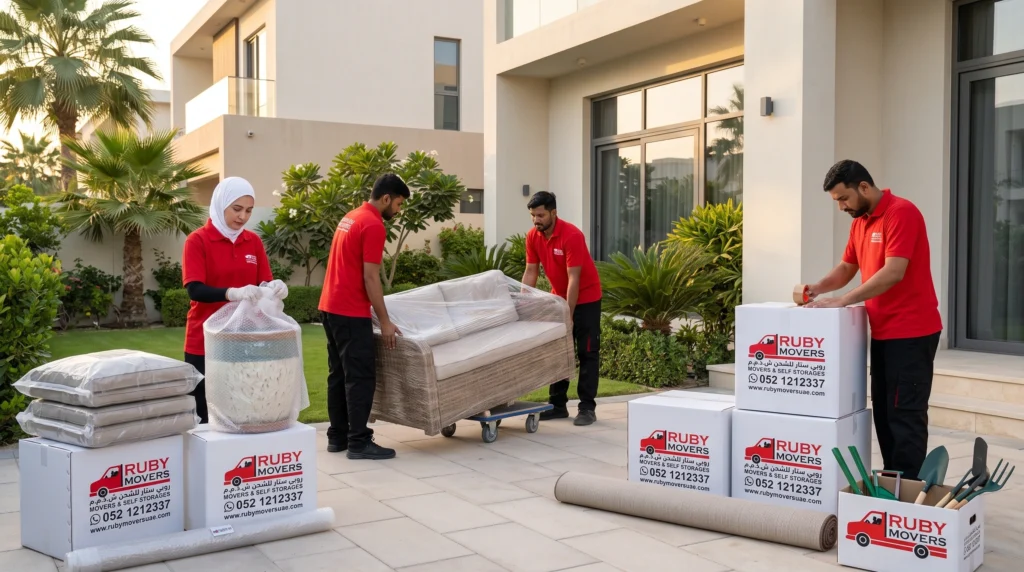
A mirror rarely cracks because it entered the truck last. Damage starts when weight, gaps, padding, or unloading order receives poor planning.
A loading sequence sets the position of every carton, appliance, furniture panel, and fragile item inside the vehicle. Heavy-first loading creates the base. Fragile separation limits crushing. Truck padding controls contact. Room labels reduce repeated handling.
For residents comparing safe villa movers Dubai, the loading plan reveals more than a general promise of careful handling. It explains how the crew protects belongings, uses the truck space, and works within Dubai community access windows.
The first test is simple: Can the mover explain where each item sits and why?
How does a planned loading sequence prevent moving damage?
Loading sequence reduces damage by controlling cargo weight, movement, contact, and handling frequency. Stable items sit low, fragile goods remain separated, and first-use boxes stay accessible.
The United Nations Economic Commission for Europe (UNECE) CTU Code states that heavy cargo must not sit above lighter cargo. Heavy units also remain separate from fragile parcels. The code places the cargo’s center of gravity below half the vehicle’s internal height where possible.
The CTU Code covers freight transport rather than Dubai household moves. Its load-position principles still provide a useful technical reference for furniture trucks. UNECE developed the code with the International Maritime Organization and International Labour Organization.
A moving truck also creates force during braking and turning. The United States Federal Motor Carrier Safety Administration requires cargo restraint systems to withstand 0.8 g forward and 0.5 g sideways or rearward.
A 100-kilogram cabinet can create about 785 newtons of forward force at 0.8 g. The same cabinet creates about 491 newtons sideways at 0.5 g. A blanket cannot restrain that movement by itself.
The table connects each loading position with its damage-control purpose.
| Truck position | Typical villa contents | Main protection method | Damage controlled |
| Floor and forward section | Appliances, book cartons, dense cabinets | Low placement, blocking, straps | Tipping and crushing |
| Sidewall section | Bed panels, table tops, wrapped frames | Vertical support and tiedowns | Sliding and edge impact |
| Central box section | Standard cartons grouped by room | Tight rows and filled gaps | Box collapse and movement |
| Protected fragile section | Mirrors, glassware, artwork, lamps | Cushioning and load separation | Breakage and compression |
| Door-end section | Tool kit, first-use boxes, assembly parts | Clear labels and controlled access | Rehandling and missing parts |
The correct position depends on weight, shape, surface, fragility, and unloading priority. Free floor space does not automatically provide a safe position.
Why are heavy items loaded before fragile items?
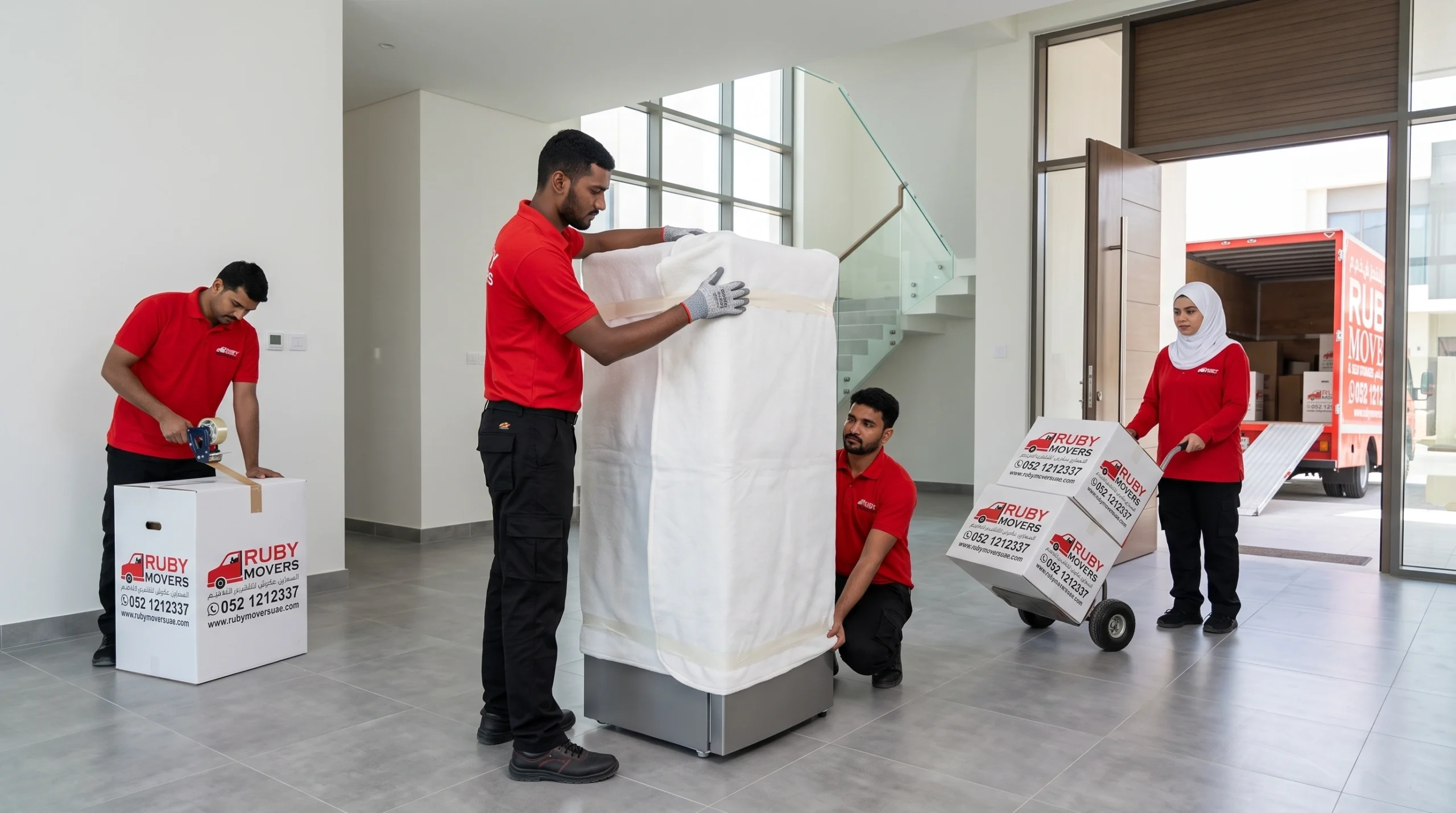
Heavy items enter first because dense cargo creates a stable lower layer. Fragile items enter later and remain outside compression zones.
UNECE advises against placing heavy goods above light goods. This arrangement keeps the center of gravity lower and prevents dense items from crushing weaker packages.
Heavy furniture still requires balanced placement. Concentrating a safe, gym machine, or stone table in one small floor area can overload that point. The CTU Code advises distributing concentrated loads across a wider floor area.
The crew also needs a controlled lifting method. The United States Occupational Safety and Health Administration states that loads above about 50 pounds, or 22.7 kilograms, increase injury risk. OSHA recommends mechanical equipment or two-person lifting above that level.
That guidance matters for damage prevention. A heavy cabinet handled by too few people can strike a doorway, tilt onto another item, or land outside its planned truck position.
Consider a four-bedroom villa in Arabian Ranches. The loading crew places the refrigerator, book cartons, dismantled wardrobes, and solid dining table first. Lamps, artwork, and kitchen glassware enter after the heavy base is secured.
Heavy-first loading does not mean pushing every large item against the front wall. The crew distributes weight across the truck floor and keeps the left and right sides balanced.
How are fragile boxes separated inside the truck?
Fragile boxes remain inside a marked protection zone with no heavy cargo above them. Each item receives individual wrapping, while filler removes empty space inside the carton.
FedEx recommends at least 8 centimeters of air-cellular cushioning around fragile items. Its guidance uses at least 5 centimeters for general items and requires filler in empty spaces.
UPS recommends at least 5 centimeters of loose cushioning around lightweight goods. For double boxing, UPS recommends an outer box 15 centimeters larger in length, width, and depth than the inner box.
These parcel-shipping measurements offer useful packing benchmarks. Villa movers still adjust the material for mirrors, chandeliers, sculptures, television screens, and custom furniture.
The crew can separate fragile cargo through 6 controls:
- Wrap each glass, ceramic, lamp, and framed item separately.
- Fill carton gaps so the contents cannot rattle.
- Mark the room, contents, orientation, and fragile status.
- Keep liquids away from documents, clothing, and electronics.
- Place no dense cartons above the fragile zone.
- Restrain the complete box group against forward and sideways movement.
A “fragile” label gives handling information. It does not provide physical protection. Cushioning, carton strength, separation, and restraint protect the contents.
Suppose a Dubai Hills villa contains 36 kitchen cartons. Twelve hold glassware or ceramics. Placing those 12 boxes in one protected row gives the crew one controlled zone instead of 12 scattered risks.
How does truck padding reduce transit damage?
Truck padding reduces transit damage by preventing rubbing, absorbing minor impact, protecting edges, and filling contact gaps. Blocking and straps control larger movement.
Moving blankets protect polished wood, painted surfaces, leather, and fabric. Corner protectors shield table edges, mirrors, frames, and cabinet corners.
Padding must cover the correct surface. A blanket wrapped loosely around a cabinet can slide down during handling. Stretch film can hold the blanket in place, but it must not touch sensitive finishes without suitable protection.
The UNECE CTU Code identifies dunnage, sheathing, blocking, and bracing as tools for separating cargo and filling gaps. It also states that higher friction between the cargo and floor supports load stability.
A complete furniture-protection sequence contains 4 stages:
- Cover the clean surface with a suitable protective layer.
- Protect glass, corners, handles, and projecting edges.
- Fill open gaps with suitable blocking material.
- Restrain the item against sliding or tipping.
Take a polished eight-seat dining table from a Palm Jumeirah villa. Blankets protect the surface. Corner guards protect the edges. Floor blocks prevent movement, while tiedowns control sideways force.
Padding without restraint can hide a weak loading plan. Ask the mover how each heavy item stays fixed after the truck door closes.
How does room labeling support the unloading sequence?
Room labeling directs each carton and furniture piece to its destination during the first carry. Clear labels reduce searching, misplaced boxes, and repeat handling.
Military OneSource advises residents to direct unloaded boxes to designated rooms. It also recommends recording valuable items and creating a separate area for goods that movers must not pack.
A practical label can contain 4 details:
- Destination floor
- Room name or room code
- Carton number
- Handling instruction
For example, “F2-B3-08, books, heavy” identifies second floor, bedroom three, carton eight. “F1-K-12, glass, top load” identifies a first-floor kitchen carton.
Numbers support inventory checks. A kitchen group numbered K-01 through K-18 immediately shows whether one carton remains inside the truck.
Room labeling also changes the loading order. Ground-floor furniture can occupy one truck zone. Upper-floor bedroom cartons can form another zone, provided weight and fragility rules remain intact.
Consider a 5-bedroom Emirates Hills villa. Twelve cartons enter the wrong floor during unloading. Returning those 12 cartons creates 24 extra handling events, one removal and one redelivery per carton.
For an 80-carton move, loading and unloading already create at least 160 basic carton movements. Twelve routing errors add 24 more, which increases box handling by 15 percent.
How does loading order affect moving time?
Loading order affects moving time by reducing rehandling, keeping pathways open, and placing first-use items near the truck door.
Poor order creates small delays that spread across the crew. A six-person team waiting 20 minutes while blocked furniture is rearranged loses two crew-hours.
The access window makes those delays more serious. Nakheel publishes moving hours of 9:00 a.m. to 5:00 p.m. from Monday to Saturday. Sunday hours run from 10:00 a.m. to 1:00 p.m.
Nakheel also requires a third-party moving company to request a daily permit one to two working days before entry. Published approval takes one day.
Emaar states that Dubai Hills Estate residents can obtain a move-in permit within one business day after completing four application steps.
Truck route restrictions narrow the usable schedule further. Dubai’s Roads and Transport Authority (RTA) restricts truck movement on selected roads, including Emirates Road towards Sharjah between 5:30 p.m. and 8:00 p.m.
RTA temporarily allowed trucks across most Dubai roads until March 4, 2026. Normal restrictions resumed on March 5, 2026. Route checks remain necessary close to moving day.
A planned loading sequence protects the permit window. Heavy items enter without interruption, fragile zones close once, and door-end boxes remain accessible at the destination.
What should residents keep outside the truck?
Residents keep identity documents, permits, medicines, valuables, keys, essential electronics, and arrival supplies outside the moving truck.
Military OneSource advises residents to hand-carry official paperwork, vehicle records, school records, medical records, keys, and wallets. It recommends placing excluded goods inside a clearly marked “Do Not Pack” area.
Keep these items with you during a Dubai villa relocation:
- Passports, Emirates IDs, visas, and driving licenses
- Ejari, title deed copies, community permits, and access approvals
- Jewellery, cash, watches, and irreplaceable personal items
- Prescription medicines and immediate medical supplies
- Phones, laptops, chargers, storage drives, and security tokens
- Villa keys, vehicle keys, gate cards, and remote controls
- Drinking water, clothing, toiletries, and children’s supplies
- Pet carriers, leads, food, water, and veterinary records
Nakheel lists Ejari, title deeds, Emirates IDs, passports, and visa copies among its permit documents. Keeping these records outside the truck avoids a security delay.
Use one locked room, parked car, or clearly marked cupboard as the exclusion zone. Tell the crew leader about that area before packing starts.
A safe move starts with the truck plan
Damage prevention depends on what happens before the truck leaves the villa. Heavy furniture needs a stable position. Fragile cartons need separation. Padding protects surfaces, while straps and blocking control movement.
Room labels matter too. They reduce wrong-floor deliveries, repeated carrying, and unnecessary box handling. In one worked example, 12 misplaced cartons created 24 extra handling events. Access delays can also consume valuable crew time inside fixed Dubai moving windows.
Before booking safe villa movers in Dubai, ask for the loading sequence in writing. Check where fragile items sit, how heavy pieces remain fixed, and which goods stay outside the truck. A clear plan gives the crew fewer chances to improvise and gives your belongings fewer chances to move.
FAQs
What is the safest order for loading a villa moving truck?
Load dense furniture low, distribute weight across the floor, restrain large pieces, group standard cartons, separate fragile boxes, and place first-use goods near the door.
Can moving blankets stop furniture from shifting?
Moving blankets reduce rubbing and minor impact, while blocking, chocks, tiedowns, and dunnage control sliding, rolling, and tipping.
How much cushioning do fragile items require?
FedEx recommends at least 8 centimeters of air-cellular cushioning for fragile items and at least 5 centimeters for general individually wrapped goods.
Where do mirrors and glass tables sit inside the truck?
Mirrors and glass tables occupy separate zones with edge protection, full wrapping, upright support where required, and restraint against sideways movement.
Bilal Al-Madani
Bilal Al-Madani is a logistics professional specializing in residential relocations and supply chain optimization. With deep experience in the moving industry, he excels in ensuring transit safety, implementing advanced packing methods for high-value items, and managing transport fleets efficiently. He is committed to simplifying the moving process through careful planning, delivering each relocation with precision, reliability, and exceptional attention to detail.