
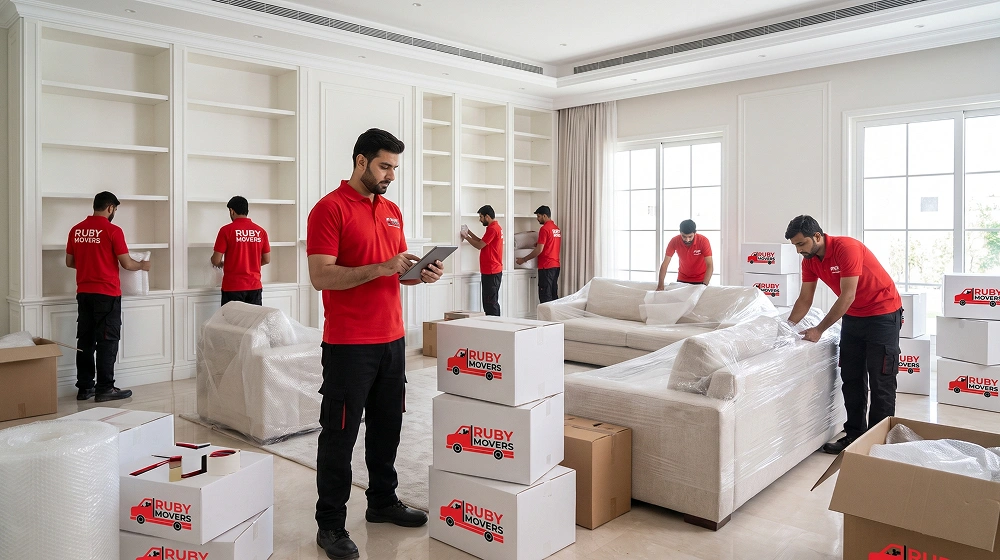
Villa movers and packers in Dubai organize each room as a separate packing zone. The crew sorts contents by material, weight, fragility, destination, and setup priority before loading.
Packing a villa room by room involves more than placing household items into cartons. Kitchen glassware, fitted wardrobes, electronics, garden furniture, mirrors, and artwork each require different materials, handling methods, and labels. Dubai community permits and property access rules can also affect when the packing crew starts.
This guide explains how villa movers and packers in Dubai organize every area before loading. It covers kitchen appliances, bedroom contents, living and dining furniture, outdoor items, fragile possessions, and storage rooms. It also explains how room codes, inventories, and box labels reduce misplaced items and make new-villa setup easier.
How do villa movers and packers in Dubai pack each room?
Villa movers and packers pack each room as a separate inventory group, using room codes, item categories, handling instructions, and destination labels.
A surveyor first records the property layout. The survey covers stairs, door widths, wardrobes, appliances, outdoor access, storage rooms, artwork, and furniture dismantling.
The crew then builds a packing sequence:
- Record each room: Assign a short code, such as K1 for the kitchen or BR2 for the second bedroom.
- Separate item groups: Divide contents into standard, fragile, heavy, restricted, and client-carried items.
- Select packing materials: Match carton size, cushioning, blankets, dividers, rigid boards, and crates to each object.
- Label every package: Add the room, contents, handling direction, box number, and setup priority.
- Reconcile the inventory: Count cartons and furniture pieces before loading and after delivery.
A documented inventory matters because every shipment contains at least two handling phases and one transport phase. Pickup and loading form the first handling phase. Unloading and placement form the second.
The table below connects each villa area with its main packing control.
| Villa area | Main item groups | Primary packing control | Useful label example | Setup priority |
| Kitchen | Glassware, cookware, food, appliances | Separate heavy and breakable contents | K1, glasses, 4 of 12, fragile | High |
| Bedrooms | Clothes, linen, shoes, personal items | Keep each occupant’s contents separate | BR2, wardrobe left, 3 of 8 | High |
| Living room | Furniture, books, electronics, decor | Record cables, hardware, and surface condition | LR, television cables, 5 of 10 | Medium |
| Dining room | Tables, chairs, cabinets, serving ware | Protect projecting legs and glass panels | DR, cabinet shelves, 2 of 7 | Medium |
| Outdoor areas | Garden furniture, tools, planters | Clean, dry, dismantle, and screen hazards | OUT, patio set, parts 1 to 6 | Low |
| Storage rooms | Dense boxes, chemicals, equipment | Separate transportable and restricted contents | STR, tools, heavy, 7 of 11 | Low |
| Fragile group | Mirrors, artwork, ceramics | Use individual risk assessment and rigid protection | F1, mirror, upright, do not stack | Controlled |
The table also helps you compare moving quotations. A general phrase such as “complete packing” does not confirm crating, wardrobe cartons, appliance preparation, or debris removal.
Room-by-room packing checklist
Check these points before the crew closes the final boxes:
- Confirm one unique code for every room and storage area.
- Remove passports, cash, jewelry, medicine, and confidential records.
- Photograph existing furniture and artwork damage.
- Match every hardware bag with its parent furniture item.
- Mark fragile packages on the top and two sides.
- Reserve first-night cartons for bedding, toiletries, chargers, and basic kitchenware.
- Count packages by room before the truck leaves.
This checklist creates a traceable handover. It also gives you evidence when a carton reaches the wrong room or an item remains at the old villa.
How is a villa kitchen packed?
A villa kitchen is packed by separating food, glassware, cookware, small appliances, fitted appliances, and cleaning products into different handling groups.
Packers place heavy pans and cast-iron cookware in small, reinforced cartons. Plates receive individual wrapping and vertical placement because flat stacks transfer pressure through the lower pieces.
Glasses, mugs, bowls, and serving dishes need internal separation. Dividers reduce contact, while cushioning fills unused space that could allow movement.
A practical kitchen packing order includes:
- Pack seasonal appliances and formal serving ware first.
- Pack pantry goods after removing leaking or expired products.
- Pack daily crockery near the end of the schedule.
- Keep one essentials carton open until the final evening.
- Separate detergents, aerosols, and flammable products for screening.
Large appliances require model-specific preparation. Samsung instructs owners to reinstall washing-machine shipping bolts because the bolts restrict drum movement. The washer also travels upright.
Refrigerator positioning affects reconnection time. Samsung Gulf specifies a settling period of at least 2 to 3 hours after upright transport. Side transport requires at least 4 hours after the refrigerator returns upright.
Consider a Dubai Hills villa with an island kitchen, utility room, and outdoor barbecue area. The packers may divide the contents into four zones rather than treating everything as one kitchen.
Confirm whether the quotation covers disconnection, water lines, transit bolts, appliance installation, and packaging removal. Packing labor does not automatically include technical work.
How are bedrooms, wardrobes, and dressing rooms packed?
Bedrooms are packed by owner, wardrobe section, clothing type, furniture item, and first-night priority.
Hanging clothes enter wardrobe cartons or garment covers. Folded clothes enter clean, lined boxes. Shoes receive separate wrapping to prevent soles and fittings from marking fabrics.
Dressing rooms need more detailed coding. Labels such as “master wardrobe right, formal wear” give the unpacking team a precise destination.
Delicate textiles require extra support. The Canadian Conservation Institute recommends planned movements, adequate cushioning against transit vibration, and custom support for oversized textiles. Large rugs and hangings may require two or more handlers.
Flat storage suits fragile, beaded, knitted, or weak-shouldered garments because the support carries the full textile weight. Folds require padding where folding cannot be avoided.
Wardrobes may travel assembled, partly dismantled, or fully dismantled. Door width, stair turns, panel strength, and manufacturer instructions determine the method.
The crew places screws, shelf pins, handles, and brackets in sealed hardware bags. Each bag carries the same inventory number as the wardrobe.
Keep personal valuables outside the standard packing stream. Carry jewelry, passports, medical records, cash, and work devices yourself unless the contract provides documented valuables handling.
How are living rooms and dining rooms packed?
Living rooms and dining rooms are packed by separating furniture, electronics, books, lighting, rugs, décor, and serving ware.
The crew records the visible condition before wrapping. This step distinguishes existing scratches, loose joints, chipped glass, and fabric marks from transport damage.
Electronics require component control. Packers photograph cable layouts, label both cable ends, secure remotes, and keep mounting parts with the related screen or sound system.
Books, records, stone ornaments, and metal decor create dense cartons. The National Institute for Occupational Safety and Health lifting equation starts with a maximum load constant of 51 pounds, or about 23 kilograms, under ideal conditions.
That figure falls when workers twist, lift repeatedly, reach away from the body, or handle poor grips. Small cartons therefore suit books and other dense contents better than large boxes.
Dining tables often require leg removal. Packers wrap each leaf, glass panel, and marble section as a numbered piece.
For an Emirates Living villa, separate LR and DR codes prevent formal dining items from mixing with family-lounge furniture. The distinction speeds placement at the destination.
How are outdoor furniture and garden items packed?
Outdoor areas are packed with cleaning, drying, dismantling, and screening furniture, cushions, tools, planters, pool equipment, and barbecue contents.
Moisture, soil, pool chemicals, and garden residue can contaminate fabric covers and cartons. Packers isolate wet or dirty items until cleaning and drying finish.
Summer timing matters in Dubai. The Ministry of Human Resources and Emiratisation prohibits open-air work under direct sunlight between 12:30 pm and 3:00 pm. The rule applies annually from 15 June through 15 September.
Outdoor packing schedules therefore benefit from early-morning preparation. Shade, drinking water, cooling equipment, and first-aid supplies form part of the ministry’s heat-stress controls.
Patio furniture receives parts counts. For example, a six-piece dining set may use labels OUT1 to OUT6, with one separate hardware pouch.
Storage rooms require a restricted-item check. Fuels, aerosols, gas cylinders, pesticides, pool chemicals, paints, and solvents may face transport limits.
The International Air Transport Association recognizes nine dangerous-goods classes. These classes cover explosives, gases, flammable liquids, corrosives, and other regulated materials.
Air-freight rules do not govern every local truck move. They still show why chemicals need identification rather than ordinary box packing.
Ask the mover for a written prohibited-items list. Confirm live plants, soil, barbecue cylinders, batteries, and pool products separately.
How are fragile items, mirrors, and artwork packed?
Fragile items are packed after assessing material, dimensions, weight, condition, value, orientation, and sensitivity to shock or climate.
The packing approach for fragile objects starts with object features and shipment details, then considers hazards, protection, packaging, and verification.
The main risks include shock, vibration, puncture, abrasion, compression, water, pollutants, pests, and unsuitable temperature or humidity.
Research cited by the institute reviewed losses reported by 126 art museums. Improper handling caused 50% of transit losses. Mysterious disappearance accounted for 34.2%, while environmental changes caused 7.9%.
The same study attributed 6.6% to theft and 1.3% to water damage. Transit represented 34.9% of all reported losses in the study.
Those figures explain why padding alone cannot protect valuable artwork. Inventory control, handling records, vehicle restraint, and environmental planning also matter.
A mirror receives protected corners, a rigid mirror carton, and an upright label. Large or unusually shaped mirrors may require a measured crate.
Paintings need material-aware wrapping. Packing film cannot touch unstable paint, gilding, varnish, or delicate decorative surfaces.
The Canadian Conservation Institute specifies five final protections for a painting package:
- Resist punctures and dents on every side.
- Block moisture and water entry.
- Cushion the painting against handling shocks.
- Insulate the package against extreme temperatures.
- Restrain the painting and package against movement.
Temperature-controlled transport may require a 15°C to 25°C control range, depending on the object and journey. Standard packaging may buffer sudden temperature change for only 30 minutes to several hours.
Ask whether the villa moving quotation includes custom crating, condition reports, declared-value records, climate-controlled transport, and specialist installation.
How does box labeling support new-villa setup?
Box labeling supports setup by recording destination, contents, quantity, handling method, and unpacking priority.
A useful label contains 5 fields:
- Room code: K1, BR2, LR, DR, OUT, or STR.
- Contents: Glasses, books, shoes, cables, or bedding.
- Box number: For example, 6 of 14.
- Handling instructions: Fragile, upright, heavy, or do not stack.
- Priority: Open first, standard, or storage.
“K1, daily crockery, 6 of 14, fragile, open first” gives the crew more direction than “kitchen.”
Place labels on the top and two sides. A side label remains visible after cartons form a stack.
The master inventory also identifies missing packages. When BR1 contains boxes 21 through 34, the team can confirm all 14 bedroom boxes before departure.
Color coding can support written labels. Color cannot replace text because lighting, printing, and color perception vary.
Labeling also controls setup order. Kitchen essentials, bedding, children’s items, and work equipment enter priority groups. Seasonal decor and archived files can wait.
A well-packed villa starts with clear room control
A successful villa move depends on how well each room is organized before loading begins. Kitchenware needs weight control. Wardrobes need clear ownership labels. Electronics need cable records. Garden items need cleaning and hazard checks. Mirrors and artwork need rigid protection and careful handling.
The same logic applies to the quotation. Check what the packing service covers before the crew arrives. Confirm appliance preparation, furniture dismantling, custom crating, outdoor items, unpacking, and packing-material removal.
Clear room codes and numbered boxes also make the new villa easier to set up. The crew knows where every item belongs, while you can identify missing or priority cartons quickly. Good packing does more than protect belongings. It gives the entire villa move a traceable structure.
FAQs
Do villa movers pack every item in the quotation?
Villa movers pack only the listed contents, so confirm outdoor items, appliances, wardrobes, crating, unpacking, and waste removal before signing.
Does a Dubai villa move require a permit?
Many managed communities require a move-in permit, and Emaar communities may deny access when the required permit is missing.
Can you pack some villa rooms yourself?
You can pack selected rooms, but owner-packed cartons require clear labels and may receive different damage coverage under the mover’s contract.
Which items stay with you during the move?
Keep passports, cash, jewelry, medicine, confidential documents, keys, and immediate-use electronics outside the general moving load.
What makes two villa packing quotations comparable?
The comparable quotations list labor, packing materials, room groups, dismantling, appliance preparation, crating, exclusions, unpacking, and packaging removal.
Bilal Al-Madani
Bilal Al-Madani is a logistics professional specializing in residential relocations and supply chain optimization. With deep experience in the moving industry, he excels in ensuring transit safety, implementing advanced packing methods for high-value items, and managing transport fleets efficiently. He is committed to simplifying the moving process through careful planning, delivering each relocation with precision, reliability, and exceptional attention to detail.


