
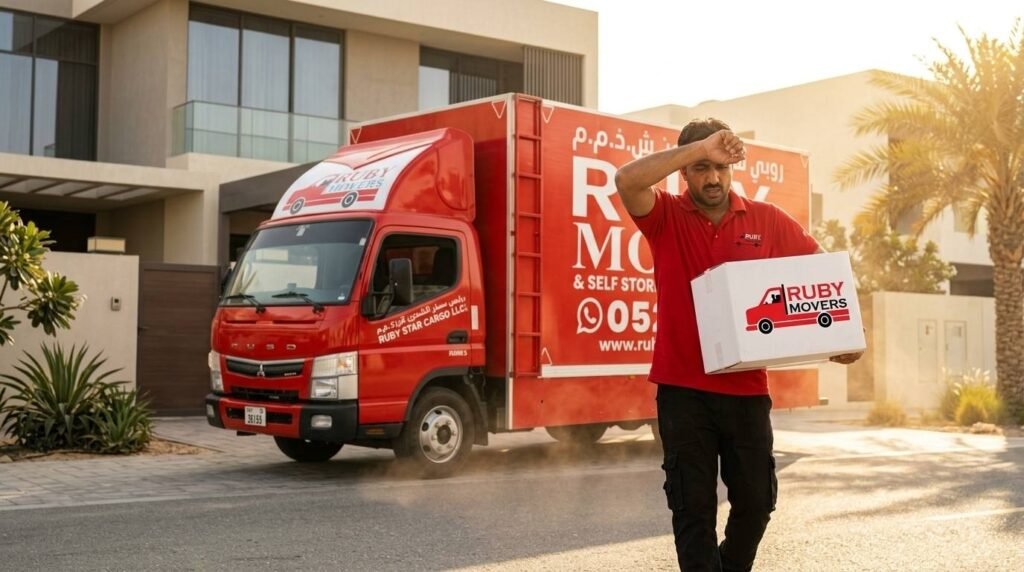
Dubai summer changes a villa move by turning exposure time into an operating constraint. Villas create more outdoor handling than most apartments. Crews cross driveways, gardens, garages, gates, and truck-side staging areas.
A fixed tenancy handover can still place your move in July or August. The practical response is shorter outdoor handling, separated heat-sensitive cargo, and a schedule built around the legal midday break.
That gives you 2 useful decisions:
- When to load
- Which items require protected transport
The first constraint is exposure.
How does summer heat change a villa move?
The Japan Meteorological Agency records Dubai’s July and August mean temperatures at 35.8°C and 36.0°C, about 35°C. World Meteorological Organization (WMO) data puts highs above 40°C, so heat increases crew strain and cargo exposure during loading, staging, and unloading.
Which villa items are damaged by heat exposure?
Heat-sensitive villa items do not share one safe exposure time. Material, packaging, direct sun, humidity, starting temperature, and truck temperature all change the result.
A useful summer moving plan therefore follows each item’s published storage or material limit. The table uses verified temperature or humidity limits where authorities publish them.
“No universal time” means the evidence does not support a fixed minute limit for a household move.
| Item class | Risk | Maximum exposure | Mitigation |
| Candles | Paraffin softens near its melting range. The National Institute of Standards and Technology (NIST) reports 48°C to 68°C for paraffin candle wax. | No universal time. Keep paraffin below the 48°C lower melting reference. The wax type can change the threshold. | Box upright. Shade cartons. Load late and unload early. |
| Electronics | High temperatures can trigger thermal protection and shorten battery life. Apple Support lists 45°C as the upper storage temperature for iPhone and iPad. | Manufacturer-specific. For these Apple devices, avoid storage above 45°C. | Power devices off. Keep them shaded. Use conditioned space for valuable electronics where practical. |
| Leather | Heat can dry leather. Humidity changes can cause hardening, buckling, or splitting. | No fixed moving limit. The Canadian Conservation Institute (CCI) recommends 18°C to 20°C and 45% to 55% relative humidity. | Use breathable protection. Reduce time inside an unconditioned truck. |
| Wood | Wood absorbs moisture as humidity rises and shrinks as conditions dry. Repeated changes can crack wood or damage finishes. | No universal time. Rapid temperature and humidity changes create more useful risk signals than one clock limit. | Shade furniture. Keep it dry. Pad surfaces and avoid long driveway staging. |
| Vinyl | Heat and thermal cycling can deform plastic records. | No universal hot-move limit. Library of Congress research found properly supported vertical discs could avoid appreciable gravity warping below 80°F, or 26.7°C, during long storage. | Pack records vertically in rigid crates. Keep crates away from truck roofs and sun-facing walls. |
| Medication | Medicines use product-specific storage ranges. Heat can affect stability without producing visible damage. | The United States Pharmacopeia (USP) defines controlled room temperature as 20°C to 25°C. Its controlled distribution framework lists excursions from 15°C to 30°C and a maximum 40°C excursion for up to 24 hours, subject to mean kinetic temperature controls. | Follow the medicine label. Carry medicines separately. Use validated cold storage where refrigeration applies. |
| Wine | Heat accelerates aging and can alter color, aroma, and flavor. | The Australian Wine Research Institute (AWRI) identifies long exposure above 25°C and short exposure above 40°C as quality risks. Changes above 40°C can appear within days. | Use insulated cases or conditioned transport for valuable collections. |
These limits matter because a Dubai moving truck can cross some item thresholds before visible damage appears. An electronic device can enter thermal protection before a wooden cabinet shows any obvious change. Medication can become a storage concern without looking different at all.
The U.S. Food and Drug Administration specifically advises patients to ask a pharmacist what to do after leaving medicine in a hot car. The United States Pharmacopeia uses controlled distribution limits, while each medicine label remains the controlling instruction.
That makes medication different from ordinary household cargo. Keep prescription medicines with you rather than inside the general villa load.
Why villa moves are scheduled in the morning
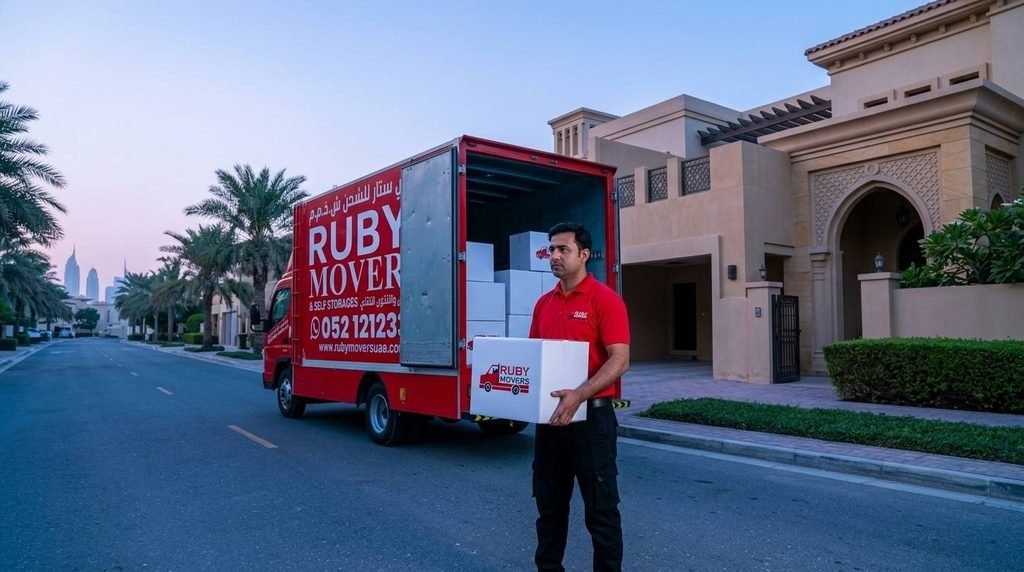
Morning scheduling reduces cumulative exposure before the hotter part of the working day. It also creates an outdoor loading window before the UAE restriction begins at 12:30 pm.
For moving in Dubai heat, air temperature alone does not describe worker exposure. The U.S. National Weather Service explains that Wet Bulb Globe Temperature (WBGT) combines temperature, humidity, wind, solar radiation, and other weather factors.
Full sunshine changes the picture again. National Weather Service guidance notes that direct sun can increase heat-index values by up to 15°F (about 8°C) compared with shaded conditions.
The loading window before peak heat
Use the early loading window for tasks with the longest outdoor carry. Heavy furniture, garden items, garage contents, and bulky pieces create repeated driveway exposure.
The National Institute for Occupational Safety and Health (NIOSH) recommends cooler-day scheduling for hot work. NIOSH also identifies larger crews and shorter work periods as controls for physically demanding work in heat.
Hydration has a measurable cadence. NIOSH recommends about 8 ounces, or one cup, every 15 to 20 minutes during moderate work in heat lasting under two hours. That equals roughly 0.7 to 0.95 liters per hour.
The table below is a summer move template, not a Dubai community-access rule. Confirm gate, parking, security, and villa access times before choosing an early start.
Build the villa moving day timeline around the longest outdoor carries first, then place boxed cargo, sensitive items, indoor work, and post-3:00 pm unloading around that sequence so the restricted midday period does not break the plan.
| Time | Villa move task | Exposure control |
| 6:30 to 7:00 am | Crew arrival and truck positioning | Keep packed cargo indoors. Establish water and shaded rest points. |
| 7:00 to 9:00 am | Heavy furniture and long-carry loading | Clear garden, garage, driveway, and bulky items first. |
| 9:00 to 10:30 am | General boxed cargo | Transfer cartons directly from indoor staging to the truck. |
| 10:30 am to 12:15 pm | Sensitive cargo and final exterior work | Reduce truck dwell time. Finish exposed tasks before 12:30 pm. |
| 12:30 to 3:00 pm | Restricted outdoor period | Stop ordinary work under direct sun and in open areas. Use suitable indoor work only. |
| After 3:00 pm | Remaining outdoor unloading | Reassess temperature, shade, hydration, and crew condition before restarting. |
The order matters more than the clock alone. A morning villa move can still involve severe heat.
Dubai International Airport normals from the Japan Meteorological Agency put July at 35.8°C and August at 36.0°C. An early start reduces exposure. It does not create cool-weather conditions.
NIOSH treats heat acclimatization as another control. Its March 2026 guidance uses a 7- to 14-day adjustment period. New workers begin with no more than 20% of normal heat exposure on day one.
The UAE midday work restriction and what it means for your move day
The 2026 UAE Occupational Heat Stress Prevention Policy runs from 15 June through 15 September 2026. The restriction applies daily from 12:30 pm to 3:00 pm.
The Emirates News Agency (WAM) 2026 announcement confirms that the policy entered its 22nd consecutive year in 2026. Work under direct sunlight and in open areas stops during the restricted hours.
The Ministry of Human Resources and Emiratisation (MoHRE) guidance gives the same dates and hours. MoHRE describes the restriction as covering all work carried out under the sun and in open places.
That creates a measurable scheduling constraint. The inclusive 2026 period covers 93 calendar days. At 2.5 restricted hours per day, summer contains 232.5 clock-hours when ordinary exposed outdoor work falls inside the restricted period.
For a villa move, that distinction matters. Loading furniture across an uncovered driveway or staging boxes beside a truck fits the published outdoor-work description when those exposure conditions exist.
MoHRE lists exemptions for specific work that cannot stop for technical or public-interest reasons. Examples include certain asphalt operations, concrete work, emergency utility repairs, and permitted work affecting essential services.
Ordinary household moving does not appear in that published exemption list.
For move-day planning:
- Finish the main exposed loading block before 12:30 pm.
- Move suitable packing, inventory, disassembly, or indoor work into the restricted period.
- Resume outdoor work after 3:00 pm, once heat controls remain adequate.
- Split a large villa move when one morning cannot absorb the outdoor workload.
MoHRE also requires employers to provide shaded areas, cooling equipment, adequate drinking water, hydration materials, and first-aid equipment. The 2026 announcement reports company compliance above 99% in recent years.
This is the local constraint that generic summer moving advice often misses. A seven-hour villa relocation does not contain seven continuous outdoor working hours during the restricted season.
How outdoor items and garden furniture are handled in summer
Outdoor villa contents begin the move without an air-conditioned buffer. Garden tables, loungers, cushions, planters, umbrellas, tools, barbecues, and storage boxes can sit under direct solar load.
For outdoor furniture and garden packing, prepare shade before dismantling, keep cushions and textiles dry, and move bulky pieces through the driveway as a short transfer rather than leaving them staged in direct sun.
Use 4 exposure controls:
- Shade items first. Move prepared pieces under a carport, covered patio, or another shaded transfer point.
- Dry soft goods. Pack cushions and fabric after they dry. Sealed plastic around damp foam can retain moisture.
- Disassemble large pieces. Smaller components shorten carrying time and simplify truck placement.
- Stage briefly. Treat the driveway as a transfer route rather than temporary storage.
The Canadian Conservation Institute furniture guidance explains that humidity changes make wooden objects swell and shrink. CCI also recommends lifting furniture at strong structural points rather than dragging it.
A closed van introduces another humidity issue. A U.S. Forest Service shipping-environment assessment reports that rapid temperature changes in closed vans can create condensation on cargo or vehicle surfaces.
That matters when furniture moves from an air-conditioned villa into hot outdoor air and then into sealed transport. Keep garden textiles dry and avoid unnecessary sealed staging.
How the truck itself becomes the risk
A closed truck becomes a thermal risk when solar radiation heats the roof and side walls faster than the cargo compartment releases that energy. A U.S. Forest Service assessment of shipping environments notes that cargo temperature can exceed ambient temperature because direct solar radiation heats the cargo, vehicle, or enclosure.
Vehicle research shows how large solar heat gain can become. A Stanford University study published in Pediatrics measured an average enclosed-vehicle temperature rise of about 40°F (22°C) within 60 minutes. About 80% of the rise occurred during the first 30 minutes.
Separate research on parked vehicles found cabin temperatures can exceed ambient temperature by more than 20°C. Another dataset recorded maximum passenger-compartment temperatures between 41°C and 76°C, depending on weather conditions.
Those passenger-vehicle figures do not mean every Dubai moving truck reaches the same temperature. A truck has different glazing, body materials, insulation, ventilation, color, cargo mass, door-opening patterns, and airflow.
The research establishes a narrower point: ambient temperature is not a safe substitute for enclosed vehicle temperature.
Truck research supports the same mechanism. Studies of refrigerated transport identify solar radiation and ambient heat as direct thermal loads on cargo compartments, even when insulation and active refrigeration are present.
For a Dubai villa move, change the loading order accordingly. Keep the truck shaded where site access permits. Reduce idle periods with closed doors under full sun. Load heat-sensitive cartons late and unload them early.
Place sensitive cartons away from roof and sun-facing wall hot spots. Do not assume a sealed transit stage protects cargo merely because direct sunlight no longer touches the item.
A standard dry moving truck is not a temperature-controlled container. Medicines requiring refrigeration, valuable wine, sensitive electronics, fine leather, archival vinyl, artwork, and similar cargo require a separate transport plan when verified storage limits sit below expected truck conditions.
Which villa moves should not be scheduled in July or August at all?
Avoid July or August when your date is flexible and the move combines long outdoor carries with strict temperature-sensitive cargo. The calendar becomes a problem when available controls cannot keep exposure within verified limits.
Five move profiles deserve another date or a separate transport plan:
- Large wine collections: AWRI identifies risk above 25°C for long periods and above 40°C for short periods.
- Temperature-controlled medicines: Follow the medicine label and pharmacist instructions rather than household moving practices.
- Archival vinyl collections: Library of Congress preservation conditions sit far below an unconditioned Dubai summer truck.
- Villas with long uncovered access: More driveway distance creates repeated worker and cargo exposure.
- Moves requiring extended outdoor staging: A crowded origin or unready destination leaves belongings exposed without advancing the move.
A fixed lease or handover date changes the solution, not the environmental limit. Split the relocation when the property date cannot move.
When the lease date is fixed, schedule the villa tenancy handover inspection around the physical move so condition photographs, empty-property checks, and key handover do not force heat-sensitive cargo or outdoor work into a worse time window.
General furniture can follow the tenancy handover. Sensitive cargo can use conditioned transport or a different loading window.
This is the practical border for villa moving in summer Dubai conditions. July and August are not automatically impossible. They become poor choices when heat exposure exceeds the controls available for the crew, cargo, truck, or property access.
Where seasonal pricing and booking timing are explained
Seasonal pricing and booking timing sit beside the environmental decision, not inside it. Fix the heat-safe working window, crew requirement, truck specification, access conditions, and sensitive-item plan before comparing quotes.
Moving-company websites publish summer discounts and different booking lead times. Treat those percentages as supplier-specific unless the company identifies a wider market dataset.
Your lease handover can also set the moving date before weather or price enters the decision. Where timing remains flexible, compare the best time to move in Dubai across four attributes: exposure, handover date, mover availability, and price.
Understanding how timing changes a villa moving quote means comparing the same scope against the available working window, crew requirements, truck specifications, community access conditions, and any split-move requirements created by summer heat.
A cheaper July quote does not change a 12:30 pm to 3:00 pm outdoor restriction. It also does not lower the temperature inside an unconditioned truck.
A Dubai summer changes a villa move by limiting outdoor execution and raising heat exposure during staging and transport. A workable summer move reduces exposure first, then fits timing and price around that limit.
Plan the villa move around heat exposure, not just the date
A Dubai summer does not rule out a villa move, but it removes room for casual scheduling. July and August mean temperatures sit around 35°C, while outdoor loading faces a legal 12:30 pm to 3:00 pm restriction during the summer period.
The practical decision is straightforward. Start exposed work early, keep driveway staging short, separate heat-sensitive cargo, and confirm how the truck handles prolonged solar exposure. Electronics, medication, wine, leather, wood, vinyl, and candles cannot all be treated as ordinary boxed goods.
A fixed handover date does not justify forcing every item through the same summer schedule. Split the move when required. General furniture can follow the main villa move, while temperature-sensitive items use protected transport or a separate loading window.
Before booking villa movers in Dubai, get 5 details in writing:
- Start time
- Crew size
- Midday-break plan
- Truck type
- Heat-sensitive item procedure
If the plan ignores summer exposure, change the plan, the vehicle, or the moving date before confirming the booking.
FAQs
Load heat-sensitive boxes late and unload them early to reduce time inside a solar-heated truck.
Suitable indoor packing, inventory, disassembly, and documentation can continue where the work remains outside the restricted outdoor exposure conditions.
No. Shade reduces solar gain, but an ordinary moving truck still does not provide verified temperature-controlled storage for wine or medication.
No. A smaller villa can create greater heat exposure when the truck sits farther away or the property requires long uncovered carrying distances.
Bilal Al-Madani
Bilal Al-Madani is a logistics professional specializing in residential relocations and supply chain optimization. With deep experience in the moving industry, he excels in ensuring transit safety, implementing advanced packing methods for high-value items, and managing transport fleets efficiently. He is committed to simplifying the moving process through careful planning, delivering each relocation with precision, reliability, and exceptional attention to detail.


