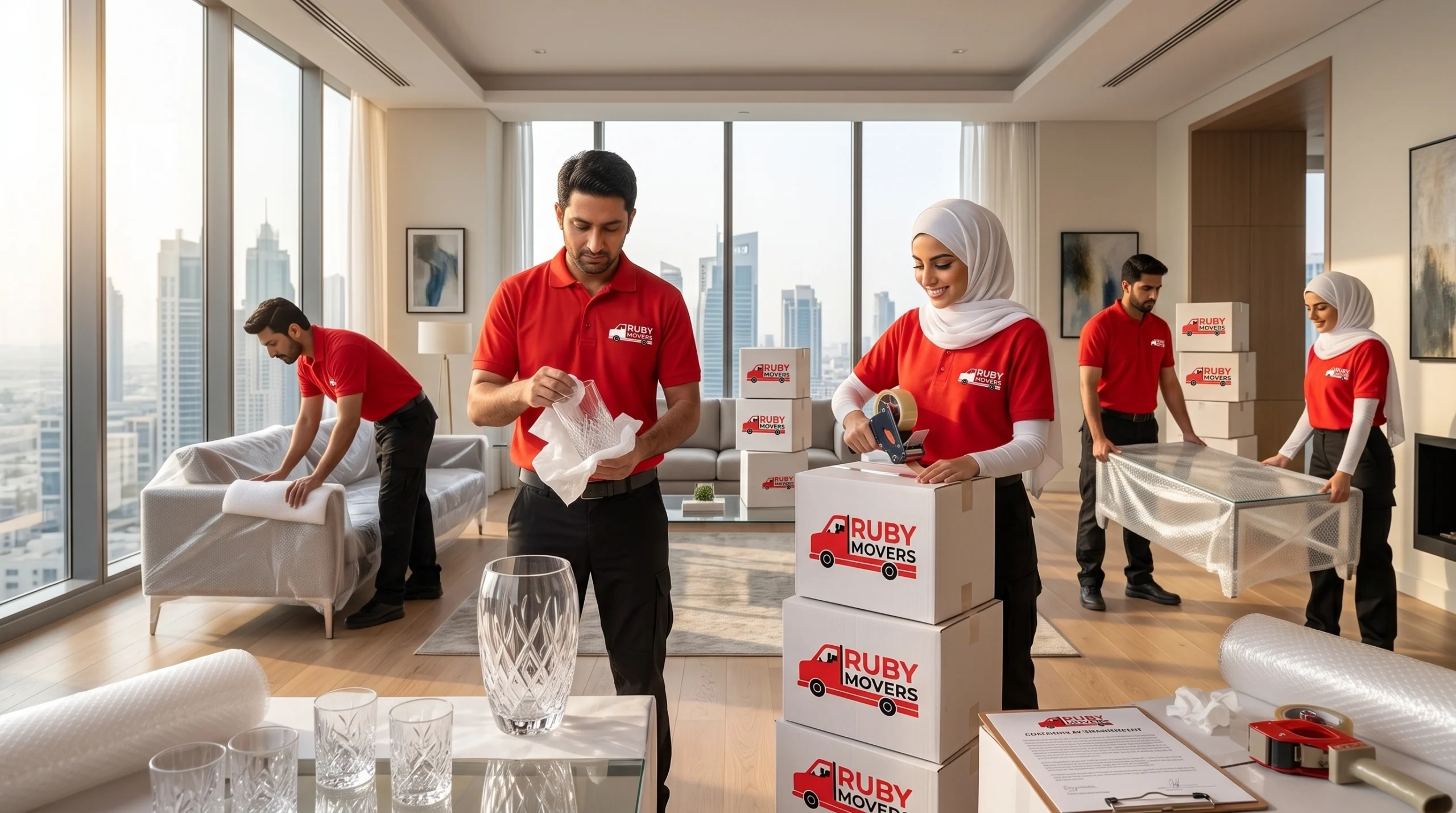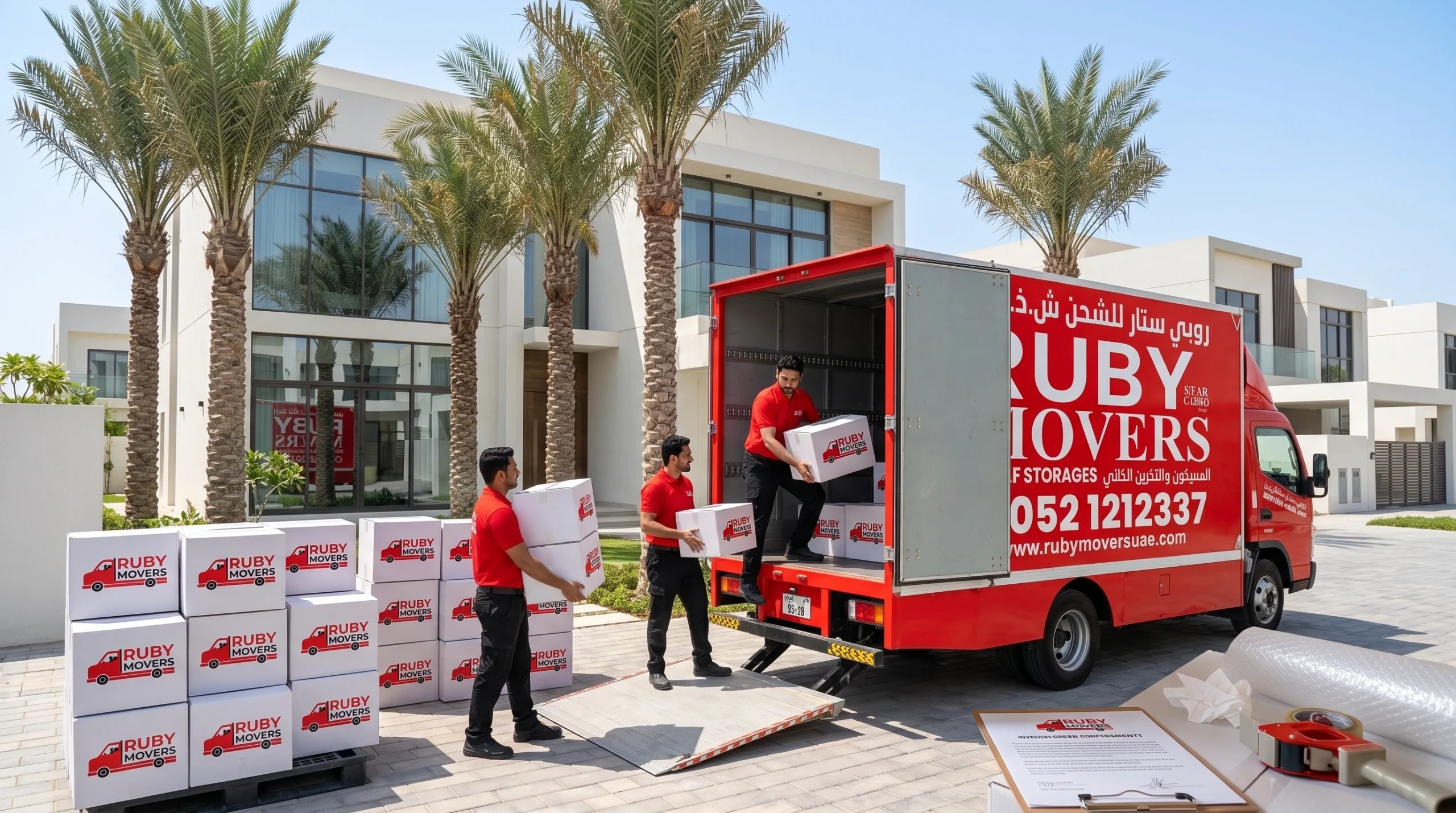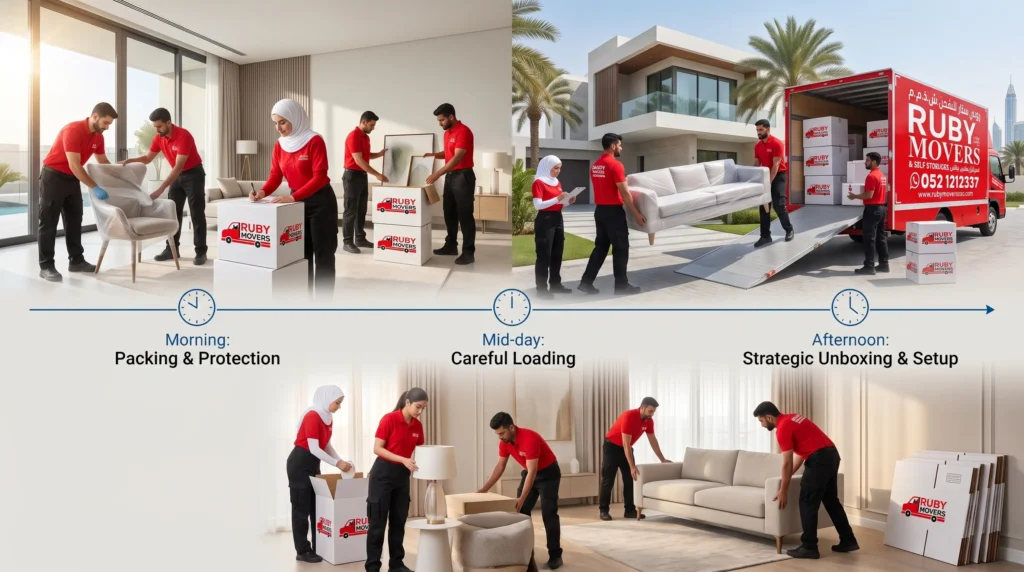
A villa move does not end when the final box leaves the truck. Poor room placement, missing hardware, unstable furniture, incorrect appliance positioning, and unrecorded damage can create problems after the crew leaves.
A controlled destination setup prevents that confusion. The process starts with access approval, continues through room-based unloading and furniture reassembly, and ends with a documented inspection. This guide explains how movers place boxes, rebuild furniture, position appliances, check fragile items, organize packing waste, and prepare the villa for final sign-off. It also provides a practical setup checklist for residents completing a villa move in Dubai.
What to Check Before Signing Off a Dubai Villa Move?
Unloading, reassembly, and setup complete a Dubai villa move through room-based box placement, furniture rebuilding, appliance positioning, fragile-item checks, waste sorting, and a documented inspection before handover.
A controlled destination setup gives you two practical benefits. You can use essential rooms sooner and separate moving damage from pre-existing villa defects. For villa setup after moving to Dubai, the sequence matters as much as the transport itself.
Access comes first in managed communities. Dubai Hills Estate requires a move-in permit at least one business day before the move. Tenant applications require an Ejari, Emirates ID, and a passport with a visa page. Security denies access without the permit.
Every later inspection depends on the placement record created during unloading. Unloading, reassembly, and setup at a new villa, therefore, start at the gate, not beside the first carton.
A 6-stage workflow keeps the crew, inventory, and resident checks aligned:
- Confirm access. Match the permit, truck details, parking point, and protected carrying route.
- Unload by zone. Separate ground-floor, upper-floor, garage, garden, and priority items.
- Place by room. Match each carton code with the destination plan.
- Reassemble furniture. Rebuild listed items and account for every hardware bag.
- Position appliances. Check dimensions, level, utilities, clearances, and model instructions.
- Inspect and clear. Record damage, count cartons, and sort packing waste.
The following table defines the evidence you can request at each destination setup stage.
| Setup stage | Crew action | Resident check |
| Access | Protects the route and confirms entry | 1 permit, 1 truck position, 1 clear route |
| Box placement | Sends cartons to labelled rooms | Floor, room, carton number, priority |
| Reassembly | Matches panels and hardware | 1 hardware bag per dismantled item |
| Appliances | Levels and positions each unit | Manual clearance, stable feet, accessible services |
| Fragile check | Opens priority cartons | Inventory number, photo, condition, time |
| Debris clearing | Separates materials | Recyclables, general waste, retained packing |
The final signature comes after these checks, not after the truck becomes empty.
How are boxes placed by room?
Boxes are placed through a four-part code: floor, room, carton sequence, and unpacking priority. The crew carries each carton to its final room instead of creating one mixed entrance stack.
Use labels such as G-KIT-03/12-P1. “G” means ground floor, “KIT” means kitchen, “03/12” means carton 3 of 12, and “P1” means first-day access. Place the code on the top and one side.
A two-story Dubai villa needs separate landing zones. Kitchen cartons remain downstairs. Bedroom cartons move upstairs. Garden cushions stay near the patio, while tools remain in the garage.
First-day boxes require a separate code. Typical contents include bedding, medicines, chargers, basic cookware, pet supplies, toiletries, and children’s items. Keep valuables and personal documents in a resident-controlled area.
Keep the main entrance, staircase, and utility route clear. Count cartons at the doorway to confirm delivery. Count each room again to confirm correct box placement.
In Dubai Hills Estate, the permit controls community access. Inside the villa, the room plan controls movement. Using both controls prevents an approved delivery from becoming a disorganized destination setup.
How is furniture reassembled at the destination?
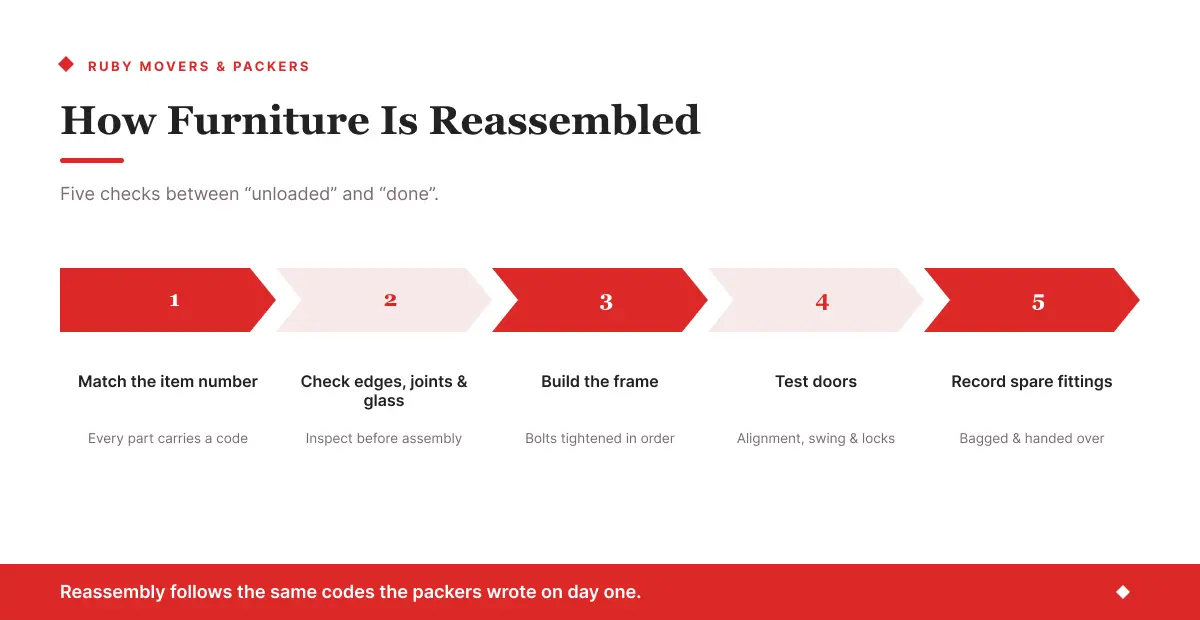
Furniture reassembly matches every dismantled panel, fitting, and hardware bag with its original item and destination room. Assembly starts on protected flooring before final furniture placement.
Use this 5-point furniture assembly record:
- Match the item number with its panels and hardware.
- Check edges, joints, glass, runners, hinges, and feet.
- Build the frame in the manufacturer’s sequence.
- Test doors, drawers, extensions, and adjustable parts.
- Record spare fittings, missing pieces, damage, or restricted wall fixing.
Manual handling depends on more than object weight. The National Institute for Occupational Safety and Health (NIOSH) lifting equation evaluates eight factors. These include hand position, vertical travel, lift frequency, task duration, and grip quality.
The agency recommends a Lifting Index or Composite Lifting Index of 1.0 or lower. This calculation helps a supervisor decide whether to change the route, add handlers, or use lifting equipment.
That assessment matters when a villa move includes stone dining tables, large wardrobes, adjustable beds, pool tables, or oversized modular sofas. Narrow stairs and long garden paths increase handling demands even when the item weight remains unchanged.
Tall furniture also requires a stability check. United States Consumer Product Safety Commission data estimated 14,500 annual emergency-department injuries involving furniture tip-overs during 2020 to 2022. Furniture represented 82% of product tip-over injuries, while children represented 44% of all injuries.
Wall material controls the anchoring method. IKEA UAE gives a 5 millimeter wood-screw example for a stud and an 8 millimeter plug for unsupported drywall. Solid masonry uses a plug and screw, while hollow masonry uses a toggle-style fixing.
Treat those sizes as product examples, not universal specifications. Obtain approval before drilling, identify concrete or gypsum surfaces, and follow the furniture manufacturer’s instructions.
How are appliances positioned at the new villa?
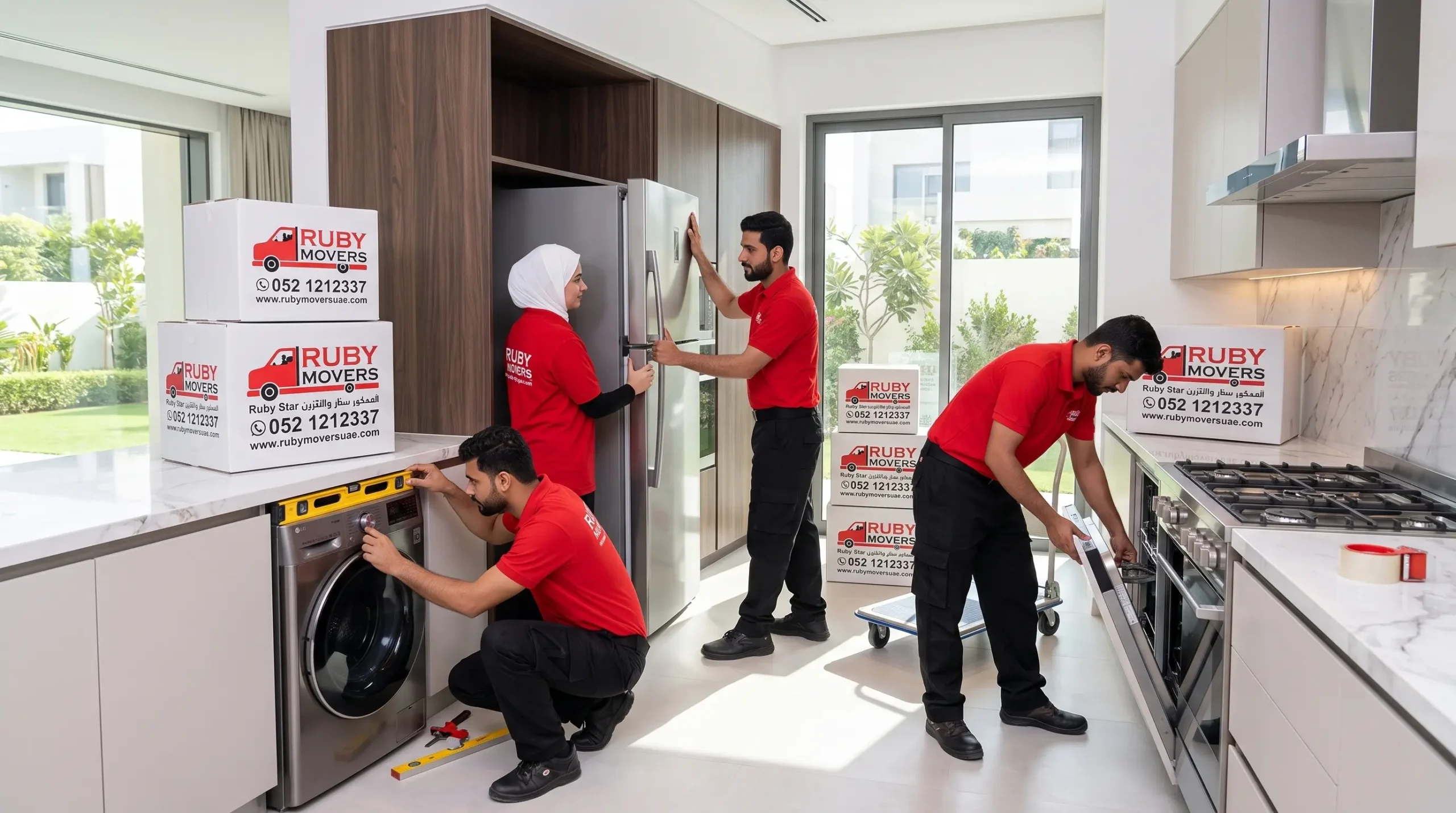
Appliance placement confirms dimensions, airflow, level flooring, utility access, and model-specific limits before connection. Positioning does not automatically include plumbing, gas, or fixed electrical work.
Washing machine placement
Remove transport restraints before testing a washing machine. One LG model manual specifies three transit bolts, a maximum floor slope of 1 degree, and a power outlet within 1.5 meters.
The same manual lists 10 centimeters behind the washer, 2 centimeters on each side, and about 20 millimeters above. It also requires all four feet to remain stable on a hard, level floor.
Keep the transit bolts. The bolts protect the drum during later transport. Record their storage location on the destination setup sheet.
Refrigerator placement
Record whether the refrigerator traveled upright or on its side. Samsung Gulf advises waiting 2 to 3 hours after upright transport and at least 4 hours after side transport.
Its current guidance also gives at least 5 millimeters of surrounding clearance. The model manual remains the final source for ventilation distance and startup procedure.
Dishwasher placement
Check water supply and drainage without bending or trapping hoses. Bosch UAE gives a water-pressure range of 0.5 to 10 bar and a minimum flow of 10 liters per minute.
The guidance limits warm water to 60°C and specifies a 220 to 240-volt electrical supply. A specialist completes any change to the electrical or water connection.
These figures explain why “place and plug in” is an incomplete appliance setup method. The rating plate and model manual control the final measurements.
After connection, check for hose movement, dripping joints, unstable feet, trapped cables, blocked ventilation, and cabinet contact. Record any test excluded from the mover’s written scope.
How are fragile items checked after delivery?
Fragile items are checked against the inventory, pre-move photographs, carton code, and visible condition before protective material leaves the room. The check covers quantity, surface condition, structure, and basic function.
Inspect fragile items in this order:
- Open mirrors, glass tops, framed art, televisions, and stone pieces first.
- Use side lighting to expose chips, hairline cracks, rubbed finishes, and fresh scratches.
- Compare each item with its pre-move photograph and inventory description.
- Photograph any issue beside the carton code or item number.
- Keep damaged wrapping until the condition record is complete.
Check glass-table corners and fixing holes closely. These areas carry concentrated stress. For mirrors, inspect the edges, backing, frame joints, and reflection surface.
A recently handed-over Dubai villa may contain existing snagging defects. Separate property defects from delivery damage and assign each issue to the correct record. For example, an old wall mark belongs on the property record. A fresh impact beside a newly placed wardrobe belongs on the moving record.
Use four evidence fields for every exception: item, room, condition, and time. Add the responsible contact when a mover, landlord, community manager, or appliance technician handles the item.
List unopened priority cartons and incomplete testing on the destination handover sheet before signing.
How is packing waste removed or organized?
Packed waste is sorted by material, kept outside walking routes, and removed under the moving scope or community rules. Do not mix recyclable cardboard with food residue, wet waste, or liquid-contaminated material.
Dubai Municipality’s 2024 Waste Segregation Guide applies to villas. It identifies corrugated shipping boxes as recyclable and excludes contaminated or plastic-coated cardboard. The guide also lists bubble wrap and packing foam as recyclable plastics.
Use the municipality’s three-bin framework where available:
- Green: Dry mixed recyclables
- Black: Non-recyclable general waste
- Brown: Organic waste
When bins are unavailable, the guide specifies at least two bags. Use one clear bag for recyclable materials and one black bag for general waste. The guide also calls for labels in Arabic and English.
Flatten cartons after completing the damage and return check. Retain appliance cartons, molded inserts, transit bolts, specialist cases, and corner protectors when warranty or future transport requires them.
Furniture and white goods follow a separate disposal route. Dubai Municipality directs households to its Bulky Waste Collection Program through 800-900.
The municipality completed 4,000 bulky-waste requests during the first half of 2022. Three field teams handled the service, and recycling companies screened most collected items for reuse. The programme excluded specified development zones and free zones at that time.
Confirm the villa community’s collection point before leaving waste outside. Some gated communities use private waste contractors or scheduled collection areas.
How should residents inspect the setup?
Residents inspect the villa room by room before signing the completion record. The review covers routes, box counts, furniture stability, appliances, fragile goods, property surfaces, waste, and incomplete work.
Destination setup checklist
- Match every room against the floor plan and carton codes.
- Count unopened boxes by room and compare them with the inventory.
- Test beds, tables, chairs, drawers, hinges, and modular connections.
- Check tall furniture for approved anchoring and stable footing.
- Inspect floors, stairs, doors, walls, skirting, and handrails.
- Review appliance clearances, feet, hoses, plugs, and visible leaks.
- Open priority fragile cartons and photograph condition changes.
- Account for screws, transit bolts, keys, brackets, and manuals.
- Confirm waste removal, retained packaging, and the collection point.
- Write each unresolved item on the handover sheet before signing.
Walk through the villa in a fixed order. Start outside and inspect the ground floor. Continue upstairs, then finish in the garage, garden, and service areas.
This route connects a defect with the movement path or setup task. A scratch beside the staircase can be matched with upstairs deliveries. A damaged patio door can be compared with the garden-furniture route.
Take one wide image of each room and close-up images of defects. Add the room, item number, date, and responsible contact. Keep the signed inventory, photographs, permit, appliance notes, and setup record together.
Destination setup completes the physical move. The written inspection starts the final damage check and protection process.
Complete the villa move with a documented final check
A villa move is complete when every item reaches the correct room, each dismantled unit works as intended, and unresolved issues appear on the handover record. An empty truck does not confirm a complete destination setup.
Walk through the villa before the crew removes the final protective materials. Check box counts, furniture joints, appliance clearances, fragile items, walls, floors, stair edges, and outdoor access routes. Keep photographs, inventory sheets, manuals, hardware bags, and written exceptions together.
This final review protects both sides. Residents gain a clear record of the villa’s condition, while the moving team receives an accurate list of completed and pending tasks. Careful unloading, reassembly, and setup turns delivery into an organized handover and creates a clear starting point for the final damage and protection check.
FAQs
How long does unloading and setup take at a Dubai villa?
The duration depends on inventory volume, villa floors, access distance, reassembly scope, appliance work, and unpacking level, so a site survey provides a defensible schedule.
Do movers unpack every box?
Movers unpack every box only when full unpacking appears in the written scope; basic setup can cover room placement, furniture reassembly, appliance positioning, and debris clearing.
Can movers connect washing machines and dishwashers?
Movers can complete simple manufacturer-approved connections included in the scope, while specialists handle changed plumbing, fixed wiring, gas work, and restricted installations.
Who approves furniture placement?
You or the named move coordinator approves furniture locations, while the supervisor checks access, assembly space, stability, wall material, and appliance clearances.
What happens when a box reaches the wrong room?
The crew corrects the room placement before unpacking, updates the room count, and restores clear routes instead of leaving mixed cartons near the stairs.
When do residents report moving damage?
Residents record visible damage during the destination inspection and follow the notice period, evidence rules, and claim process written in the moving contract.
Bilal Al-Madani
Bilal Al-Madani is a logistics professional specializing in residential relocations and supply chain optimization. With deep experience in the moving industry, he excels in ensuring transit safety, implementing advanced packing methods for high-value items, and managing transport fleets efficiently. He is committed to simplifying the moving process through careful planning, delivering each relocation with precision, reliability, and exceptional attention to detail.