
Unpacking extends a villa move beyond delivery. The crew can stop at sealed cartons, open cartons, or place contents in their final locations.
The problem is scope. Residents may expect a fully arranged kitchen, while the booked service may cover only basic unpacking. The same gap appears with wardrobe hanging, carton removal, debris collection, and final placement.
This guide explains the 4 practical unpacking levels:
- What each level covers?
- Where extra charges can appear?
- Which rooms deserve priority?
- How unpacking connects with damage checks and destination setup?
Is unpacking included in a villa moving quote?
Do not assume unpacking sits inside a villa moving quote. Ruby currently includes basic unpacking in its full service scope, while fuller item placement depends on booking. The three practical boundaries are unload only, unpack to surface, and unpack and place.
For residents comparing post-delivery scope, villa unpacking services in Dubai should be confirmed in writing before the move so basic unpacking, full placement, and carton removal are not treated as the same service.
According to Ruby Movers’ current service information, its written full service quote includes unloading, basic unpacking, and furniture reassembly. Its dedicated villa moving service separately states that unpacking remains available when you include it in the booking.
That distinction matters. “Basic unpacking” does not automatically define cupboard arrangement, wardrobe hanging, drawer organization, appliance setup, or complete carton removal.
The FIDI Professional Cooperation Guidelines treat unpacking labor and other accessorial services as work that requires defined responsibilities. The commercial lesson is simple. Put the exact post-delivery tasks in the written scope.
The three unpacking tiers, and what each includes
The three-tier ladder separates unloading from actual household setup. It is a comparison framework.
The table defines each service boundary and shows only pricing information.
| Tier | What the crew does | What you do | Typical AED | Time |
| Unload only | The crew carries sealed cartons into agreed rooms | You open, organize, flatten cartons, and clear packing waste | Ruby does not publish this as a standalone villa tier | No standalone Ruby duration published |
| Unpack to surface | The crew opens agreed cartons and places contents on a nearby clear surface | You organize cupboards, drawers, shelves, and personal storage | Ruby includes basic unpacking within full-service moving. The published Dubai market range is AED 3,500 to 6,500 for 3 to 4 bedrooms | Ruby does not publish separate unpacking hours |
| Unpack and place | The crew opens agreed cartons and organizes approved contents in defined locations | You direct placement and retain private items | Available on request. Ruby publishes no standalone AED unpacking price | Scope-based, with no separate published duration |
For larger villas, current published market guides place 5-bedroom and larger full-service moves at AED 6,000 to AED 10,000+.
These figures are Dubai market ranges, not guaranteed quotations. The actual price follows a property survey.
That point prevents a pricing error. The AED 3,500 to AED 6,500 range covers the complete move, including basic unpacking. It is not an unpacking-only rate.
A separate cost guide gives another useful time reference. A 3-bedroom villa can occupy 6 to 10 hours, while a 4-bedroom move can occupy 8 to 12 hours.
A 5-bedroom villa can extend across 1 to 2 days. Those figures describe the full move rather than unpacking alone.
Check Value Added Tax (VAT) separately when comparing quotations. The UAE Federal Tax Authority confirms a standard VAT rate of 5%.
Ask whether the written AED figure already includes applicable VAT. That keeps the unpacking comparison tied to the amount you actually pay.
What ‘unpack to surface’ means in practice
“Unpack to surface” means opening agreed cartons and placing the contents on a suitable nearby worktop, table, bed, counter, or other clear surface. It is not putting your kitchen away.
Plates on a kitchen counter can be set on the surface. Plates sorted into your chosen upper cabinet require another placement decision.
The same distinction applies upstairs. Folded clothes placed on a bed are unpacked, but they are not organized inside drawers.
A clear scope can be like this:
- Open every carton marked K1 and K2.
- Place wrapped kitchen contents on cleared counters.
- Hang garments from labeled wardrobe cartons.
- Leave medicines and private cartons sealed.
- Remove opened cartons and protective wrapping.
- Record unopened cartons before final sign-off.
Specific instructions make the service measurable. “Full unpacking” without those details leaves too much room for different expectations.
Which rooms are worth paying to have unpacked?
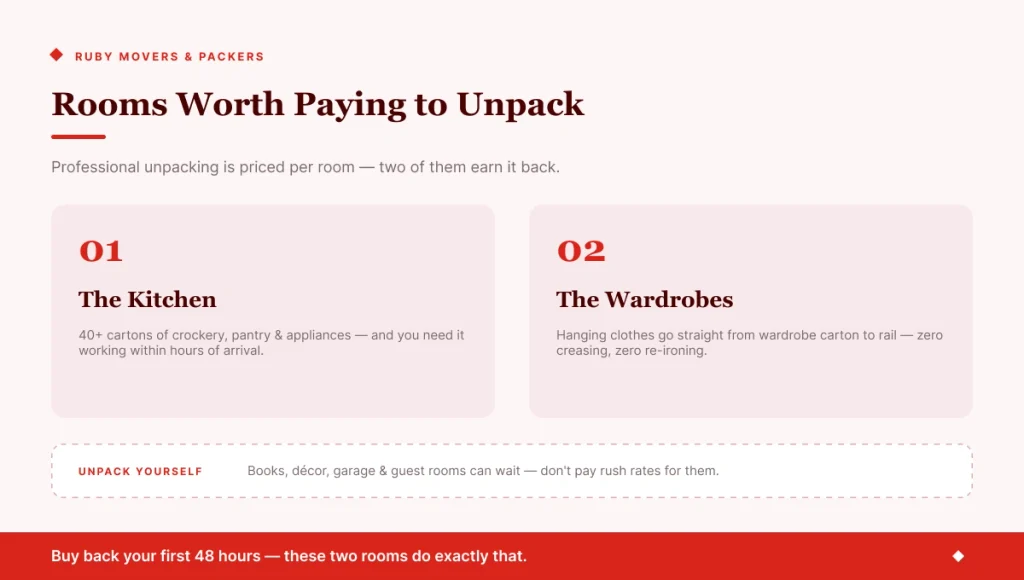
Kitchen and wardrobe unpacking usually produce the largest time saving because both areas contain many separate items with defined destination locations.
Ruby’s packing-volume example helps quantify that workload. A kitchen example contains 24 cartons occupying 84 cubic feet, or 2.38 cubic meters.
Its wardrobe example uses 14 packages occupying 116 cubic feet, or 3.28 cubic meters. The wardrobe group occupies more space despite using fewer packages.
- Kitchen, because of volume and fragility
Kitchen unpacking covers agreed crockery, cookware, utensils, pantry items, and approved small appliances.
The kitchen deserves early attention because box count alone understates the work. One dish pack can contain many individually wrapped objects.
Ruby’s worked kitchen calculation uses 18 standard cartons and six dish packs. Together, those 24 packages occupy 2.38 cubic meters.
The National Institute of Standards and Technology defines one cubic foot as exactly 0.028316846592 cubic meters. That conversion supports the volume calculation.
Kitchen placement requires instructions before cartons open. Otherwise, crew members know the destination room but not your cupboard logic.
Useful placement instructions include:
- Put everyday plates in the marked upper cabinet.
- Put pans in the labeled lower cabinet.
- Place glassware in the marked cupboard.
- Leave pantry cartons sealed until shelves are ready.
- Keep medicines, cash, and private items with you.
Ruby’s villa kitchen packing guidance also separates perishables, medicines, valuables, hazardous goods, and final-day essentials before packing.
Those exclusions remain useful during unpacking. The crew cannot organize an item that you intentionally kept outside the shipment.
- Wardrobes, because of hanging order
Wardrobe unpacking transfers agreed to hang clothes into the correct bedroom, dressing room, or wardrobe rail.
A wardrobe carton can hold a large volume. Ruby’s packing-volume table assigns a 10 cubic foot capacity, equal to about 0.283 cubic meters, to one wardrobe box.
Its worked wardrobe group combines eight wardrobe boxes with six large linen cartons. The resulting volume reaches 116 cubic feet or 3.28 cubic meters.
Placement still depends on ownership and order. Mark each carton with the room, owner, garment group, and destination rail.
Bedroom and wardrobe guidance also separates hanging clothing, folded clothing, mattresses, bed frames, valuables, and children’s items.
That classification prevents one wardrobe instruction from covering every bedroom possession.
What happens to the cartons and packing waste?
Carton removal after moving depends on when the cartons are opened. Same-day unpacking can support immediate removal, while retained cartons require later disposal or collection terms.
Dubai Municipality uses 4 color-coded bins:
- Black for general waste
- Yellow for dry recyclables (paper, plastic, metal, cardboard)
- Green for organic and food waste
- Red for hazardous waste
Dubai Statistics Center data sourced from Dubai Municipality recorded 158,627 metric tons of domestic waste in Q4 2024.
The same dataset recorded 2,427,220 metric tons of total collected waste across the listed categories and transport sources during that quarter.
Those city figures are not moving-industry waste totals. They show why cardboard removal belongs inside a defined disposal process rather than an informal garage pile.
- Same-day removal versus scheduled collection
Same-day carton removal means the crew clears opened boxes and agreed packing materials before leaving the destination.
Ruby publishes this service in several residential scopes. Its Palm Jumeirah moving service includes removal of cartons and packing materials within the requested post-move setup.
The same page lists room-by-room unpacking, organization, furniture placement, and a final walkthrough within its requested setup service.
Scheduled collection is different. The sources reviewed for this article do not show a standard Ruby carton-return timetable.
Ask for 4 details if cartons remain at the villa:
- Confirm the collection date.
- Confirm the maximum carton quantity.
- Confirm whether cartons need flattening.
- Confirm whether damaged packing material qualifies for collection.
Without those terms, “carton return” remains undefined.
- Whether removal is chargeable
Carton removal becomes chargeable according to the written moving scope, labor allocation, collection timing, and whether the crew returns after move day.
A separate visit or extra labor can create unpacking charged outside the quote when that work was not included in the agreed service boundary.
You need a separate price confirmation when collection requires another visit. Get the amount in the quotation before retaining packaging.
Do not treat “cartons included” and “carton collection included” as the same promise. The first covers supply. The second covers removal after use.
Keep reusable cartons separate from damaged or contaminated packaging. Dubai Municipality’s waste classification recognizes cardboard as a recyclable category, which supports separating clean cartons from mixed debris.
How unpacking interacts with the damage check
Unpacking exposes concealed damage before the final handover. That gives you a better opportunity to connect an item, carton, room, condition, and time.
If damage found after delivery appears while priority cartons are opened, record the carton or item number, destination room, photographs, and time before final sign-off.
Check priority fragile cartons while the crew remains on-site. Photograph damaged contents before removing all internal wrapping.
Record 4 pieces of evidence:
- Item or carton number.
- Destination room.
- Visible condition.
- Photograph and time.
The current FIDI Professional Cooperation Guidelines separately address claims handling and loss or damage prevention at origin and destination.
After sign-off, a claim can depend more heavily on written evidence and the contract’s notice terms. Do not assume the same claim deadline applies to every mover.
Dubai residents also have an official complaint route. Dubai Consumer Rights requires evidence of what the business promised and how the delivered service differed.
The authority states that complaint resolution usually takes 5 working days. The establishment also needs to fall within the Dubai Department of Economy and Tourism jurisdiction.
That is another reason to define unpacking before move day.
Which items should never be unpacked by the crew?
Keep passports, Emirates ID documents, cash, jewelry, medicines, keys, confidential records, private data storage, and irreplaceable personal papers under your control. Keep passports, tickets, and travel bags separate from the household shipment.
Apply the same control at the destination. Crew unpacking adds little value when an item requires privacy, personal judgment, secure storage, or regulated handling.
Keep these categories outside general unpacking:
- Carry personal documents yourself.
- Retain cash, jewelry, watches, and small valuables.
- Control prescription medicines and temperature-sensitive medical products.
- Keep passwords, drives, company records, and confidential files secure.
- Separate chemicals, fuels, paint, and restricted materials.
- Direct high-value collectibles personally.
Tell the supervisor which cartons stay sealed. Mark them before loading and repeat the instruction at the destination.
Where destination setup and reassembly are documented
Destination setup belongs in the written villa moving scope beside unpacking, room placement, furniture reassembly, appliance positioning, damage inspection, and debris removal.
The destination plan should identify unloading, reassembly and setup at the new villa as separate line items so each task has a clear finish point.
Keep unpacking separate from reassembly. Opening a carton does not rebuild a bed. Hanging clothes does not reconnect an appliance. Clearing cardboard does not confirm furniture stability.
Your quote can therefore record post-delivery execution as individual line items:
- Confirm room-based unloading.
- Record basic or full unpacking.
- Define kitchen and wardrobe placement.
- List furniture requiring reassembly.
- Record appliance positioning or connection exclusions.
- Define carton and packing waste removal.
- Complete the inventory and damage check before sign-off.
Booking timing also affects this scope. 1 to 2 weeks is a comfortable booking window and directs urgent moves to availability checks. Adding extensive unpacking late can change crew allocation and working time.
A villa move therefore finishes at the agreed service boundary, not when the truck becomes empty. Define unpacking before booking, record the placement level, and connect the final villa move handover to carton clearance and documented setup.
Define the unpacking boundary before move day
A villa move is not finished simply because every carton reaches the right room. The real finish point depends on the unpacking scope written into the quote.
Basic unpacking, surface placement, full placement, wardrobe hanging, kitchen setup, carton removal, and reassembly are separate tasks. The existing service guide already shows that Ruby distinguishes basic unpacking from fuller placement and setup work.
The clearest way to avoid post-delivery confusion is to define each task before move day. State which cartons the crew opens, where contents go, which rooms receive priority, and who removes packing waste.
That detail matters after the final box leaves the truck. A villa move can involve dozens of cartons and several cubic meters of household goods, while kitchen and wardrobe groups alone can represent a large share of the unpacking workload.
Keep damage inspection inside the same handover process. Record carton numbers, room locations, visible condition, photographs, and time before final sign-off.
The contract and notice terms determine how a late damage discovery affects a claim, especially when the issue is recorded only after the crew has left and final sign-off is complete.
In practical terms, good unpacking starts with a clear service boundary. Define what gets opened, what gets placed, what stays private, and what leaves with the crew. That makes the final stage of a villa move easier to price, inspect, and close properly.
FAQs
Yes. You can limit the unpacking scope to high-workload rooms such as kitchens and wardrobes, provided the quotation identifies those rooms clearly.
No. Full unpacking only covers final placement where that level of organization appears in the agreed service scope.
Yes. Cartons can remain if collection or removal is not part of the booked scope, so collection terms require confirmation in advance.
Yes. Opening priority cartons before final sign-off gives you a clearer opportunity to document item condition, carton details, photographs, and timing.
Bilal Al-Madani
Bilal Al-Madani is a logistics professional specializing in residential relocations and supply chain optimization. With deep experience in the moving industry, he excels in ensuring transit safety, implementing advanced packing methods for high-value items, and managing transport fleets efficiently. He is committed to simplifying the moving process through careful planning, delivering each relocation with precision, reliability, and exceptional attention to detail.