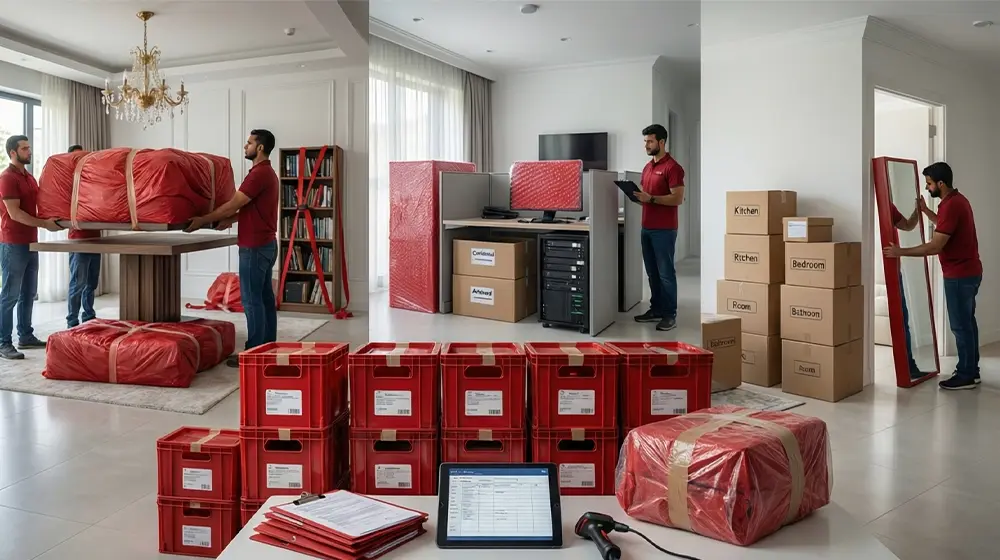
Moving insurance in the UAE is often misunderstood. Many people assume “the move is insured,” only to face claim denials, excess deductions, or uncovered losses when something goes wrong. Moving insurance in the UAE covers specific loss events during defined move stages. Coverage depends on policy wording, declared value, deductibles, and exclusions. These variables decide payout ceilings and denial triggers.
This guide explains moving insurance in operational terms. It separates insurance cover from mover liability, clarifies what is actually covered during villa, apartment, and office moves, and exposes the exclusions that most often defeat claims.
Benefits of reading this article
- A coverage boundary map that separates insurance cover from mover liability, with exclusion and storage risk made explicit.
- A claims-evidence framework that improves approval probability through inventory discipline, photos, and signed handover records.
This article breaks moving insurance into four decision variables: insured events, exclusions, valuation, and evidence requirements.
What is moving insurance in the UAE in operational terms?
Moving insurance in the UAE is a contractual risk transfer for defined loss events. It is separate from the mover’s contractual liability. The only binding definition comes from the policy schedule and wording issued by the insurer.
The UAE insurance market is large and claims-active. In 2024, gross written premiums reached AED 64.8 billion, and gross paid claims reached AED 42.9 billion, per the UAE Central Bank annual report. That scale matters because consumer-facing policy governance prioritizes disclosure clarity and documented claims handling. These totals do not describe “moving claims” specifically. They do show a system where claims handling is mature and document-driven. This directly affects how relocation losses are assessed
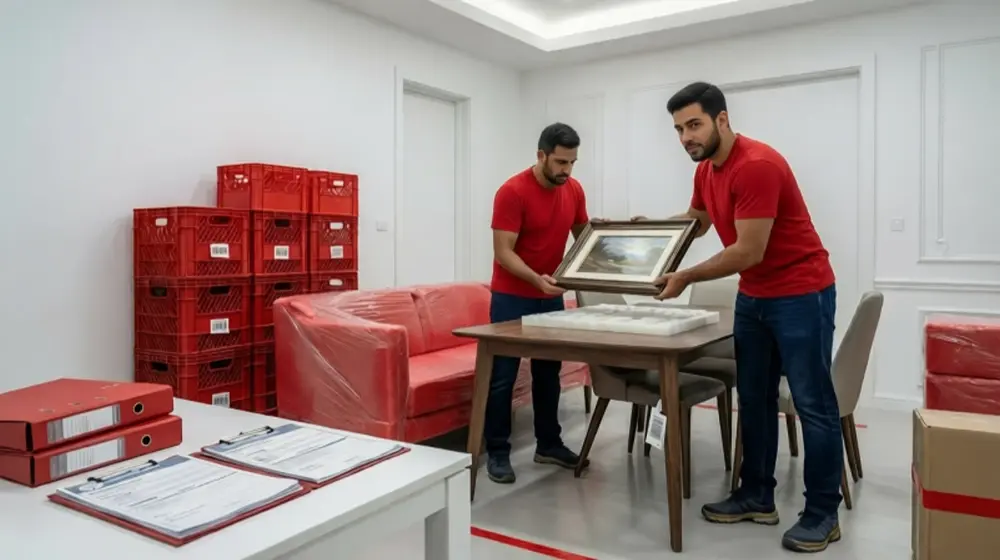
In relocation contexts, “moving insurance” often appears in two forms.
- The first form is a home contents policy extension that covers “furniture in transit” under specified conditions.
- The second form is a standalone goods in transit policy used in commercial transport. Both forms include exclusions and excess structures that control the net claim value.
What move stages sit inside the coverage boundary?
Coverage boundaries typically attach to the custody stage and route definition. Many policies anchor transit cover to “professional removal contractors” moving contents “directly” from one home to another within the UAE, which narrows the insured path and reduces ambiguity.
A widely used home policy wording in the UAE describes “Furniture in Transit” as accidental loss or damage to contents during transit by land by professional removal contractors, from an existing home directly to a new home, with both homes in the UAE.
That same wording also lists boundary conditions that change claim outcomes:
- Excess: “The first AED 250 of each claim” applies.
- Storage can be excluded: Loss or damage to property in a furniture depository or storage is not covered in that clause.
- Wear and tear exclusion applies.
So the operational coverage boundary is not “moving day.” It is the set of events that occur inside the defined transit path and outside the listed exclusions.
Stage boundary model used in claim reviews
Use this model to map exposure:
- Packing and dismantling
- Loading
- Road transit
- Unloading and placement
- Temporary storage or staging
Many disputes cluster around stage 1 and stage 5. Stage 5 becomes decisive when move-out and move-in dates do not align.
What is commonly covered during villa and apartment moves?
Accidental damage during transit is commonly covered when the event sits inside the policy boundary, and the item class is not excluded. In the same UAE home policy example, the covered trigger is “accidental loss of or damage” during transit by professional contractors between UAE homes.
Coverage language often distinguishes “accidental loss of or damage to contents during transit by land” from gradual deterioration. This distinction blocks claims tied to wear and tear, depreciation, or pre-existing fragility.
Covered-event patterns commonly include:
- Impact damage during carry and loading
- Crush or compression damage inside the vehicle
- Breakage during handling, if the policy does not exclude fragile categories
- Damage caused by sudden vehicle movement, if the policy recognises it as accidental
Coverage does not mean automatic payout. The claim still depends on excess, limits, and proof. Coverage viability often depends on item class. Policies frequently treat sets and pairs by pro-rata valuation methods, which affects payout logic for dining sets, matched chairs, or paired decor items. That method reduces the risk of overcompensation and standardizes settlement.
Why does “AED 250 excess” change how claims behave?
An excess of AED 250 is explicitly stated in the furniture-in-transit wording cited above.
In practical terms, this shapes claims in two ways:
- Low-value breakage clusters often become uneconomic to claim.
- High-value single-item incidents become the dominant claim type.
This co-pay structure makes declared valuation and proof of value central.
What is commonly covered for loss and theft, and what conditions apply?
Theft is not a universal “moving cover” assumption. Theft coverage depends on event definitions and proof conditions.
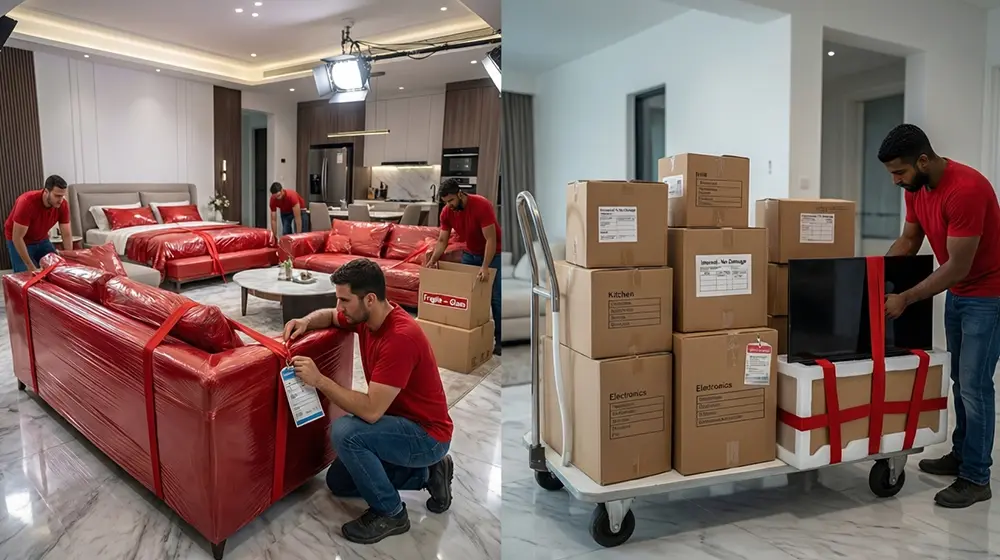
Theft and disappearance sit in a high-denial category unless the insured event definition is met. Many policies require evidence of forcible entry, documented custody logs, and immediate reporting. The policy wording defines proof thresholds.
For moving-related theft, evidence typically requires:
- Custody tracing,
- Timely reporting,
- Clear stage mapping showing the loss occurred in insured transit,
- Item existence proof.
Loss events also depend on route integrity. “Directly to your new home” language narrows coverage when the load diverts to staging yards or interim warehouses. This boundary matters for projects with handover gaps, renovation schedules, or staggered office fit-outs.
Why storage risk dominates theft exposure?
Supply chain insurers and risk bodies repeatedly identify storage facilities as a theft hotspot. TT Club reports that 76% of cargo theft in the Middle East context is from warehouse and storage facilities, and it also notes hotspots in the UAE and Saudi Arabia, and the targeting of electronics.
This matters because many home transit clauses restrict cover to “direct” movement and can exclude loss in storage depots. So a staging yard or temporary storage period is not only higher risk. It can also fall outside the insured boundary.
What is not covered in most moving insurance policies in the UAE?
Exclusions decide outcomes more often than “covered events.” A UAE home policy example excludes:
- Damage caused solely by wear, tear, or depreciation
- Damage caused by vermin, insects, domestic pets, mildew, or fungus
- Loss or damage to property in a furniture depository or storage in the furniture-in-transit clause
These exclusions shape claim arguments. A scratched veneer panel can fall into wear and tear logic if the evidence does not show sudden accidental impact. A mold-affected carton after storage can fall into mildew or fungus exclusion logic.
“Reasonable measures” clauses and suitability clauses appear in goods-in-transit wordings. These clauses link coverage to operational controls like vehicle fitness, load security, and protective handling. When the insured fails those controls, the policy can forfeit benefits.
Improper packing exclusion: The logic behind this exclusion triggers frequent disputes. Many policies apply different liability outcomes when the mover packs versus the customer packs. The practical control point is the packing scope statement and carton labeling logic.
Exclusion categories that frequently appear in practice
Use this checklist:
- Wear and tear, gradual deterioration, corrosion
- Inherent vice or fragility, including items that crack under normal vibration
- Mold, mildew, fungus, pests
- Unattended goods, insufficient packing, or customer-packed fragile items
- Storage exclusions or time-limited storage-in-transit clauses
- Cash, jewelry, documents, or specialty items requiring a separate declaration
Do not treat this list as universal. Policy wording controls.
What is the difference between insurance cover and mover liability?
Insurance is the insurer’s promise under the policy wording. Mover liability is compensation exposure under the mover’s contract terms and legal responsibility.
- Insurance pays when an insured event occurs within the policy conditions. Insurance is a contract with an insurer.
- Mover liability is compensation exposure defined by the mover’s terms, tariff logic, or bill of lading logic. Liability pays when the mover is contractually or legally responsible, and compensation is usually capped.
Many markets distinguish “valuation coverage” from “insurance” because valuation is a liability limit, not an insurance policy.
Valuation models often cap compensation based on weight or declared value logic. For example, US federal guidance describes two valuation options, including full value protection versus released value, showing how liability can undercompensate high-value items without separate insurance. That model illustrates the same structural risk in any jurisdiction when liability caps exist.
In the UAE moves, the operational takeaway is simple. Insurance pays only within its wording. Liability pays only within the mover’s liability cap and negligence framing. Risk allocation depends on which framework applies to the loss event.
What clauses shift risk allocation between customer, mover, and insurer?
Consumer protection standards emphasize fair treatment and disclosure expectations in financial services, which connects to how policy terms are communicated.
Subcontracting introduces a risk handoff. When a mover uses third-party carriers, the claim path can involve more than one custody chain. Risk allocation then depends on who holds contractual responsibility and who carries the insurance. Policy wordings and contracts govern this, not assumptions.
Risk allocation shifts through 3 clause families.
1) Excess and co-pay clauses
A stated excess of AED 250 is a direct deduction in at least one UAE furniture-in-transit clause.
A policy handbook example adds 10% of the claim amount when the item exceeds the Single Article Limit.
2) Direct transit versus storage boundaries
A furniture-in-transit clause can require movement “directly to your new home” and can exclude storage depot losses. This shifts risk back to the customer when a schedule creates a storage gap.
3) Proof and value clauses
One policy handbook recommends keeping receipts, valuations, photographs, instruction booklets, and guarantee cards for items exceeding the Single Article Limit, and notes that evidence of existence and possession can be required.
These clauses change claim economics and increase the value of prevention controls for high-value items.
How does declared value change payout ceilings and claim outcomes?
Declared value turns household or office contents into a quantified exposure. It supports payout ceilings and reduces disputes over underinsurance. Without declared value logic, settlement relies on default limits that can undercompensate complex inventories.
Declared value interacts with:
- Policy sum insured
- Single article limits
- Valuation basis
- Evidence requirements
Valuation also depends on the settlement basis. Replacement cost differs from depreciated value. Policies often cap the maximum payable per policy period, such as AED 250,000 in some contents wordings, subject to schedule selection. This ceiling changes risk planning for villas with high-value contents.
Declared value method that reduces under-declaration
Use category banding. It creates consistent valuation logic.
Band model
- Band 1: Fragile decor and glassware
- Band 2: Electronics and appliances
- Band 3: Furniture and joinery
- Band 4: Art, antiques, collectibles, specialty equipment
Each band uses:
- Approximate replacement cost range per item type,
- Proof type expected,
- Packing method and handling constraint.
Category banding improves completeness and reduces under-declaration.
What documentation creates evidence-grade proof for claims?
Evidence-grade claims rely on 3 records. Record one is an inventory list. Record two is a condition evidence set. Record three is a custody evidence set. Policies use these records to test causality and coverage boundaries.
Record set 1: Inventory record
An inventory list works best with structured fields.
- Item name
- Room or department
- Quantity
- Condition notes
- Value band
- Serial number for electronics and IT assets
Record set 2: Condition evidence
A condition evidence set uses timestamped photos. Capture wide context shots and close-ups. Capture pre-move condition and post-delivery condition. Photographic evidence supports causality when handling stages involve multiple parties and time gaps.
Record set 3: Custody evidence
A custody evidence set uses signed documents.
- Packing list
- Delivery note signatures
- Incident report with time and location
- Vehicle identifier or job number
These records align with how insurers test causality and boundary compliance.
What claim steps cause approvals, and what steps trigger denials?
Claims succeed when notification timing aligns with policy conditions and evidence integrity. Claims fail when the evidence chain breaks or the loss event falls into an exclusion bucket. Policy wordings define the conditions.
Claims workflow
A claims workflow uses 6 steps.
- Loss identification and containment.
- Immediate documentation with photos and notes.
- Notification to the insurer and mover with incident reference.
- Preservation of damaged items for inspection.
- Submission of inventory, delivery notes, and valuation evidence.
- Adjuster assessment and settlement.
Denial trigger clusters
Denial triggers cluster into four categories.
- Stage mismatch, such as storage loss when the clause excludes depot or storage loss
- Exclusion trigger, such as wear and tear or mildew
- Evidence weakness, such as no pre-move condition set
- Under-declaration, such as no proof for high-value items when proof is required
What changes in office relocations compared to home moves?
Office moves introduce asset governance and third-party ownership. Office move risk differs because:
- Many devices are leased,
- Many assets hold data,
- Chain-of-custody controls become audit-linked,
- Downtime cost sits outside typical transit clauses.
Cargo risk sources consistently emphasise targeting high-value electronics. This reinforces the need for:
- Serial number logs
- Fixed asset register snapshots
- Device custody sign-offs per handover point
Office relocation evidence additions
Add these fields to the inventory:
- Asset tag ID
- Serial number
- Department owner
- Destination seat or room code
- Packed by whom and sealed by whom
- Seal number for crates
These controls support both claim defensibility and internal governance.
What do home movers in Abu Dhabi verify before booking coverage?
Home movers in Abu Dhabi operate in a high-demand environment. Abu Dhabi’s population reached 4,135,985 in 2024, representing 7.5% annual growth, per Statistics Centre Abu Dhabi. Demand pressure increases elevator slot contention and compressed move windows. Compressed windows increase packing error probability and increase staging or storage exposure.
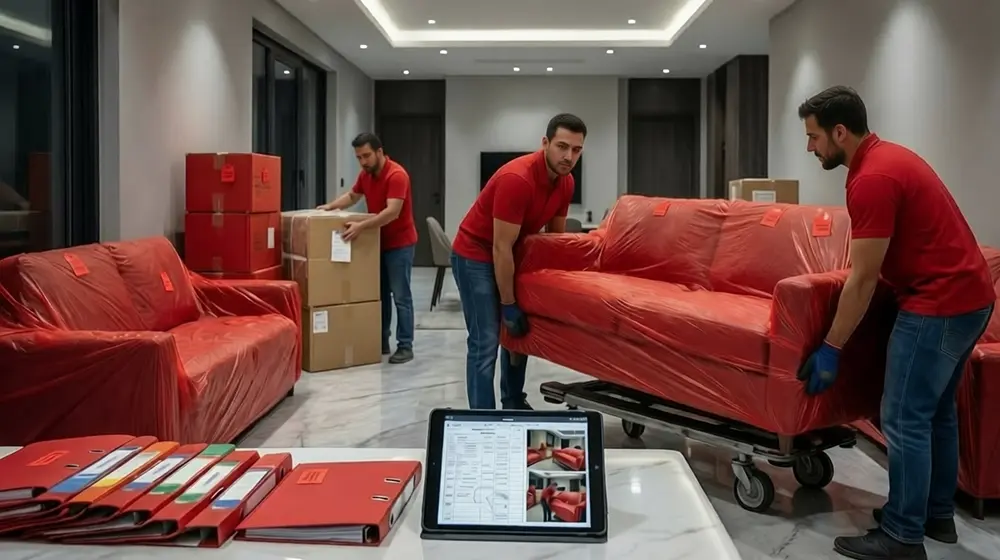
- Verification step one is policy identity
Confirm insurer name, policy type, deductible, and policy term. Confirm whether the coverage is a contents extension or a goods-in-transit policy. The policy wording is the authority reference.
- Verification step two is the stage boundary
Confirm whether coverage includes packing and dismantling. Confirm whether the route is “direct” or allows interim storage. Many transit clauses specify direct movement between UAE homes.
- Verification step three is the exclusions list
Confirm exclusions for wear and tear, depreciation, and packing responsibility. Confirm single-article limits and excess sharing for high-value items. UAE policy booklets commonly include AED 250 excess structures.
- Verification step four is the evidence pack requirement
Confirm inventory format, photos, delivery note signatures, and incident reporting windows. Consumer protection regulation sets expectations around fair treatment and transparent product terms in financial services.
How does Ejari renewal timing influence moving risk and coverage outcomes?
Ejari timing influences relocation risk through schedule compression and handover gaps. Dubai Land Department reported that its Ejari system registered more than one million contracts up to the first half of the referenced year, including 344,000 commercial and more than 677,000 residential contracts.
High renewal and registration volume compresses available move windows, especially around month-end and typical tenancy cycles.
Coverage relevance comes from policy boundary logic:
- Direct transit clauses rely on defined movement from the old home directly to the new home.
- Storage exposure increases when Ejari renewal and handover dates create a gap.
- Storage theft risk is elevated in general logistics contexts, and storage may also be excluded in transit clauses.
Ejari timing control points that reduce storage exposure
Use a schedule model that reduces staging:
- Early contract confirmation,
- Controlled handover times,
- Tight transport alignment,
- Minimal “in-between” storage hours.
This is not legal advice. It is a risk control approach based on boundary definitions and storage loss concentration.
What decision framework matches coverage selection to move type?
A practical framework uses 5 questions.
- What move type exists: villa, apartment, or office?
- What stage boundary exists: direct transit or staged transit?
- What item classes dominate: fragile, electronics, art, and IT assets?
- What valuation basis exists: declared value banding or default limit?
- What evidence capacity exists: inventory discipline and photo discipline?
This framework reduces marketing noise. It also supports procurement logic for office relocations where stakeholders require defensible risk allocation.
Coverage reality versus assumptions for the UAE moves
| Decision area | Common assumption | Coverage reality (wording-driven) | What changes outcomes |
|---|---|---|---|
| Transit stage | “Covered during the move” | “Direct transit by professional contractors” can be required | Route definition and custody proof |
| Storage | “Storage is part of moving” | Storage can be excluded in the transit clause | Storage-in-transit endorsement or separate cover |
| Excess | “Claim equals repair cost” | AED 250 excess exists in the example clause | Deductible plus single-article co-pay |
| High-value items | “Insurance covers everything” | Proof of value and limits apply | Receipts, valuations, scheduled items |
| Theft | “Missing item equals payout” | Theft sections can require specific evidence conditions | Forcible entry evidence, custody chain |
Moving Insurance in the UAE: Know the Boundary, Control the Evidence, Reduce the Surprise
Most moving insurance disputes in the UAE are not caused by bad luck. They are caused by boundary mistakes and weak documentation. Losses fall outside cover because the move stepped into storage, the route was no longer “direct,” the item exceeded a limit without declaration, or the evidence could not prove when and how the damage occurred. Insurance follows wording, not intent.
The practical takeaway is simple. Treat moving insurance as a defined risk-transfer tool, not a blanket guarantee. Confirm where the cover starts and ends, understand the excess and exclusions, declare value realistically, and document condition and custody at every stage. Insurance responds only when the loss falls within the insured path, and the proof holds up under review.
When you plan the move around coverage boundaries and build an evidence-grade inventory, insurance works as intended, with fewer disputes, clearer responsibility, and faster, cleaner settlements.