A compact apartment move in Dubai looks simple on paper. Fewer rooms. Less volume. Lower expectations. Yet many residents discover the opposite when the quote arrives. Elevators become bottlenecks. Loading bays disappear behind security gates. Time windows shrink. Every corridor, lift, and permit turns into paid minutes. Cost stops following square footage and starts following constraints.
This article explains why that happens. It breaks down the real operational drivers that push compact apartment moving costs close to, and sometimes beyond, villa pricing.
What benefits does this guide provide?
- A 9-factor cost driver model that converts “small move” assumptions into measurable pricing variables you can validate before booking.
- A documentation and evidence checklist that reduces extras, rework, and claim disputes during handover.
The most accurate way to understand apartment moving costs in Dubai involves isolating the operational constraints that towers impose and then mapping each constraint to time, labor, and risk exposure.
9 factors that make compact apartment moves price higher than villa relocations
The 9 factors are elevator dependency, loading bay and parking limits, carry distance, time window restrictions, packing intensity for vertical transport, building SOP and permit workflows, liability and common area damage exposure, disassembly and reassembly complexity, and rework risk from scope gaps.
The rest of the article breaks each factor into measurable inputs, typical failure points, and validation checks.
Factor 1: Why does elevator dependency raise moving costs in Dubai?
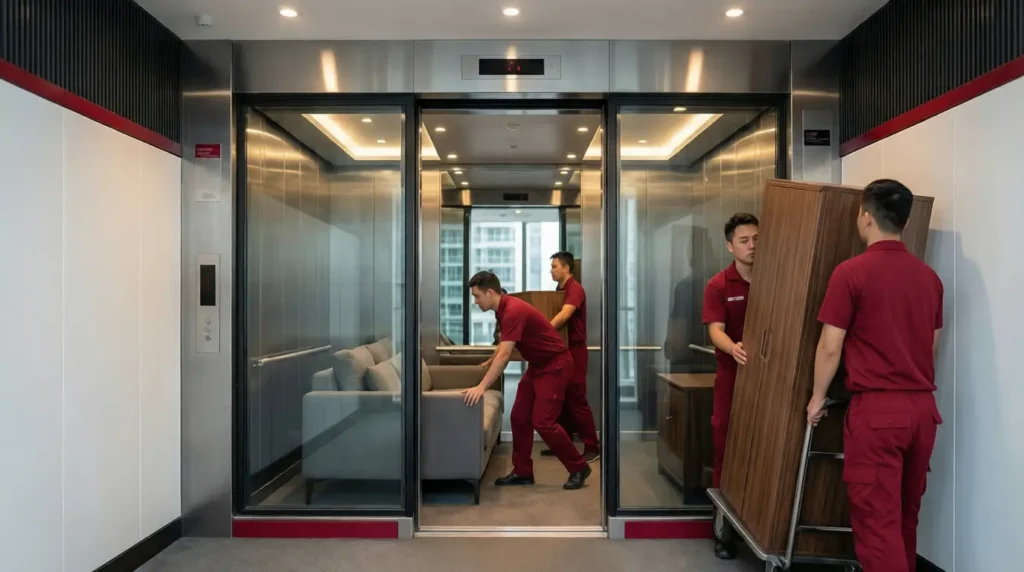
Elevator dependency raises moving costs in Dubai because elevator time becomes a hard capacity limit on material flow, which creates waiting time and fragmented trip cycles. When the elevator schedule blocks continuous movement, labor productivity drops, and staffing hours rise.
High-rise logistics research treats vertical transport as a bottleneck that affects system performance when elevator availability changes.
Cost inputs that movers use
- Lift size and door width in centimeters.
- Reserved elevator slot duration in minutes.
- Number of trips for cartons, furniture, and appliances.
- Queue risk from concurrent resident usage.
Quote lines to request
- Request the building’s elevator booking rule, including slot length and permitted hours.
- Confirm whether service elevator access exists or passenger elevator use applies.
- Confirm the pickup and drop floor, plus any intermediate staging floor.
Common elevator constraints include short booking slots, peak hour exclusions, and lift sharing with residents.
Factor 2: Why do loading bays and parking constraints inflate compact apartment move quotes?
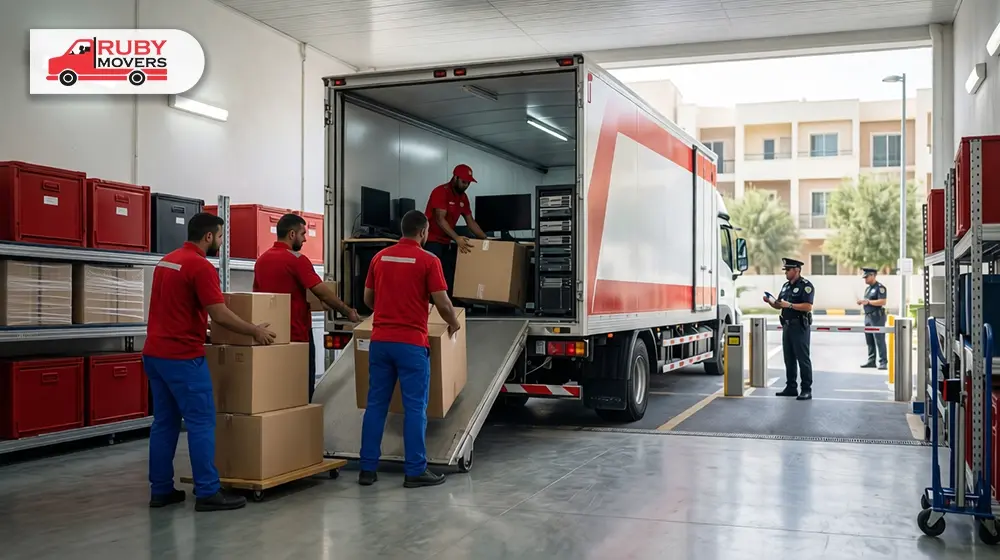
Loading bays and parking constraints inflate compact apartment move quotes because vehicle staging time expands, and crew walking distance increases. Towers often route vehicles to designated bays or remote parking, which increases handling cycles per item.
Dubai tower operations also reflect broader demand pressure, including rapid population growth that increases housing turnover and relocation activity. Dubai population figures show sustained expansion in 2025, which amplifies building traffic and operational controls.
Cost inputs
- Distance from truck to lobby in meters.
- Bay booking or access control procedures.
- Vehicle size constraints, including maximum length and height.
Validation checks
- Schedule a vehicle arrival time aligned to bay availability.
- Identify the closest legal parking option when bay access closes.
- Confirm whether security requires a vehicle list and driver ID.
- Confirm whether trolleys and ramps are permitted in the bay corridor.
A villa move often uses driveway staging. A tower move often uses controlled bays, remote parking, or time-restricted access.
Factor 3: Why does carry distance matter more in apartments than villas?
Carry distance matters more in apartments than villas because towers convert distance into repeated micro carries across lobbies, corridors, access doors, and elevator thresholds. Each threshold increases handling time and increases contact risk with walls, corners, and finishes.
Ergonomics guidance defines manual materials handling as moving loads by lifting, lowering, pushing, pulling, carrying, or holding. Handling intensity increases when distance increases, or path complexity increases.
Cost inputs
- Horizontal travel distance per trip.
- Door count and pinch points on the path.
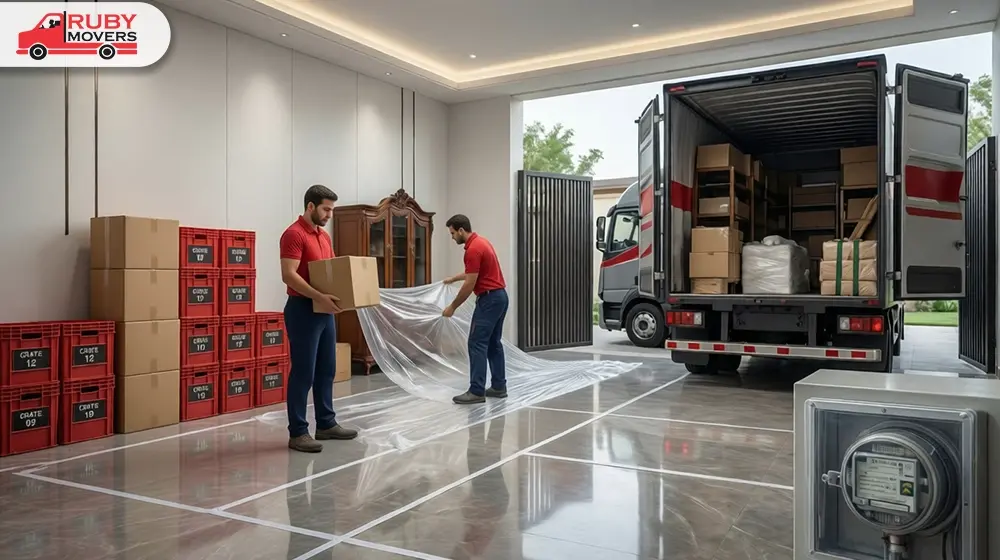
- Requirement for protective floor covering in corridors.
Fast evidence request
- Ask for a simple route map from the unit door to the truck.
- Ask for a distance estimate in meters.
High-friction route features include narrow corridor turns, double door access points, and carpeted lobbies with protection requirements. A route plan reduces variance in labor hour estimates.
Factor 4: Why do time windows and community rules raise moving costs in Dubai?
Time windows and community rules raise moving costs in Dubai because they compress work into short permitted periods, which increases staffing intensity and overtime probability. Towers often restrict moves to specific hours and require pre-approved booking.
Move-in and move-out permit workflows appear across major Dubai developers and communities, with portals and apps used to control access and reduce common area damage.
Measurable inputs
- Permitted moving hours per day
- Weekend restriction status
- Security escort requirement count
- Lift reservation rules and cut-off times
Operational consequence
A tight time window forces parallel workstreams. Packing, staging, and transport run concurrently, which increases the crew size required to finish inside the slot.
Checklist
- Confirm the building-approved move date in writing.
- Confirm elevator booking confirmation.
- Confirm loading bay access pass or security gate pass.
Permit and SOP entities commonly referenced in Dubai
- Emaar community permit workflows and community management portals appear in public guidance and community pages.
- General move-in/out permit guidance.
Factor 5: Why does packing intensity rise in compact apartments?
Packing intensity rises in compact apartments because vertical transport amplifies damage probability for fragile items, electronics, and small furniture. Movers often increase carton specification, protective layers, and labeling rigor for tower moves.
This effect also links to claim risk, because common area damage often triggers chargebacks or deposit deductions within managed communities. Move permit systems exist partly to control these risks.
Measurable inputs
- Carton count by size
- Fragile item count
- Protection layers per item class
- Appliance preparation tasks
Packing attributes that change pricing
- Carton grade and size mix.
- Edge protection for furniture and frames.
- Appliance protection and transit locks.
- Floor and wall protection materials.
Ask for a packing specification list. Request carton counts and protection materials as quantity lines.
Factor 6: Why do permits, SOPs, and documentation add cost to apartment moves?
Permits, SOPs, and documentation add cost because compliance tasks consume administrative time and force sequencing constraints. Many buildings and master communities require documentation before access approval.
Developer and community platforms commonly manage move requests and permits through dedicated portals or apps, including community management policies that deny access without approval.
Documentation set that affects the price
- Move-in or move-out permit reference.
- Tenant or owner authorization.
- Security gate pass requirements.
- An insurance certificate, if the building asks for it.
Treat compliance as a scope line item. Missing line items cause rework charges. Scope clarity reduces variation across quotes.
Factor 7: Why do liability exposure and evidence controls raise total move cost?
Liability and evidence controls raise total cost because towers create shared surfaces and shared assets. Corridors, lifts, lobbies, and service areas introduce more claim pathways than villa driveways or private gates.
A building code framework exists for safety and performance in Dubai’s built environment, which is why property managers enforce controlled moving operations.
Evidence controls that add labor minutes
- Condition photos for corridors, lift, lobby, and apartment entry.
- Inventory with item-level condition notes.
- Signed the handover sheet with a time stamp.
Quote lines to demand
- “Inventory method and proof” description
- “Common area protection” inclusion
- “Damage claim handling” process
Claims prevention logic
More evidence reduces disputes. Dispute reduction reduces rework and follow-up visits, which often cost more than the initial evidence capture.
Factor 8: Why does disassembly and reassembly complexity appear higher in apartments?
Disassembly and reassembly complexity appear higher in apartments because item geometry conflicts with corridor turns, lift dimensions, and door widths. A compact apartment also contains high-density furniture layouts, which increase extraction complexity.
Elevator design and tall building movement constraints remain a known focus in building systems research, which supports the idea that vertical transport capacity shapes handling workflows.
Cost inputs
- Furniture category requiring dismantling.
- Tools required and technician time.
- Reassembly calibration for wardrobes, beds, and modular systems.
High dismantling categories include modular wardrobes, king beds, sectional sofas, and large dining tables.
Validation
Measure critical dimensions. Examples include lift door width, cabin depth, apartment door width, and corridor turning radius.
Factor 9: Why do scope gaps and rework risk hit compact apartment moves harder?
Scope gaps hit compact apartment moves harder because towers penalize re-entry. If access approval exists for a single day, a second trip triggers a fresh permit and fresh booking. Rework then compounds costs.
This logic explains why quoted prices for apartments can sit close to villa pricing despite lower volume. Consumer-facing cost guides show that moving prices vary strongly by operational variables beyond unit size.
Scope gaps that frequently create extra charges
- Packing exclusions for kitchen glassware or wardrobe contents.
- Appliance disconnection and reconnection exclusions.
- Long carry and stairs not included in the base quote.
- Permit and booking handled by the client, which fails under time pressure.
Control grid
Use a single scope map across all bidders. Compare line by line.
How can you compare compact apartment quotes vs villa quotes line by line?
You can compare quotes line by line by converting each offer into the same cost driver grid, then checking whether each driver carries an explicit inclusion, limit, and evidence requirement.
Use this grid to compare offers fairly. Each bidder must state what’s included, where the limits are, and what proof they provide. If a line is missing, treat it as a likely extra.
| Cost driver | Apartment risk | Villa risk | What to demand in the quote (specific proof line) |
|---|---|---|---|
| Elevator time | High | Low | Booked slot minutes, service vs passenger lift, estimated trips, and who supervises lift runs |
| Loading bay and parking | High | Medium | Bay access method, vehicle size limits, legal parking plan, security gate process, and arrival timing rule |
| Carry distance | High | Medium | Measured meters truck→lobby→unit, trolley/ramp use allowed, route constraints (doors, turns, thresholds) |
| Time window | High | Medium | Approved moving hours, weekend status, cutoff times, overtime rate + trigger conditions |
| Packing specification | Medium–High | Medium | Carton count by size, carton grade, fragile protocol, protection materials (edges, blankets, stretch), labeling system |
| Permits and SOP compliance | High | Medium | Who handles permits, required documents list, submission timeline, approval proof (permit + booking reference) |
| Common area liability | High | Medium | Corridor/lift protection plan, pre/post condition photos, damage handling process, and claim timeline |
| Dismantling and reassembly | Medium | Medium | Item list requiring dismantling, technician hours, tools included, reassembly scope (beds, wardrobes, modular items) |
| Rework and revisit risk | High | Medium | Revisit policy, exclusions that trigger return trip, pricing for second visit, re-entry/permit responsibility |
Compare quotes line by line. The most reliable quote is the one with explicit limits and clear proof, not the lowest number.
What makes moving costs in Dubai behave differently for compact apartments?
Moving costs in Dubai behave differently for compact apartments because high-rise operations add constrained access windows, elevator dependency, loading bay controls, and higher damage exposure per handling cycle. These variables increase labor hours and supervision intensity even when the item count stays low.
What do moving costs in Dubai look like for apartments and villas?
Consumer quote bands show the typical local moving ranges for Dubai by unit type. These are market summaries, not fixed tariffs, and they vary by scope and access.
Typical Dubai moving costs, reported in different guides
| Unit type | Reported typical range (AED) |
|---|---|
| Studio apartment | 1,000 to 1,200 |
| 1-bedroom apartment | 1,200 to 1,500 |
| 2-bedroom apartment | 1,800 to 2,500 |
| 3-bedroom villa | 4,000 to 5,000 |
These bands overlap with real quotes when tower constraints increase the time on site. That overlap explains why a compact apartment can be priced closer to villa work even at lower volume.
Why does Dubai amplify tower friction compared with many cities?
Dubai’s demand intensity raises building traffic and tightens operational controls in towers.
- Dubai recorded 9.88 million overnight visitors in Jan to Jun 2025, up 6% versus the same period in 2024, per Dubai Department of Economy and Tourism data.
- Dubai’s population reached about 3.95 million in 2025 in a widely cited summary referencing Dubai Statistics Center figures, and other trackers report over 4.0 million by late 2025 using the population clock methodology.
High visitor flow and population growth increase elevator usage, service bay demand, and security enforcement. Those are the exact systems that constrain moving operations.
What documentation reduces disputes and extra charges?
Documentation reduces disputes and extra charges by replacing verbal scope with measurable evidence. Towers reward documentation because property managers process claims through controlled workflows.
Evidence pack checklist
- Apartment inventory with item-level condition notes.
- Photo set of pre-move conditions for key items and common areas.
- Building permit confirmation and elevator booking confirmation.
- Handover sheet signed at pickup and delivery with timestamps.
- Payment terms stated with surcharge triggers.
What cost model explains the compact apartment pricing paradox?
The model is time-based. Labor hours and constraint minutes dominate.
A simple time-based model for quote comparison
Use this model as a diagnostic, not as a claim about any specific mover.
1. Base handling trips
Cartons plus furniture pieces convert into trips.
2. Trip cycle time
Each trip includes corridor travel, elevator time, and loading bay travel.
3. Constraint multipliers
Lift booking gaps, security checks, and bay waits add idle time.
Example calculation with explicit assumptions
Assume 60 trips in total.
- Corridor and lobby walking adds 2 minutes per trip.
- Elevator cycle adds 3 minutes per trip.
- Loading bay walk adds 2 minutes per trip.
Trip time equals 7 minutes. Total handling equals 420 minutes, which equals 7 hours.
A villa move with driveway staging can reduce per-trip time because elevator and lobby cycles disappear. That is why a smaller volume does not always mean lower labor time.
What helps classify whether an apartment moves prices like a villa?
This diagnostic categorizes the constraint tier.
Compact apartment constraint diagnostic
Score 1 point per condition.
- Elevator booking slot under 60 minutes
- Loading bay walk over 50 meters
- Move the window under 6 hours
- Service elevator unavailable
- Truck parking restricted to remote zones
- The corridor includes tight turns or narrow doors
- Move permit required by community management
- Fragile item count at 10 or more
- Dismantling required for 3 or more large items
Interpretation
- 0 to 2 points: low constraint profile
- 3 to 5 points: medium constraint profile
- 6 to 9 points: high constraint profile
High constraint profiles align with higher labor hours and higher risk controls.
How does relocation demand in Dubai influence moving operations?
Relocation demand in Dubai influences moving operations because population growth and tourism activity increase building traffic, which strengthens enforcement of building access controls and booking systems. Dubai’s visitor volumes and population expansion show strong demand signals across the city’s operational systems.
Final Recap: The 9-Factor Checklist That Protects Your Budget
A compact apartment move in Dubai is not priced like a “small move.” It is priced like an operational puzzle. When elevators cap throughput, loading bays control vehicle timing, and community rules compress work into narrow windows, the cost driver becomes minutes, not square meters. That is why two apartments with the same item count can receive very different quotes, and why a studio can sometimes land uncomfortably close to villa pricing.
The advantage is that these drivers are measurable. Lift slot duration. Carry distance in meters. Permitted hours. Permit workflow steps. Dismantling triggers. Re-entry penalties. When you map them upfront, you turn a vague quote into a scoped service. Use the 9-factor grid to standardize bidders, demand the proof lines that prevent “extras,” and build a simple evidence pack that protects you at handover. In Dubai towers, the cheapest move is rarely the lowest number. It is the move with the fewest surprises.