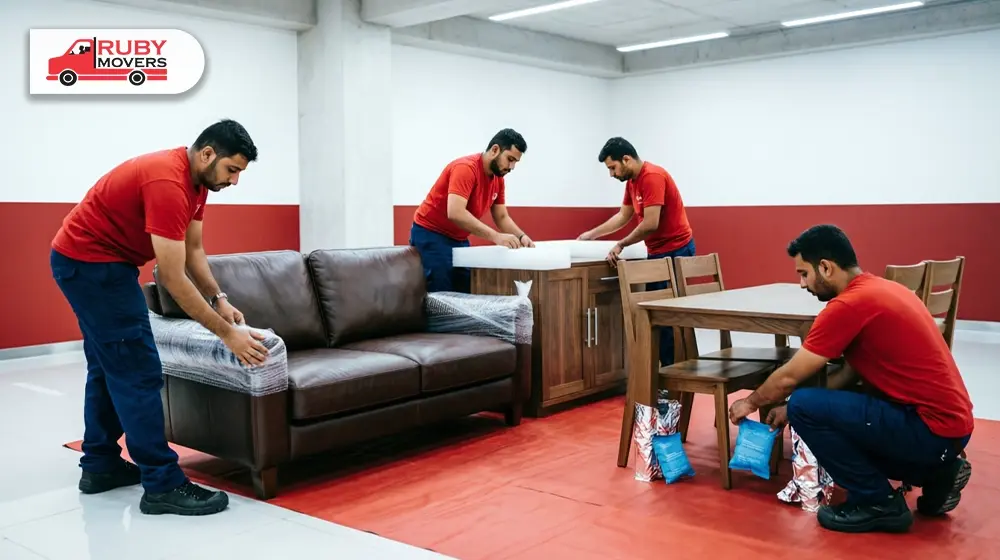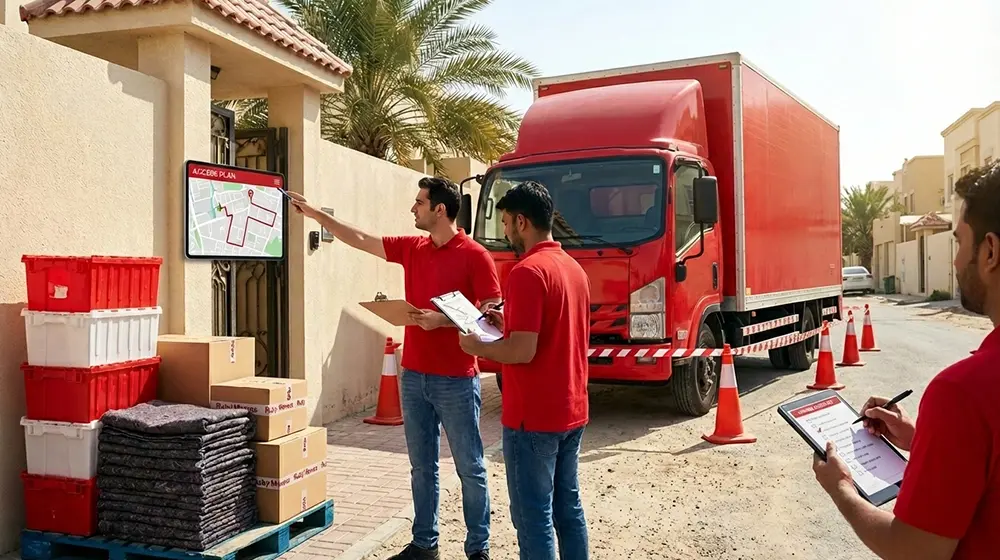
Al Jurf villas often fail due to a single constraint: access. Narrow streets compress turning space, curb staging, and safe reversing. That creates truck turnaround stress, repeat handling, and schedule drift. Access planning is the fastest way to reduce narrow-street delays in Al Jurf. Access planning reduces repeat handling, which reduces damage exposure and dispute frequency in household moves, where claims and complaints appear often enough to justify evidence-driven documentation.
This guide explains how villa movers in Ajman control those variables using access planning. It breaks access planning into measurable inputs such as turning geometry, gate timing, staging footprint, and carry distance. The article also covers route selection, staging design, packing controls, crew sizing, and an evidence pack that reduces dispute friction in household goods moving
Two outcomes this article targets
- Fewer turnaround failures through measured turning and staging inputs, so dispatch matches Al Jurf’s narrow-street reality
- Lower dispute friction by using inventory logs, condition reports, and photo evidence, aligned to claims realities in household goods moving.
What is “access planning” in a villa move, and what does it include?
Access planning is a documented method that converts street and site constraints into a move execution plan. It covers the route approach, gate entry, staging zone, truck turning feasibility, loading bay geometry, and the walking and carrying path from the truck to the villa.
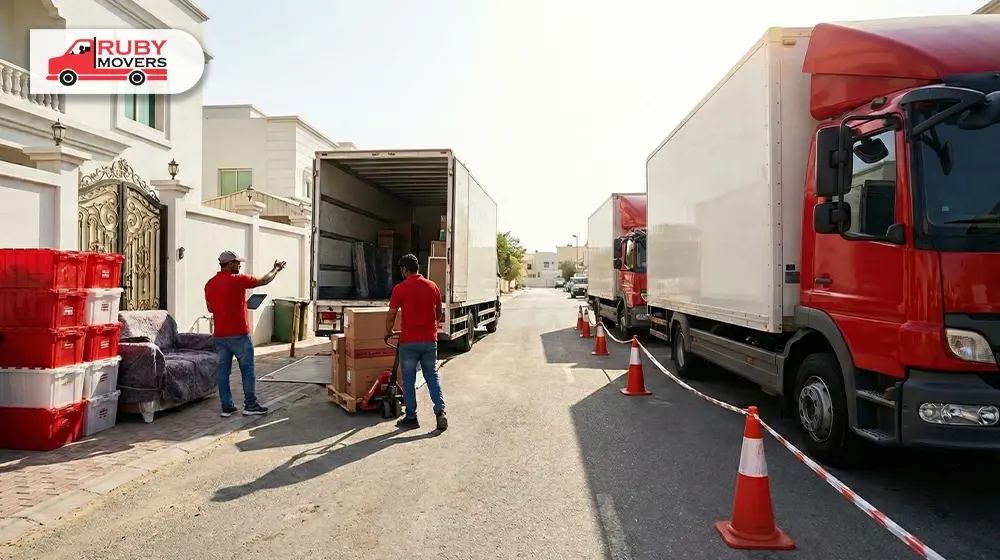
Access planning is a structured data set. It contains measurements, photos, timing windows, and constraints that influence dispatch and risk controls.
Access planning data set for Al Jurf
- Street geometry: Road width, curb conditions, parked-car density, turning points, dead-end exposure
- Turnaround feasibility: Available turning circle, reverse distance, safe pivot points
- Staging zones: Space for cartons, blankets, disassembly staging, and temporary pallet positions
- Gate controls: Guard instructions, ID checks, visitor protocol, time windows
- Carrying path: Distance to door, stairs, ramps, floor protection requirement
- Risk objects: Glass, marble, oversized furniture, sensitive electronics
Turning feasibility is not abstract. Turning constraints are measurable and solvable when inputs match vehicle geometry. Road space and turning radii become the limiting factor, not motivation.
Swept path analysis templates for a 7.5t box van show a kerb-to-kerb turning radius of 7.4 m and provide vehicle profile dimensions that anchor feasibility screening.
Why do narrow streets create truck turnaround stress in Al Jurf?
Truck turnaround stress is a logistics mismatch between vehicle turning space and street reality. The stress usually appears as repeated reversals, blocked turns, forced unloading far from the villa, and delay accumulation at gates and parked-car bottlenecks.
Turnaround feasibility depends on the turning geometry. Urban street design guidance emphasizes the importance of calculating effective turning radius and available space for turning, including on-street parking effects.
Stress triggers
- Insufficient turning space relative to the truck’s turning radius
- Parked vehicles are compressing the road width at critical points
- Dead ends without a pivot zone for a multi-point turn
- Gate queues that remove staging space at the street edge
- Reverse-only access that increases cycle time and contact risk
Turnaround stress has a cost signature. It appears as time loss, labor inflation, and higher damage probability due to repeated handling and longer carry distances.
What is a time model for turnaround events in Al Jurf?
Turnaround time in narrow streets is mainly the sum of reverse travel, multi-point turns, and walking carry cycles.
A) Model inputs
Vehicle and turning
Turning diameter (curb-to-curb) or turning circle in meters.
Examples:
- Ford Transit spec shows Turning Circle (Kerb-to-Kerb) 15.8 m.
- A 7.5T box van swept path document reports a kerb-to-kerb turning radius of 7.4 m, which implies a turning diameter of 14.8 m.
Reversing and turning
- Reverse distance (R) in meters from the gate or last turn to the stopping point.
- Multi-point turns (N) count, where each point includes stop, steer, and reposition.
Carrying
- Carry distance (D): One-way in meters from the truck to the villa door
- Trip count (T): Number of trips carrying boxes, small furniture, and protective materials
Walking speed evidence to parameterize carry time
- Walking at a self-selected (usual) pace averages 1.31 m/s in healthy adults.
- The average walking speed of pedestrian carrying baggage from the observations is reported at 0.70 m/s in a pedestrian study.
For Al Jurf move modeling, 0.70 m/s is a defensible baseline for carry cycles because it reflects movement while burdened.
B) Formulas
1) Reverse time
Use an observed reverse-speed range based on constrained residential maneuvering. Because reverse speed varies by visibility, spotter use, and parked-car compression, keep this as a measured value from a short timing test in the street.
Reverse time (minutes)
trev = R / vrev ÷ 60
Where:
- R= reverse distance in meters
- vrev = reverse speed in m/s (measured on-site with a 20 m timing)
2) Multi-point turn time
Each multi-point turn includes stop, steering, and micro-repositioning. Use a per-point time recorded during a short maneuver test.
Turn time (minutes)
tturn = N × tpoint
Where:
- N = number of points
- tpoint = average seconds per point ÷ 60 (measured)
3) Carry cycle time
A carry “trip” typically includes a loaded walk to the villa plus a return walk.
- Loaded speed baseline: 0.70 m/s
- Unloaded return speed can be approximated toward “usual pace” at 1.31 m/s
Carry time (minutes)
tcarry = T × (D / 0.70 + D / 1.31) ÷ 60
4) Total turnaround event time
tevent = trev + tturn + tcarry + tbuffer
tbuffer is a small allowance for stop-start friction, such as gate pause, spotter checks, and staging resets.
C) Carry-distance estimates
Use carry-distance brackets because distance is easy to measure in Al Jurf streets.
| Carry distance D (one-way) | Time per trip (sec) | Time for 10 trips (min) |
|---|---|---|
| 10 m | (10/0.70 + 10/1.31) = 21.9 s | 3.7 |
| 25 m | 54.8 s | 9.1 |
| 40 m | 87.7 s | 14.6 |
| 60 m | 131.6 s | 21.9 |
When a narrow-street constraint forces the truck to stop further away, carry time scales quickly. That is why access planning prioritizes truck placement feasibility and staging footprint.
Which risk segmentation is linked to measured access constraints?
Risk segmentation converts survey measurements into probability bands for turnaround stress. It is designed for villa movers in Ajman who need fast decision logic for Al Jurf.
Risk variables tied to measurable constraints
1. Turning the feasibility threshold
Turning feasibility is constrained by the truck’s turning diameter and available space. Turning circle values are published for common vans and box configurations, such as a Ford Transit kerb-to-kerb turning circle of 15.8 m and a 7.5t box van kerb-to-kerb turning diameter of 14.8 m, derived from the reported 7.4 m radius.
2. Carry disbtance effect
Carry cycle time can be bracketed using published walking speeds for usual pace and movement with baggage.
| Risk band | Turnaround stress probability | Measured indicators in the Al Jurf access survey | Operational meaning |
|---|---|---|---|
| Band 1 | Low | Forward exit exists, reverse distance < 15 m, multi-point turns = 0, carry distance 0–15 m | Standard dispatch works. The evidence pack still applies. |
| Band 2 | Medium | Reverse distance 15–40 m, multi-point turns 1–2, carry distance 15–40 m, staging zone limited | Dispatch match required. Spotter role fixed. Staging must be zoned. |
| Band 3 | High | Reverse distance > 40 m, multi-point turns ≥ 3, carry distance 40–60 m, parked cars compress turning points. | High turnaround stress. Truck selection becomes a control. The loading sequence must reduce re-handling. |
| Band 4 | Critical | Dead-end exposure plus no pivot zone, reverse distance > 60 m, carry distance > 60 m, gate queue blocks staging. | High failure risk. Alternative vehicle or shuttle method becomes the primary plan. |
Why are these indicators credible?
- Turning diameter and turning radius directly govern feasibility in tight streets.
- Carry distance is a direct time driver based on published walking speeds for typical pace and baggage movement.
What truck geometry facts matter most for narrow streets and turnarounds?
The most useful facts for feasibility screening are vehicle width, overall length, and turning radius.
A swept-path analysis document lists a 7.5t box van with overall length 8.010 m, overall width 2.100 m, and kerb-to-kerb turning radius 7.400 m.
A separate reference database lists typical 7.5-ton box vehicle dimensions, supporting the concept that vehicle width sits close to the 2.1 to 2.5 m range, depending on model and body.
Truck feasibility screening inputs for access planning
| Input field | Unit | Why it matters in Al Jurf’s narrow streets |
|---|---|---|
| Truck overall width | m | Determines clearance risk near parked cars and walls. |
| Truck overall length | m | Drives multi-point turning and staging space requirements. |
| Kerb-to-kerb turning radius | m | Defines minimum turn feasibility in tight corners and cul-de-sacs. |
| Available turning space | m | Determines whether a forward exit exists or if the reverse distance increases. |
| On-street parking compression | Qualitative plus photos | Reduces effective space for turning and staging. |
Decision rules
Use the matrix as a decision framework tied to your survey numbers:
- If turning feasibility is uncertain, choose the vehicle with the smaller published turning diameter, where possible, and validate on-site.
- If the carry distance exceeds 40 m, treat the carry time as a primary cost driver and prioritize closer truck placement or the staged shuttle method. Carry-time scaling is supported by published walking-speed values.
- If multi-point turns exceed 2, treat the move as high turnaround stress and lock in a spotter role plus a staged stop plan.
What facts and figures explain why access planning improves outcomes?
Access planning improves outcomes because it targets the largest time sinks in dense residential moves: parking search, manual handling exposure, and dispute resolution friction.
1) Delay has measurable components in curb access and parking search
A survey conducted by IBM found that finding parking in Toronto required an average search time of 13 minutes.
Through the review of 13 studies of mostly American and European cities, it was found that, on average, 30% of trac is cruising for parking during rush hours and the average cruising time is 7.8 minutes.
These studies are not UAE-specific, but they quantify a universal operational pattern: unplanned curb access consumes predictable time.
2) Manual handling has a quantifiable injury burden
UK HSE statistics report 40.1 million working days lost due to work-related illness and workplace injury, and an estimated £22.9 billion cost in 2023/24.
HSE also reports 7.1 million days lost due to work-related musculoskeletal disorders in 2024/25.
The most common cause of non-fatal accident in the workplace, is handling, lifting or carrying at 17% (as reported under RIDDOR 2023/24).
Narrow-street moves increase carrying distance and re-handling cycles. Access planning reduces re-handling by aligning truck placement and staging.
3) Claims and damage appear at meaningful rates in moving contexts
Section 209 (b) of the Motor Carrier Safety Improvement Act of 1999 increased the maximum amount for shipper claims of damage and loss to which HHG carriers were required to enter arbitration from $1,000 to $5,000.
A new analysis shows that 21% of all domestic Defense Department household goods shipments in 2018 had at least one damage claim.
Nearly a quarter of people said items did not make it to their new home in the same condition they left in, according to a new survey by Direct Line home insurance. The average cost of repairing or replacing these items was nearly £700 for each homeowner, equating to a total of more than £1.3billion.
These figures justify evidence packs and condition logs as operational controls rather than “extra paperwork.” That figure supports a practical point: disputes are common enough to justify evidence packs and condition reporting even in routine household moves.
What data is captured in an Al Jurf access survey before move day?
An Al Jurf access survey is a structured site assessment conducted before dispatch. An access survey becomes actionable when it captures measurable fields and links them to dispatch decisions.
Access the survey checklist for villa movers in Ajman in Al Jurf
1. Route approach
- Primary approach road and alternate approach road
- Pinch points, parked-car clusters, and delivery traffic patterns
2. Turn feasibility
- Cul-de-sac presence, dead-end presence
- Pivot space availability at the endpoint
3. Truck position
- Feasible stop point that preserves traffic flow
- Visibility for reversing and spotter line-of-sight
4. Staging footprint
- Carton staging zone size and surface condition
- Fragile zone separation area
5. Carrying path
- Door-to-truck distance estimate
- Stairs count and ramp slope presence
6. Gate controls
- Entry rules, ID check steps, timing windows
7. Risk assets
- Glass, mirrors, TVs, artwork, marble, oversized furniture
8. Evidence capture
- Time-stamped photos of access constraint points
- Pre-condition photos for high-value items
Urban street design guidance recommends calculating turning radius with consideration of on-street parking and lane space, which aligns directly with this survey structure.
How does route selection reduce turnaround events on Al Jurf streets?
Route selection reduces turnaround events by controlling where the truck enters, how it approaches the villa, and whether it exits without reversing through congested segments.
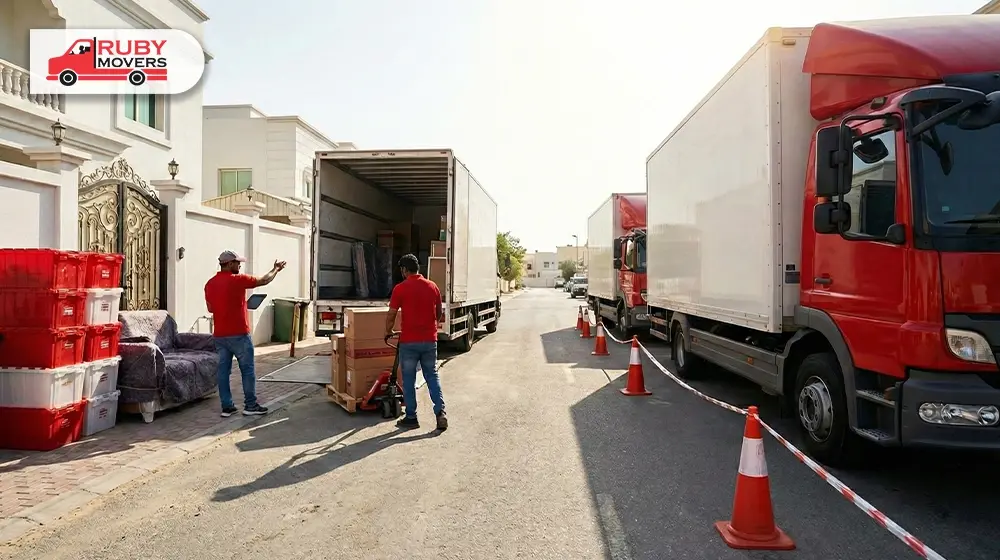
Route planning is a risk control when it is constraint-based. It becomes a sequence of decisions tied to street geometry and gate timing.
Constraint-based route selection logic
- Prefer approach directions that preserve a forward exit
Forward exits reduce reversals and reduce contact probability at parked-car choke points.
- Select a staging point with buffer space
Buffer space reduces double parking and supports carton staging.
- Choose an approach that avoids pinch points during peak return hours
Peak return periods compress parking availability and increase interruption.
The route plan becomes more accurate when it includes turnaround feasibility. Turning radius values do not replace site measurements, but they inform feasibility screening.
What controls reduce truck turnaround stress when the turning space is limited?
Truck turnaround stress reduces when the move plan sets a dispatch match and a contingency method.
Controls that reduce turnaround stress
- Vehicle matching: Match truck size to turning feasibility
- Staging control: Use a defined staging zone to prevent scattered unloading
- Load sequencing: Sequence loading to reduce re-handling at the destination
- Spotting control: Use a single spotter for reversing and tight turns
- Time window control: Align arrival to lower street congestion periods
- Gate protocol control: Pre-clear entry to reduce queuing at the gate line
Ajman can also require the use of outside space that falls under road reserve permissions in some contexts. Ajman Municipality provides an e-service related to requests for using outside areas within the road reserve for permitted activities. This type of municipal process matters when a move requires temporary external staging or managed use of space adjacent to a public right-of-way.
How does packing design change when streets are narrow and the carrying distance increases?
Packing design becomes a throughput system when the carrying distance increases. The objective is to reduce trips, reduce handling cycles, and keep load integrity stable.
Packing design is a control set, not a carton count.
Packing controls that improve throughput
- Carton standardization: Consistent carton sizes simplify stacking and reduce collapse risk
- Weight caps: Keep cartons within predictable handling ranges
- Zoning labels: Zone by destination room and fragility class
- Fragile unitization: Bundle fragile sets into rigid containers or crates
- Seal and count controls: Numbered seals or count logs for high-value cartons
Manual handling risk increases with heavier and awkward items. Safety sources highlight handling, lifting, and carrying as a major injury category. In practice, reducing carry distance and re-handling reduces exposure.
What staging strategy removes most of the stress in narrow streets?
A staging strategy removes stress when it concentrates cartons and protected items into one controlled footprint and prevents scattered unloading that blocks turning and increases re-handling.
Staging design for villa movers in Ajman
- Primary staging zone: Cartons and soft goods
- Fragile staging zone: Glass, artwork, electronics
- Hardware and tools zone: Labeled, sealed container
- Disassembly zone: Doors, panels, bed frames, modular units
This structure supports fewer touches per item. Fewer touches reduce manual handling exposure, which aligns with HSE statistics on musculoskeletal burden and days lost.
How does crew sizing change when access constraints increase?
Crew sizing changes with carrying distance, stairs, disassembly volume, and item count. The crew count becomes a throughput variable, not a marketing choice.
Crew sizing becomes more accurate when it is tied to measurable inputs:
- Carry path distance
- Stairs count
- Number of bulky items
- Disassembly workload
- Packing density and carton count
Access constraints also change the balance between packing labor and transport labor. Narrow-street moves can shift labor into carrying and staging. A plan that ignores this shift produces delay and fatigue.
Manual handling safety sources emphasize the importance of reducing handling risk through controls and processes. A move plan that reduces unnecessary carries aligns with the evidence base.
What documentation reduces disputes, supports claims handling, and creates an audit trail?
Dispute reduction comes from traceability. Traceability comes from consistent records, not from promises.
Evidence pack components for a villa move-in in Al Jurf
- Inventory register: Item list with counts and category tags
- Condition report: Pre-move condition notes for high-value items
- Photo log: Time-stamped photos before packing and after placement
- Exception register: Record of deviations, access constraints, delays, and changes
- Signature chain: Sign-off at pickup and handover
Evidence pack mapping to typical dispute types
| Dispute type | Evidence field that resolves it | Why does it resolve it |
|---|---|---|
| “Item missing” | Inventory register plus signature chain | Confirms count at pickup and handover. |
| “Item damaged” | Condition report plus photo log | Shows pre-state and post-state traceability. |
| “Delay caused costs” | Exception register with time stamps | Links delay to access constraint events. |
How does the security gate control affect Al Jurf’s moves in Ajman?
Gate controls affect queue time, staging availability, and vehicle positioning. Gate control becomes a throughput constraint when entry is slow.
Security gate control fields in the access plan
- Entry instructions and timing
- ID requirements
- Visitor protocol
- Guard contact method
- Allowed vehicle type list, if any
- Queue behavior at peak periods
Move-in and move-out permits are common in UAE property management contexts, especially in managed communities and major developers in other emirates, and the concept is widely documented in Dubai moving permit guidance. Al Jurf contexts vary, but the access plan treats gate control as a hard constraint.
What is the cost escalation pattern when access planning is missing?
Cost escalation follows repeat handling, re-routing, and overtime accumulation. The escalation pattern has identifiable triggers.
Cost escalation triggers
- Extra carry distance due to poor truck positioning
- Repeated reversals or multiple-point turns due to an infeasible turnaround
- Gate delays due to missing protocol alignment
- Repacking or re-handling due to bad staging control
- Damage events caused by congestion and repeated moves
Parking and access delays are documented as measurable time costs in urban mobility literature. These delays translate into labor and vehicle time inflation.
What are the most common operational mistakes that create repeat trips in Al Jurf?
Repeat trips occur when dispatch assumptions do not match site reality. The error is usually a missing constraint.
Repeat-trip drivers
- No survey data for turning feasibility
- Wrong truck size for the street geometry
- Staging area omitted from the plan
- Zoning labels are missing or inconsistent
- Fragile separation absent
- Disassembly tools and hardware kits are unmanaged
These drivers map directly to access planning. Each is correctable by converting constraints into method steps.
How does handover stay controlled and verifiable in a villa move?
Handover is controlled when placement is verified by zone, exceptions are logged, and the condition report closes.
Handover controls
- Room-by-room verification against the inventory register
- High-value item checks first
- Damage and exception log with photos
- Signature closeout with time stamp
Claims guidance in multiple consumer contexts emphasizes documentation and reporting clarity. A verifiable handover reduces ambiguity.
Final Assessment: Access Planning Makes Al Jurf Villa Moves Predictable
Al Jurf villa relocations run into a delay when access constraints are guessed instead of measured. Access planning removes that uncertainty by translating street geometry, gate timing, staging footprint, and carry distance into dispatch decisions. The time model shows where minutes accumulate, reverse distance, multi-point turns, and carry cycles. Risk segmentation then classifies each move by probability band, so truck selection, crew sizing, and staging controls match the site conditions. Documentation completes the control system. Inventory logs, condition reports, photo evidence, and an exception register reduce dispute friction and support claims readiness in household goods moving contexts. The result is fewer repeat trips, fewer re-handling cycles, and a verifiable handover.
FAQs
What is access planning for villa movers in Ajman serving Al Jurf?
What causes truck turnaround stress on Al Jurf’s narrow streets?
Which measurements matter most in the access survey?
How does the numeric time model help in real moves?
When does a move fall into a “high-risk” access band?
How does truck selection reduce repeat trips in Al Jurf?
What staging setup reduces re-handling in narrow streets?
Which packing controls matter most for tight access routes?
Which records reduce disputes in household moves?
What is the first operational step after booking the move?
Bilal Al-Madani
Bilal Al-Madani is a logistics professional specializing in residential relocations and supply chain optimization. With deep experience in the moving industry, he excels in ensuring transit safety, implementing advanced packing methods for high-value items, and managing transport fleets efficiently. He is committed to simplifying the moving process through careful planning, delivering each relocation with precision, reliability, and exceptional attention to detail.