

A large 3 to 4BHK family move-in in Dubai involves inventory mapping, room-wise packing, building access approval, lift booking, truck planning, utility coordination, and handover evidence.
For families, apartment moving is not only about loading furniture into a truck. A 3BHK or 4BHK apartment usually contains multiple bedrooms, wardrobes, appliances, children’s items, fragile décor, electronics, kitchenware, balcony furniture, and storage items. Apartment movers in Dubai treat this type of move as a controlled relocation project.
Dubai adds a second operational layer. Families often move between high-rise towers, gated communities, serviced residences, or managed apartment buildings. These properties can involve security gate clearance, service elevator slots, loading bay timing, parking access, community move permits, and move-out inspection requirements.
This guide explains how apartment movers in Dubai handle large 3 to 4BHK family moves from survey to handover. You get a practical view of planning, packing, documentation, truck selection, and risk control.
What do apartment movers in Dubai check before quoting a large family move?
Apartment movers in Dubai check apartment size, item volume, building access, packing scope, fragile inventory, truck access, lift rules, and administrative requirements before quoting a large move.
A large apartment move cannot rely on bedroom count alone. A lightly furnished 4BHK may move faster than a densely furnished 3BHK with books, toys, storage items, and fragile décor. Movers use the survey to convert household contents into time, manpower, packing material, and truck capacity.
Pre-move survey checklist
Apartment movers usually check these 12 points:
- Number of bedrooms, bathrooms, maid’s room, study room, balcony, and storage areas.
- Number of beds, wardrobes, sofas, cabinets, dining units, desks, and appliances.
- Fragile items, such as mirrors, lamps, artwork, glass tops, and decorative pieces.
- Heavy items, such as marble tables, safes, gym equipment, and large appliances.
- Electronics, including televisions, monitors, routers, printers, and office devices.
- Furniture dismantling needs for wardrobes, beds, bunk beds, and modular units.
- Packing scope, including full packing, partial packing, or owner-packed cartons.
- Floor number, lift size, corridor width, stair access, and loading distance.
- Truck parking location, basement height, loading bay rules, and gate clearance.
- Building a move permit, service lift slot, and security approval.
- DEWA move-in or move-out timing.
- Handover evidence needed for the landlord, agent, or property manager.
A written survey reduces quote disputes. It also prevents underestimating cartons, crew size, packing time, and truck space.
How do apartment movers in Dubai estimate truck size for a family move?
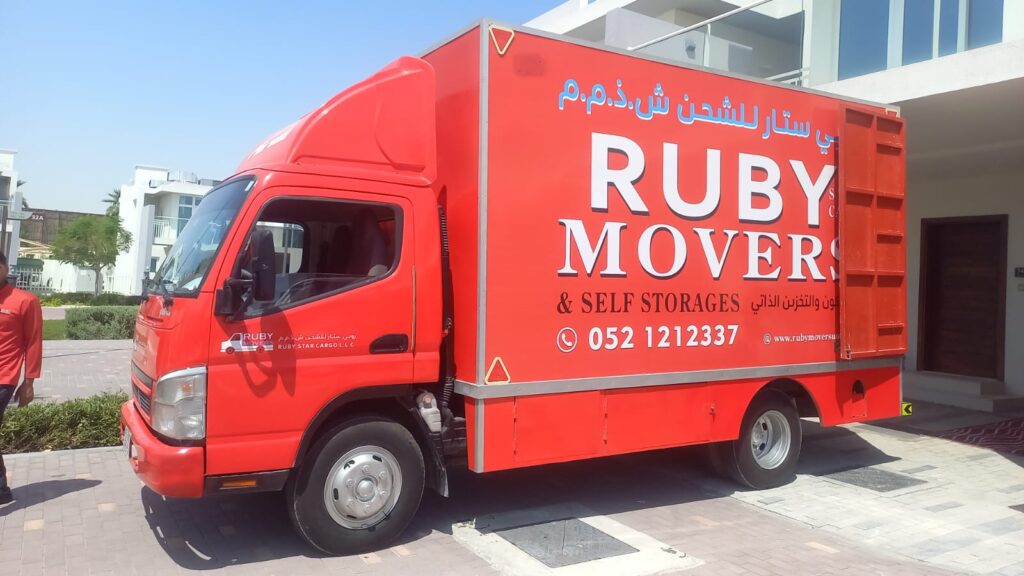
Apartment movers in Dubai estimate truck size by cubic volume, item count, furniture bulk, elevator distance, and whether the move requires one trip or staged trips.
A 15-foot truck is commonly used for 2-bedroom apartments and has 764 cubic feet of volume. That is a useful reference point, not a Dubai rule.
A 3 to 4BHK family move usually exceeds a 2-bedroom apartment moving truck baseline. A family apartment often needs a larger box truck, multiple trips, or two trucks, especially when the apartment includes bulky wardrobes, children’s beds, storage shelves, outdoor furniture, or a large kitchen inventory.
The table below explains how movers use bedroom count as a starting estimate, then adjust for furniture density.
| Apartment size | Typical planning logic | Truck implication | Risk if estimated too low |
| 2-bedroom apartment | Medium furniture volume, fewer wardrobes, limited storage | Around the 15-foot or 16-foot truck category in many rental guides | Extra trip, rushed loading, weak stacking |
| 3BHK apartment | Larger living room, more bedrooms, more cartons, more appliances | Larger truck or multiple trips | Lift slot overrun, added labor time |
| 4BHK apartment | Full family inventory, heavy furniture, fragile décor, storage overflow | Larger truck plus detailed load sequencing | Delays, damage risk, and access conflict |
This table gives a planning framework, not a fixed quotation. A lightly furnished 4BHK can move faster than a densely furnished 3BHK. A survey gives the real answer.
Why do Dubai building permits and access rules matter?
Dubai building access matters because service elevators, security gates, loading bays, and community rules can stop movers even when the truck and crew are ready.
Large 3 to 4BHK moves depend heavily on elevator access. A family move can require dozens of lift trips because packed cartons, sofas, mattresses, wardrobes, appliances, and fragile items cannot move in one batch.
Apartment movers in Dubai normally ask for these access details before move day:
- Current building move-out permit.
- New building move-in permit.
- Service lift booking time.
- Loading bay location.
- Truck height limits.
- Security gate approval.
- Floor and corridor protection rules.
- Contact number for the building supervisor.
Imagine drones delivering your online orders to your flat in a Dubai building. The emirate is one step closer to that ambitious vision, with the Dubai Municipality coming up with a project to give digital geospatial addresses to each unit in all buildings for indoor navigation.
It may sound like it is time for Google Maps to move over soon, since Dubai Municipality’s futuristic project using its indigenous navigational map Makani is going to let people, emergency services, and even drones find the location map of each flat and shop in all buildings within the next three years.
An extension of the existing 10-digit Makani digital addressing for building entrances, the new system will include a six-digit alphanumeric code for all types of units within the buildings—whether they are residential units, shops, offices, etc. Said to be the first-of-its-kind in the world, the system assigns a code similar to DMHQ01 for each unit. This matters in Dubai because many towers have multiple entrances, podium levels, and separate service gates.
For families, the practical rule is clear. Give movers the community name, tower name, apartment number, service gate location, and Makani number before the move.
How do movers plan to pack for a 3 to 4BHK family apartment?
Apartment movers plan packing by room, item category, fragility level, unpacking priority, and transport risk.
Room-wise packing keeps the apartment moving and traceable. Each carton receives a room label, item category, and priority mark. For example, “Kitchen: plates: fragile: open first” gives the crew and family clear instructions at the new apartment.
The best sequence starts with rarely used items. Guest room goods, décor, books, and storage items can be packed first. Daily use items, medicines, school uniforms, chargers, passports, and baby items stay in a separate family essentials box.
Apartment movers in Dubai also plan the carton weight. Heavy items go into small cartons. Light items go into large cartons. Mixed heavy cartons create lifting injuries, box failure, and furniture scratches during stacking.
How do movers protect furniture during a 3 to 4BHK move?
Movers protect furniture by dismantling oversized items, labeling hardware, wrapping exposed surfaces, padding corners, and loading heavy items before fragile cartons.
Large family apartments often include king beds, bunk beds, modular wardrobes, dining tables, cabinets, study desks, and large sofa sets. These items may not fit through apartment doors, service lifts, or tight corridors as assembled pieces.
Furniture protection process
Apartment movers usually follow this sequence:
- Photograph the item before dismantling.
- Remove detachable panels, legs, shelves, and headboards.
- Pack screws, bolts, and brackets in labeled bags.
- Attach hardware bags to the correct furniture part.
- Wrap polished surfaces with protective sheets.
- Add corner protection to exposed edges.
- Load heavy pieces upright or flat based on the structure.
- Reassemble and test drawers, doors, and panels at delivery.
This process protects furniture and reduces handover disputes. It also helps families identify whether damage existed before the move or occurred during transport.
How do movers handle fragile, premium, and high-value items?
Movers handle fragile and high-value items through item-specific packing, separate loading zones, photo records, and delivery condition checks.
A 3 to 4BHK family apartment may contain fragile and premium items that require extra planning. These can include chandeliers, wall art, mirrors, marble tables, porcelain décor, crystalware, glass dining tops, designer lamps, large televisions, and musical instruments.
Fragile item controls
Use these controls before moving day:
- Create a fragile inventory list.
- Photograph fragile items before packing.
- Mark carton sides and top with item category.
- Avoid mixing glassware with heavy kitchen tools.
- Keep marble and glass pieces away from load pressure.
- Request crating for high-value or irregularly fragile items.
- Keep invoices or valuation records for expensive pieces.
Movers can reduce risk, but families control proof. A photo record before packing gives both parties a clearer baseline.
How do apartment movers handle DEWA, Ejari, and tenancy administration?
Apartment movers do not replace official tenancy steps, but they align moving dates with Ejari, DEWA activation, DEWA deactivation, access approval, and handover timing.
Dubai’s tenancy and utility systems affect the physical move. Dubai Land Department states that the Register or Renew Ejari Contract service allows customers to register or renew a tenancy contract in Dubai. Dubai REST also lets owners and tenants manage lease registration, renewal, cancellation, rental dispute cases, and follow-up actions.
DEWA connects utility activation with the move-in process. DEWA states that electricity and water activation is linked to the move-in service package, and supply activation support applies if activation does not happen within 15 working hours after security deposit payment.
For moving out, DEWA lets customers select the date and time of deactivation, pay outstanding bills, and receive the final bill and clearance after settlement. DEWA lists AED 125 for disconnecting small electricity and water meters, with an AED 10 knowledge fee and an AED 10 innovation fee.
Families can use this timeline:
| Timing | Admin action | Why it matters for apartment moving |
| 7 to 14 days before move | Confirm building move permits and elevator slots | Prevents gate refusal and loading bay conflict |
| 3 to 7 days before the move | Confirm Ejari, DEWA move-in, and DEWA move-out status | Aligns utility access with occupancy |
| 1 to 2 days before the move | Share access approvals with movers | Allows crew entry without delay |
| Move day | Keep Emirates ID, Ejari copy, permit copy, and contact numbers ready | Speeds security and management checks |
| After move | Complete final meter, handover, and condition evidence | Protects deposits and reduces disputes |
This table connects official administration with moving operations. It also helps families avoid a common Dubai problem: the furniture arrives before access, electricity, or water is ready.
How do movers manage lift slots, parking, and loading bays?
Movers manage lift slots, parking, and loading bays by reserving access, checking truck restrictions, staging items near the service lift, and assigning a supervisor to control loading flow.
A 3 to 4BHK move can fail at the access layer. The crew may arrive on time, but security may deny entry if the permit is missing. The truck may arrive, but the loading bay may not allow the truck’s height. The lift may be available, but another tenant may have the same slot.
Access-risk controls
Apartment movers in Dubai reduce access risk by checking the following:
- Service elevator time slot.
- Elevator padding requirement.
- Loading bay height.
- Distance from the apartment door to the truck.
- Parking permit or temporary parking permission.
- Community security approval.
- Tower supervisor contact.
- Working hours allowed by building management.
Dubai’s daytime population pressure makes this important. As of June 2025, Dubai’s population stands at approximately 3.95 million, so road timing, tower queues, and loading access need practical scheduling.
How long does a 3 to 4BHK family move take?
A 3 to 4BHK family move can take one full day or multiple staged days, depending on packing scope, item volume, lift access, distance, and reassembly work.
Apartment movers do not estimate time only by room count. A 3BHK with heavy storage and fragile pieces may take longer than a 4BHK with minimal furniture.
Practical timeline table
| Stage | 3BHK planning range | 4BHK planning range | Main variable |
| Survey | 30 to 60 minutes | 45 to 90 minutes | Inventory detail |
| Pre-packing | Half day to 1 day | 1 to 2 days | Fragile and storage volume |
| Move-day packing | 2 to 4 hours | 3 to 6 hours | Daily-use items |
| Loading | 2 to 5 hours | 4 to 7 hours | Lift and loading bay access |
| Transport | Area-dependent | Area-dependent | Distance and traffic |
| Unloading | 2 to 5 hours | 4 to 7 hours | Room labels and lift access |
| Reassembly | 2 to 5 hours | 3 to 8 hours | Furniture complexity |
This table gives planning ranges. It does not replace a survey. Families with children, pets, school schedules, or work-from-home setups often benefit from pre-packing one day before the truck arrives.
How do movers’ prices move in a large apartment?
A mover’s price for a large apartment moving is determined by volume, manpower, truck size, packing material, dismantling complexity, fragile item handling, distance, access difficulty, and unpacking scope.
A low price without scope can create problems. The final cost can change if the crew discovers extra cartons, unlisted wardrobes, missing lift approval, long carry distance, or large fragile items.
Pricing factors to compare
| Cost factor | What it means | What to ask |
| Labor | Number of packers, loaders, and supervisors | How many crew members are included? |
| Truck | Size and number of trips | Is one trip assumed? |
| Packing | Cartons, bubble wrap, film, foam, and blankets | Are materials included? |
| Dismantling | Beds, wardrobes, tables, and shelves | Is reassembly included? |
| Fragile handling | Glass, artwork, mirrors, and décor | Is crating extra? |
| Access | Lift booking, long carry, stairs, and basement rules | Is access difficulty priced? |
| Unpacking | Placement only or full unpacking | What happens after delivery? |
| Documentation | Inventory, photos, and delivery note | Is handover proof included? |
This table helps families compare apartment movers in Dubai by scope, not only by price.
How do movers create an inventory for a family apartment move?
Movers create an inventory by numbering cartons, grouping items by room, identifying fragile goods, recording high-value items, and matching delivery placement with labels.
Inventory is important in large family moves because many cartons look similar. A 4BHK move can include kitchen cartons, toy cartons, linen cartons, document cartons, bathroom cartons, study cartons, and storage cartons.
Use this structure:
- Carton number.
- Room name.
- Item category.
- Fragility level.
- Open-first status.
- Destination room.
- Notes for missing or damaged items.
How do movers protect personal data and electronics?
Movers protect electronics with padded packing, upright handling, cable separation, remote control grouping, and careful placement away from heavy items.
Families manage data custody better when they separate private devices before movers arrive. This includes laptops, hard drives, USB drives, tablets, passports, office files, school records, and banking documents.
Data custody checklist
Keep these items with you:
- Laptops and tablets.
- External hard drives.
- USB drives and memory cards.
- Passports and Emirates IDs.
- Medical records.
- School certificates.
- Jewelry and cash.
- Work documents.
- Router passwords and network devices.
- Remote controls and critical chargers.
This is not only a privacy step. It prevents delays at the new apartment when internet, school, work, and family routines restart.
How do families prepare before apartment movers arrive?
Families prepare by reducing unused items, separating valuables, confirming building approvals, emptying appliances, labeling priority rooms, and keeping essential items outside the moving load.
Preparation affects cost and timing. Movers work faster when the family has already decided what moves, what stays, what goes to donation, and what goes to disposal.
Family preparation checklist
Complete these tasks before move day:
- Confirm move-in and move-out permits.
- Book the service lift.
- Share Makani and service gate details.
- Empty refrigerators and freezers.
- Disconnect washing machines and dishwashers where required.
- Separate valuables and private documents.
- Remove personal items from drawers.
- Mark items for disposal or donation.
- Prepare first-night essentials.
- Keep medicine and baby supplies accessible.
- Photograph the apartment’s condition.
- Confirm DEWA move-in or move-out status.
This preparation gives movers a clean operational path. It also reduces family stress because essential items remain visible.
What should the first-night box include?
A first-night box includes the items your family uses during the first 24 hours after moving into the apartment.
A large move can leave many cartons unopened on the first night. The first-night box prevents searching through 40 or 80 cartons for basic items.
First-night box list
Pack these items separately:
- Toiletries.
- Towels.
- Pajamas and next-day clothes.
- Phone chargers.
- Basic medicines.
- Baby supplies.
- School uniforms, if needed.
- Snacks and bottled water.
- Paper plates and cups.
- Coffee, tea, or breakfast basics.
- Basic cleaning supplies.
- Router and internet devices.
- Bedsheet set for each bed.
- Important documents.
Ask movers to load this box last and unload it first.
What happens on moving day?
Moving day follows a controlled sequence: crew arrival, supervisor briefing, final packing, dismantling, lift staging, truck loading, transport, unloading, reassembly, carton count, and handover check.
Moving day sequence
- Supervisor reviews the apartment and confirms the scope.
- Crew protects floors, corners, and high-contact areas where needed.
- Packers complete remaining cartons.
- Technicians dismantle large furniture.
- Fragile items receive separate handling.
- Cartons move to the lift staging area.
- Heavy items are loaded first in the truck.
- Fragile cartons load separately.
- The truck moves to the new apartment.
- Items unloaded by room labels.
- Furniture is reassembled.
- Family checks item’s condition.
- Supervisor records exceptions.
- Crew removes packing waste, if included.
This structure keeps the apartment moving and organized. It also gives the family checkpoints during a busy day.
How do apartment movers complete delivery and handover?
Apartment movers complete delivery by placing items room by room, reassembling furniture, counting cartons, checking visible damage, collecting packing waste, and closing the delivery note.
The delivery stage matters as much as packing. A poor unloading plan creates extra lifting, misplaced cartons, blocked corridors, and delayed family setup.
Delivery checklist
Before the crew leaves, check:
- Beds assembled correctly.
- Wardrobe doors aligned.
- Dining table stable.
- Sofa and chairs placed correctly.
- Appliances placed in agreed locations.
- Fragile cartons checked.
- Television and monitor boxes visible.
- Carton count matched to inventory.
- Missing items recorded.
- Damage notes written on delivery documents.
- Packing waste removed, if included.
Do not sign a clean delivery note if visible damage exists. Record the issue clearly and take photos.
Final thoughts: Large apartment moving needs planning, proof, and access control
A 3 to 4BHK family move-in in Dubai is not just a packing job. It is a coordinated handover involving access approvals, lift timing, truck planning, furniture protection, DEWA steps, inventory records, and delivery checks. Families get better results when apartment movers in Dubai inspect the home properly, explain the scope clearly, and document the move from the first carton to the final room placement.
The real value is not only in carrying items safely. It is in reducing delays, avoiding avoidable damage, and keeping the move aligned with building rules and tenancy handover. A well-planned apartment move protects your furniture, your time, your deposit, and your first few days in the new home.
FAQs
Apartment movers in Dubai handle large 3 to 4BHK family moves through surveys, packing, permits, lift booking, truck planning, inventory, delivery, reassembly, and handover checks.
A 15-foot truck is a common 2-bedroom apartment moving truck reference, and U-Haul lists it with 764 cubic feet of loading space.
A 3BHK move often needs a larger truck because extra bedrooms, wardrobes, cartons, appliances, and fragile items increase load volume.
Apartment movers ask about lift booking because service elevator access controls loading speed, building approval, and move-day timing.
Apartment movers do not register Ejari, but they align moving plans with tenancy timing, building approvals, and DEWA activation.
DEWA notes that customers can contact customer care if the supply is not activated within 15 working hours after the security deposit payment.
DEWA lists AED 125 for disconnecting electricity and water for small meters, plus an AED 10 knowledge fee and an AED 10 innovation fee.
Makani matters because its 10-digit address system helps movers locate the correct building entrance in Dubai.
Families should keep passports, Emirates IDs, medicines, jewelry, cash, laptops, hard drives, school records, and private documents with them.
Delays usually come from missing permits, unbooked lifts, underestimated inventory, wrong truck access, parking restrictions, unfinished packing, and unclear handover instructions.
Bilal Al-Madani
Bilal Al-Madani is a logistics professional specializing in residential relocations and supply chain optimization. With deep experience in the moving industry, he excels in ensuring transit safety, implementing advanced packing methods for high-value items, and managing transport fleets efficiently. He is committed to simplifying the moving process through careful planning, delivering each relocation with precision, reliability, and exceptional attention to detail.


