
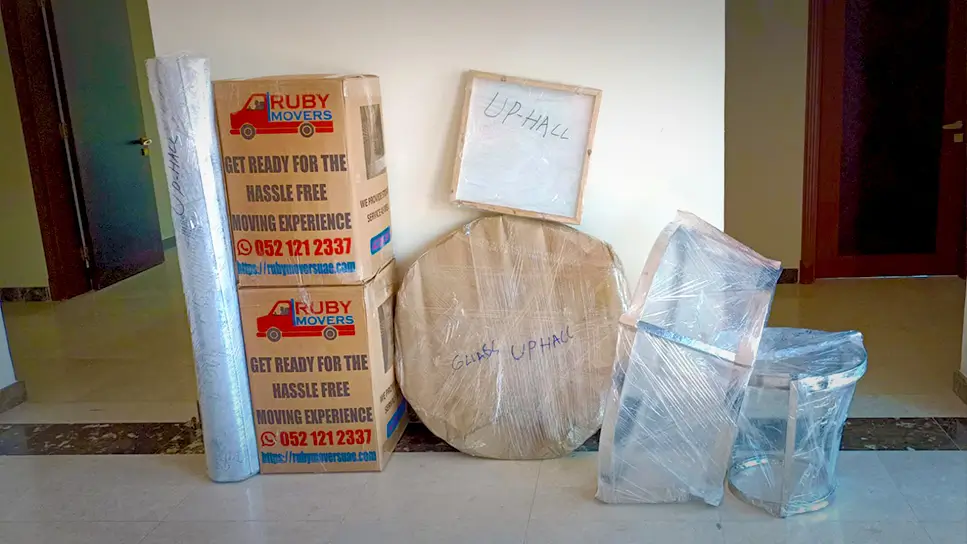
Moving a studio to a four-bedroom home in Dubai can cost AED 800 to AED 5,500, based on Movers’ published prices. But apartment size doesn’t tell the whole story. A restricted service lift, distant truck parking or additional packing can change your quote, even when you’re moving within the same community.
A 1-bedroom apartment move costs AED 1,200 to AED 2,000 under published rates. That doesn’t include every relocation expense. Online Ejari registration costs AED 177.75, as confirmed by the Dubai Land Department, while DEWA requires a refundable AED 2,000 deposit for a new apartment utility account. So, how much should you actually budget?
This guide breaks down apartment moving costs in Dubai by property size, lift access, parking and additional services. It also separates mover charges from third-party fees, explains potential surcharges and identifies practical ways to reduce your moving quote without compromising furniture protection.
How much does an apartment move cost in Dubai by size?
Published apartment-moving bands run from AED 800 to AED 5,500 across studio to 4-bedroom homes. Studios cost AED 800 to AED 1,400, and 1-bedroom moves cost AED 1,200 to AED 2,000. Confirm package scope and building access before treating these figures as final prices.
To get a fixed apartment moving quote, provide the moving company with a complete inventory, photographs of large furniture, and details of lift access and parking at both properties.
The table uses Ruby’s published home-moving rates. Transport-only prices and separate access surcharges remain unverified.
| Apartment size | Transport only | Standard | Full service | Access tier |
| Studio | AED VERIFY, transport, Oct 2026 | AED VERIFY, standard, Oct 2026 | AED 800 to 1,400, published bundle, Oct 2026 | Low, AED VERIFY, Oct 2026 |
| 1-bedroom | AED VERIFY, transport, Oct 2026 | AED VERIFY, standard, Oct 2026 | AED 1,200 to 2,000, published bundle, Oct 2026 | Low, AED VERIFY, Oct 2026 |
| 2-bedroom | AED VERIFY, transport, Oct 2026 | AED VERIFY, standard, Oct 2026 | AED 1,800 to 2,800, published bundle, Oct 2026 | Medium, AED VERIFY, Oct 2026 |
| 3-bedroom | AED VERIFY, transport, Oct 2026 | AED VERIFY, standard, Oct 2026 | AED 2,500 to 3,500, published bundle, Oct 2026 | Medium, AED VERIFY, Oct 2026 |
| 4-bedroom | AED VERIFY, transport, Oct 2026 | AED VERIFY, standard, Oct 2026 | AED 3,200 to 5,500, published 4 BHK/townhouse bundle, Oct 2026 | High, AED VERIFY, Oct 2026 |
The full-service column represents Ruby’s advertised bundled service, not a separately verified premium package. All Ruby price bands require operational confirmation. Access tiers are indicative classifications, not published AED surcharges.
1. Studio and 1-bedroom price band
A studio move costs AED 800 to AED 1,400 under the published schedule. The companies assign an indicative 2 to 3 movers and 3 to 5 working hours to this category.
A 1-bedroom apartment moving cost ranges from AED 1,200 to AED 2,000, with 3 movers and 4 to 6 hours. Home-moving price cards provide these estimates.
The AED 800 difference between the 1-bedroom minimum and maximum represents a 66.7% increase over the lower figure. It demonstrates the width of the published range, not an independently measured access premium.
Apartment cost guides also discuss AED 1,049 to AED 1,500 market benchmarks. Those figures come from broader market comparisons.
You obtain a property-specific figure through an inventory survey. Include photographs, floor numbers and lift details. Skipping those details can leave additional handling outside the original scope.
2. 2-bedroom price band
A 2-bedroom apartment move costs AED 1,800 to AED 2,800 in the residential price schedule. The companies identify 3 to 5 movers and 5 to 7 working hours.
The midpoint of this published band is AED 2,300. That is AED 700 higher than the 1-bedroom midpoint of AED 1,600. These are calculated midpoints, not average prices from completed customer transactions.
When comparing crew and truck size by apartment size, treat the bedroom count as a starting point rather than a final allocation.
You need a detailed quote when furniture volume exceeds the expected allocation. Two apartments with identical bedroom counts can contain different numbers of wardrobes, appliances and cartons.
Request confirmation of the truck capacity and included dismantling work. Without an inventory check, a second vehicle trip or extra handling may fall outside the initial estimate.
3. 3- and 4-bedroom price band
A 3-bedroom home move costs AED 2,500 to AED 3,500, with 4 movers and an indicative 6 to 9 hours.
Four-bedroom/townhouse category costs AED 3,200 to AED 5,500, with 4 to 5 movers working approximately 1 full day. Published pricing groups 4-bedroom apartments and townhouses together.
The 4-bedroom range spans AED 2,300, considerably wider than the AED 1,000 3-bedroom band.
You need an apartment-specific quotation when the property has extensive furniture or high-rise access restrictions. Share the complete inventory and identify specialist packing requirements.
A bedroom count cannot confirm vehicle capacity or the number of journeys. Skipping the survey leaves those requirements unresolved.
Which charges sit on the mover’s invoice and which are paid to others?
Apartment moving costs fall into two payment categories: the moving company’s service charges and third-party fees.
The Dubai Land Department publishes Ejari registration charges. Dubai Electricity and Water Authority (DEWA) separately publishes electricity and water connection fees.
| Mover invoice | Paid to others |
| Crew, packing, transport and unloading | AED 177.75, online Ejari through Dubai Land Department |
| Furniture dismantling and reassembly: agreed scope | AED 220, Ejari through an approved trustee centre, Dubai Land Department |
| Premium packing or specialist handling | AED 2,000, refundable apartment security deposit, DEWA |
| Additional labor or vehicle trips | AED 155, small-meter new-account activation, DEWA |
| Storage or waiting charges | Building permit or damage deposit |
The amounts above are not all permanent expenses. The mover’s invoice pays for the physical relocation. Ejari fees and DEWA payments belong to different service providers. The DEWA security deposit represents recoverable funds under the applicable account-settlement rules.
The AED 2,000 utility deposit also has a different financial purpose. DEWA identifies it as refundable, subject to the applicable account settlement arrangements.
1۔ Mover invoice lines
Mover invoice lines cover the physical work involved in transporting your household belongings.
You need an itemized quote before confirming the booking. Home-moving service description includes packing, dismantling, transportation, unloading and reassembly.
Ask the company to identify excluded materials and specialist services. Premium wardrobe cartons and wooden crating appear among additional packing options.
Confirm Value Added Tax (VAT) treatment. The Federal Tax Authority identifies 5% as the UAE standard VAT rate.
For example, AED 2,000 before applicable VAT becomes AED 2,100. This calculation does not mean Ruby’s published figures exclude VAT.
Skipping the itemized quotation makes it harder to establish whether an additional charge belongs to the agreed work.
2۔ Government and utility lines
Government and utility fees cover tenancy registration and electricity or water services, rather than moving labor.
The Dubai Land Department’s Ejari service lists the online fee components:
- AED 100 tenancy registration
- AED 10 knowledge fee
- AED 10 innovation fee
- AED 55 service partner fee
- AED 2.75 VAT on the partner fee
The total is AED 177.75. DLD publishes AED 220 for registration through Real Estate Services Trustee Centers.
The difference between the two published channel totals is AED 42.25. The available registration method depends on the property’s eligibility and transaction requirements.
For a new apartment account, DEWA’s Move-in schedule requires an AED 2,000 deposit. Small-meter activation totals AED 155, comprising AED 125 connection and three AED 10 fees.
DEWA identifies a 15-working-hour connection target after payment. Complete the required activation process before moving day.
Existing customers have another option. DEWA’s Move-to service transfers eligible security deposits, avoiding another full deposit when sufficient funds exist.
If you are closing an existing utility account, check the DEWA deposit refund timeline before relying on the returned money for other moving expenses.
3۔ Building management lines
Building management lines cover property-specific permits, access arrangements and any required security deposits.
You encounter these conditions when the building restricts moving hours, elevator use or vehicle entry.
For example, Emaar Community Management’s The Greens and Views guidance requires move-in permit applications at least one business day before the scheduled move.
The application requires an Ejari copy, Emirates ID and passport documentation for tenants. Management handles the permit through its online community process. Emaar Community Management provides the application instructions.
No universal Dubai-wide building moving deposit appears in these cited rules. Request the applicable amount and refund conditions directly from your property manager.
For building move permit fees, ask your property manager whether an application charge or refundable damage deposit applies.
Skipping a required permit can prevent entry. Emaar South’s official move-in guidance expressly warns that access is denied without its required permit.
Example: What is the total initial cash requirement for a 1-bedroom move?
Consider an illustrative new-account scenario using the AED 1,200 published lower price and the official online registration route.
| Expense | Amount |
| 1-bedroom move | AED 1,200 |
| Online Ejari registration | AED 177.75 |
| DEWA small-meter activation | AED 155 |
| DEWA refundable apartment deposit | AED 2,000 |
| Initial cash requirement | AED 3,532.75 |
The calculated non-deposit expense is AED 1,532.75. This excludes old-account closure, VAT adjustments, building fees and tenancy-related costs.
Why can a small apartment cost more to move than a villa?
A small apartment can cost more to relocate than a villa when controlled building access increases the crew’s working time.
Apartment-versus-villa cost analysis identifies lift dependency, carrying distance, parking restrictions and fixed moving windows as relevant cost drivers.
| Cost factor | Small apartment | Villa | Possible price effect |
| Lift access | Shared service elevator | Possible direct entrance | Waiting time |
| Carrying route | Basement, lift and corridor | Potentially shorter route | Additional labor minutes |
| Truck parking | Restricted loading bay | Possible driveway access | More handling |
| Permissions | Building and lift approvals | Community gate approval | Coordination time |
| Furniture dimensions | Lift-door restrictions | Different entrance dimensions | Dismantling |
| Protection requirements | Shared lift and lobby | Floors, doorways and paths | Material and labor requirements |
These are operational comparisons, not recorded average costs. A villa with difficult access can also require additional labor.
1۔ Lift slot and carry distance
A lift slot is the period allocated for moving furniture through a building’s service elevator. You need a confirmed slot when building management controls furniture transportation.
Apartment moving cost guides identify carrying distance and lift availability as operational pricing variables.
Consider a move involving 20 trolley journeys. Three additional minutes per journey add 60 minutes of handling time. This is an example, not measured moving-company data.
Confirm lift availability with the property manager and share the reservation with your mover.
Without that confirmation, the crew may encounter an unavailable lift or a shorter working window than planned.
2۔ Parking and loading bay minutes
Loading bay access determines the available truck position and the carrying route between the building and vehicle.
You need this information when the collection or destination building restricts commercial vehicle access.
The Emaar Community Management guidance directs residents to contact tower reception or community security for local parking information.
Ask management for the approved loading location, vehicle-height limitations and permitted moving hours. Forward those details to the mover.
Published pricing guidelines identify long carrying routes and difficult access as factors affecting estimates.
An unconfirmed parking arrangement may require additional movement or a different loading plan.
3۔ Disassembly of built-in units
Furniture disassembly separates removable components so workers can transport them through the available access route.
You need a specific assessment when wardrobes, bed frames or large cabinets cannot pass through approved entrances.
Home-moving scope includes ordinary furniture dismantling and reassembly. This does not independently confirm that permanent fitted installations are included.
Show the mover photographs of wall-mounted or built-in furniture. Request an itemized assessment of what can be removed.
Obtain property approval when the work affects permanent fixtures.
Skipping this assessment creates uncertainty about additional labor and possible property repairs.
How do floor, lift slot and parking change the quote?
Floor level, lift access and truck parking influence apartment moving prices through handling requirements.
Pricing criteria identify floor access, parking and distance as relevant variables. No verified fixed AED surcharge per floor appears in its published rate card.
1. Ground, low-rise and high-rise tiers
Access tiers classify the difficulty of moving furniture between an apartment and the truck.
You need this assessment when comparing buildings with different entrances and elevator arrangements.
Three practical tiers are:
- Ground access: Direct entry with no lift journey.
- Low-rise access: Limited vertical travel using stairs or an elevator.
- High-rise access: Controlled service lifts, shared routes and scheduled loading periods.
These categories describe access complexity rather than official Dubai tariffs.
Home-moving schedule uses low, medium and high pricing classifications but does not publish corresponding fixed access surcharges.
Share both properties’ access details to establish the applicable quote. A floor number without loading information gives an incomplete assessment.
2. Booking window and peak-day premium
A booking window defines when the moving crew and building facilities are available.
You need a confirmed moving date and elevator slot before comparing time-sensitive quotations.
Weekends, end-of-month bookings, and short-notice moves are possible cost factors. This does not establish one fixed premium applicable to every booking.
Compare available moving dates and request confirmation of any additional charge.
For buildings with permit requirements, submit the application within the relevant management deadline. Emaar Community Management provides a one-business-day minimum for its cited community.
A cheaper date offers no practical saving when building access remains unavailable.
What must a written quote list to stop day-of surcharges?
A written apartment moving quote must define the services, inventory, access conditions and additional-charge triggers.
Property surveys and written pricing are based on the job requirements. Check these 8 items before accepting a quotation:
- Inventory: Furniture, appliances, cartons and oversized items.
- Crew: Number of movers and assigned working arrangement.
- Truck: Vehicle capacity and included journeys.
- Packing: Standard materials, premium protection and exclusions.
- Furniture handling: Dismantling, reassembly and specialist work.
- Access: Lift reservations, stairs, parking and carrying distances.
- Extras: Waiting, storage, additional labor and revised inventory.
- Commercial terms: Final price, VAT, payment conditions and damage coverage.
The VAT distinction deserves attention. The Federal Tax Authority confirms the standard 5% rate. An AED 2,800 taxable quote excluding VAT becomes AED 2,940.
Compare quotations using identical service scopes. A lower transport-only price cannot be compared directly with a bundled packing and reassembly service.
Check damage coverage separately. Request the applicable terms, exclusions and claims process.
Any agreed change in inventory or access needs requires written approval with its price effect. This makes a revised charge identifiable before the work proceeds.
How do you lower the cost without adding risk?
You lower moving costs by reducing unnecessary handling, matching the service package to the actual inventory and confirming building access before booking.
When weighing apartment movers vs DIY cost, compare the itemized moving-company quote with vehicle rental, packing materials, loading help, parking and the number of trips required.
Household volume, access difficulty, and included services are important quotation variables. Six practical actions help control those variables:
- Remove unnecessary items. Reduce the furniture and cartons included in the inventory.
- Document large belongings. Provide photographs and dimensions before the survey.
- Compare package scopes. Request separate transport-only and bundled prices.
- Secure lift access. Confirm the service-lift slot and approved truck route.
- Compare available dates. Ask whether changing the booking date affects the total.
- Transfer eligible deposits. Use DEWA’s Move-to process where an existing account qualifies.
Do not assume every reduction in workload creates an automatic discount. Request a revised written price after changing the inventory or packing scope.
Existing Dubai residents also have an official way to reduce their initial utility cash requirement.
Under DEWA’s Move-to service, an existing residential deposit can transfer to the new account when sufficient funds remain available. A customer with a fully available AED 2,000 flat deposit may therefore avoid paying another complete apartment deposit.
DEWA’s transfer guidance also requires settlement of outstanding amounts on the previous account.
This distinction matters when calculating the true cost of moving an apartment in Dubai.
The mover’s invoice represents the relocation service. Registration and activation fees represent separate transactions. Refundable deposits represent temporary cash commitments rather than equivalent permanent expenses.
Which permits and fees start before the movers arrive?
Moving permits and deposits create separate pre-move requirements. Emaar Community Management documents advance permit rules. Dubai Land Department confirms Ejari fees, while DEWA confirms utility deposits.
Check permit amounts and refundable balances before booking.
Next: Examine how apartment size affects crew allocation, truck capacity and the access conditions behind the final quote.
Pricing and official fee verification: Ruby’s published rate bands require operations approval before use as confirmed company quotations. Third-party fees require re-verification by 11 January 2027, under the 90-day compliance review cycle.
Know Your Total Apartment Moving Cost Before Booking
An apartment moving quote in Dubai is only useful when it reflects the actual work involved. Published prices range from AED 800 for a studio to AED 5,500 for a four-bedroom home, but furniture volume and building access determine where your move falls within that range.
Before choosing apartment movers in Dubai, get a complete inventory assessment. Confirm the crew size, truck capacity, packing services and furniture dismantling. More importantly, secure your service lift and loading bay arrangements before accepting the final price. A cheaper quote means little when essential handling services are missing.
Keep third-party payments separate. The Dubai Land Department lists online Ejari registration at AED 177.75, while DEWA requires a refundable AED 2,000 apartment deposit and AED 155 small-meter activation fee for new accounts.
Request a written, itemized quote after confirming your inventory and building access. Compare complete costs, not advertised starting prices. Settle permits before moving day and approve any additional charges in writing.
FAQs
No. Confirm loading bay access separately with building management because lift reservations do not automatically authorize truck parking.
Yes. DEWA’s Move-to service allows eligible customers to transfer an existing deposit when sufficient funds remain available.
No. Request a revised written quotation because removing furniture does not guarantee a reduction in the agreed moving price.
A second journey is included only when the agreed quotation covers it; confirm the truck capacity and number of trips before booking.
Bilal Al-Madani
Bilal Al-Madani is a logistics professional specializing in residential relocations and supply chain optimization. With deep experience in the moving industry, he excels in ensuring transit safety, implementing advanced packing methods for high-value items, and managing transport fleets efficiently. He is committed to simplifying the moving process through careful planning, delivering each relocation with precision, reliability, and exceptional attention to detail.